
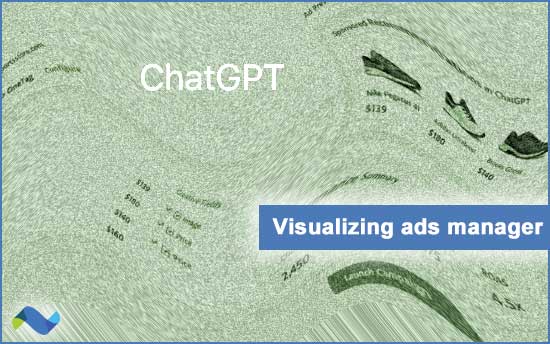
Sources told Adweek’s Trishla Ostwal that early performance results for advertising in ChatGPT weren’t knocking anyone’s socks off.
She previewed her Adweek article on LinkedIn and also reported the existence of an Ads Manager for ChatGPT:
“OpenAI is testing an Ads Manager with a small group of partners as its ChatGPT ads pilot takes shape. Early data: some brands see CTRs below 1%, far behind Google Search. To be sure, it is unrealistic to expect OpenAI’s developing ad solution to be nearly as effective as Google’s, an ad-selling giant that has been in the business for more than a quarter century.”
Read on LinkedIn. (March 13)
In the Adweek article, an OpenAI spokesperson confirmed a few details:
“The company has begun testing an Ads Manager with a small group of partners and is gathering feedback, an OpenAI spokesperson confirmed to Adweek. The Ads Manager is a dashboard that lets marketers run, monitor, and optimize campaigns in real time.
The spokesperson also confirmed that testers currently get weekly Comma Separated Values (CSV) reports, which are spreadsheets with performance-data-like clicks or impressions…”
Read: OpenAI is Testing An Ads Manager, As Its New Ads Business Fights Growing Pains (March 13) – Adweek (subscription)
From tipsheet: It’s still very early days in conversational advertising at OpenAI.
LLMs & CHATBOTS
Developments
- Figma and HubSpot CEOs Say They Aren’t Fazed by Risks From AI Agents. Their Disclosures Say Otherwise (March 15) – The Information (subscription)
- “AI Is Now a Macro Variable. Are You Positioned?” (March 9) – Morgan Stanley
- AWS and Cerebras collaboration aims to set a new standard for AI inference speed and performance in the cloud (March 13) – Amazon
LLMs & CHATBOTS
ChatGPT enters ‘The Smile Curve’
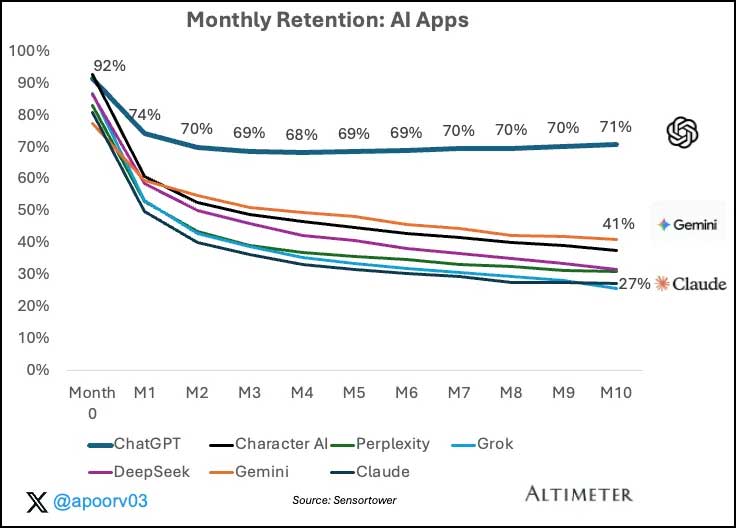
Altimeter Capital investor Apoorv Agrawal, formerly an engineer at Palantir — and “way back when” he was an engineer at ad tech firm Rocket Fuel — has produced a new research piece on chatbot retention metrics that may be of interest to you.
Mr. Agrawal posits that OpenAI’s chatbot ChatGPT may be nearing a level of retention that may make it impossible for competitors to catch up.
Using web analytics data from Sensor Tower, he found stable and growing user retention for ChatGPT — a pattern known as “The Smile Curve”:
Agrawal, who is also an investor in OpenAI, observed:
“ChatGPT is no longer just the biggest AI app. It is becoming one of the stickiest products on the internet. High weekly engagement, strong early retention, and improving stickiness even at massive scale. That is not novelty. That is habit formation.
And in consumer technology, habit is what separates reach from revenue. A product with 900 million weekly users and improving retention is not just winning attention. It is building a franchise.
For competitors, the window to displace ChatGPT is narrowing. Not because the product is unbeatable, but because the habit is compounding.”
Read: “The State of Consumer AI. Part 2: Engagement and Retention” (March 10) – Apoorv Agrawal, investor, Altimeter Capital on Substack
More: “The State of Consumer AI. Part 1: Usage” (March 2) – Apoorv Agrawal on Substack
Mr. Agrawal is an investor at Altimeter Capital. He’s also an investor in OpenAI, according to his LinkedIn profile.
 From tipsheet: Part 3 is due out this week with his thoughts on chatbot monetization. You can subscribe here or wait for me to tell you about it.
EVENT
Amazon Ads presents at Nvidia GTC
From today through Thursday, Nvidia GTC (GPU Technology Conference) will take place in San Jose, California. See agenda.
Among the highlights for advertising and marketing technologists, Amazon Ads VP Muthu Muthukrishnan will be discussing GenAI and LLMs at 4 pm PT at the San Jose McEnery Convention Center:
“Running GenAI at Amazon Ads Scale: Lessons from Building and Operating LLM Inference Systems”
“Amazon Ads is using large language models (LLMs) to reinvent shopping and advertising experiences. This session shares how Amazon Ads built a LLM inference system with NVIDIA Dynamo on AWS EKS, shaped by workload-aware design patterns that apply broadly beyond Amazon. Learn how classical engineering disciplines evolve in the LLM inference domain and hear practical lessons from operating an always-on production system.”
Muthu Muthukrishnan, VP, Sponsored Products and Brands, Amazon
Runqing Yang, Principal Engineer, Amazon
“Key takeaways” for the session according to the website:
- ”Learn how to navigate the many LLM inference optimizations by starting from business application requirements and workload patterns.”
- ”Dive into LLM inference optimizations such as disaggregated inference, KV-aware routing, and speculative decoding, and how Amazon Ads adopted them in production.”
- ”Discover the operational lessons behind fault tolerance, bottleneck analysis, deployment coordination, and reconfiguration velocity in large-scale, always-on LLM inference systems.”
- ”See how Amazon Ads applies the optimization and operational patterns with NVIDIA Dynamo on AWS EKS, without building the system from scratch.”
See more details about today’s session on Nvidia’s website.
AGENCIES
Google pilot simplifies agency workflow
A new Google pilot program that merges an agency’s client accounts into a single view launched last week in Google Merchant Center.
Google Senior Director, Product Management, Shavi Goel, explained on LinkedIn last week:
“We designed this new, centralized hub to streamline client management and accelerate performance by reducing the time spent switching between accounts. It provides the insights and tools to help you and your teams deliver better results, faster.
Our pilot partners are already seeing significant impact, with some achieving 50% faster resolution on monitoring tasks.
We’re deeply committed to the success of our agency partners, and this is another step in providing the tools you need to excel.”
Read more on LinkedIn. (March 11)
More: Introducing Merchant Center for Agencies (March 11) – Google Merchant Center
From tipsheet: Though it’s not agentic by name, the new feature syncs with a future of AI-enabled workflow agents for agencies.
Less manual work means more time spent funneling investment across Google’s ads and commerce products.
COMMERCE MEDIA
The ‘agentic commerce’ pillar
CEO and founder James Avery of retail media firm Kevel is joined on his company’s “Unlocking Retail Media” podcast by Melissa Burdick, co-founder and President of commerce media firm Pacvue.
Ms. Burdick is a veteran of Amazon Ads, an experience which gave her special insight into Amazon Ads API and was part of the early inspiration for Pacvue.
Among the podcast’s highlights, she discussed her company’s API first-strategy which connects retailer to demand as well as her “three pillars of commerce media” as follows (lightly edited):
“So one is discovery commerce and that’s TikTok, Instagram… where people are going to discover and find brands. A lot of people are going to TikTok. And the type of content that you need on TikTok is upper funnel, more higher level content — influencer marketing using influencers.
The next pillar is retail media. So that’s the hundreds of retailers where you can have sponsored products, you can buy into their networks.
And then the last pillar is our newest one this year. If you were at CES, you heard this word all the time, but agentic commerce, and that’s the trend. I think that we know the least about this and the model continues to change, but that’s where people are going to ChatGPT and LLMs to ask, ‘What should I be buying?’…”
Hear more on Apple Podcasts app. (March 11)
Related: “Shopify says purchases are coming ‘inside ChatGPT’ through agentic storefronts as OpenAI retreats on Instant Checkout” (March 12) – Modern Retail
MARKETERS
Black boxes and incrementality
Reprising his recent Marketecture Live presentation, analyst Andrew Lipsman provided on Substack a cautionary tale regarding Big Tech’s “black boxes” and their siren call to marketers today.
He believes marketers should not hand over their budgets to Big Tech (Google, Meta, OpenAI) without proper measurement in place. Lipsman explained, “The emergence of black box AI targeting tools—specifically Meta Advantage+ and Google Performance Max—has further manipulated performance metrics to the platforms’ benefit.”
He concluded in part:
“The good news for advertisers is they can course correct. Improving adoption of incrementality measurement (particularly causal modeling approaches to media mix models) will help them better evaluate media platform over- and under-investment. And as advertisers direct more dollars to high-quality media—and re-prioritize audiences over algorithms—they’ll unlock true marketing effectiveness and watch incremental sales rise.
Advertisers have a choice…”
Read: “When the Juicero is Not Worth the Squeeze – Taking a Peek Inside Silicon Valley’s Black Boxes” (March 15) – Andrew Lipsman, analyst on his Media, Ads + Commerce Substack
From tipsheet: CMOs may want to send a link to this article to their CFO if they’re looking to justify additional budget for incrementality measurement.
Even Google may agree (2023) with Mr. Lipsman.
MEASUREMENT
Video: Meta on incremental attribution
“Sam Piliero from The Moonlighters (runs Meta ads for 100+ brands) sat down with [Meta’s] Josh Newman for a great breakdown of Incremental Attribution, including a great use case around creative optimization.
Worth a watch”
Video: Director of Meta Reveals One Setting That Can Increase ROAS Immediately (March 6) – YouTube
Mr. Newman is “responsible for full lifecycle product marketing across all Ads Manager measurement, signal ingest, shops, browser and partnerships,” according to LinkedIn.
SELL-SIDE
More mobile ad inventory with AI’s help
AI-generated content is merging with the real thing in NBCU’s Peacock mobile app initiative serving fans of the Bravo channel.
TechCrunch reported that the move is a bet on AI and mobile-first entertainment.
NBCU called this a first step in “vertical video” (the Bravo vertical) which “adds to NBCUniversal’s expansive slate of advertising capabilities, offering brands a new, seamless way to align with fan-favorite franchises on Peacock,” according to a release.
TC’s Lauren Forrestal explained:
“Behind the scenes, Peacock says the system uses computer vision to identify key storylines and moments across its library. AI agents trained on Bravo fan behavior help determine what viewers care about most, while the platform stitches clips together across seasons and franchises. The result, according to Peacock, is more than 600 billion possible viewing variations.”
Read TechCrunch. (March 13)
More: NBCUniversal Super‑Serves Fans With AI‑Driven Entertainment Features on the Peacock Mobile App (March 13) – NBCU
From tipsheet: AI-generated content is going to be huge and come in many flavors. NBCU is looking to unlock social media with this initiative, too.
Imagine the prompt-based creation of entertainment using any historical event/data? It’s already happening. Read about “On this day. 1776” on Ars Technica.
SEARCH
SEO’s transition to AI Search
Search engine optimization has gone away, according to Modern Retail. In fact, “AI Search” is adding to the SEO discipline’s mix – rapidly creating new interconnected silos known today as GEO (generative engine optimization) or AEO (answer engine optimization).
Modern Retail’s Allison Smith spoke to an online retailer:
“Furniture[dot]com executives see GEO as an extension of traditional SEO, rather than a replacement for it entirely. ‘The shift from SEO to GEO is actually more an evolution than a shift,’ [Alexandra Seaman, Furniture[dot]com’s senior vice president and co-founder] said. ‘A lot of the original pillars of SEO have just changed, and they started changing really rapidly as AI and GEO became more of the landscape.’
One key difference is the way people search. Instead of typing short phrases like ‘modern sofa,’ consumers can now ask detailed questions. For example, a shopper may ask a chatbot for a sofa and side table for their living room in avocado green tones, with a budget under $900 and delivery before Christmas.”
Read: “Furniture[dot]com was built for SEO. Now it’s trying to crack AI search” (March 12) – Modern Retail
From tipsheet: Good article.
There’s more complexity to AEO/GEO due — in part — to one simple difference with today’s SEO: One player (i.e. Google Search) does not dominate the AEO/GEO market like it does in Search.
EVENTS
Jeff Green on AI
“I don’t think that there is an industry in the world that is more conducive to AI than programmatic advertising…” – Jeff Green, CEO, The Trade Desk at Marketecture Live in NYC (March 13) – Marketecture podcast
PEOPLE MOVES
Now hiring
Media mix modeling firm Mutinex announced new hires including former TransUnion executive Mike Finnerty as President, US, and marketing leader Lou Paskalis as senior advisor. (March 13) – Henry Innis, co-founder of Mutinex on LinkedIn
MORE
- Inside Google and Shopify’s sprint to build the future of AI shopping (March 13) – Jason Del Rey on The Aisle (subscription)
- “User IDs and the Powers That Be” (March 13)- AdTech AdTalk on Apple Podcasts
- Zevia doubles down on AI satire in ads starring creepy robot coworker (March 12) – Marketing Dive
- How does UberEats rank restaurant ads? (March 15) – Eric Seufert, analyst, Mobile Dev Memo on X