
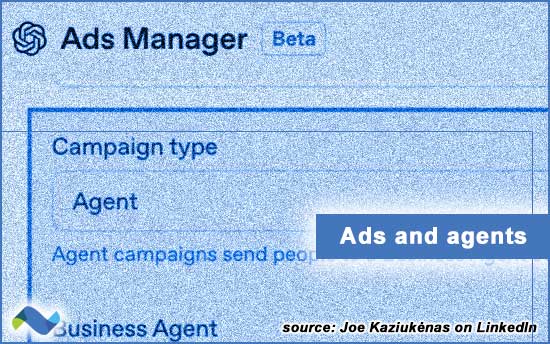
OpenAI appears to be testing a new advertising format that sends users to a business AI agent rather than a website. Entrepreneur Joe Kaziukėnas shared screenshots from OpenAI’s Ads Manager beta showing a new “Agent” campaign type that directs users to a Business Agent conversation.
According to Kaziukėnas, advertisers can configure a business agent using website content, connect product feeds and MCP tools, capture leads through custom forms and send ad traffic directly into an AI conversation. He adds, “The business agent is the same underlying tech as custom GPTs.”
Read more on LinkedIn. (July 30)
From tipsheet: The landing page is becoming a conversation. Rather than optimizing a website after the click, advertisers may increasingly optimize a business agent that answers questions, accesses enterprise data and guides customers toward a purchase.
Related: Time has started serving ads to AI agents (July 30) – Digiday (subscription)
AGENTS
Time and Mobian serve ads to AI agents
AI ad technology firm Mobian says it has served what it believes is the world’s first ad designed specifically for an AI agent through its publisher client, Time.
From Mobian CEO Jonah Goodhart on LinkedIn yesterday:
“The ad ran on a machine-readable page on TIME, purposely targeted to an AI agent instead of a human. (…) When I was CEO of Moat, I used to say that bots don’t buy things. That has changed. (…) Our launch brands are Ally and Project Management Institute.”
Read more on LinkedIn. (July 30)
On Digiday, Sara Guaglione explains:
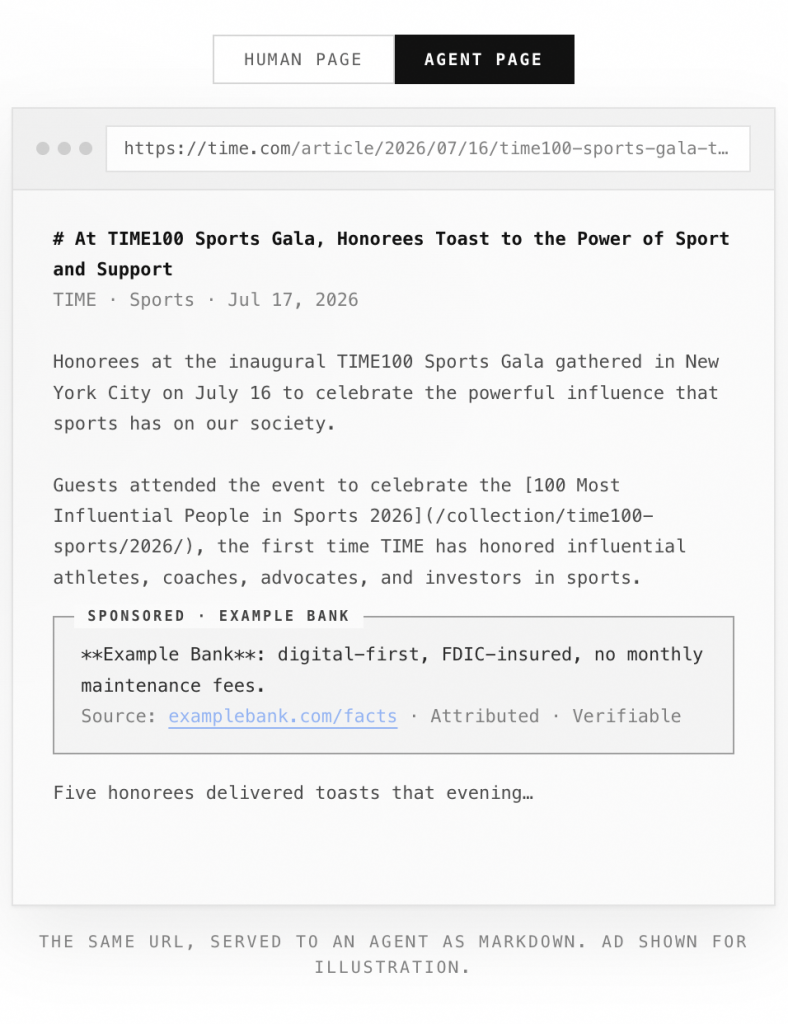
“Last month, Time began converting all its webpages from HTML into markdown versions — stripped-down, text-only copies of each page that drop the design and images, making them easier for AI systems and agents to read. The easier that access, went the publisher’s thinking, the better its chances of showing up in generative search queries.”
Read: Time has started serving ads to AI agents (July 30) – Digiday (subscription)
On the company’s home page, Mobian reproduces a visualization of the ad for agents:
 Read: Introducing Agent Ads (July 30) – Jonah Goodhart on Mobian
Related: Q&A: Mobian adds GEO product for publishers, brands (April 5) – tipsheet
From tipsheet: Publishers have spent decades monetizing human attention. Time and Mobian are testing whether AI attention can become a new form of media inventory. If AI agents become an important audience in their own right, publishers may eventually sell two kinds of inventory: impressions for people and retrieval opportunities for AI systems.
PROTOCOLS
IAB Tech Lab updates agentic standards
IAB Tech Lab CEO Anthony Katsur announced AAMP 2.3 (Agentic Advertising Management Protocols), adding enterprise deployment support for Amazon Bedrock AgentCore and Databricks, production-ready Agentic Audiences (was LiveRamp’s User Context Protocol), support for Meta buying and Google Ad Manager reporting and new open source contributions from AWS, HyperMindZ, Mixpeek, SafeGuard Privacy, Adform and others.
Katsur said the update reflects how “so many organizations actively contribute to and support an open framework for agentic advertising.”
Read more on LinkedIn. (July 30)
More:
- Agentic Advertising Matures with AAMP 2.3 (July 30) – IAB Tech Lab
- AAMP – GitHub
Related: IAB Tech Lab CEO Anthony Katsur on AI and governance (Feb. 2) – tipsheet
From tipsheet: When I interviewed Katsur at the IAB’s Annual Leadership Meeting at the beginning of the year, he described a roadmap centered on “agentifying” existing advertising standards rather than replacing them. Six months later, AAMP has evolved from that vision into shared infrastructure with contributions from a growing ecosystem of companies, reinforcing the idea that open standards become more valuable as more organizations build on them.
FINANCIALS
Reaction: Meta earnings
On Meta’s Q2 2026 results
Dan Salmon, principal analyst, New Street Research:
“We think the ad business remains very impressive but is increasingly less likely to drive upside this year. Under-the-hood ad improvements remain the key driver of pricing and continued share gains (and continue to receive praise in our channel checks), but impression growth slowed. There remains potential for new ad load on Meta AI, but the company continues to focus on growing engagement first, like Google with the Gemini app, and different than OpenAI, which is aggressively pushing new ad load in ChatGPT.”
Brian Nowak, managing director, Morgan Stanley:
“Meta’s core leading social platform continues to become stronger, with 3.6bn daily active users across Family of Apps and 2bn Daily Active Users (DAU) on Instagram. Engagement trends and Meta’s ability to serve more relevant organic and paid content are only improving. The $64bn top end of 3Q revenue guide implies 26% y/y growth on an ex FX basis, which is an acceleration on a two-year stacked basis (51% in 3Q vs 48% in 2Q)… and was better than we expected. This reach, engagement and monetization moat is deepening too as Meta analyzes more of its data in more analytical methods (now with LLMs). This is Meta’s multi-generational moat that we see driving cash flow for investment while also enabling it to scale new products over time.”
Eric Seufert, analyst, Mobile Dev Memo:
“…it seems fairly clear in the context of all of the RecSys and advertising systems improvements that I’ve highlighted consistently in my earnings coverage and otherwise over the past 18 months that growth, which compounds over time, wouldn’t be as strong in the absence of those investments.
So when public markets dramatically react to capital expenditures updates or reasonable and entirely predictable fluctuations in revenue, it’s a consequence of a lack of confidence in the company’s ability to properly size these investments relative to the expected benefits.”
Read: “Meta Q2 2026 earnings: the albatross weighs heavily” (July 30) – Mobile Dev Memo (subscription)
Malik Ahmed Khan, senior analyst, Morningstar:
“While the firm’s investments in Reality Labs have been demonstrably unprofitable, we are more optimistic about Meta’s investments in AI. We believe Meta’s AI investments, especially those aimed at improving the firm’s ad-targeting algorithms, are value-accretive… We believe Meta’s ability to weaponize its scale as a competitive advantage makes the economic moat around its business more durable.”
More:
- Meta Q2 2026 earnings coverage (July 29) – tipsheet
- Meta Q2 2026 Earnings Call Transcript (July 29) – Meta
From tipsheet: AI is becoming a force multiplier for proprietary advantages. Meta is using AI to make its existing data, user graph and engagement signals more valuable. Consequently, its moat appears to be widening even if near-term market reactions suggest otherwise.
AGENCIES
WPP and The Trade Desk
WPP Media CEO Brian Lesser announced a new interview series called Made Together. The first guest is The Trade Desk CEO Jeff Green who joins for a 20-minute conversation.
On LinkedIn, Lesser previews the series:
“I’m pleased that our first guest for this series is Jeff Green, Founder and CEO of The Trade Desk. I’ve known Jeff since before he founded The Trade Desk, and it was a privilege to sit down with him to discuss the evolution of programmatic, the essential role of agencies, and why integrated, omnichannel planning is critical to creating better outcomes for brands.
We also talk about the future of data and measurement, the importance of earning trust through transparent value creation, and why the next era of marketing will depend on partners working together around real client growth…
In upcoming episodes, we’ll talk to other important partners – let me know who you’d like to hear more from. Next up…Google and Amazon.”
Read more. (July 29)
Watch: Inside the WPP Media & Trade Desk Partnership (July 29) – WPP Media on YouTube
From tipsheet: WPP is signaling that collaboration across the advertising ecosystem is becoming part of its competitive positioning. In the age of AI, the agency’s role is to serve as the trusted layer where proprietary technologies, data and partners create more value together than they could independently.
Related: “How ad agencies can reduce AI token costs” (July 30) – Ad Age (subscription)
CONNECTED TV
Samsung leans into ads and AI TV
Samsung reported its second quarter results yesterday and highlighted the role advertising will play in growing profitability:
“In H2 2026, the Visual Display Business will lead the AI TV market with differentiated customer experiences based on Vision AI while capturing seasonal demand through strengthened channel partnerships. The Business will also enhance TV market leadership and profitability by growing its service business through the diversification of its Samsung TV Plus content and expansion of its advertising business.”
Read: “Samsung Electronics Announces Second Quarter 2026 Results” (July 30) – Samsung
Related:
- Home Screen Ads On Samsung TVs Will Soon Be Available Programmatically (June 10) – AdExchanger
- Samsung Ads Announces Shoppable CTV Experience with Flagship Brand Partners (June 22) – Samsung
From tipsheet: Samsung is turning its TV operating system into an advertising platform. Alongside Samsung TV Plus, it is opening premium home screen inventory to programmatic buyers and adding shoppable TV experiences. Like Walmart with Vizio, it is using its installed base to build a higher-margin media and advertising business.
TECH
Google structures data for AI
Google released Structured Data Files (SDF) v10.1 for Display & Video 360, adding support for AI disclosure labels on YouTube video assets, digital out-of-home (DOOH) campaigns, new creative mapping fields and updated inventory options. Google also deprecated earlier SDF versions.
Read: “Launching Structured Data Files v10.1” (July 29) – Google Ads Developer Blog
The update follows Google’s announcement earlier this month regarding AI disclosures in ads. Read tipsheet. (July 10)
From tipsheet: AI-generated content is beginning to carry machine-readable provenance. Rather than inferring how a creative was produced, AI agents can retrieve structured metadata directly. Provenance becomes a signal for automation, governance and, over time, optimization.
FINANCIALS
More earnings reported yesterday
Amazon
- Markets: Amazon stock was up 7.1% in after-hours trading yesterday.
- Stat: “Advertising had another strong quarter with 26% year-over-year growth.” Ad revenue grew to $19.8 billion.
- Stat: “Advertisers using Ads Agent see 8% lower cost-per-impression and 6% lower cost-per-acquisition than those that don’t use it.”
- Company: Amazon.com Announces Second Quarter Results (July 30) – Amazon
- Read: Amazon posts Q2 revenue beat, accelerating cloud growth (July 30) – CNBC
- Read: Amazon beats estimates for quarterly cloud revenue growth (July 30) – Reuters
- Markets: Reddit stock was down 5.3% in after-hours trading yesterday.
- Stat: “Total revenue increased 61% year-over-year to $805 million, Ad revenue increased 64% year-over-year to $762 million, and Other revenue increased 24% year-over-year to $43 million.”
- Company: Reddit Reports Second Quarter 2026 Results (July 30) – Reddit
- Read: Reddit shares sink 7% on ‘choppy’ search referrals even as results blow past estimates (July 30) – CNBC
- Read: Reddit Had A Great Q2, But Investors Have AI Search Jitters (July 30) – AdExchanger
More: Apple earnings live updates: Revenue beats as iPhone sales jump 22%, but services unit misses (July 30) – CNBC
From tipsheet: Amazon is selling advertisers on measurable improvements from agentic tools like Ads Agent, reinforcing that AI assistants will be judged by business outcomes rather than chat capabilities.
LLMs & CHATBOTS
Developments
- Advancing the price-performance frontier with GPT‑5.6 (July 30) – OpenAI
- Gemini Robotics 2 brings whole body intelligence to robots (July 30) – Google Deep Mind
- Synthetic-user startup Simile raises $200M at $2B valuation 5 months after $100M Series A (July 30) – TechCrunch
TECH
Search retargeting and AI
Yahoo and Amazon Web Services describe how Yahoo is using Amazon Bedrock to enhance its Search Retargeting (SRT) capabilities in Yahoo DSP.
From the AWS blog:
-
“In this post, we demonstrate how Yahoo implemented Amazon Bedrock to enhance their Search Retargeting (SRT) capabilities in the Yahoo DSP ad tech suite. SRT is a core audience targeting solution that helps advertisers reach users based on their historical search behavior, bridging search intent with display, video, and native advertising. Beyond targeting keywords entered on Yahoo Search, SRT uses AI to identify and engage users who demonstrate intent through search activity both on Yahoo and across integrated partner systems.”
Read: How Yahoo enhances search retargeting using Amazon Bedrock (July 30) – Amazon Web Services
From tipsheet: Search retargeting today. Prompt retargeting tomorrow?
MORE
- LinkedIn Reverses Approach To AI-Generated Content (July 30) – MediaPost
- “Netflix, LG, and Samsung are betting that free, low-friction gaming could provide a valuable boost to engagement” (July 30) – Adweek
- Transaction ID on CTV Explained (July 28) – Trey Titone on Marketecture’s Ad Tech Explained
- Unlocking better performance optimisation and measurement for marketers in ChatGPT (June 10) – LiveRamp blog
- Monetate Acquires Simon AI, Uniting AI-Powered Experience Optimization with an AI-First Composable CDP (July 30) – press release
·