
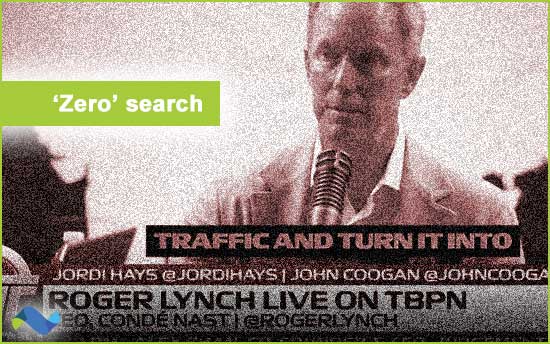
Condé Nast CEO Roger Lynch is planning for the worst when it comes to search referrals — zero.
In his appearance on video podcast TBPN on Tuesday, he said:
“We took a snapshot of search results from seven or eight years ago. And what you saw were a few sponsored links, then the ten blue links – the traditional search page.
Do the same search today, you get an AI overview, then you get rows and rows and rows of commerce links, then you get sponsored stuff. (…)
Each of the last three years, we would do our budgets, and we’d put forecasts in of search traffic declining. Why? Because we’d seen the pattern of algorithm changes. And generally those algorithm changes were negative. Every year, our search traffic was down more than we had forecast.
So last year I told our teams, ‘Assume there’s no search.’ You have to have your businesses planned as if search is zero.
We don’t expect it to be zero, [but] we expect it to be a single-digit percentage of our traffic. So we started working on plans for each of our brands around that.”
See the TBN interview clip on X. (May 12)
Later, regarding emerging competition from AI content, Lynch said that “Condé Nast content will always be created by humans, and that the flood of AI content only accrues to the benefit of companies that can stand out from that. ‘It’s what our audiences expect and want. And we have no competitive advantage over creating AI-generated content. That doesn’t leverage any of the advantages we have’,” according to another TBPN clip on X.
From tipsheet: Large publishers need to be destinations and stop worrying about distribution dependencies like search. Beyond that, the prescription is original content and tech: identity systems powered by the publisher’s proprietary data.
Publishers may think this future moves them away from tech and programmatic. It doesn’t. In fact, this may simply be the next evolution of publisher-owned ad tech and data infrastructure. They are building their own machine.
Does revenue tilt toward subscriptions and custom sponsorships in Lynch’s scenario?
The pitch becomes the value of the audience uniquely gathered on Condé Nast properties. A Condé Nast AI chatbot tied to Condé Nast content and data might be useful, too, by providing differentiated answers to users while generating valuable data for content and advertising addressability.
The irony is that, over time, AI search will get even better at giving users exactly what they want. AI search will then need the exact kind of differentiated publisher content companies like Condé Nast say they will produce. (Better data in, better answers out.)
- AI will give better referrals to the publisher.
- The publisher will give better data (proprietary content) to AI.
And this all speaks to the value of search referrals only going up from here.
Good luck, everyone.
LLMs & CHATBOTS
Developments
- Podcast: “‘The Cone of Uncertainty” with Krishna Rao, CFO, Anthropic (May 13) – Invest Like The Best on Colossus
- Introducing a Completely Private Way to Chat With AI (May 13) – Meta
- New Copilot entry points, smart suggestions, and keyboard-first design (May 11) – Microsoft 365 Insider Blog
LLMs & CHATBOTS
Amazon unifies AI assistant strategy
It’s official — the Rufus shopping chatbot is being renamed “Alexa for Shopping.”
Amazon explained yesterday why it unified its two AI chatbots:
“Today, Amazon is introducing ‘Alexa for Shopping,’ the world’s best, most personalized AI assistant for shopping—available to U.S. customers on the Amazon Shopping app and website, and Echo Show devices.
Customers already rely on Alexa+, available across hundreds of millions of devices, Alexa[dot]com, and the Alexa app for everything from answering questions and researching topics to managing smart homes, coordinating family events, making reservations, and staying entertained.
Rufus helped over 300 million customers in 2025 research, compare, and buy the products they want and need at the best prices on the Amazon Shopping app and website.
By bringing together Rufus’s product expertise and Amazon shopping history with the personalized knowledge and context of Alexa+, Alexa for Shopping delivers a more personal, helpful shopping experience across a wide range of surfaces and devices—from the Amazon Shopping app and website to Echo Show, where customers can now browse and shop the full Amazon store using voice, touch, or both.”
Read: Meet Alexa for Shopping, your personalized, agentic AI assistant on Amazon (May 13) – Amazon
From tipsheet: Makes sense to me. Marketing AI to consumers just got simpler at Amazon. It also strengthens the case for AI using Alexa+ and Rufus data across the Amazon experience — a unified optimization and personalization layer across Amazon’s commerce, media and advertising ecosystem. Amazon DSP gets more powerful.
Does Amazon eventually launch an Alexa LLM? In some ways, it already exists as the backbone of Alexa and Rufus today. Google’s Gemini strategy could inspire Amazon.
SEARCH
Opinion: First-party data matters more
Assembly Global’s SVP of Search Dan Roberts argues that AI search and agentic interfaces are making traditional search measurement increasingly obsolete.
On Search Engine Hubbub, Roberts wrote:
“…the quality of your first-party data starts to matter a lot more, because AI search experiences and more agentic search experiences rely on clean, consented signals to learn which journeys actually lead to outcomes.
So the challenge is not simply that zero-click search is growing. The challenge is that too many brands are still using a 2016 measurement model to judge a 2026 search experience.
That is the real shift. Search value did not disappear. Our scorecards just stopped reflecting how modern search actually works.”
Roberts provides a concise list of what marketers should be measuring now.
Read: “Search Didn’t Break. Your KPIs Did” – Search Engine Hubbub
From tipsheet: This essay is relevant to anyone who is a marketer — and that means publishers, too.
PLATFORMS
YouTube uses AI to package live-event inventory
YouTube is using AI to bring more contextual intelligence to media buying strategies, including live events.
The Wall Street Journal reported on announcements coming out of Google’s TV Upfront, which took place last night:
“YouTube has approached sports events in a similar way by tying packages of sports-adjacent creator content, from Shorts to video podcasts, to an upcoming game or tournament that’s of interest to advertisers, along with standard ad formats.
‘That will be a big part of our behind-the-scenes discussions with advertisers,” said Google President, Americas, Sean Downey. “We’re bundling anything on YouTube that works for them.’
The company is pressing its one-platform-fits-all strategy with a new AI tool that it says will custom-build ad inventory based around cultural events that interest advertisers but aren’t on YouTube’s calendar. If a marketer wants to reach people interested in a tour by pop star Olivia Rodrigo, for example, YouTube’s AI can help identify content in proximity to the concerts that matches the brand’s needs, according to a YouTube spokeswoman.
The tool will be exclusive to upfront buyers, the spokeswoman said.”
Read: YouTube Promises All Things to All Advertisers, With Some Help from AI (May 12) – The Wall Street Journal (subscription)
From tipsheet: AI could match ads to content both through reserved deals and dynamically in programmatic environments — especially given the volume of user-generated content that can be published around live events on YouTube.
The distinction between reserved sponsorships and programmatic advertising may start to blur as AI systems assemble creator inventory dynamically around cultural moments.
One could see how Google’s AI tools compete with the “reserved” world that startup Agentio is trying to facilitate, where it uses AI to match marketers with content creators and vice versa across YouTube and Instagram.
Taking it a step further, Google is effectively using AI to auto-tag live-event-related content for advertisers at massive scale.
See also: “YouTube’s AI ad network of tags” (September 2025) – tipsheet
Related: MrBeast’s creator platform signals a more programmatic creator economy (May 13) – Digiday (subscription)
CONNECTED TV
Quote: Prime Video engagement rises
-
“Last night at Upfront 2026 – Alan Moss, Vice President of Global Ad Sales, Amazon Ads: ‘Prime Video ad-supported customers are watching 17% more hours every month than just a year ago. When the content is this good, people don’t just show up. They stay.’ (May 13) – Andy Plesser, Beet TV on LinkedIn
From tipsheet: Prime Video is increasingly an engagement surface for advertising and commerce — not just subscriptions. Netflix, an Amazon Ads partner, is taking note.
PLATFORMS
BranchLab raises $26M to modernize pharma marketing
BranchLab, an AI marketing platform for pharmaceutical companies, announced a $26 million Series A funding round yesterday led by McKesson Ventures. This brings the Boulder-based company’s total funds raised to $35 million.
A press release provided details on the product:
“Pharma commercialization—spanning patient identification, audience segmentation, activation, and real-world measurement—has historically relied on fragmented vendors, delayed analytics, and manual workflows. The result is a system that is data-rich but operationally offline, limiting how quickly teams can learn, adapt, and drive impact. (…)
[BranchLab] has built a unified AI platform that puts audience identification, activation, and optimization directly in the hands of pharma teams and their agencies—enabling them to act on high-intent patient and healthcare professional (HCP) audiences in near-real-time. Today, BranchLab is used by leading pharmaceutical companies and has delivered an average increase of nearly 70% in marketing efficacy across a diverse set of therapeutic areas.
Read: “BranchLab Raises $26M Series A Led by McKesson Ventures to Bring AI to Pharma Commercialization” – BranchLab
BranchLab co-founder and CEO Josh Walsh added on LinkedIn: “We just raised a $26M Series A. That’s exciting, but the most important part is the problem we’re solving. Pharma has no shortage of high-quality data yet remains surprisingly analog. What it lacks are commercialization systems that can actually use that data in live environments to improve patient outcomes…” Read more. (May 13)
From tipsheet: BranchLab appears to be positioning itself as a broader pharma marketing platform rather than simply an advertising product, moving “up the stack” with an AI-native commercialization pitch.
From a paid media perspective, the company appears to be targeting a market similar to well-funded healthcare DSP DeepIntent, particularly around healthcare audience activation and measurement.
AGENTIC
TikTok welcomes AI agents
“The company will begin welcoming third-party AI agents that allow advertisers to use AI agents for autonomous campaign development and management. Third-party API agents can also help advertisers with the creation of custom infrastructure for their unique workflows. That interoperability, announced at TikTok World, the platform’s annual marketing and advertising showcase, is enabled by a Model Context Protocol (MCP) server. Similar to an API, developers can bring their own tech into another company’s software ecosystem.” (May 13) – Kendra Barnett, Senior Tech Reporter on Adweek
Read: “TikTok Builds for the AI Future, Welcoming Third-Party Agents for Ads” (May 13) – Adweek (subscription)
MORE
- “Study: AI-referred shoppers convert better and spend more: What Shopify’s early data shows” (May 13) – Read more from Lauren Nemeth, VP of Global Enterprise Revenue, Shopify on LinkedIn
- “Radical Ventures podcast: Building AI-Native Advertising” (May 12) – Read more from Michael Rubenstein, co-founder and co-CEO, Firsthand on LinkedIn
- “We are in the early innings of the Agentic era, and not enough is said about what its impact will be on the email channel. Agents will act as consumer concierges, and that has already extended to email for the early adopters.” (May 13) – Matt Keiser, CEO, LiveIntent on LinkedIn
- “The Forecasting API is the second half of IAB Tech Lab’s LEAP. Concurrent Streams (the first half) tells a bidder how many viewers are watching right now. The Forecasting API tells it what is coming hours or days ahead.” (May 13) – Damian Naglak, Head of Engineering, Bedrock Platform on LinkedIn
- “AppLovin MCP is now in limited beta.” (May 13) – Axon by AppLovin on LinkedIn