
Apoorv Agrawal, an OpenAI investor and former AI engineer at ad tech firm Rocket Fuel, explored the improvement of retention in consumer AI — specifically, OpenAI’s ChatGPT — in the final installment of his popular 3-part series on Substack.
Agrawal writes, “The real question isn’t who has the most users. It’s who has the most habitual users. And that’s where engagement and retention come in.”
Using Sensor Tower data, Agrawal notes:
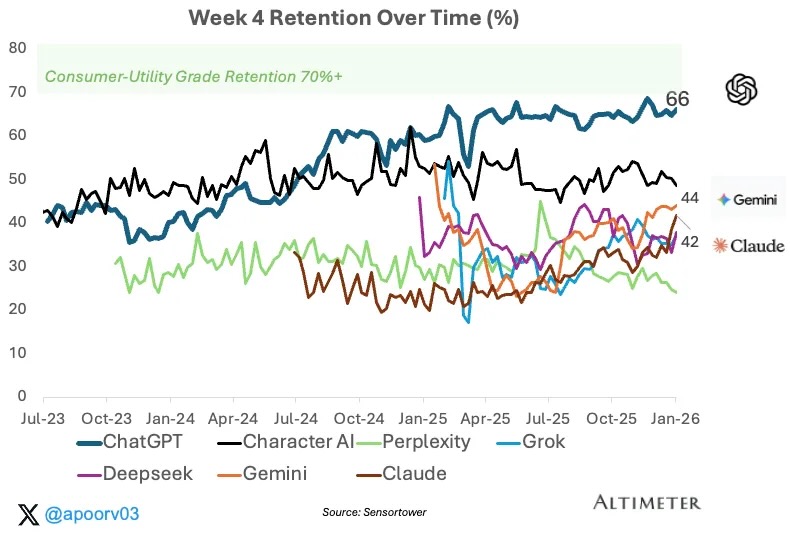
“Three years ago, ChatGPT’s Week 4 retention was closer to 40%. It has climbed to 66% today, a roughly 25 percentage point gain. Most apps see retention set early and stay flat or decline as the user base matures and more casual users come in. ChatGPT has done the opposite: as its user base has grown 10x, retention has gotten better. The most likely explanation is product improvement. Each major release has given users a new reason to come back.”
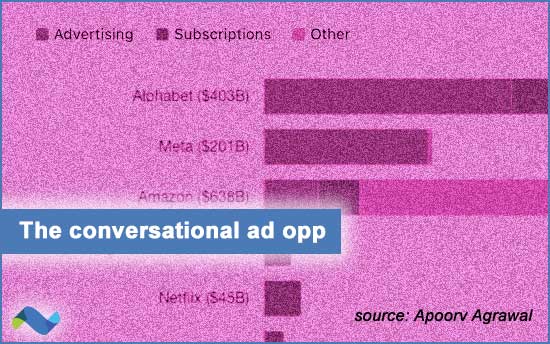
Money quote: “If AI enables hyper-personalization, agentic behavior, and truly conversational moments with brands, the advertising opportunity may not just be large. It may be meaningfully different from any ad experience that exists today.”
Also of interest is Agrawal’s footnotes to Part 3: “Thanks to Sarah Friar and Fidji Simo for reviewing drafts of this article and series.”
That’s none other than OpenAI CFO Sarah Friar and CEO of Applications Fidji Simo who had a hand in editing the piece.
Read: “The State of Consumer AI. Part 3: Time is Money” (March 30) – Apoorv Agrawal on his Substack
More:
- The State of Consumer AI. Part 1: Usage (March 2) – Apoorv Agrawal on his Substack
- The State of Consumer AI. Part 2: Engagement and Retention (March 10) – Apoorv Agrawal on his Substack
From tipsheet #1: This is an important argument for the investor class as they wonder whether Google and its Gemini multi-pronged chatbot (chatbot, search, AI mode/overviews) effort will overwhelm ChatGPT. Mr. Agrawal’s point — “Among AI apps, only ChatGPT looks like a plausible new utility” — sharpens the debate.
Certainly, as an OpenAI investor, he has clear incentives. But the argument appears compelling. And investors will likely appreciate Friar and Simo’s participation in the review process.
For background, in an OpenAI podcast released last July, OpenAI’s Head of ChatGPT Nick Turley said that the company optimized for retention not time spent. Agrawal has extended the theme in his Substack series.
From tipsheet #2: OpenAI is preparing for an IPO. This series could become part of the investor narrative assuming the data trends hold.
LLMs & CHATBOTS
Developments
- Mistral secures $830 million in debt financing to fund AI data center (March 30) – CNBC
- Why Are Large Language Models so Terrible at Video Games? (March 29) – IEEE
- Copilot Cowork: Now available in Frontier (March 30) – Microsoft 365 blog
LLMs & CHATBOTS
Ads update for Rufus shopping assistant
In Adweek, Trishla Ostwal obtains an Amazon Ads pitch deck for ads within the company’s AI shopping assistant Rufus.
Conversational advertising takes another step at the eCommerce giant as Ostwal reports:
“Amazon first introduced its core ad product Sponsored Ads on its Rufus AI shopping assistant in 2024, ADWEEK previously reported, but a leaked pitchdeck, shared with ad buyers earlier this month, reveals important details that will be crucial in securing brand spend: how these ads will be measured and priced, as the offering becomes generally available. ‘Amid moving from open beta to launch advertisers will now be charged and see their cost per click,’ the pitchdeck reads…”
Read: “Leaked Pitchdeck Reveals Amazon’s Pitch to Get Advertisers on Rufus” (March 30) – Adweek
More:
-
Sponsored Products prompts and Sponsored Brands prompts (March 10) – Amazon Ads
-
Amazon Sponsored Products Prompts: What Rufus Ads Mean for Your Brand (February 2026) – PPC Ninja
-
Rufus – Amazon Customer Help
From tipsheet: Rufus ads are not a new ad product. They are the interface where ads become answers.
Independent, non-Amazon incrementality studies will be critical to understanding the true value of conversational ads.
AGENCIES
Former agency exec Moorcroft talks trends
In an “expert call” with investors last week, Brendan Moorcroft, an executive with past leadership roles at Publicis, WPP and IPG Mediabrands, spoke to New Street Research analyst Dan Salmon to discuss several themes riding the AI transformation wave in today’s ad ecosystem.
According to Salmon, key takeaways from the call included:
- “How The Trade Desk’s agency relationships are evolving: more margin and fee battles“
- “The Trade Desk + Brands: JBPs (Joint Business Plans) shift commercial control to brands, expect brand audits as well“
- “AI stacks + walled gardens: scale, data, & infrastructure concentrate spend“
- “Amazon: data + supply + economics converge, with AWS as the hidden advantage“
- “Google: AI reinforces DV360 + YouTube’s gravity in programmatic“
- “Criteo and LiveRamp: interoperability layer gets more valuable as AI restructures workflows”
Drilling into the final takeaway, Mr. Salmon reported:
“Moorcroft was constructive on both Criteo and LiveRamp, but for specific reasons tied to how the ecosystem is evolving. His core framework is that value in the ecosystem is increasingly concentrated in data, infrastructure, and the ability to connect them at scale.
For LiveRamp, the role is becoming more critical. As brands seek to use their first-party data across multiple walled gardens – and now, new chatbot/LLM experiences — without losing control, Moorcroft described LiveRamp as a ‘Rosetta Stone’—a translation layer that enables interoperability between closed ecosystems and independent data assets. In a world where data remains siloed but needs to be activated broadly by LLMs, that function becomes increasingly valuable.
For Criteo, the opportunity is tied more to infrastructure and workflow. Moorcroft pointed to its history of building foundational technology (including early DSP infrastructure) and suggested that platforms connecting data, supply, and demand become more important in an AI-driven environment.
His broader view is that as the industry moves toward software-to-software and agent-driven workflows, some of the ‘fluff’ in the ecosystem gets stripped out. What remains valuable are systems that can:
-
- connect data across environments
- enable decisioning and execution programmatically
- integrate cleanly into AI-driven workflows
In that context, both Criteo and LiveRamp are positioned as beneficiaries—not because they compete with walled gardens on scale, but because they enable the connective tissue across them.”
Moorcroft’s long history in data-driven digital advertising included helping to germinate IPG’s programmatic ad platform (i.e. agency trading desk) in the early 2010s with Quentin George and Michael Brunick.
Today, the agency trading desk model has morphed into a marketing OS such as Publicis’ “Power of One”, Omnicom’s Omni and WPP’s WPP Open.
Related: “The Agency That Survives Won’t Be the Smartest. It’ll Be the One That Knows What It Knows.” (March 30) – Laurent Oppenheim on LinkedIn
From tipsheet: LiveRamp’s strong focus on unlocking its open-source Agentic Audiences protocol (was User Context Protocol) within the ad ecosystem and Criteo’s turn toward agentic commerce represents the clear shift happening in advertising technology today due to AI and the rise of large language models (LLMs).
MARKETER
2026 ad budget is experimental
If you’re a marketer spending in digital today, you’re constantly experimenting — that’s the premise of a deeper look at spend trends by Digiday’s Kimeko McCoy.
The catalyst begins with AI platforms. McCoy writes:
“Those marketers are revamping their test-and-learn budgets to account for things like generative search optimization (GEO), ChatGPT pilot ads and even out-of-home. Agencies say there’s a larger appetite to test the unknowns, shift KPIs and expectations for the sake of scale and incrementality. In some cases, that’s growing the budget. In others, it’s shifting existing dollars away from so-called guaranteed performance channels to experimental places like AI ads or retail media…”
Read: “What AI disruption means for experimental ad budgets” (March 30) – Digiday
Related: “What is Incrementality And How Do We Measure it in 2025?” (September 2025) – Maor Sadr, CEO, incrmntal on his company’s blog
From tipsheet: In parallel with always-on measurement, experimentation is becoming part of the allocation algorithm.
TECH
OpenAI apps and AOL dial-up
Bloomberg said yesterday that “six months in, ChatGPT’s third-party apps offer limited functionality and have been frustrating for developers.”
Bloomberg said that “interviews” reveal…
“While there are now more than 300 app integrations available, they’re hidden away and the functionality has been limited by the partner companies, which are hesitant to hand off customer relationships and payments to OpenAI. Developers have also complained about a tedious app-approval process, a buggy coding system and a lack of usage data.”
Read: “OpenAI’s ChatGPT App Store Took Aim at Apple, But Results Lag So Far” (March 30) – Bloomberg (subscription)
From tipsheet: A few thoughts…
-
Seems to me the biggest retailers in the world are clamoring for their apps to be embedded in ChatGPT. That’s a positive signal.
-
This story appears to be seeded by certain developers (unclear which developers) who are attempting to gain leverage in their negotiations with OpenAI and its retailer partners. If there are more stories like this over time, perhaps things change and the developers get the leverage they’re looking for.
-
The Bloomberg story is another positive signal for OpenAI.
-
This narrative echoes AOL in the ’90s when consumers complained their dial-up service wouldn’t connect to the internet because the service was busy.
Read: “More Busy Signals at AOL” (January 1997) – Time
It’s still early. OpenAI — and everyone else, which includes developers — is building, testing and launching on the fly in a most dynamic business environment.
SELL-SIDE
PubMatic, Amazon Ads partner on pipes
Sell-side platform (SSP) PubMatic and Amazon DSP (Amazon Ads) announced a new partnership which brings together PubMatic’s “traffic shaping” with “Amazon’s Dynamic Traffic Engine (DTE).”
A PubMatic blog post explained:
“Amazon’s Dynamic Traffic Engine (DTE) is a traffic optimization solution that shares demand signal recommendations with SSPs, approaches supply chain efficiency from the demand side — enabling us to identify which bid requests are most likely to match active Amazon Ads demand and prioritize accordingly. The result is a more efficient supply chain for everyone: SSPs optimize infrastructure, advertisers access more relevant inventory, and publishers see stronger fill rates. It is, in essence, a demand-side expression of the same principle we apply on the supply side: that intelligence outperforms scale, and that a cleaner supply chain benefits everyone in it.
Our integration with DTE is now live globally and already delivering measurable results — including up to a 10% increase in eCPM. Since integration, we’ve seen stronger value out of each bid request, improved campaign efficiency, and a more efficient supply chain overall.”
Read: Building a Better Supply Chain: PubMatic on the Future of Programmatic Performance with Amazon Ads (March 30) – PubMatic
More: Making Programmatic Smarter: How Amazon’s Dynamic Traffic Engine (beta) Tackles Inefficiencies in Ad Buying (November 2024) – Amazon Ads
From tipsheet: The market is moving toward more transparency and sell-side ad tech firms want to stay close, and relevant, to demand — if not aggregating their own. (See PubMatic’s Activate)
The Trade Desk’s OpenPath has one approach to transparency in bypassing SSPs. PubMatic’s strategy is about redefining why they shouldn’t be bypassed.
SEARCH
AI trends in search
- “14% of shopping queries on Google now trigger an AI Overview. For “best [product]” queries, that number is over 80%. Google’s Shopping Graph is consistently a top-5 cited domain across all of them…” (March 30) – Rishabh Jain, CEO, Fermat Commerce on LinkedIn
- Sites are getting 2x more AI traffic from Gemini but that still trails ChatGPT (March 26) – SE Ranking
- “An easier way to explore Search trends with Gemini” (January 2026) – Google’s The Keyword blog
MARKETING
SemantiIQ Health: Agents win on workflow
“30 days ago we launched SemantIQ Health. In the last month, 150+ users have used our agents to run real healthcare commercial and marketing workflows fulfilling Target List Profiling, Segmentation and Custom Audience building, New-business pitches, and executing Healthcare Insights utilizing real world data…”
Read more on LinkedIn. (March 30)
PEOPLE MOVES
Now hiring
“I’m thrilled to welcome two new leaders to Pinterest as we continue to sharpen how we build and scale monetization.
Vik Gupta just joined in a newly created role as VP & GM of Monetization. He brings nearly 20 years of advertising experience across Instacart, Google, and Meta, including building and scaling ads platforms from 0 to 1 and leading high-performing teams. He’ll be leading Product, Engineering, and Data Science for Monetization as we drive greater impact for Pinterest users and advertisers.
We are also welcoming Sumanth Jagannath as our new VP of Measurement. As our ambitions grow, so does the need for rigorous, trustworthy measurement, helping advertisers clearly see the value Pinterest delivers and helping us focus on the products and signals that accelerate performance.”
– Matt Madrigal, CTO, Pinterest (March 30) on LinkedIn
More: Pinterest bets measurement and SMBs will boost performance revenue (March 30) – Digiday (subscription)
MORE
- “At Shoptalk, retail media’s agentic anxiety turned into action” (March 30) – Kiri Masters, analyst on The Drum
- When DSPs and SSPs Converge” (March 30) – Karsten Weide, analyst, W Media Research on Marketecture
- Podcast: “Rewriting the Rules of Programmatic: Adam Heimlich on Agentic Bidding, ARTF, and Building Chalice AI” (March 23) – Signal & Noise on YouTube
- Sett secures $30 million Series B to automate game marketing with AI agents (March 29) – CTech
- Microsoft’s AI slop is infecting GitHub — Copilot is now injecting ads into pull requests (Update) (March 30) – Windows Central