
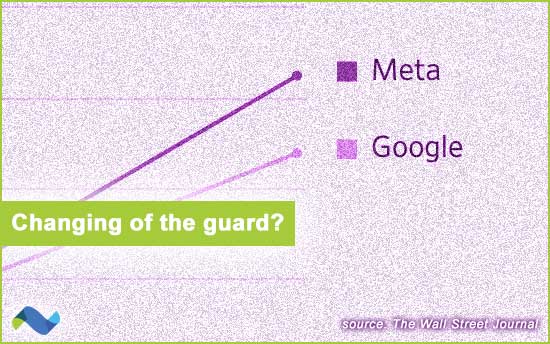
Scaled, AI-enabled ad platforms continue to grow.
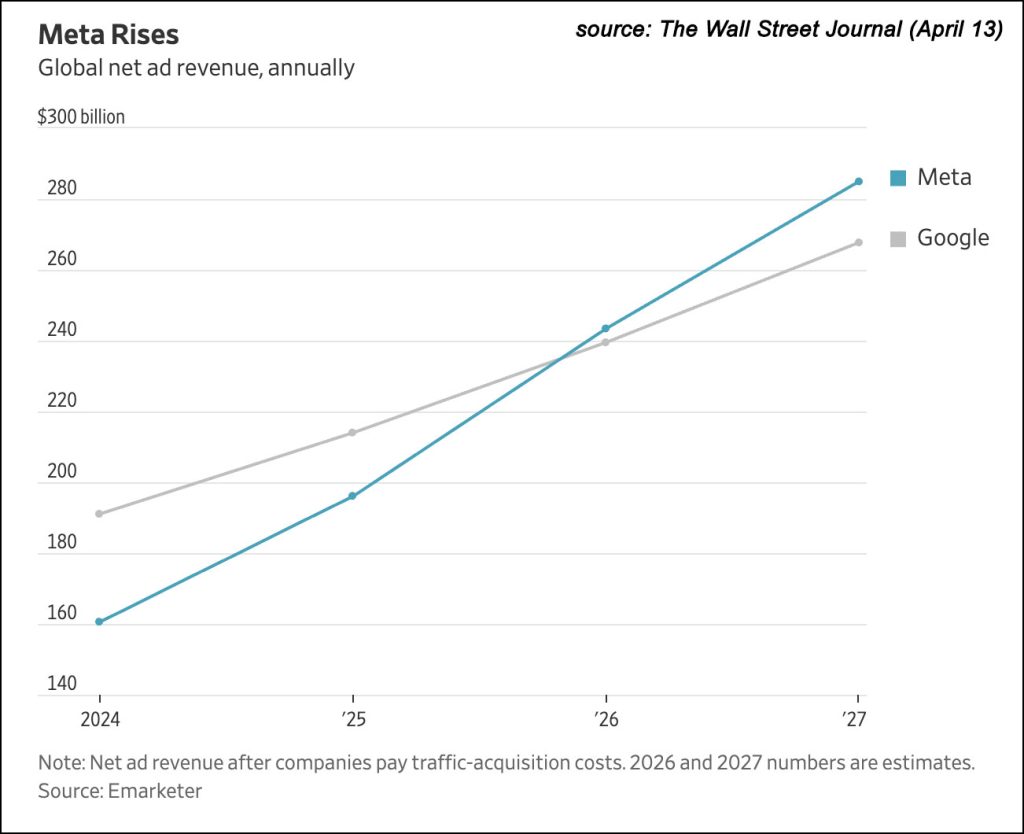
In a comparison of net advertising revenues, Meta will pass Google this year, according to eMarketer.
The Wall Street Journal reported on Monday:
“Advertising research firm Emarketer projects that Meta will surpass Google in net ad revenue this year, reaching over $243.46 billion, edging past Google’s $239.54 billion. The research firm’s estimates account for revenue after deducting traffic and other content acquisition costs, such as the money Google shares with its creators.
Meta’s ad business is seeing a lift, thanks to the success of new ad offerings, including the short-form video format Reels, and the broader boost that artificial intelligence has provided.”
Read: “Meta Expected to Unseat Google as World’s Largest Digital-Ad Player” (April 13) – The Wall Street Journal (subscription)
Marketecture’s Ari Paparo noted on X about the projection, “They are taking CAC out for Google which isn’t really a fair comparison. Google still sells more ads.” Read it. (April 13)
LLMs & CHATBOTS
Developments
- The Enigma of the Data Labeling Startup Explosion (April 14) – The Information (subscription)
- “MAI-Image-2-Efficient: Flagship Quality, 41% Lower Cost” (April 14) – Microsoft AI
- Trusted access for the next era of cyber defense (April 14) – OpenAI
LLMs & CHATBOTS
Bluefish is an agentic marketing platform
Pure-play generative engine optimization (GEO) startups continue to attract investment from the venture capital community. See Profound ($96 million in February), Evertune ($15 million last August) — and now Bluefish ($43 million yesterday after raising $20 million in August).
Bluefish said in a statement:
“The platform is already used by about 10% of the Fortune 500, with hundreds of accounts across 12+ verticals including financial services, pharmaceuticals, beauty, luxury and consumer packaged goods. Bluefish customers already include many of the world’s largest brands, including Adidas, American Express, Hearst, LVMH, and Ulta Beauty. The platform currently processes millions of AI prompts and responses per day across all major AI providers including ChatGPT, Google AI, Claude, Perplexity, and Amazon Rufus, covering billions of monthly active users (MAU).”
Read: “Bluefish Raises $43 Million Series B to Power Agentic Marketing for the Fortune 500” – Bluefish AI
In a competitive space, agents are starting to reshape the GEO category, too. Bluefish is calling itself an agentic marketing platform, rather than anything embedded with “GEO.”
More:
- Adweek’s Trishla Ostwal reported the funding news and said that CEO Alex Sherman “positioned Bluefish as an ‘agentic marketing platform for enterprises,’ designed to help them manage a growing number of AI-driven surfaces—from generative search to retail assistants and social AI—within a single system.” Read more. (April 14)
- On LinkedIn, Sherman said, “The brands we serve at Bluefish aren’t just learning about GEO and agentic marketing anymore – they are competing and winning in this critical new channel.” Read more. (April 14)
From tipsheet: A few thoughts:
- From GEO platform to agentic marketing platform — the new AMP.
- The use of “agentic” may have more to do with serving the “agentic commerce” future rather than anything specifically agentic about the platform. Ann Bordetsky (Bluefish board member) of venture firm NEA says in the release, “Bluefish is scaling fast, with 10% of the Fortune 500 engaged, triple-digit performance gains for the world’s most demanding brands and a platform built for the agent-driven commerce era.”
- This sector wants to distance itself from any connection to search engine optimization (SEO) where the company valuation multiples are much lower.
- Where there is an LLM to be optimized, there will be GEO firms… or agentic marketing platforms.
SEARCH
GEO needs Marketing Engineer, says Profound
“Every marketing team on the planet will use AI to do their jobs better. But to build truly impactful systems, you need an owner and an orchestrator. That’s the Marketing Engineer.
Because we believe this role is the future of marketing, we’re offering a free course through Profound University — high-quality lessons on exactly how we’re doing this job internally.”
More: “Introducing the Marketing Engineer” – Profound University
Related: Opal launches Gem, “an AI solution built to align marketers on things like overall brand strategies and the particular nuances of a product line.” (April 14) – AdExchanger
AGENCIES
Dentsu launches agentic operating system
Shirli Zelcer, Chief Data and Technology Officer of Dentsu, announced the “next-generation” of her agency holding company’s AI platform focused on the agentic future.
Ms. Zelcer said, “We’ve been on a journey to build a fully connected platform that transforms how we support our clients and today marks an exciting next step with the latest evolution of dentsu[dot]Connect. This is our next‑generation intelligent operating system, designed to unify the entire marketing lifecycle and put end‑to‑end agentic workflows at the center of how we work. The future of marketing is agentic and we’re already there, with a live proof of technology being shown to clients today.”
Read more on LinkedIn. (April 14)
Adweek’s Kendra Barnett reported: “The newest iteration of Dentsu.Connect, built on a combination of custom small language models and frontier large language models like Google’s Gemini and Meta’s Llama models, goes much further. It acts as a centralized platform where all the existing workflows, like media planning, strategy, audience-building, can communicate and learn from each other.”
Read: “Dentsu Revamps Its AI Platform for an Agentic Future” (April 14) – Adweek (subscription)
Related: “CMOs should tap into agency AI platforms now, but don’t get tied down” (April 14) – Jay Wilson, analyst, Gartner on The Drum
From tipsheet: The agency operating system pitch to marketers continues.
Can agencies make it stick long-term with their clients? Switching costs could play a factor as AI and client data creates an AI specialization at an agency in the form of fully-trained customized models that brands may have a hard time walking away from.
BRANDS
AppLovin touts Axon, video ads
AppLovin advertisers are being encouraged to use the company’s 60-second Rewarded Ads format for games via its AI-enabled Axon platform. In some ways, this is nothing new. Access to in-app game publisher inventory is core to its offering.
But, AppLovin’s late March announcement on AI video ad creation may further invigorate the Rewarded Ad concept.
An AppLovin LinkedIn post explained why the “unskippable” ads work:
“Rewarded ads are requested by the user in exchange for an in-game reward. Once they start, they’re unskippable for up to 60 seconds. That’s a different kind of attention.
44% of top spending ads run between 46-60 seconds.
Another 37% between 31-45 seconds.
Short ads account for a fraction of top performance.
TIP: If you don’t have a long asset, stitch together multiple UGC clips. More creators also means more chances to resonate.”
Read more on LinkedIn. (April 13)
More: “AppLovin’s E-Commerce Expansion Could Unlock a New Growth Engine” (April 10) – Zacks on Yahoo Finance
From tipsheet: As AppLovin expands beyond games, how the learning from this type of in-app game format transfers to eCommerce, for example, will be something to watch.
TECH
Meta VP departs as WhatsApp ads grow
Nikila Srinivasan, Meta’s VP, Product, Business Messaging (WhatsApp, Messenger, Instagram Direct), announced her departure from the company after three years at the company.
On LinkedIn yesterday, she noted her group’s accomplishments — particularly around WhatsApp — saying: “Business Messaging across WhatsApp, Messenger, and Instagram Direct is now a $12B+ business and growing. Our new business line, Paid Messaging, scaled to $2B+. More than 200 million businesses around the world are building their livelihoods on these platforms. It means a great deal to leave this phase with both the business and the team in such a strong position.” Read more. (April 14)
The $2 billion figure for Paid Messaging is an annual run-rate that was announced in Meta’s Q4 2025 earnings report. See Meta earnings call transcript. (January 28)
More: “Meta’s Business Messaging Product Lead Says Bringing Ads To WhatsApp Is ‘An Evolution,’ Not A Broken Promise” (July 2025) – AdExchanger
From tipsheet: The expanding business messaging business is feeding more data into the AI marketing “machine” at Meta and further closing the loop for brands.
SELL-SIDE
Hearst optimizing the supply path
Nate Lopez-Ryckman, VP Programmatic, Hearst News, announced, “We’ve unified all of Hearst’s omnichannel news supply into a single programmatic network – Hearst News. This makes it even easier for advertisers to access and buy all of our news content in 1 place.” Read on LinkedIn. (April 13)
More: Hearst Built A Unified Ad Marketplace To Simplify Omnichannel News Buys (April 13) – AdExchanger
Related: “In Graphic Detail: New data shows publishers face growing AI bot, third-party scraper activity” (April 13) – Digiday (subscription)
From tipsheet: Centralize inventory management using the latest sell-side tools – that appears to be the strategy for Hearst.
SELL-SIDE
OpenX rebrands
- “The Intelligent SSP – It’s a reflection of what we’ve built and where programmatic is headed.” (April 13) – OpenX CEO Matt Sattel on LinkedIn
- “OpenX Repositions as The Intelligent SSP to Simplify Advertising” (April 14) – ExchangeWire
- “As an (ad tech) marketer, I have a lot of appreciation and empathy for OpenX’s new positioning. It’s a thoughtful, purpose-driven and simplified approach. They can now address what “bucket” they are in and make a clearer differentiation push.” (April 14) – Ben Kaplan, CMO, Nexxen on X
PLATFORMS
Snap needs OpenAI, says former exec
More indications (see Eric Seufert on X) that a partnership deal between Snap and AI company Perplexity has run aground are circulating.
The deal was originally announced in November. But Snap CEO Evan Spiegel revealed on an earnings call in February that the transaction was delayed.
Comcast Universal Ads executive James Borow, a former Snap executive, filled the potential breach with a new idea yesterday.
He suggested:
“The more I think about it, the more I believe that Evan Spiegel has a real power move left that can 100% flip the narrative. (…)
Channel his inner AppLovin, get obsessed with extreme efficiency on the business side and cut deep (over 50% unfortunately). (…)
Announce a strategic partnership with OpenAI (which IMO should buy them), both for the team to leverage internally and for usage across the ‘new family of apps’. Added bonus that Evan would get to rip off Zuck for once and say ‘family of apps’ on earnings calls.
Obviously easier said than done but I think they do this and good things start to happen much faster than people think.”
Read more on LinkedIn. (April 14)
Related: “Perplexity is still a startup. We just 5X’ed revenue from $100M to $500M with only 34% growth in team size. 2x revenue growth in 2026 with same small team. And we’re just warming up.” (April 13) – Perplexity CEO Aravind Srinivas on X
SELL-SIDE
Q&A: Cloudflare on agentic advertising protocols
Last week, content delivery network Cloudflare announced a partnership with GoDaddy for Cloudflare’s AI Crawl Control product which gives publishers the ability to “gate” access for AI agents.
Cloudflare chief strategy officer Stephanie Cohen said at the time, “By putting tools like AI Crawl Control and open standards into the hands of website owners, we are providing essential underpinnings for a new Internet business model.”
GoDaddy said it will support Agent Name Service and Web Bot Auth for the “verifiable identity layer needed for a functional digital marketplace.
Read: “Cloudflare and GoDaddy Partner to Help Enable an Open Agentic Web” (April 7) – press release
James Smith, Senior Director of Product Management, Cloudflare, answered a selection of follow-up questions from tipsheet via email.
tipsheet: “How do you see emerging agentic advertising protocols, like those from IAB Tech Lab and AgenticAdvertising.org, fitting into Cloudflare’s approach to managing AI agent traffic?”
James Smith, Cloudflare: “Emerging agentic advertising protocols, such as those from the IAB Tech Lab and AgenticAdvertising.org, fit perfectly into Cloudflare’s vision. We need to support a broad range of protocols for this maturing ecosystem. Because Cloudflare powers such a significant portion of the Internet, our role is to serve as both the enablement and verification layer for these standards. We provide the platform that authenticates an agent’s identity, ensures it respects a publisher’s specific preferences in real-time, and mitigates the technical friction of these handshakes. By providing the pipes that allow these micro-negotiations to happen at scale, we help move the industry away from simple blocking and toward a sophisticated, revenue-generating value exchange.”
Additional questions include:
- What still needs to fall into place before publishers can meaningfully monetize AI agent access to their content?
- How should publishers think about the timeline for moving from controlling bots to actually monetizing them?
- Does Cloudflare see an opportunity for creating its own marketplace where AI companies can buy publisher content on a pay-per-crawl or pay-per-inference (or pay-per-whatever) basis? Currently, smaller publishers and many large publishers do not have access to the relationships and deals that certain publishers (such as People Inc. which you identified) do with AI companies.
Read full Q&A: “Cloudflare discusses publisher monetization in the age of AI” (April 14) – tipsheet
MORE
- Pacvue Launches Pacvue Agent, Advancing AI-Powered Commerce Media Execution (April 14) – Pacvue
- IAB Introduces Actionable Industry Guidelines as Commerce Media Enters AI-Fueled Performance Era (April 14) – IAB
- TikTok adds new AI video generation to Symphony ad tool kit (April 13) – Social Media Today
- FreeWheel Launches First-of-its-Kind Context Engine to Deliver Scaled, AI-Driven Contextual Targeting Globally Across Premium Video (April 14) – FreeWheel
- “What is the IAB Tech Lab’s AAMP And What Does It Mean For You?” – Karsten Weide, analyst on the W Media Research blog