

Google updated its guidance for third-party search engine optimization (SEO) tools and services late last week, including those that claim to improve visibility in AI-generated search experiences.
Search Engine Land’s Barry Schwartz reported yesterday that Google’s guidance warns marketers to carefully evaluate vendors that claim they can improve performance in AI-powered search experiences, including those “promising improvements for AI experiences and search formats (also known as answer engine optimization (AEO) or generative engine optimization (GEO) tools).”
Google also cautioned marketers against trusting guarantees from optimization vendors, noting that “third-party tools don’t have access to our internal ranking data. They can’t guarantee performance.”
The update is part of broader changes to Google’s SEO documentation, including new references to optimizing for generative AI experiences and evaluating third-party recommendations against official Google guidance.
Read:
- Google adds guidance on third-party SEO tools, services, advice and updates hiring an SEO doc (June 7) – Search Engine Land
- Google Search’s guidance on using third-party SEO tools, services, and advice (June 5) – Google Search Central
- (Updated) Do you need an SEO? (June 5) – Google Search Central
From tipsheet: AEO vendors often position themselves as something fundamentally different from SEO. Google’s latest guidance suggests the company may see AEO as an extension of the same discipline. The difference is that traditional SEO was largely about understanding one dominant platform. AI search is emerging across Google, OpenAI, Anthropic and others, potentially creating multiple systems that marketers must understand and optimize for.
LLMs & CHATBOTS
Developments
- Apple Set To Introduce AI-Powered Siri Digital Assistant At WWDC (June 7) – IBD
- ChatGPT turning it into a superapp soon (June 7) – Financial Times (subscription)
- What remains scarce after AGI? (June 4) — Dwarkesh podcast
DATA
Publicis-LiveRamp: Learning-system acquisition?
On the Ad Age Insider podcast, Ad Age senior editor Garett Sloane discussed what Publicis Groupe’s acquisition of LiveRamp could mean for agencies, brands and ad tech.
The debate has largely centered on neutrality, but Sloane highlighted a potentially bigger shift as AI becomes embedded across marketing workflows.
“Your AI agents—buying agents, your selling agents—these autonomous new tools within the programmatic landscape that are starting to learn media plans and activate those media plans using large language models and AI, those are going to be trained on data that’s made available through platforms like LiveRamp.”
Publicis argues the acquisition is an AI play rather than a data play. Sloane notes that AI systems increasingly depend on the data, identity and collaboration infrastructure that powers audience creation, planning, activation, measurement and optimization.
From tipsheet: The neutrality debate matters. But the bigger question may be whether Publicis is acquiring a critical position inside the future marketing learning system. This was a key part of Publicis Groupe CEO Arthur Sadoun’s pitch to investors when he announced the acquisition: “Accelerating data co-creation to build more intelligent agents.” As AI agents become more involved in planning and execution, access to feedback signals may become more valuable than access to data alone.
Read: “Brands face an AI-era reckoning—take control or trust the ‘neutral’ middle” (June 5) – Ad Age
MOBILE
Was aggregation, now distribution
Mobile Dev Memo analyst Eric Seufert highlights a nugget from a recent Financial Times graphic showing:
- The number of Apple App Store app releases is skyrocketing due to AI enabling easy app creation. Seufert also points out that the surge in App Store releases coincides with Apple’s January introduction of an additional Search ad placement in the App Store.
- The number of Google Play app releases has not seen the same increase due to AI doing a better job of curating amid the flood of new apps created with AI’s help. (Data is from Seufert’s own proprietary dataset.)
Seufert observes, “As I note in the first episode of ‘The Prosperous Society,’ AI-enabled output shifts the binding constraint for commercial success to distribution.”
Read more on LinkedIn. (June 6)
More:
- The App Store discoverability squeeze (April 7) – Eric Seufert on Mobile Dev Memo
- How much value is AI really creating? (June 4) – Financial Times (subscription)
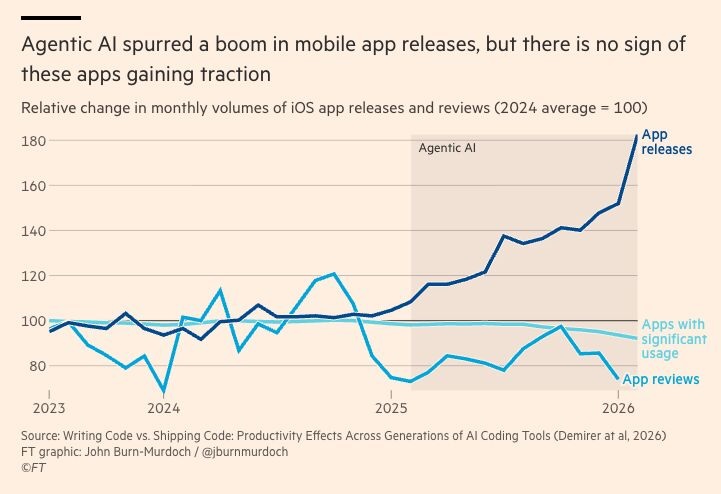
From tipsheet: AI is flooding markets with new supply. The next battle may be over who controls discovery. If that’s true, the winners may be the companies that curate, rank and route attention.
TECH
Creating the loop for the fandom economy
On the Marketecture podcast, former AppNexus and Microsoft executive Alex Chatfield discussed his startup Endorseable (formerly ADvolution), which aims to help brands reach creator and celebrity fandoms through addressable audiences in programmatic. By connecting creators, fans, advertisers and campaign outcomes, the company is building a measurable feedback loop around fandom.
Hear: “Episode 176: Alex Chatfield on How Influencers are Leveraging Data Technology” (June 5) – Marketecture Podcast
Why mobile is different
In reviewing the news of the week, Marketecture’s Ari Paparo and Aperiam’s Eric Franchi discussed last week’s initial public of mobile ad tech firm Liftoff Mobile:
Ari Paparo: “These mobile companies have just — the honest truth that no one wants to hear among the programmatic people is — a more sustainable business than the programmatic world does. They’re not dependent on search traffic nearly as much. People are willing to pay for the games and customer acquisition works at scale. So if they could call this a mini AppLovin and have it can execute and thereby grow, well, that sounds like a pretty exciting stock to own. (…)”
Eric Franchi: “So I agree with you in the characteristics of the [mobile] market. And it’s also one of these markets that is — I don’t want to say AI resistant — but it’s not subject to some of the issues that other categories like the open web have with respect to AI. People are actually playing more games than are playing less games.”
Ari Paparo: “The consumer AI play isn’t in jeopardy here. Consumers aren’t going to switch off games to do AI, although they may have new apps that — like the companion apps effectively are AI, but they act like games basically.”
Eric Franchi: “And by the way, these ads that AppLovin and others run, they are completely portable to some of those environments. So it’s like uniquely AI resistant.”
From tipsheet: Lots of good insights in the podcast. Unlike many parts of the open web, mobile app gaming ads, in particular, benefit from direct user relationships, clear measurement and business models that don’t depend on the whims of search traffic, as Paparo and Franchi noted. Together, those elements create a powerful feedback loop that gives marketers a clearer view of what is working, what isn’t and where to invest the next dollar.
TECH
Explainer: Why AI needs audit trails
In a blog post in support of its Realize+ performance marketing platform, ad tech firm Taboola argues that every AI-generated recommendation, action and decision should be traceable back to its source. As AI takes on larger roles across marketing workflows, the company says enterprises need audit trails, approval systems and decision logs to understand how AI outputs are produced.
From the post published last week:
“Every AI action in 2026 should have an immutable audit trail. If your team can’t answer who approved a prompt, which model generated a recommendation, or why a campaign decision was made, you’re operating in a risk zone. Governance means traceability, accountability and confidence in every AI-assisted action.”
Read: “AI Governance in Marketing: Why It Matters More Than Ever” (June 2026) – Taboola
From tipsheet: We spend a lot of time discussing models, agents and automation. But enterprises often care just as much about accountability. If AI becomes part of core business operations, companies need ways to reconstruct what happened, why it happened and who was responsible. Governance is emerging as the layer that makes autonomous systems auditable, manageable and trustworthy.
MARKETING
Edelman: Marketing operating model is changing
Google published an essay from former CMO David Edelman who argues that AI’s biggest impact on marketing may not be faster content creation or more efficient campaigns, but a redesign of how marketing organizations operate.
Edelman says that many companies are using AI to make existing processes faster when the bigger opportunity is to rethink the operating model itself.
He describes a shift toward smaller, more autonomous teams supported by AI-driven intelligence, experimentation and decision-making: “The leaders who make the choice, today, to step back and rethink their model will be in a very different position in two years than those who use AI to run the same factory faster.”
Read: “The CMO factory: AI for marketing leaders” (June 2026) – Think With Google
From tipsheet: One theme keeps appearing across Google, Meta, Amazon, Walmart and others: AI is pushing marketing from a campaign-centric discipline toward a learning-system discipline. The winners may not be the companies that simply deploy the most AI tools, but the ones that redesign their organizations to continuously learn from customer interactions, experiments and outcomes.
LLMs & CHATBOTS
Chief AI Officers are temporary
The emergence of Chief AI Officers suggests organizations are shifting from experimentation toward enterprise-wide adoption. Nevertheless, the AI leadership role may have a limited shelf life, says James Chandler, chief strategy officer at IAB UK.
Digiday’s Seb Joseph reports that Chandler “sees the role as a means to an end — that end being a business where AI is so embedded it no longer needs a dedicated executive to champion it. Once that work is done, every function owns it. Nobody needs a dedicated champion anymore.”
Read: “‘They’re going to be extinct at some point’: Why the chief AI officer is a transitional species” (June 4) – Digiday (subscription)
From tipsheet: The AI officer is reminiscent of the Chief Digital Officer role. The difference is that AI may become embedded across organizations much faster than digital did.
PEOPLE MOVES
The Trade Desk COO adds CRO role
Adweek’s Kendra Barnett reported yesterday that The Trade Desk’s COO Vivek Kundra will take over the CRO role from Anders Mortensen, who departed the company after coming over from Google in November.
Read: The Trade Desk CRO Anders Mortensen Out After 7 Months (June 7) – Adweek (subscription)
Related: “Citi is forming a new team and we are currently hiring across multiple disciplines. If you are a media strategist, data and measurement expert, martech specialist, or sales leader, there may be a position for you.” – Joe Watson, AVP, US Media, Citi on LinkedIn
MORE
- Your Inbox Might Be the Next AI Search Signal (May 21) – iPullRank blog
- Perplexity’s new ‘trust and transparency’ pitch does little to win over publishers (June 4) – Digiday (subscription)
- Podcast: AI Off The Rails (June 5) – The Big Story on AdExchanger
- Peer39 Acquires Adloox, Extending Brand Safety, Contextual Intelligence and Verification Across DV360, Meta, and Amazon DSP (June 3) – Peer39
- Podcast: Yext CEO Mike Walrath discusses the SaaSpocalypse, AI and overhiring, more (June 7) – Topline Podcast on YouTube