
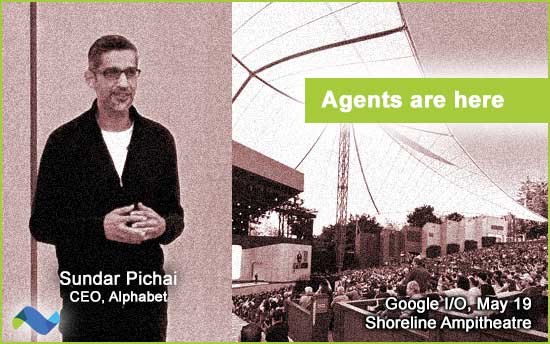
Sundar Pichai, CEO of Alphabet, followed by Google DeepMind CEO Demis Hassabis, opened yesterday’s Google I/O, the company’s annual developer conference.
This year’s keynote centered on agents, which were presented as the practical interface layer connecting Google’s AI models, products and services across both consumers and the enterprise.
Among the highlights:
Extending the chatbot: Google is increasingly extending Gemini across products like YouTube (with “Ask YouTube”), Gmail and Google Docs while evolving its AI systems beyond chatbot interactions toward persistent task execution and workflow orchestration.
New models + infrastructure: Hassabis announced new Gemini models alongside continued TPU infrastructure advancements designed to support increasingly capable reasoning and multimodal AI systems. (See Gemini 3.5 Flash and Gemini Omni.)
Google Spark: Google introduced Spark, a proactive personal AI agent designed to coordinate tasks and workflows across Google services. Demonstrations included personalized email writing (“make the email sound like me”) and pulling context across products like Docs and Gemini itself.
Workflow agents: Google also demonstrated reasoning agents and personalized AI assistants designed to help users coordinate information, summarize activity and manage ongoing workflows.
Read:
- “I/O 2026: Welcome to the agentic Gemini era” (May 19) – CEO Sundar Pichai on Google’s The Keyword blog
- Gemini 3.5: frontier intelligence with action (May 19) – Google The Keyword blog
- “The Gemini app becomes more agentic, delivering proactive, 24/7 help” (May 19) – Josh Woodward, VP, Google Labs, Gemini app & AI Studio, on Google’s The Keyword blog
Video: “Google I/O ’26 Keynote” (May 19) – YouTube
From tipsheet: Pichai was notably direct about the enormous AI infrastructure investments Google continues making and appeared focused on demonstrating practical user-facing applications for that spending — namely, agent workflows.
Agents give Google a consumer-friendly interface layer for reasoning models, multimodal AI systems and workflow orchestration — helping turn abstract AI capability into everyday product behavior.
SEARCH
Google I/O: ‘Google Search is AI Search’
Is Google Search destined to become a conversational chatbot? If so, AI-enabled discovery will lead the way.
Google VP of Search Liz Reid took the stage and declared: “Google Search is AI Search.” Twice.
With agents and image inputs now being added directly into the search box, Google Search is increasingly being positioned as Google’s primary AI discovery interface. Not Gemini.
- Search is becoming the conversational layer for exploration, recommendations and commercial discovery.
- Gemini, meanwhile, is evolving into an execution layer: an agentic system focused on work, actions and tasks.
Ultimately, Google appears to be collapsing “search engine” and “AI assistant” into two entry points for the same underlying AI ecosystem.
Read: “A new era for AI Search” – Google VP of Search Liz Reid on Google’s The Keyword blog
More: “Excited that in the future anyone can be a builder in Search.” – Robbie Stein, VP, Product, Google Search on X
Related: “Loving this shift in the search experience announced at Google I/O today. One of the biggest to the main search bar in a while. We’ve been expecting a consolidation of experiences for a while now and here it is. The narrative of “traditional” search vs AI/LLM starts to fall away when the masses get the best of the past and future in one place.” (May 19) – Corey Kahn, SVP Head of Search Digitas North America on LinkedIn
From tipsheet: Google Search is doing the discovery. Gemini is doing the work. These two apps increasingly appear to be on a collision course.
COMMERCE MEDIA
Google I/O: Universal Cart
Also at Google I/O, Vidhya Srinivasan, VP/GM of Advertising & Commerce, announced the company’s new Universal Cart product — “bringing superpowers to your shopping” — for agentic commerce supported by Universal Commerce Protocol (UCP) and Agent Payments Protocol (AP2).
Universal Cart aims to function as a persistent shopping cart across participating retailers on the open web.
For example, if a user shops across Amazon, Target and Shopify merchants that support Universal Cart, Google’s agent can add disparate retailer products into a single cart while still allowing the retailer to remain the checkout destination and merchant of record. The interoperability layer is facilitated through UCP.
Read: “Introducing the Universal Cart and more ways to help you shop” (May 19) – Google’s The Keyword blog
More: “Another area that’s crucial for agentic commerce is safe, secure agentic payments – and we shared that we’ll begin bringing AP2 to Google products, starting with Gemini Spark. AP2 makes it easy to set strict guardrails so your agent can securely make payments on your behalf, with boundaries and accountability to give you peace of mind.” (May 19) – Vidhya Srinivasan on LinkedIn
From tipsheet: With Universal Cart, users continue to encounter retailer-owned shopping surfaces — including AI shopping assistants like Amazon’s Rufus or Walmart’s Sparky — while Google’s agent coordinates activity across retailers and services.
This differs from earlier AI shopping implementations that relied primarily on users handing over their login credentials. Google’s approach instead appears built around retailer-approved interoperability via standardized protocols like UCP and AP2.
That distinction matters. Retailers still retain transaction visibility, checkout control and monetizable surfaces like ads — helping explain why protocol-based interoperability may prove more scalable for agentic commerce than unauthorized agent access alone.
LLMs & CHATBOTS
Developments
- “OpenAI Guaranteed Capacity” (May 19) – Denise Dresser, CRO, OpenAI on LinkedIn
- Mistral AI buys Austrian physics AI startup in industrial push (May 19) – Reuters
- Gemini for Science: AI experiments and tools for a new era of discovery (May 19) – Google’s The Keyword blog
CONNECTED TV
Roku adds creator content to tech platform
Connected TV operating system and ad platform Roku is adapting to a media environment where creators increasingly function like studios.
After hiring Lisa Holme as Head of Content last September, Roku is moving ahead with a more robust creator-content strategy for its platform.
“According to Lisa Holme, the head of content for Roku Media, the company will also increase the amount of licensed programming the platform has from top creators, with FAST channels from Prof G Podcast, iShowSpeed, Jesser, Stokes Twins and other creators set to join the platform as well.’
‘We just see that the demand among both audiences and, really significantly, advertisers has just continued to grow, and as Roku thinks about its content offering, we want to make sure that we have a good selection of anything that a consumer wants to watch,’ Holme tells THR, adding that the platform is responding to the signals it has been getting from users.”
Read: “Roku Doubling Down on Creators With Dedicated Destination and New FAST Channels” (May 19) – The Hollywood Reporter
From tipsheet: Roku wants a piece of the creator-economy revenue increasingly captured by YouTube, TikTok and other platforms. AI could eventually accelerate that shift even further by dramatically lowering the cost of producing video content — potentially enabling globally scalable shows and creator-led channels run by teams of one or two people.
AGENCIES
Opinion: The accountability gap in agentic AI
“The reason decision-making rights matter should be an obvious one: decisions, no matter how small, have consequences. The inherent challenge here is that while we give agents agency, they do not have accountability. They can act on our behalf, increasingly autonomously, but the goals aren’t theirs. It is no skin off an agent’s back if the strategy is brilliant or mediocre. They don’t feel the weight of a recommendation that changes a client’s direction. They have no real stake in the outcome.” – Amelia Gandar, WPP
Read: “The Decisions We Give Away” – Amelia Gandar, Global Head of Agentic Strategy and Design, WPP on her Substack
Related: “Presentations: ‘AI eats the world’” (May 2026) – Benedict Evans
MARKETING
Meta playbook for ad campaign testing
Yony Levy, whose position at Meta is listed on LinkedIn as “Head of DTC, Ecommerce Canada,” provided his X followers with a playbook for ad campaign testing yesterday.
With criticism of Meta’s ad platform ever-present among performance marketers on X, Levy’s thread appeared aimed at reinforcing how marketers should think about measurement and testing inside increasingly automated systems.
He tweeted:
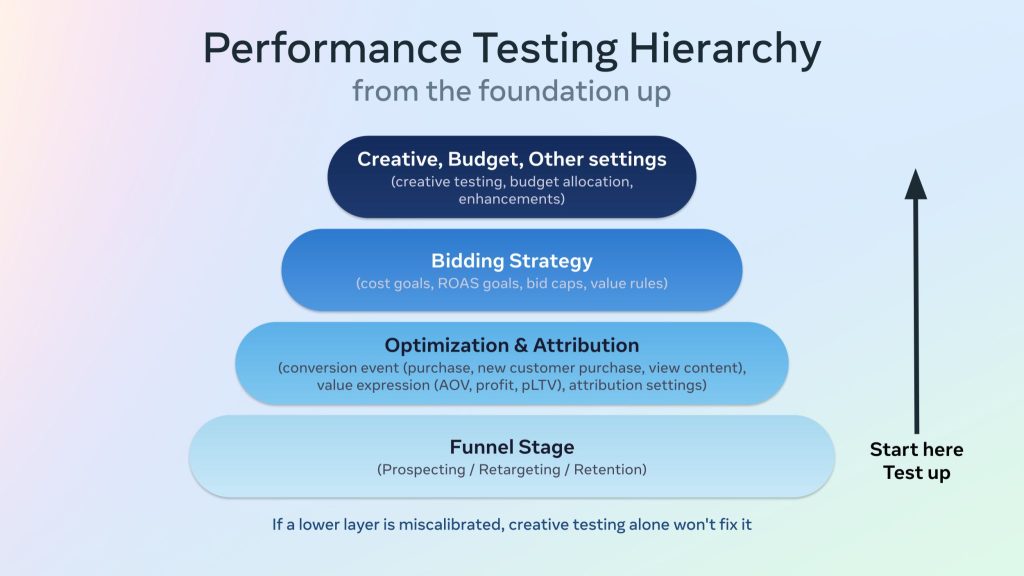
“The best testing plans work from the bottom up:
Funnel stage: Measure the incrementality of each stage independently. How incremental is your prospecting spend vs. retargeting vs. retention? Validating this layer alone has redirected meaningful budgets for brands that assumed their allocation was sound. Prospecting undervalued, retargeting over-credited.
Optimization and attribution: Are you optimizing for the right conversion event? Value or volume? Are your attribution settings maximizing incremental results? For higher spending brands advertising across multiple channels, multi-cell tests at this layer often surface the biggest gaps between attributed and incremental performance.
Bidding: Cost goals, ROAS goals, bid caps, value rules. These only work correctly if the layers beneath them are sound. Test bidding strategies after your funnel allocation and optimization settings are validated.
Creative: You test creative. With the foundation in place, creative winners are real winners, not artifacts of a miscalibrated system.”
Read more on X. (May 19)
From tipsheet: As Meta automates more of the ad stack, the company increasingly appears to be teaching marketers how to operate inside probabilistic AI systems — especially around incrementality, attribution and signal calibration.
The key line in Levy’s framework is at the bottom in smaller type: “If a lower layer is miscalibrated, creative testing won’t fix this.” Meta’s message is that creative performance sits downstream — even if the creative testing itself appears at the top of the chart. If attribution settings, optimization signals or funnel allocation are flawed, the system can still optimize confidently toward non-incremental outcomes.
AI advertising systems still require humans to structure the feedback loop correctly.
CONNECTED TV
Peer39 CEO: Is CTV ready for its entrance?
Mario Diez, CEO, Peer39, on LinkedIn yesterday:
“… there is going to be a dramatic increase in the CTV market with an expanded set of advertisers entering. This has been the undercurrent of the upfronts – how are we preparing for a CTV market where there are 100k advertisers?
I was catching up on some reading and saw Disney had a great quarter, revenue up + streaming growth continuing + ESPN still navigating some pressure.
But if we take a major streamer like Disney I’m asking: ‘Are all of our media signaled the right way for this next wave to find and buy our inventory?’
Not the top 4-500 advertisers a direct sales team can support through direct relationships. The next wave. That scale = a different operational problem entirely.”
Read more on LinkedIn. (May 19)
LLMs & CHATBOTS
The AI learning loop expands
- Google Ads To Automatically Link YouTube Channels (May 14) – Search Engine Journal
- New AI Assistant traffic measurement (May 13) – Google Analytics Help
From tipsheet: Google’s closed loop keeps expanding. YouTube engagement signals, AI assistant referrals and conversion measurement increasingly feed the same optimization system. Discovery, attribution and media buying are collapsing into a unified learning loop.
PLATFORMS
New startup merges voice talent with AI
Former Cross Pixel Media CEO Alan Pearlstein has launched a new AI startup called TrustedVoice, an “AI-powered advertising platform, bringing talent and influence to advertisers at programmatic scale.”
A press release explained:
“The platform combines pre-licensed talent, AI-generated voice advertising, and automated creative workflows into a streamlined system that enables brands and agencies to create and deploy Talent-Read Ads in minutes and hours, rather than weeks and months.”
Read: “TrustedVoice Launches AI Platform Redefining How Brands Access Talent & Influence” (May 19) – press release
PEOPLE MOVES
Now hiring
-
“We’re entering a fascinating moment where AI is beginning to fundamentally reshape how consumers discover, engage with, and experience content. Few companies sit at the intersection of storytelling, technology, and global reach the way Paramount does across Paramount+ and Pluto TV.” (May 19) – Barak Turovsky on joining Paramount as EVP & Head of Consumer AI on LinkedIn
MORE
- Podcast: “Ari Paparo on writing VAST, building beeswax, and why nobody actually wants their own bidder” (May 19) – The Trade Desk’s The Build
- “Pitch deck: X leans on AI and performance in a bid to win ad dollars” (May 19) – Digiday (subscription)
- “Excited to launch Chalice’s partnership with Equativ SSP. Equativ built to the Agentic Real-Time Framework (ARTF) to host bidding agents in the hot path, so advertisers can orchestrate any set of measurement, inventory, and data partners with zero integration lift.” (May 19) – Adam Heimlich, Co-Founder and CEO, Chalice AI on LinkedIn
- “Google’s Latest AI Search Guidance is a Validation of Bluefish Methodology” (May 19) – Jing Feng, Co-founder and COO, Bluefish on Bluefish’s blog
- “Mutinex Pips Google By Launching Self-Serve Commercial Mix Model” (May 18) – B&T (Australia)