
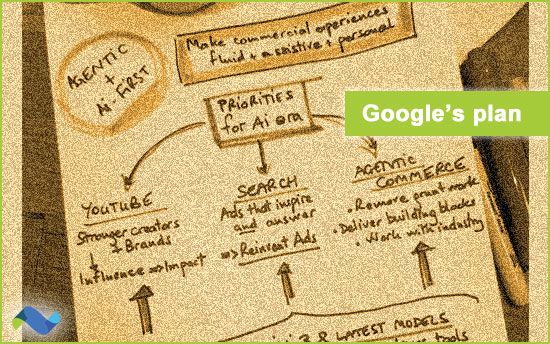
In her third annual letter, Google VP/GM of Ads & Commerce Vidhya Srinivasan laid out her division’s priority for 2026.
She teed up her letter on LinkedIn saying, in part:
“2026 is an expansionary moment for businesses and consumers alike but it requires a new playbook. Today, in my 3rd annual letter, I talk about what to expect for advertising and commerce in 2026 – how we’re making commercial experiences fluid, assistive and personal…”
See a hand-drawn roadmap on LinkedIn. (February 11)
In the letter posted on the company’s Ads & Commerce blog, Ms. Srinivasan pinpointed 5 areas for development — I’ve added a quick synopsis:
- “Turning influence into impact on YouTube” – The plan here is to use AI to match creators with brands via “open call” which was introduced in June 2025. Neal Mohan still needs his “old” ads team even though he runs YouTube now.
- “Reinventing ads for the new era of Search” – Refining and augmenting “AI Mode” ads are the focus here – especially retail media. Also, there will be continued development of Direct Offers, which is tied to Google’s agentic commerce strategy and was intro’d at CES.
- “Unlocking the future of agentic commerce” – Agentic commerce checkout in Gemini and Search is being rolled out right now, says Srinivasan, courtesy of Agent Payments Protocol (AP2) and Universal Commerce Protocol (UCP). Etsy and Wayfair are new partners.
- “Accelerating growth with Gemini 3” – The Gemini LLM – including Veo 3 — will be increasingly used to power ad tools. Srinivasan provided a sample stat related to creative generation: “In Q4 alone, Gemini was used to generate nearly 70 million creative assets in AI Max and Performance Max.”
- “Building on a foundation of trust” – “Trust” in the age of AI is a familiar theme to AI ads aficionados (e.g. OpenAI’s ads strategy rollout). Google wants to be here too “as we empower agents to act on behalf of consumers and businesses,” according to Srinivasan.
Read: “What to expect in digital advertising and commerce in 2026” (February 11) – Vidhya Srinivasan on Google Ads & Commerce blog
From tipsheet: Juggernaut. Google’s AI investment is plugging in everywhere.
With Google’s plans for increased capital expenditure in 2026 doubling to around $185 billion, what does this plan look like a year from now?
LLMs & CHATBOTS
Developments
- Covering electricity price increases from our data centers (February 11) – Anthropic
- Mistral’s revenues soar over $400mn as Europe seeks AI independence (February 11) – Financial Times
- Opinion: “OpenAI Is Making the Mistakes Facebook Made. I Quit.” (February 11) – The New York Times
LLMs & CHATBOTS
OpenAI’s Simo talks ChatGPT ads
OpenAI CEO of Applications Fidji Simo appeared on Alex Heath’s Sources podcast, “Access,” for an hourlong interview recorded in her Los Angeles home on Friday.
Given the timing, Super Bowl ads from her company and Anthropic were a topic but didn’t overwhelm the 60 minutes. It’s worth a listen.
During the interview, Ms. Simo stressed again the “church and state” separation between ads in ChatGPT and the answers that are delivered to the chatbot consumer — they do not pull from the same place.
But, she explained an ads “trick” for the consumer using the LLM. It begins by asking ChatGPT what it thinks of the ads on the page:
FIDJI SIMO: “In some cases, the model is going to say, well, I see the ads for those two companies, but actually that one is good, but that one is actually not really good. But I also think we live in a world where transparency and authenticity are what count.”
Regarding expectations on ad revenue, Ms. Simo said ads were not the big revenue opportunity for her AI company:
FIDJI SIMO: “Well, the thing that’s interesting is, if you look at our revenue projection, which I’m not going to give you in details, ads will remain a minority of our revenue in our projections.”
SOURCES: “For like years or how long are we talking?”
FIDJI SIMO: “For many, many years and I think probably forever.”
SOURCES: “Really? You don’t see it being the majority of the business at some point.”
FIDJI SIMO: “No, no. I think that it’s a very helpful business model for the reasons we mentioned, but I actually really don’t think it’s going to be the majority of the business.
When you look at the market on the B2B side for companies paying to accelerate themselves with AI, when you look even at the propensity to spend for some people who are going to want the maximum access of intelligence, like, I actually think it stays a minority.”
Simo also said that OpenAI awaits the delivery of its latest LLM update before “Code Red” is rescinded.
More: “OpenAI’s Fidji Simo on ads in ChatGPT and ending the Code Red”
- Read: Sources (February 11)
- Listen: Apple Podcasts
- Video: YouTube
From tipsheet #1: Lots of implications from Ms. Simo’s comment about ad evaluation and asking the chatbot about its favorite ad.
I’ll bite.
If ChatGPT and its LLM get “good” at creative evaluation, and the marketer understands at least some of the contextual and audience parameters, perhaps this becomes a way to provide cross-”black box” optimization as marketers buy across fully-automated ad platforms like Google’s Performance Max, Meta’s Advantage+, Reddit Max, Pinterest Performance + and so on?
From a sell-side perspective, for starters, publishers could use the LLM as a diagnostic tool for client creative in trying to understand what will work best on the publisher’s website — or its own chatbot?
Some in the ad tech space who license the OpenAI LLM, Gemini, Anthropic, etc. may already be exploring this today. You know who you are.
From tipsheet #2: It’s still not clear how ads will eventually be optimized within ChatGPT — other than 1) it won’t use the LLM feeding the chatbot answers and 2) it will be contextual according to the past and current chats and 3) user ad interactions will provide additional signal for targeting says the OpenAI ads “Help” page released in mid-January.
There’s gotta be an ads LLM roadmap somewhere given all that engineering talent at OpenAI led by the Statsig acquisition and its former CEO — now the CTO of Applications and head of ads under Ms. Simo — Vijaye Raji.
AI should make ads better. If OpenAI can’t do it, Google and Meta are and will make it happen at a minimum. This is the great AI-enabled ads race.
TECH
GEO firm Evertune adds programmatic
“When we started Evertune AI two years ago, we didn’t just set out to create a GEO platform – we knew the day would come for ads. Our belief was that AI models would become a massive marketing channel, rivaling social media in influence. And we’ve been building our product to follow suit, with content creation tools, shopping analytics and more. Today is a big milestone for us as we launch our first advertising products with The Trade Desk and Index Exchange. We’re starting with a contextual targeting tool to reach the consumers who click sources and citations and leave the LLM. Then we’ll add an audience targeting element as well. Creative ad copy tools are coming next. This is the start of something big.” – Brian Stempeck, CEO and co-founder, Evertune AI
Read more on LinkedIn. (February 11)
More: “Evertune Announces AI Retargeting Through New Partnerships with Index Exchange and The Trade Desk” (February 11) – press release
FINANCIALS
Now reporting
- AppLovin Announces Fourth Quarter and Full Year 2025 Financial Results (February 11) – press release
- “Criteo Says Its Bullish On The Future, But The Market’s All Bears” (February 11) – AdExchanger
- “MNTN soars 40% as fourth quarter earnings crush expectations” (February 10) – Investing[dot]com
- Unity Software craters after Q1 sales and earnings guidance fall short of estimates (February 11) – Sherwood News
RETAIL MEDIA
Shopify and agentic commerce
If you’re following the agentic trend, Shopify is in the middle of it with its agentic commerce efforts.
Yesterday, Shopify reported its Q4 2025 earnings and although revenues exceeded Wall Street’s expectations, earnings did not. The company’s stock price suffered and its market cap hovered just above $150 billion.
Read more on CNBC. (February 11)
On the earnings call with Shopify management, Morgan Stanley analyst Keith Weiss asked about agentic commerce protocols:
Keith Weiss: “Can you help us understand the [Google’s] Universal Commerce Protocol (UCP) versus Agentic Commerce Protocol (ACP), the other standard that OpenAI and Stripe are putting forward? Are these overlapping standards? Do they compete? Are they complementary in any way? And what does this do to the timing of adoption of agentic commerce? Does it confuse the market? Is this like a VHS versus Betamax type thing of that. It has to be resolved first before you have mainstream adoption?”
In response, Shopify President Harley Finkelstein didn’t address all of Weiss’s questions – such as ACP – but said in part:
“In our view, UCP covers the full commerce journey end-to-end. And we think — we have 20 years of doing this. Commerce is very complex. It is easy to get it wrong. And I think that it’s more than just a transaction. It’s an entire experience and UCP covers all of that. And we’re really proud of what we do. We did it with our friends at Google. It was an incredible experience to work on it with them. But it works, and we think we’re already seeing incredible adoption from some of the largest retailers on the planet.”
About agentic commerce, Finkelstein added during the call:
“Google AI mode in Gemini, ChatGPT, Microsoft Copilot… one click and our merchants get instant access to millions of potential buyers who are actively looking for their products. We’ve already seen huge brands like [indiscernible], Glossier, Steve Madden and Spanx sign up and start selling plus through the catalog, our partners get the most accurate up-to-date data for billions of products for millions of the best brands on the planet.”
Read: “Shopify (SHOP) Q4 2025 Earnings Call Transcript“ (February 11) – The Motley Fool
From tipsheet: For agentic commerce (and advertising) lovers, the revenue effects of chatbot-initiated sales will be something to watch in quarters to come. “The rails have been laid,” according to Mr. Finkelstein.
BRANDS
Incrementality, AEO pique Bayer’s interest
On The Drum, editor Gordon Young sits down with media leader Ryan Verklin at Bayer to discuss the latest digital ad trends beginning with measurement.
Mr. Verklin says incrementality measurement is critical today for understanding cross-channel impact on a desired outcome.
In an article preview on LinkedIn, Verklin emphasized:
“My calling card for 2026, both internally at Bayer and externally, is a focus on the two aspects of incrementality in retail media. I’m happy this point made it into The Drum piece, “We’re talking about driving incremental sales… But there’s another aspect… incremental reach compared with your national campaigns. Networks that allow deduplication and cross-channel coordination increasingly win Bayer’s investment. Those are the retail media networks that allow that… and budget tends to flow in their direction.””
Read more on LinkedIn. (February 11)
Later in the article, agentic commerce and AI are explored, too – especially as it relates to answer engine (AEO) or generative engine optimization (GEO) today. Young wrote:
“Another looming shift is agentic commerce – AI systems making purchasing decisions on behalf of consumers. For Bayer, with its portfolio that includes health and wellness products, brand trust becomes critical in that future.
’When consumers start adopting agents to buy their pharmaceuticals,’ Verklin says, ‘I hope the agents are smart enough to know that the Bayer brands are some of the most trusted brands.’
He believes trusted names like Claritin, Aleve and One-A-Day should naturally surface in AI recommendations, but acknowledges the industry is still figuring out how brands show up in LLM environments. The shift feels familiar. ‘It reminds me of search engine optimization. Kind of feels like we’re going back to the early days of search.’”
Read: “Why the retail media boom is doomed if measurement isn’t fixed” (February 11) – The Drum
Related: “10 AI Marketing Trends for 2026: Agentic AI and Search Shifts” – Shiv Singh on Adweek
TECH
Rembrand augmenting creative with AI
Virtual ad placement tech company Rembrand announced a new “AI Intelligence Suite” powered by its Spaceback acquisition in September.
Rembrand CEO Omar Tawakol explained on LinkedIn:
“This is an exciting moment for us because we are releasing a suite of innovations that take authentic, approved social posts for a brand, and turn them into effective CTV and OLV ads that can run anywhere programmatically using AI.
This represents a step forward in AI creative that honors the brand’s guidelines, while using authentic human creativity as the seed. AI then augments the creative in significant ways to make it work better for the format. It approaches the whole problem by augmenting rather than replacing authentic creative.”
Read more on LinkedIn. (February 11)
More: “Rembrand Launches AI Intelligence Suite for Spaceback, Empowering Brands to Further Augment and Amplify Social Content As Performance Advertising In CTV” (February 11) – press release
From tipsheet: “Give me one execution and I’ll give you thousands.”
AUDIO
Podcasts
- “Who’s Winning The AI Race? + Software’s Future — With Sridhar Ramaswamy, CEO, Snowflake.” (February 11) – Big Technology Podcast
- “Navigating Data Identity and AI in Marketing with Matt Spiegel, TransUnion” (February 10) – Next In Media on YouTube
- “AdCP with Joe Hirsch” (February 11) – The Aperiam Podcast on Apple Podcasts
MORE
- “Check Out Brandlight’s $30M Pitch Deck Used to Help Brands Navigate the Agentic Web” (February 11) – Adweek (subscription)
- Adobe partners with OpenAI to test ads in ChatGPT (February 11) – Adobe blog
- “Gigi Gets Promoted: Moving from Assisted AI to Authoritative AI” (February 11) – Adam Epstein, CEO, Gigi on his personal blog
- “Is your campaign structure holding you back in the era of AI?” (February 11) – Google Ads & Commerce blog