
The IAB wants to know.
Let’s say:
-
- An AI assistant recommends a product.
- The shopper searches for the brand three days later and buys it.
- Search gets the conversion credit.
- AI’s role in shaping the purchase goes unrecorded.
How should advertisers account for that missing influence?
The Interactive Advertising Bureau released its AI-Era Attribution Blueprint yesterday, proposing a shared framework for distinguishing who created purchase intent, who shaped the final choice and who completed the transaction.
The blueprint explains:
“The consequence is not that AI-influenced sales vanish from reporting. They are often reported under the wrong source of influence.
“A sale shaped by an AI recommendation may arrive as search or direct traffic. Dashboards credit what they can observe, and the next marketing investment may then follow the wrong channel.”
The framework classifies conversions as Human-Owned, AI-Assisted or AI-Executed, then defines which participants are eligible to claim influence and what evidence they need.
Service vs. influence
One useful distinction: “Execution alone earns no claim.”
-
- An agent reordering the dog food a consumer already selected is performing a service.
- An agent choosing which dog food to buy may qualify for a decision claim…
- …while publishers whose reviews informed that choice may qualify for contributory claims.
Those claims don’t establish incremental value or determine how much credit each participant receives. Much of the evidence needed to substantiate them remains inside AI platforms.
Read: “The AI-Era Attribution Blueprint” (Nov. 12) – IAB
From tipsheet: Shared rules for evaluating claims could still leave plenty of room for competing measurement approaches. Meanwhile, will AI platforms cooperate and provide enough evidence for independent verification?
MEASUREMENT
Jeff Green tees up measurement launch
The Trade Desk CEO Jeff Green is making the case for advertisers to rethink attribution ahead of the company’s planned open measurement product launch later this quarter.
In an opinion piece published in The Current, which The Trade Desk owns, Green argues that last-click and last-touch attribution direct budgets toward platforms that capture purchases while undervaluing the advertising that makes people want to buy.
His analogy:
“There is no such thing as performance farming. No smart money would ever pay most of the money to a self-proclaimed ‘performance farmer.’ Someone who essentially declares, ‘I don’t get up early. I don’t plant seeds. I don’t water seeds. I don’t fertilize. I’m a performance farmer; I only harvest.’”
Green draws on Michael Farmer’s research into major brands’ growth.
In a LinkedIn post on Wednesday promoting the piece, Green wrote:
“Over the last 15 years, 43 of the top 60 brands grew slower than nominal GDP. In the last decade, Google, Meta, and Amazon grew to nearly half of global ad revenue. It’s hard to call that a good trade.”
Green argues that advertisers’ pursuit of cheap reach and reliance on platforms’ own measurement have weakened investment in brand building through premium video and audio.
His LinkedIn closing line: “Cheap reach won’t fix this. Better measurement will.”
Read: “Why most big brands are not growing” (Nov. 11) – The Current
From tipsheet: The commercial opportunity for The Trade Desk is clear: if its measurement can demonstrate that premium media drives more sales than current attribution recognizes, advertisers could shift budgets toward the open internet and The Trade Desk.
PLATFORMS
Google puts invalid traffic savings on display
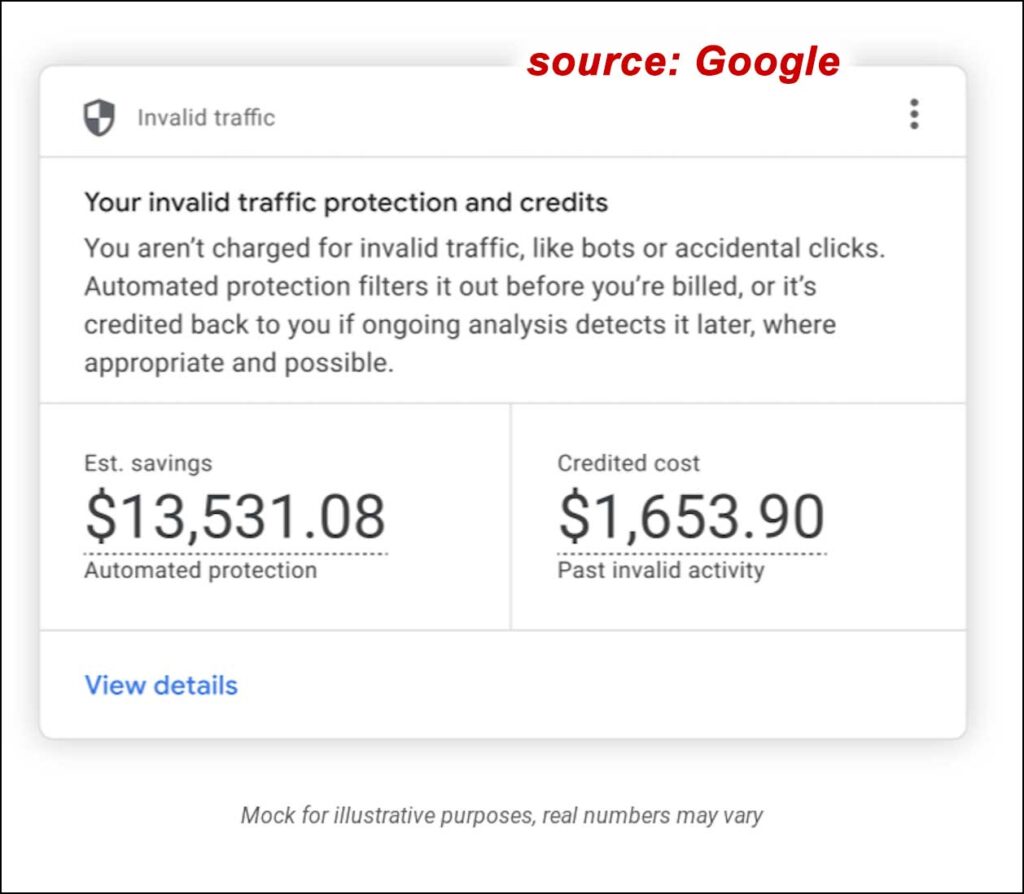
Google is rolling out an Invalid Traffic Overview Card in Google Ads to show advertisers the financial impact of its traffic protections.
Keerat Sharma, Google’s VP and General Manager of Ads Privacy and Safety, explained in a Google blog post:
“We don’t charge for invalid traffic, and our multi-layered defenses have always worked in the background to catch it before an advertiser is billed. We issue a credit when it’s detected later, where appropriate and possible. Now, for the first time, businesses can see both the amount saved and the credits we automatically provide for invalid activity.”
The card separates estimated savings from filtered traffic and credits for past invalid activity, with campaign details showing affected clicks and impressions. Invalid traffic includes bots, fraudulent activity and accidental clicks.
Read – and see the video: “We’re introducing a new transparency tool for invalid traffic in Google Ads” (Nov. 12) – Google
The AI connection
Google previously reported that newer AI applications have improved its content reviews, contributing to a 40% reduction in invalid traffic stemming from deceptive or disruptive ad serving practices.
Separately, Google said system upgrades have reduced advertiser exposure to invalid leads by an average of 30% so far in 2026.
From tipsheet: Advertisers get a clearer accounting of what Google says its defenses caught. At the very least, they get more answers for the CFO.
AGENTS
Putting AI analysis in media buyers’ hands
Hill’s Pet Nutrition is testing Newton Research’s AI agents to let media buyers investigate Amazon advertising results and pursue their own follow-up questions, Ad Age’s Garett Sloane reports.
The time savings:
“An Amazon advertising analysis that once required Hill’s Pet Nutrition to enlist an analyst and data scientist and took four to six weeks can now be completed in minutes or hours by AI agents.”
Workflow, FTW.
Read: “AI agents cut Amazon ad analysis from weeks to hours—what changed for media buyers” (Nov. 12) – Ad Age (subscription)
In a LinkedIn post promoting the piece, Sloane said testing has focused mostly on Amazon. The broader opportunity is independent measurement across platforms, including comparing retail media performance with Hill’s national media strategy. Agents coordinating across platforms and updating media plans in real time remain a future goal.
From tipsheet: A four-to-six-week wait can limit which questions a media buyer bothers to ask. Making follow-up analysis available in hours could change how often buyers test assumptions and adjust campaigns. The next measure of success: whether faster answers lead to better spending decisions.
Related: “Smarter Advertising Decisions, Not Just Automation: With John Hoctor of Newton Research” (Nov. 10) – AdTechGod Pod on Marketecture
AGENTS
eMarketer’s $5 billion agentic forecast for 2027
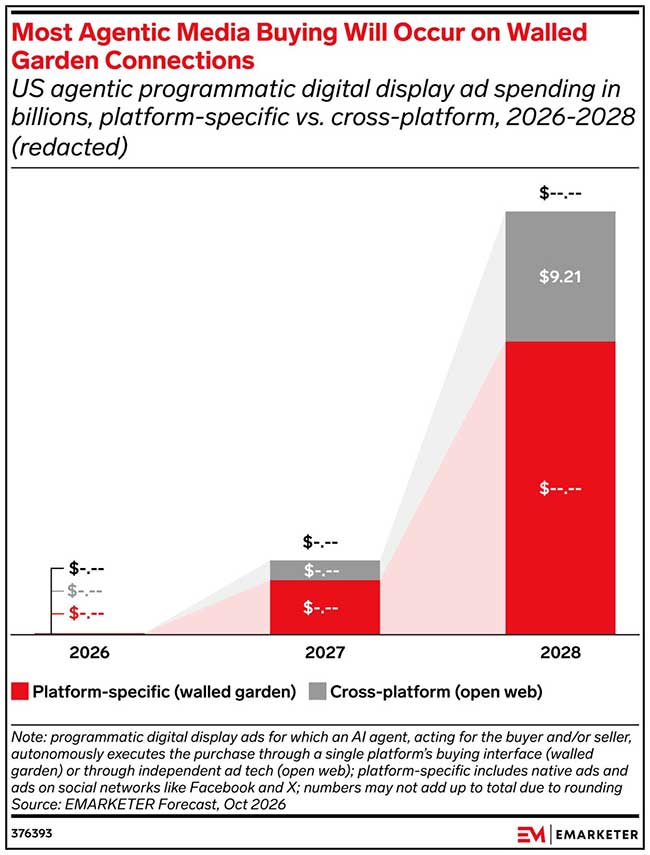
US agentic media transactions will surpass $5 billion in 2027, eMarketer forecasts, with walled gardens driving early adoption.
Sharing the forecast on LinkedIn, principal analyst Yory Wurmser said agentic buying will account for 10% of US programmatic display ad spending by 2028. His colleague Andrew Spink developed the forecast.
What counts as agentic buying? Wurmser explains:
“There are different ways to define agentic media buying. We have an expansive view of agentic media buying that includes transactions where a buyer agent makes autonomous decisions on the way to making a purchase via a walled garden MCP, such as those offered by Amazon and Meta. We expect these types of interactions to pave the way for agent-to-agent media planning and buying between multiple ad platforms. And by 2028, those cross-platform transactions will pass $9 billion (along with another $20 billion in single-platform agentic buying). I’d count that as mainstream!”
Read: “Agentic Media Transactions Will Surpass $5 Billion in 2027” (Nov. 10) – eMarketer (subscription)
From tipsheet: In our July interview, Magnite CEO Michael Barrett described expectations for protocol-based buying in 2027 ranging from essentially no meaningful DSP adoption to $600 million–$700 million in spending. eMarketer’s $5 billion forecast presents a more bullish picture, though its expansive definition includes transactions through individual walled gardens, making a direct comparison difficult.
AGENTS
Nexxen shares agentic buying timetable
More earnings calls, more insights.
Ad tech company Nexxen, which provides tools for media buyers and sellers, expects most workflows on its advertising platform to be executable through AI agents by the end of Q1 2027, CEO Ofer Druker said on the company’s third-quarter earnings call.
CFO Sagi Niri described what that could mean for buyers: “You will not need to go into the DSP in a couple of quarters probably. You can interact with our DSP through an agent-to-agent and through MCP solution. I think that the industry is going there. I think it is going much faster than we understand.”
Druker said that Nexxen already has 10 platform agents supporting tasks including reporting, quality assurance, audience intelligence, incremental spend analysis and campaign troubleshooting. Additional agents for audience building and full-scale campaign and deal creation are planned.
Eight agency and holding company partners have begun testing or using Nexxen within their own AI environments through Model Context Protocol (MCP) integrations, Druker said. He separately noted that some campaigns are already running agentically.
The CEO expects agentic buying to be “massive in 2027” and described the next phase: “Today, customers must actively select agents for specific tasks, but soon these capabilities will shift to always-on, continuously identifying opportunities and taking action to improve performance.”
Read:
-
- Nexxen Q3 2026 earnings call transcript (Nov. 12) – Investing[dot]com
- Nexxen Reports Record Third Quarter 2026 Financial Results (Nov. 12) – Nexxen
Nexxen shares were up about 12% in midday trading yesterday, giving the company a roughly $580 million market capitalization.
From tipsheet: If buyers increasingly work through their own AI environments, a DSP’s data, optimization and execution capabilities will have to earn the business behind that interface.
PEOPLE MOVES
Now hiring
-
- “I am very excited to share that I’ve joined Anteriad as CEO! It’s an incredible time to take on this role. AI is reshaping B2B marketing faster than most playbooks can keep up. Buyers are researching with AI, staying anonymous for longer, and making decisions in complex buying groups” – Michael McLaren on LinkedIn
LLMs & CHATBOTS
Developments
-
- Colette Kress, interim CEO and CFO, NVIDIA (Nov. 12) – LinkedIn
- AI models from Google, Anthropic and more lean on recommending promoted drugs: study (Nov. 12) – Fierce Pharma
- “Google Search gets a major upgrade with Gemini 4 Hydrogen” (Nov. 12) – Google
MORE
-
- Automation: “AppsFlyer Expands Agentic AI and MCP Tools to Empower Marketers with Trusted Automation” (Nov. 12) – press release
- Creative: “TikTok updates its AI video ad tools” (Nov. 9) – Social Media Today
- Policy: “Google Ads clarifies AI-generated public figure impersonation is banned, even with disclosure” (Nov. 12) – Search Engine Land
- User control: “Your Algorithm: Giving People More Ways to Personalize Facebook Recommendations” (Nov. 10) – Meta
- Antitrust: “Google Faces Renewed Risk of EU Penalty Over AdSense Platform” (Nov. 12) – The Wall Street Journal (subscription)