
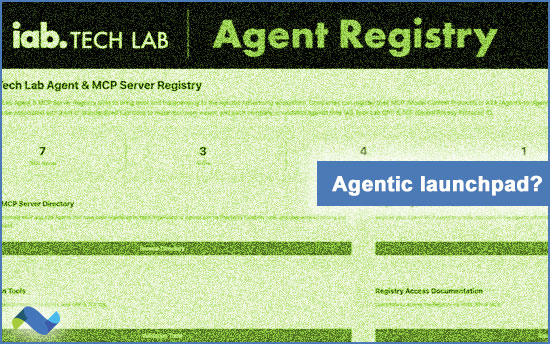
On LinkedIn yesterday, IAB Tech Lab CEO Anthony Katsur announced, and as promised, availability of a new Agent Registry in the Tech Lab’s Tools portal. He said it was “designed to bring transparency and discoverability to agentic services across the digital advertising ecosystem.”
Katsur continued:
“As part of our Agentic Advertising Management Protocols (AAMP) initiative, the registry allows companies to publish their advertising agents, define their capabilities, and enable partners to discover and connect with them.
Early supporters such as Equativ, PubMatic, and Mixpeek, amongst others, are already participating.
This is an important step toward building trusted infrastructure for agent-to-agent interoperability across the industry.
On the roadmap, we are also introducing agent ratings and feedback, geo and country filtering, and support for tenants, containers, and downloadable or local MCP servers and agents.”
Read his intro on LinkedIn. (March 4)
In a longer form post on LinkedIn, Katsur shed more light on the registry’s future features:
“- Providing the ability for users to score and rate registered agents and to leave feedback
– Introducing a Geo or Country flag for filtering and sorting
– Supporting local or private tenants, agentic containers, and downloadable/local MCP servers & agents
– Creating the ability to verify that seller agent actually represents a property (like ads.txt for agents)
– Adding the ability to update existing agents by authorized users alongside a streamlined approval process.”
Read: “Introducing the IAB Tech Lab Agent Registry” (March 4) – Anthony Katsur on LinkedIn
Register: Agent Registry – IAB Tech Lab Tools portal
From tipsheet: Equativ and PubMatic are early members of the Ad Context Protocol (AdCP) initiative, too.
AdCP efforts have, at times, been seen at odds with the IAB Tech Lab and its containerization initiative now known as Agentic Real-Time Framework (ARTF).
The IAB’s standards arm supports building agentic standards on top of the existing inventory of standards which it manages. Meanwhile, AdCP has established a governance arm of its own and several tests of the protocol have already taken place.
PubMatic has been very open about its interest in protocol efforts by the IAB Tech Lab and AdCP. For context, read: “Moving Beyond ‘AdCP vs ARTF’: Understanding the Agentic Landscape Taking Shape” (January 5) – Nishant Khatri, EVP, Product Management on PubMatic’s blog
LLMs & CHATBOTS
Developments: Nvidia, AI inflection points
In the latest installment of Stratechery, analyst Ben Thompson examined AI chipmaker Nvidia’s business and the broader AI trend — which are inextricably tied together.
The concern in the market is that an AI ‘bubble’ may be about to burst. But Thompson doesn’t see it happening any time soon.
He explained:
“There are three key inflection points that AI has already gone through that directly apply to Nvidia’s addressable market:
The first inflection point was the emergence of LLMs — call this the ChatGPT moment. In this first paradigm, tokens were generated by GPUs and presented as the answer to a question.
The second inflection point was the emergence of reasoning models — call this the o1 moment. In this paradigm there are a very large amount of tokens that are generated to figure out the answer before the answer is actually generated; this was an exponential increase in the addressable market for tokens.
The third inflection point was the emergence of functional agents — call this the Opus 4.5 moment. In this paradigm those reasoning models are not triggered by humans asking a question, but by an agent solving a problem. This increases the market in two directions: first, humans can run multiple agents, and secondly, agents can leverage reasoning models multiple times to accomplish a task. This isn’t just an exponential increase in the addressable market for tokens, it’s actually squared.”
Read more in Stratechery. (March 4 – subscription)
AGENCIES
Vibe coding GEO for clients
Anthropic’s Claude AI chatbot is becoming an integral part of agency workflow, according to Adweek’s Trishla Ostwal. She reports that some agencies are now creating their own generative engine optimization (GEO) solutions.
Ostwal previewed her article on LinkedIn:
“Foundation model companies are moving up the stack, and agencies like Havas are following. With tools like Anthropic’s Claude Code, shops are ‘vibe coding’ GEO software in-house, sidestepping startups and turning internal builds into client products. That’s changing who captures value in the AI search economy.
Still, agencies have opted against signing an exclusive enterprise deal with Anthropic, which sources said runs into ‘multiple millions’ annually–arguing that off-the-shelf tools don’t fit how their teams work.”
Read more on LinkedIn. (March 4)
Read: Ad Agencies Are Embracing ‘Vibe Coding’ to Build GEO Products for Clients (March 4) – Adweek
From tipsheet: For GEO/AEO startups, there seems to be a new threat every day. Yet funding continues to flow.
SELL-SIDE
‘NATO for news’ and AI monetization
In global affairs publication Monocle, columnist Colin Nagy, whose day job is Global Brand Strategy & Marketing at Meta’s Instagram, looked at publishers’ compensation when it comes to AI companies.
In particular, Mr. Nagy singled out the “NATO for news” effort announced last week by a consortium of publishers under the SPUR (Standards for Publisher Usage Rights) umbrella which includes BBC, The Financial Times, The Guardian, Sky News and The Telegraph.
Nagy saw an “attention vs. algorithm” issue in publishing and explained:
“AI disruption has not created a new problem for publishing. It has clarified an old one. The publications that survive will not be those that most successfully lobby for a fairer share of the attention economy, though fairer terms would be nice. They will be those that built something that readers chose to return to because it is irreplaceable, not gaming page views or letting audience engagement call the shots.”
Read: “AI hasn’t created a new problem for publishing – it has simply clarified an old one” (March 4) – Monocle
From tipsheet: This is likely not an opinion widely held at Meta. Or is it?
Mr. Nagy is a prolific writer. See this bio.
MARKETING
What are marketers doing with AI today
Business Insider’s Lara O’Reilly asked a group of “rising star” marketers how they use AI tools day-to-day, as well as their advice for young marketers.
O’Reilly found a variety of answers — particularly between creative and media roles.
Here’s a selection:
- “I’ve built a small AI stack that mirrors how I work day-to-day: Perplexity for deep research, Claude as a pressure-tester to push back and find holes in my thinking, and tools like Nano Banana and Higgsfield for quick visual exploration, from rough comps to pushing static ideas into motion.” – Benny Gee, creative director, Edmunds
- “For those entering the field, I’d encourage them to build fluency with AI tools while also investing in the humanities by studying behavior, culture, and storytelling. The marketers who will rise are the ones who can pair technical capability with critical thinking, empathy, and a clear point of view.” – Fiona Green, communications, Amazon
- “Recording and summarizing meeting notes has been the most effective use of AI for me. It allows me to stay present and jot down key ideas in brainstorms without missing any of the details. Other than that, I’m somewhat of a Luddite because we have a company policy that prohibits the use of AI for writing.” – Mia Vandermeer, marketing manager, Tennr
Read: “9 rising stars of brand marketing share how they’re using AI and their advice for entry-level marketers” – Business Insider (subscription)
From tipsheet: Everyone’s workflow is in the midst of changing due to AI. I suspect this sort of list will look much different in a year or two with deeper integration of tools and an increased understanding of where the human is essential.
SELL-SIDE
Bringing more targeting to Netflix
Streaming service Netflix announced new targeting capabilities for Netflix Ads Suite courtesy of two AI-enabled DSPs.
A press release read:
“Starting in Q2 in the US — and rolling out to our other ad-supported countries later this year — clients will have new ways to connect with the right audiences on Netflix through expanded targeting capabilities via Amazon DSP and Yahoo DSP.
Advertisers will now be able to leverage Amazon Audiences to inform their programmatic buys on Netflix.”
Read: Netflix Ads Suite Expands Capabilities (March 4) – Netflix
Yahoo DSP Head of Product Giovanni Gardelli commented on what his DSP will be bringing to the table on LinkedIn: “With Yahoo DSP now able to activate deterministic Yahoo audiences in the expanded Netflix Ads Suite, brands can unlock more precise targeting and deeper personalization across Netflix’s highly engaged audience.”
Neflix’s Director of Key Accounts Jessica Masters chimed in on the announcement:
“Additionally, we are enhancing our first-party measurement solutions with a 1P CAPI.
Netflix Ads is not merely a destination for brand awareness ‘TV’ budgets; it is a platform where strategic planning and data-driven execution can drive KPIs from brand awareness to conversions in a premium, attention-grabbing environment.”
Read her post on LinkedIn. (March 4)
From tipsheet: Amazon DSP (September) and Yahoo DSP (June) received access to Netflix’s CTV inventory last year.
PLATFORMS
Targeting workflow with agentic interfaces
AI ad targeting company Dstillery has built a new, custom audience platform called DS-1 in service to programmatic advertising.
AdExchanger’s Joanna Gerber picked up the story this week and found an AI workflow use case for campaign setup which reduces setup time to “minutes,” versus the previous two to seven days.
Gerber reported:
“Removing that inefficiency is the vision behind DS-1, a new agentic AI interface developed by audience platform Dstillery. DS-1 allows Dstillery’s clients to develop custom audiences in minutes and push those segments to The Trade Desk for activation.
Under the hood, DS-1 was built using Model Context Protocol and can integrate into whatever platform a client chooses, including Slack, Microsoft Teams, web browsers or a brand’s own custom collaboration platform.
Keynes, a tech platform that helps brands target audiences for CTV advertising, is an early adopter of DS-1 and has partnered with Dstillery since 2019.”
Read more in AdExchanger. (March 3)
Keynes CEO Dan Larkman, whose company appears to be a CTV specialist agency, said that it uses The Trade Desk’s demand-side platform (DSP) to activate Dstillery’s audiences.
According to the press release, Dstillery CEO Michael Beebe and The Trade Desk’s GM for data partnerships, Peter Ibarra, identify “AI as a co-pilot” in the new offering.
Read: Dstillery, Keynes, and The Trade Desk Partner to Advance Agentic Advertising (March 3) – press release
Related: “WTF is Multimodal AI in Advertising?” (February 19) – Taejin In, Chief Product Officer on the Dstillery blog
TECH
Products and partnerships
- “Smoot Unveils Sift, the Agentic Infrastructure Layer for Self‑Service Programmatic Deal Automation” (March 4) – press release
- “New Kokai workflows are here” (March 4) – Neil Harris, product marketing, The Trade Desk on LinkedIn
- “Chalice is now powering new Experian audiences that classify consumers based on patterns in credit behavior and progression across different stages of the credit journey.” (March 4) – Ali Manning, co-founder and COO, Chalice AI on LinkedIn
PEOPLE MOVES
Now hiring
- Havas Media Network Names Sharona Sankar-King Chief Data & Product Officer (March 4) – MediaPost
- Alex Belaidi joins Spectrum Reach as VP, Data & Category Sales (March 4) – LinkedIn
- “I’m absolutely fired up to share that I’ve joined Seedtag as Chief Marketing & Communications Officer.” (March 3) – Brendan McCarthy on LinkedIn
MORE
- 2026 Media and Entertainment Industry Outlook — including AI (March 3) – Deloitte
- Opinion: “The Collapsible Funnel: Part 1” – Analyst Andrew Lipsman on Media, Ads + Commerce
- Fraudsters create 200+ AI slop websites in one operation (March 4) – Axios
- Research: “Thinking—Fast, Slow, and Artificial: How AI is Reshaping Human Reasoning and the Rise of Cognitive Surrender” (February 2) – Steven Shaw and Gideon Nave, Wharton on SSRN
- Onetag Acquires Aryel to Create the New Value Exchange for Programmatic Advertising (March 2) – press release