
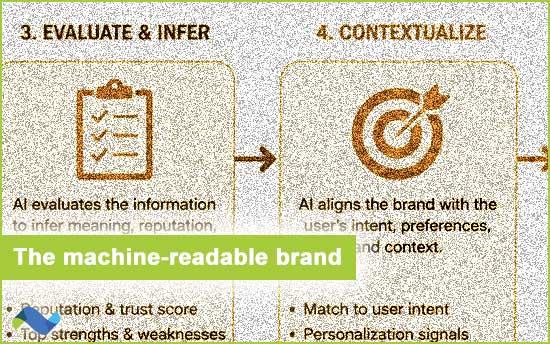
How does AI perceive your brand?
The New York Times reports that AI visibility startups were among the companies pitching brands at Cannes last week, including:
- IV[dot]AI, which “monitors external A.I. search outputs and suggests language that may improve citations”
- Jasper, which “helps brands generate content optimized for A.I. systems”
- And unicorn Profound, which “tracks the volume of mentions to show how A.I.-generated answers describe and cite brands across ChatGPT”
Agents were part of the story, too:
“Some brands have concluded they need two versions of some content — one for the machines, one for the humans — said Anda Gansca, a co-founder and the C.E.O. of Knotch, a content marketing start-up.
She was in Cannes to promote her company’s new ‘agentic content engine,’ which helped brands like Zillow and Ally Financial develop a second version of their existing content meant to be more visible and readable to machines.”
Read: “Advertisers Are Good at Getting Human Attention. Can They Stand Out to A.I.?” (June 27) – The New York Times (subscription)
From tipsheet: AI systems don’t simply retrieve information about brands—they construct an understanding of them. The strategic question shifts from “Can AI read my brand?” to “Does AI understand my brand the way I intend?”
LLMs & CHATBOTS
Developments
- Previewing GPT‑5.6 Sol: a next-generation model (June 26) – OpenAI
- Google caps Meta’s Gemini use as AI demand strains capacity (June 28) – Financial Times
- Anthropic Economic Index report: Cadences (June 26) – Anthropic
AGENTS
In-housing agentic strategy in the marketer org
Noting this month’s publicized test of agentic buying systems by WPP (for video) and Dentsu (for analytics and media planning), Digiday looked at how marketers may be in-housing agentic efforts, too.
Digiday’s Sam Bradley reports:
“Hyundai, for example, has been working with AI firm Chalice and its in-house media agency Canvas (which also works with other brands, including Zillow) to develop custom AI models and bidding agents using a ‘containerized’ AI solution, OpenXBuild.
When used to find inventory on OpenX’s SSP, the system led to a 67% reduction in online video CPM rates. Tylynn Pettrey, svp of analytics and AI at Chalice, said the CPM reduction was due to the agent finding inventory that would have otherwise been overlooked. The cost per ‘high value action,’ defined by Hyundai as a dealership visit or similar interaction, fell 20% during a pilot scheme. ‘We eliminated some not-great inventory that we might have purchased; we’re focusing our investment on where it matters the most, and scaling it quicker,’ said Sean Gilpin, North America CMO of Hyundai.”
Read: “Agencies look to AI agents for edge, but must fend off brands looking to in-house with the same tech” (June 24) – Digiday (subscription)
Related: Hyundai Applies AI To Curated Videos To Drive Performance (June 26) – MediaPost
From tipsheet: As AI automates campaign execution, ownership of the decision layer becomes a strategic choice. Brands may build proprietary marketing intelligence internally, while agencies increasingly position themselves as AI engineering partners that design, build and operate those systems.
GOVERNANCE
AppsFlyer reaction: Neutrality investment
Last week’s big investment into mobile measurement firm AppsFlyer was one of the subjects of the latest episode of the Marketecture podcast.
AppsFlyer received $1 billion in Series E funding from Google, Meta, Unity and Moloco valuing the company at $2.7 billion. Marketecture’s Ari Paparo and Aperiam Ventures’ Eric Franchi walked through the transaction details and saw market pressure driven by mobile ad tech company AppLovin as a potential catalyst of the transaction.
For background, AppLovin owns mobile measurement company Adjust which it acquired for approximately $1 billion in 2021 and is an integral part of its formidable mobile ad machine today.
Paparo observed:
“So AppLovin has everyone scared to death. They’re gaining market share from Meta and Google, which is supposedly impossible to do. And they have a complete stack. They have the auction level, they have the algorithm level, and they also measure their own homework. — And that’s not a great place to be if you’re trying to build a mobile app business like some of the names [that invested in AppsFlyer].
We have talked endlessly about Jim Payne‘s startup CloudX, which is sort of an attack at the auction level to try to open up AppLovin’s control there.
And [AppsFlyer] is a company that those companies really didn’t want to be owned by the wrong party. I mean, if you imagine hypothetical: What if Meta bought them?
Would Google really love it if Meta was seeing every conversion across AdWords, across every app in AdWords and was determining who gets credit? And vice versa is true also.”
The Marketecture team sees an eventual IPO for AppsFlyer as its ultimate investment outcome.
Podcast: “Episode 179: The Good Vibe(s) at Cannes, Plus UTA’s Michael Burke on the Creator and Influencer Takeover” (June 26) – Marketecture Podcast
More: “Adjust vs. AppsFlyer – Adjust sets the standard for mobile marketing measurement” – AppLovin’s Adjust
From tipsheet: Plenty of smart observations in this podcast (Cannes, Walmart/Vibe, creator momentum).
As AI systems learn from every conversion, proprietary feedback loops become a competitive advantage. At the same time, independent measurement infrastructure becomes more valuable because competitors need a trusted, neutral source of truth. Neutrality itself is becoming a strategic asset.
PLATFORMS
AppLovin’s share of wallet grows
On the latest episode of the Mobile Dev Memo podcast, analyst Eric Seufert and Olivia Kory, CMO of incrementality firm Haus, review last week’s mobile ad technology news including the AppsFlyer investment and AppLovin launch of its self-serve ad platform AppLovin Ads.
On AppLovin, Kory says her firm has been tracking impressive performance over time from AppLovin:
“[We looked at how AppLovin is] performing versus the typical test run at the same time to control for seasonality.
And AppLovin was beating the typical test between like 60 and 85 percent of the time in 2025. So just consistently winning in terms of performance. But in 2026, that number has come down and it’s settled to closer to like a coin flip, which means only half the time is it beating the average of other tests and other channels being run at the same time.And so that suggests that that like early edge that they have is normalizing as brands scale up spend.
But we’re seeing like AppLovin share of wallet increase very clearly. It was 5% in January to over 8% share of wallet in May.”
Listen: “Podcast: The AppsFlyer investment and the new dynamics of mobile attribution (with Olivia Kory)” (June 28) – Mobile Dev Memo
More: “Is AppLovin More Than a Hype Channel?” – Haus blog
From tipsheet: AppLovin’s growing share of wallet reinforces the company’s broader ambition. As it expands beyond gaming, retail media and DTC represent its next opportunity to capture performance marketing budgets.
Related: Q&A: Inside AppLovin’s vision for AI performance marketing (June 25) – tipsheet
AGENTS
Buy-side agents aiding workflow
Ad Age senior editor of technology and AI Garett Sloane reports:
-
“A connected TV campaign was mostly running smoothly through Magnite’s ad server until an AI buyer agent flagged an anomaly. The CTV ads were hitting 99% completion rates on most of the premium streaming publishers, except for one that flashed a completion rate of 94%. The AI agent traced the gap to a deal ID from another streaming publisher that included mobile in-app ad inventory providing only 71% completion rates, bringing down the overall performance.”
Read: How agentic AI is saving more than time in buying ad campaigns (June 25) – Ad Age (subscription)
From tipsheet: Agentic media buying is evolving from automation toward diagnosis.
CONNECTED TV
From household to person: Netflix’s identity graph
Ars Technica reports that Netflix’s recent changes to user logins took effect on June 15.
“The change means that every user can now have their own login credentials, which could make it easier for secondary account users to store or change their credentials, log in to a new device, or use two-factor authentication.”
Read: “Netflix now requires every user profile to be tied to unique email address” (June 15) – Ars Technica
More: Sharing your Netflix account – Netflix
From tipsheet: Password sharing may be the headline, but the longer-term shift is toward person-level identity. Every additional verified email gives Netflix a more durable relationship with an individual user rather than a household profile—a change that could strengthen recommendations, measurement and advertising over time.
Related: Omnicom Media Becomes Neflix’s First Data Collaboration Partner for AI Powered Ad Creative (June 22) – press release
DATA
The Trade Desk on the most important data
As part of its “Journal House” activation at Cannes last week, a Dow Jones Factiva-moderated panel discussed the AI opportunity for publishers.
Partricipants included Deloitte’s Stacy Kemp, Dow Jones’s Scott Havens and Trade Desk’s Will Doherty.
The Trade Desk’s Doherty said on what data is the most important in a changing marketplace:
“On my side, if I was to stack rank in order, I would say:
- Having a direct consumer relationship — both as a brand or as a publisher — is number one. If you have that at scale, you’re going to be fine. With identity, you can win.
- Next is the data around your own ad experience. How many ads is someone getting, what’s the experience for them — really think about churn, how often you can keep them. You create a very good experience and then that becomes accretive to return traffic — not net new traffic per se. [But] both are important…
- Then really manage the data around the ads that you get and the relevancy. If you get all three of those things right, you’re going to be fine.”
Later, Doherty emphasized that, in five years, marketers will pay the most for premium content.
Video: “The AI Paradox: How AI Made Publishers More Valuable, Not Less” (June 24) – The Wall Street Journal (subscription)
From tipsheet: Proprietary data is becoming less about audience targeting and more about continuous learning. Identity, user experience and advertising performance create a feedback loop that improves with every interaction—an advantage that AI systems can compound over time.
TECH
AI observations from Cannes
Edwin Wong, Head of Global Measurement Science for Uber Advertising, shared highlights of his marketing discussion with eMarketer AI analyst Nate Elliott last week.
Wong writes:
- “Technology is not a strategy”
- “LLM tool usage = first run Explaining and Asking before Shopping (by a lot)”
- “Connection might be the second reason why we use the internet, but not why we use AI… at all:
- “Millennials love these tools, [Gen Z] is suspect but tops usage”
Read on LinkedIn. (June 24)
Related:
- “Here’s How AI Media’s Cannes Coming-Out Party Went” (June 26) – Analyst Debra Aho Williamson on LinkedIn
- “The Top Twelve news from the 2026 Cannes Lions Festival Of Creativity” – Analyst Karsten Weide on W Media Research
- OpenAI’s Cannes pitch: A whole ‘new channel for marketers’ (June 26) – The Drum (subscription)
MORE
- Large Language Models Are Overkill For Some Marketing Tasks. Enter The Small Language Model (June 25) – AdExchanger
- Search And Agents Are One Product. You Only Need One Playbook (June 28) – Search Engine Journal
- Google brings Maximize Conversion Value bidding to Standard Shopping (June 26) – Search Engine Land
- About Maximize Conversion value bidding – Google
- Jellyfish Expands Share of Model with Creator Intelligence Updates (June 25) – Jellyfish