
If there’s one stealth trend in advertising and marketing, it’s hardware.
Oh boy, good luck to the humble analyst.
Meta’s new MTIA 400 AI accelerator chip will train large language models (LLMs) and run the recommendation systems used to serve ads.
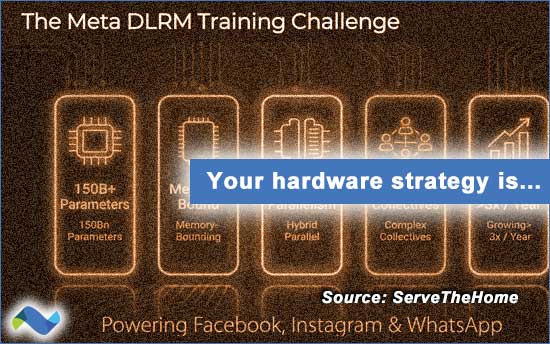
As The Register reports: “The combination of LLM training and the deep learning recommender model (DLRM) inference used for serving ads is unusual, as the two have wildly different performance demands. LLM training is enormously compute-intensive, often requiring tens or even hundreds of thousands of accelerators to train models in a reasonable amount of time. DLRM inference, on the other hand, is a predominantly memory-bound job.”
Meta is already developing the higher-bandwidth MTIA 450, expected to enter production next year. The Register says it should be particularly well suited to the LLM-based recommendation models Meta has been discussing.
Read: Meta’s new MTIA 400 chip has a split personality: Training AI and serving ads (August 26) – The Register
More: Meta’s MTIA slide deck at Hot Chips 2026 (August 26) – ServeTheHome
From tipsheet: Everyone’s ad stack is extending into silicon, like it or not. As AI puts more advertising intelligence into models and real-time decisioning, hardware matters more to the advertising ecosystem. Compute cost, memory, bandwidth and where models execute can determine which strategies are economically viable. Given its scale and resources, Meta can build chips around its own advertising workloads. Other ad tech companies may not build silicon, but they increasingly need a hardware strategy.
See the deck:
SEARCH
Default “on” and AI Overviews
Search Engine Land’s Barry Schwartz says Google has taken another step with AI Overviews embedded in Google Search:
“Google has confirmed that for some queries AI Overviews may dynamically expand to its full state, replacing the AI Overview snippet with a full detailed response. This not only removes the ‘Show more’ button in the AI Overview but it also pushes down the core search results that searchers were able to see without having to always scroll down the page.
Now the Google Search results look more like a full AI answer, more like how AI Mode works, versus how Google has typically shown AI responses within Search.”
Read: “Google is dynamically expanding AI Overviews for some queries” (August 28) – Search Engine Land
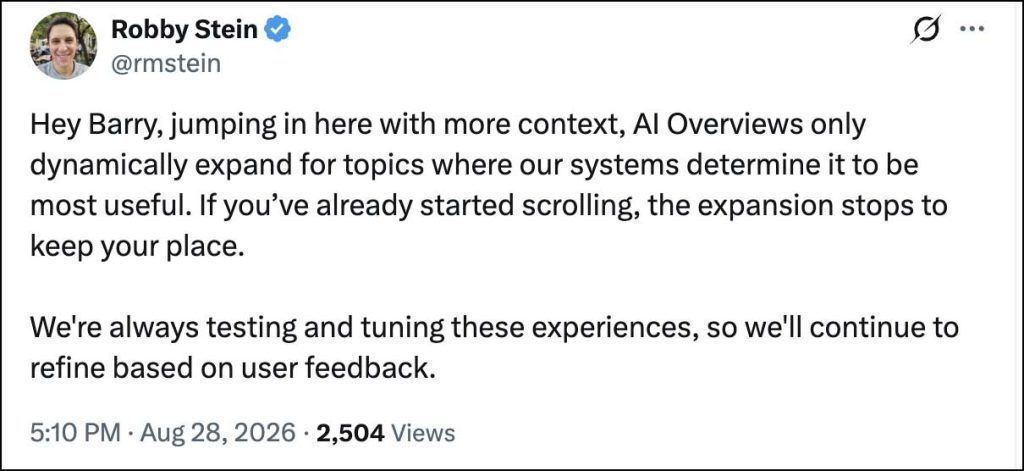
Google’s confirmation included a response from Google Search’s VP of Product Robbie Stein on X:
From tipsheet: Google is optimizing the entire search journey, which now includes deciding when to respond to a traditional search query with a full AI-generated answer. The user doesn’t have to choose AI Mode; increasingly, Google can choose an AI Mode-like experience for the user. How far that goes remains to be seen and will ultimately be shaped by the push-pull between search economics and regulatory constraints.
CONNECTED TV
What is the TV at your airport gate?
ReachTV is building something that sits between CTV and digital out-of-home (DOOH).
AdExchanger’s Victoria McNally reports that the Stagwell-owned streaming network “has screens at 2,400 airport gates and in 500,000 hotel rooms across North America, which together reach more than 51 million travelers a month.”
ReachTV provides the content, led by sports, and sells the advertising. Dave Olesnevich, the network’s COO and Stagwell’s Chief Growth Officer, says ReachTV sells national and local spots through direct deals, private marketplaces and auctions across multiple DSPs and SSPs.
The network also uses data including TSA travel data, mobile location data, third-party credit bureau data and Nielsen measurement to understand and target its audience.
Read: How ReachTV Brings Streaming And Advertising To America’s Airports (August 28) – AdExchanger
From tipsheet: The boundaries between CTV and DOOH are blurring. At what point does “CTV” stop describing where video is watched and start describing the advertising architecture around it? For that matter, when does OLV become CTV? And are streaming and CTV the same thing?
Related:
- ReachTV and Magnite’s streamr[dot]ai launched a self-serve CTV ad platform powered by GenAI in September 2024. Read the release.
- GenAI Ads Manager FAQs – ReachTV
CREATORS
Trust signal inflation
Survey says:
- “…Half of marketers misprice creator fees and 40% of them feel like they overpaid, according to 1,000 marketing and procurement leaders surveyed by Billion Dollar Boy. Danielle Wiley, CEO of influencer marketing agency Sway, said anecdotally that brands pay too much 90% of the time…”
Read: Creator industry admits that fee pricing is out of control, but can’t agree on a fix (August 28) – Digiday (subscription)
From tipsheet: Marketers are moving money toward creators partly because creators provide something increasingly scarce in advertising: authenticity and human trust. But how do you value that?
AGENCIES
$9 billion in billings with ‘AI embedded’
Omnicom Media officially launched Hearts United on Friday:
- Hearts & Science and Mediahub are merging into a new agency network spanning 40 markets and representing about $9.1 billion in 2025 billings.
- The agency says “AI is embedded into workflows and the operating model.” Nicole Estebanell will lead the U.S. business, with Ross Jenkins leading EMEA.
Read: “Omnicom Media Officially Launches Hearts United” (August 28) – Omnicom Media
Visit:
From tipsheet: “AI embedded” is the agency operating model going forward. The question is how deeply, and that will depend in part on what clients want. At a minimum, they still want humans with an eye on their AI-driven campaigns.
LLMs & CHATBOTS
Developments
- The state of AI in 2026: On the road to ROI (August 25) – McKinsey & Co. (signup required)
- a16z launches $1.1 billion “Machine Age” fund for the physical infrastructure powering AI, from chips and memory to networking, data centers and robotics (August 28) – TechCrunch
- How Salesforce Is Overhauling the Way It Charges for AI (August 31) – The Information (subscription)
MORE
- Early days issues? Data Reveals ChatGPT Ads Not Performing (August 28) – MediaPost
- Licensing or not: Anthropic Has Never Signed a Licensing Deal With a Digital Publisher, Yet Never Been Sued. Why? (August 26) – Adweek
- Measuring mobile: Mobile Pixalate Releases OpenEPG Index: Weather Channel’s ‘America’s Morning Headquarters’ Leads Small-Screen (Mobile) Programmatic Ad Spend (August 27) – press release
- Small biz (Video): Small businesses turn to AI for marketing as costs rise (August 29) – KY3 TV (Missouri)