
“Did this person click an ad like this before?”
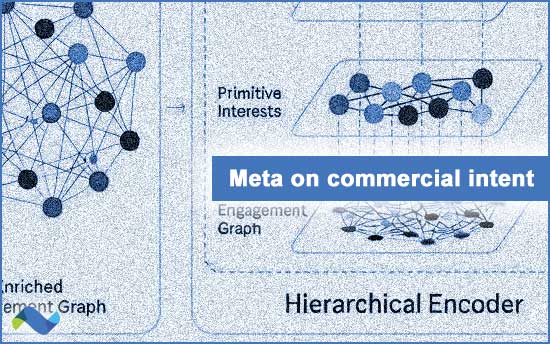
Meta has published research describing an AI system that organizes user interests into multiple layers to improve deep funnel optimization across its advertising platform.
Meta’s engineering team wrote:
-
“Hierarchical Interest Representation is a research area for Meta Ads. We’re exploring an upstream representation layer over the universe of Ads entities – users, advertisers, products, services – learning unified embeddings that connect users’ inferred interests with the breadth of what advertisers offer in their deep funnel ads.”
The system combines engagement signals with advertiser and product content processed through LLMs to create a shared understanding of users, advertisers and products that can power personalization, retrieval and ranking across Meta’s ads stack.
Read: Exploring Hierarchical Interest Representation For Meta Ads Deep Funnel Optimization (July 15) – Engineering at Meta
From tipsheet: Rather than asking, “Did this person click an ad like this before?” Meta is building AI that understands what people are interested in and how those interests relate to advertisers and products. That shared understanding of commercial intent powers retrieval, personalization and ranking across Meta’s advertising systems.
MEASUREMENT
Why Google and Meta backed AppsFlyer
Last month, mobile measurement partner (MMP) AppsFlyer, whose SDK is in over 100,000 mobile apps according to the company, raised more than $1 billion (tipsheet, June 22) in funding from an unlikely group of investors: Google, Meta, Unity and Moloco.
The premise behind the investment was independence. The four companies believed it was strategically important for AppsFlyer to remain independent rather than be acquired by a company like AppLovin, which owns the #2 MMP, Adjust.
On Friday, the Marketecture Podcast’s Ari Paparo and Aperiam Ventures’ Eric Franchi interviewed AppsFlyer President Brian Quinn about the deal.
Quinn explained (edited for length):
“Many of these companies see us as an optimization signal for their own advertising business. Advertisers look at AppsFlyer data as a source of truth, so these platforms began optimizing on that signal… The ability for AppsFlyer to send rich post-backs about what happened across web, TV and mobile becomes their optimization signal. That’s very, very important signal they can’t get on their own… They recognize that not only is measurement important to keep independent, effectively like the referee of the game, but that advertisers recognize AppsFlyer as a source of truth for their own optimization.”
Listen: “Episode 182: Brian Quinn from AppsFlyer on the Billion Dollar Investment from Google and Meta” (July 18) – Marketecture
From tipsheet: As AI automates more advertising decisions, independent measurement becomes more valuable. Advertisers still need a trusted source of truth, and the platforms increasingly optimize against it.
Related: “Picking An MMM” (July 17) – The Big Story podcast on AdExchanger
SEARCH
The economic value of search referrals
With surveys and anecdotal reports suggesting AI search is reducing publisher referral traffic, Google is continuing to push back.
On Friday, Google SVP of Knowledge & Information Nick Fox reiterated the company’s position on LinkedIn:
“It’s been fascinating to see how people are actually using AI in Search.
When we first started rolling out these features, there were a lot of questions. Many thought AI would make searching obsolete — because why search if AI can just give you a quick answer. But we’re actually seeing the opposite. Turns out, when people can ask whatever questions are on their minds, they use Google Search more than ever.
People also asked if AI in Search would mean that people never click through to websites anymore. Actually, as we’ve shared before, we continue to send billions of clicks to the web every day through Search…”
Read more. (July 17)
Search Engine Land reporter and search marketing expert Barry Schwartz questioned Google’s claims. He wrote, “Google continues to refuse to share click data, even after releasing AI performance reports in Google Search Console. If we are getting clicks, show us the data.”
Read: “Google says AI Search features sending billions of clicks to websites each week” (July 17) – Search Engine Land
From tipsheet: The debate is shifting from whether AI search sends traffic to how much traffic it sends relative to traditional search. For publishers, what matters most is the economic value of AI search referrals.
The missing data isn’t clicks. It’s search referral revenue. The next phase of this debate will be driven by publishers’ revenue data, not Google’s click data.
LLMs & CHATBOTS
Developments
- A scorecard for the AI age (July 17) – CFO Sarah Friar on OpenAI
- Meta Plans to Hire Top Amazon Computing Executive as It Weighs Cloud Push (July 17) – The Wall Street Journal (subscription)
- Feathery, which develops an AI operating and decisioning system for financial services, raised $30M in total funding (July 15) – FinTech Global
FINANCIALS
Earnings calendar: key reports ahead
Below are earnings report dates for a selection of companies involved in the AI opportunity in advertising and marketing.
- Alphabet/Google – Wednesday, July 22
- Comcast – Thursday, July 23
- Omnicom – Tuesday, July 28
- Meta – Wednesday, July 29
- Microsoft – Wednesday, July 29
- Apple – Thursday, July 30
- Amazon – Thursday, July 30
- Reddit – Thursday, July 30
- Snap – Monday, August 3
- Pinterest – Tuesday, August 4
- People, Inc. – Tuesday, August 4
- MNTN – Tuesday, August 4
- AppLovin – Wednesday, August 5
- Taboola – Wednesday, August 5
- Magnite – Wednesday, August 5
- Shopify – Wednesday, August 5
- Fox – Thursday, August 6
- Unity – Thursday, August 6
- WPP – Thursday, August 6
- Viant – Monday, August 10
Estimated
Criteo (late July/early August), Roku (late July), DoubleVerify (early August), The Trade Desk (early August), PubMatic (early August), LiveRamp (mid-August), Walmart (mid-August), Perion (August), Snowflake (late August), S4 Capital (mid-September), SpaceX (TBD).
From tipsheet: Four calls we’ll be watching especially closely:
- Meta faces mounting questions about AI spending and whether advertising results can quiet critics.
- Pinterest will be pressed on Performance+ and its integration of tvScientific.
- AppLovin must show its new self-serve platform and ecommerce ambitions are translating into growth.
- Fox reports for the first time since announcing its Roku acquisition, offering another read on Roku’s advertising momentum before the deal closes next year.
MARKETERS
Bayer explores predictive media buying
After discussing AI’s potential to reshape media buying in Ad Age, Maria Givens, VP, Head of Media & Digital Platforms at Bayer, expanded on LinkedIn about where she sees the technology creating the greatest value:
“At Bayer | Consumer Health, we’re investigating how AI-enabled predictive modeling can help us reduce wasted media spend, identify higher-value audiences, anticipate attrition before it happens, and uncover growth opportunities earlier.
- The future is not just better targeting, it’s better prediction of business outcomes…
- …AI search optimization requires trust, authority, and cross-functional partnerships beyond media…”
Read more. (July 16)
More: “How Bayer’s head of media is using AI-powered predictive targeting and navigating AI search” (July 16) – Ad Age (subscription)
From tipsheet: Media buying has long relied on predictive models to identify the audiences most likely to respond. AI expands that role by helping marketers predict broader business outcomes, including customer value, churn risk and incremental growth.
PEOPLE MOVES
The Trade Desk in-housing marketers
- Kristi Argyilan, former Uber Chief Marketing Officer, is joining as Chief Commercial Officer and Executive Vice President – Kristi Argyilan on LinkedIn
- Vinny Rinaldi, formerly VP of Media, Marketing Technology & Data Activation at Hershey, joins as VP of Client Strategy and Growth – The Trade Desk on LinkedIn
From tipsheet: As AI reshapes marketing workflows, The Trade Desk is hiring marketers with firsthand advertiser experience. Those executives understand how agencies create value today and where AI is likely to change the workflow.
The Trade Desk-Publicis disagreement earlier this year reflected more than a dispute between two companies. It highlighted a broader industry shift as AI blurs the boundaries between software and marketing services.
Related: Ron Lambrecht, former Amazon executive, joins The Trade Desk as Chief Business Development Officer, SVP (July 17) – Ron Lambrecht on LinkedIn
AGENCIES
Agency buys AI creative intelligence
Independent agency Brunner has acquired AdSkate, an AI-powered creative analytics platform that predicts advertising performance before campaigns launch. The platform analyzes images, video, messaging and audience segments to identify the creative elements that drive engagement, conversions and return on ad spend.
Read tipsheet’s 2025 profile of AdSkate.
Brunner said it will continue offering AdSkate to outside agencies while integrating the technology into its own services. AdSkate CEO Akaash Ramakrishnan will join Brunner as Senior Director of AI and Innovation.
Read: “Agency Brunner Acquires Creative Analytics Platform AdSkate” (July 16) – MediaPost
From tipsheet: Owning technology that predicts creative performance before launch could become an important competitive advantage for agencies.
MORE
- Instacart acquires Israeli AI startup Arpalus to bring real-time shelf intelligence to supermarkets (July 16) – Calcalist
- How Dollar Shave Club uses generative AI to unlock advertising creativity (July 14) – Marketing Dive
- ‘Top Stories’ rolls out in Google AI Overviews (July 17) – Search Engine Land