

Meta is bringing its new Muse Image model to advertisers through Advantage+ Creative, marking the first commercial deployment of the image generation model according to a press release Tuesday.
Meta offered 3 key takeaways for advertisers and agencies:
- “In the coming weeks, Muse Image, the first image generation model from Meta Superintelligence Labs, will help power image generation in Meta Advantage+ creative —bringing smarter reasoning and iterative refinement to our popular gen AI ad creative tool.”
- “Early results with Muse Image-powered generation variants show strong promise—advertisers who tested the experience cited higher-quality creative, with photorealism and product integrity standing out.”
- “Muse Image now enables room restyling in Meta AI Shopping, letting people visualize products from your business’ catalog in their own spaces—creating a richer, more immersive path from discovery to purchase.”
The announcement builds on Meta’s Cannes unveiling (June 23) of an end-to-end AI creative system, extending that vision with Muse Image’s integration into Advantage+ Creative.
Muse Image will also power new creative experiences across Meta AI, Instagram and WhatsApp.
Read:
- B2B: “Muse Image Brings Next-Generation AI to Image Generation for Businesses” (July 7) – Meta
- Everyone: “Introducing Muse Image: Image Generation Built for Your World” (July 7) – Meta
From tipsheet: Meta is closing the creative loop. By embedding image generation into Advantage+ Creative, it is making creative production part of the same AI system that plans, optimizes and delivers campaigns.
Related: “Dentsu strikes Meta deal to build plumbing for mass influencer activation” (July 7) – Digiday
LLMs & CHATBOTS
Developments
- Expanding Managed Agents in Gemini API: background tasks, remote MCP and more (July 7) – Google
- Verbalizable Representations Form a Global Workspace in Language Models (July 7) – Anthropic
- Microsoft Replaces OpenAI, Anthropic With Own AI in Some Apps (July 7) – Bloomberg on Yahoo Finance
M&A
Vista’s next platform starts with Criteo?
Private equity firms don’t always buy companies to own them. Sometimes they buy platforms to build on.
Reuters reported Monday that Vista Equity Partners and Quinti Capital have offered to acquire Criteo:
-
“The firms submitted an offer last week that valued Criteo at more than a 50% premium to its recent share price, the sources said, declining to be identified because the information is not public. (…) Paris-based Criteo has not yet made a decision on how to respond to the takeover approach…”
Read: “Vista Equity, Quinti Capital offer to buy French adtech firm Criteo, sources say” (July 6) – Reuters
On LinkedIn, Nova Studio CCO Matt Barash remarked on the 50% premium: “That’s notable because public investors have largely treated ad tech as cyclical advertising exposure rather than durable software platforms.” Read more. (July 7)
The Mediaocean playbook
The reported bid recalls Vista’s investment in Mediaocean in 2015. During its ownership, Mediaocean expanded beyond its ubiquitous Donovan/Mediabank back office “pipes” for media buying through acquisitions including:
- Measurement firm 4C Insights (2020).
- Video ad/creative platform Flashtalking (2021). The acquisition included verification firm Protected Media.
- After Vista exited in 2021, Mediaocean continued the strategy under new owners by acquiring CTV ad platform Innovid (2024).
From tipsheet: So what adjacent assets could Vista combine with Criteo over the next five years if it moves forward with an acquisition?
If the Mediaocean playbook is any guide, Criteo could become the foundation for a broader commerce media and advertising infrastructure platform. That raises the question: Which adjacent capabilities would make that platform more valuable?
One logical adjacency is commerce optimization.
A commerce platform such as Fermat Commerce could be an interesting match with Criteo. Fermat focuses on optimizing the commerce experience including AI visibility and raised a $45 million Series B round of funding in August 2025. For argument’s sake, replace “Meta” with “Criteo” in Fermat’s Series B announcement: “Just as Meta constantly ingests and analyzes data to optimize ad delivery, FERMÀT learns from each brand’s data to determine and deliver the best possible commerce experience for every human or agentic shopper.”
M&A
On that note… PE wants to sell
The Wall Street Journal reports:
-
“Buyout firms face a backlog of unsold portfolio companies that is only worsening as investor concerns deepen about artificial intelligence’s impact on the software industry. The firms are expected to take about nine years to clear their logjam at the current pace, according to a PricewaterhouseCoopers analysis of PitchBook data released last month.”
Read: “Private-Equity Firms Are Sitting on a Nine-Year Backlog” (July 7) – The Wall Street Journal (subscription)
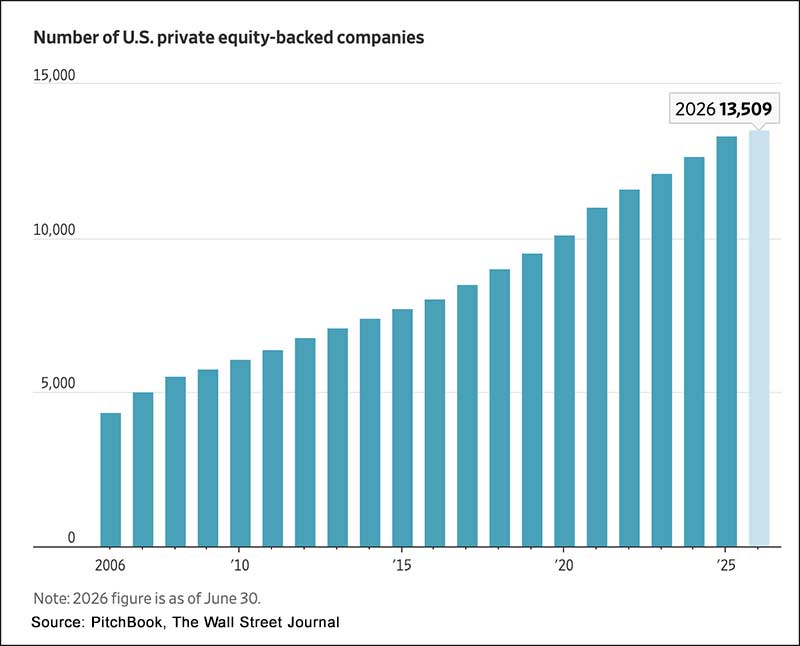
From tipsheet: AI isn’t repricing all software equally. Generic SaaS may be under pressure while infrastructure that owns data, workflows and the decision point may be becoming more valuable. That may be Vista’s bet with Criteo.
MARKETING
AI simulation for ad campaigns
Strategus, a CTV campaign management platform, has launched Blueprint, a planning tool that the company says can use more than a decade of historical campaign data to predict likely performance before media is activated.
Strategus client Melissa Kovach at Columbus-based agency Jackson Spalding says: “The tool is designed to give advertisers clearer insights into a campaign’s likely performance ‘before we even launch.’”
Read: “This New Tool Is Built On Historical Data To Predict Marketers’ Future Performance” (July 7) – AdExchanger
From tipsheet: Eventually marketers won’t ask “What happened?” They’ll ask, “Should I run this campaign at all?”
TECH
New CEO at ad verification firm IAS
Former Slack and Bumble CEO Lidiane Jones is succeeding Lisa Utzschneider as CEO. Utzschneider is stepping down for “both personal and professional” reasons, reports Axios.
Utzschneider joined IAS in 2019 after advertising leadership roles at Yahoo and Amazon. During her tenure, the company went public in 2021 before being acquired by private equity firm Novacap last September.
In a LinkedIn post announcing her departure, Utzschneider reflected on IAS’s evolution from reactive brand safety toward AI-powered media analysis:
“We also continued to push the boundaries of AI, advancing our technology to analyze content in real time across text, image, audio, and video. Those innovations gave advertisers and publishers a clearer understanding of where their ads run, how they perform, and how to optimize outcomes with greater confidence.”
Read more on LinkedIn. (July 7)
A press release described incoming CEO Jones as an “accomplished AI and technology executive to lead IAS’s next phase of innovation and growth.”
Read: “Integral Ad Science Appoints Lidiane Jones Chief Executive Officer” (July 7) – press release
From tipsheet: Verification is becoming another AI decision layer. The opportunity shifts from identifying unsafe inventory to helping advertisers make better media decisions.
COMMERCE MEDIA
Sam’s Club bets on membership intelligence
Sam’s Club’s newly renamed advertising business, Sam’s Club Connect, is positioning its membership model—not just its stores—as a competitive advantage in commerce media.
On Next In Media, founder Mike Shields talks to Sam’s Club Connect VP and GM Harvey Ma who says membership enables deterministic measurement across purchases, fuel, product sampling and services while giving advertisers to understand the “full membership journey” rather than isolated transactions.
Ma explains:
“Membership really changes everything. If you think about a membership model, members actually pay us for the privilege to shop at a Sam’s Club both online and in club. What that means for us as a retailer is we have a profound sense of responsibility to deliver upon that expectation.
From a retail media perspective though, it creates a lot of really unique nuance in terms of measurement. If you think about it, closed loop reporting is the cat’s meow when it comes to retail media. You have to scan your member ID with every single transaction both online, in club and beyond that (…)
The need to extrapolate doesn’t exist for us because that one-to-one deterministic measurement is so important. I also think, too, retail media has so long been built off of the transaction.”
Read:
- “Where Sam’s Club (With Help From Walmart) Thinks it Can Challenge Amazon” (July 7) – Mike Shields on his Next in Media Substack
- Interview: “Inside The Global Rebrand Of Sam’s Club Connect” (July 7) – Next in Media on YouTube
From tipsheet: Membership isn’t simply a loyalty program. It’s an intelligence system. Every interaction—from product samples to fuel purchases—creates deterministic signals that improve recommendations, measurement and campaign optimization over time.
AGENTS
AdCP agentic media buy
Boostr CEO Patrick O’Leary announced on LinkedIn:
-
“We’re proud to announce Vox Media executed an Agentic Media Buy using AdCP. Using boostr’s Seller Agent, Vox Media negotiated, transacted, trafficked and set a campaign live. What typically takes weeks, took less than 2 minutes with humans in the loop. A huge shout out to Lauren Winter for bravely leading the charge at Vox Media on this historic event. This is the future of automated buying.”
Read more. (July 6)
Related: “Built for the Industry, by the Industry: Inside the Organization Shaping Agentic Advertising” (July 2) – AgenticAdvertising[dot]org
PLATFORMS
AI lowers the cost of buying media
With Walmart’s acquisition of video ad platform Vibe in mind, OpenAds CEO Steven Liss argues that AI is collapsing one of advertising’s oldest tradeoffs: the most relevant media opportunities have historically been difficult to buy.
He writes: “Only with AI creative integrated with media buying at the DSP level is it finally possible to bundle thousands of hyper-relevant contexts and bespoke creatives into something a brand can buy with a few minutes and a credit card.”
See his visual on LinkedIn. (July 6)
From tipsheet: AI reduces the transaction costs of buying media. As operational friction falls, advertising opportunities that were once too fragmented or bespoke to scale become economically viable.
Side note: Podcast advertising may become the ultimate proof point if AI can package and buy thousands of niche shows as easily as programmatic display.
Related: “Walmart Chases Amazon While Amazon Prepares for an AI Future” (July 7) – Adweek (subscription)
MORE
- Google Search lets creators know more about their reach (July 7) – The Verge
- Dollar Shave Club’s bet: AI makes agencies optional, not obsolete (July 7) – Digiday (subscription)
- Why beauty brands are ahead of the curve with AI—and what others can learn (July 7) – Ad Age (subscription)
- European Telcos, Retailers, and Ad Tech Companies Form European Media Marketplace (July 7) – Videoweek
- “Cannes 2026 gets serious about results” (July 7) – Jason Fairchild, CEO of Pinterest’s tvScientific on tvScientifc’s blog