
OpenAI appears to be building a dashboard that would show verified businesses how often they appear in ChatGPT responses and how many clicks their website links receive.
E-commerce analyst Joe Kaziukėnas shared a screenshot Friday of an unreleased “Claim your business in ChatGPT” screen. The screen also describes how businesses could update their product information and give a business agent the context it needs to answer customer questions.
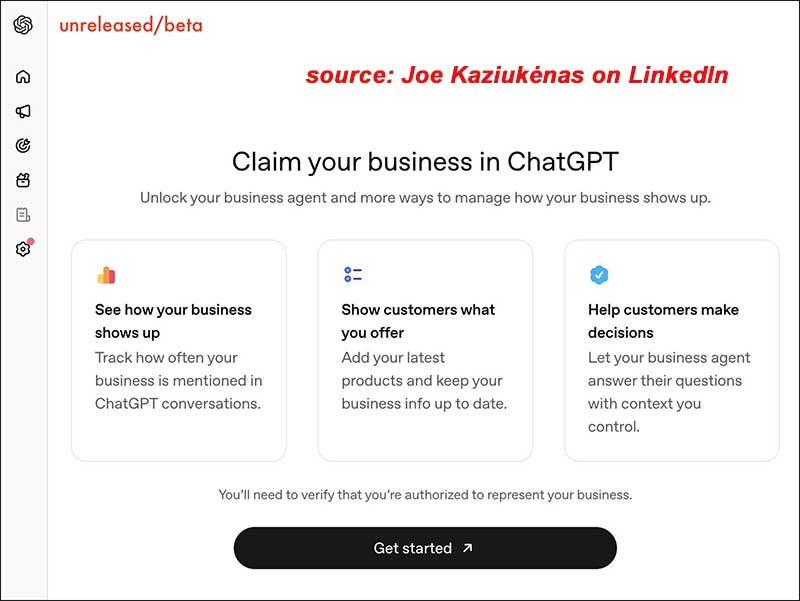
Kaziukėnas writes:
“It measures both impressions and clicks: number of times a business appeared in ChatGPT responses and number of clicks on links to their website. It tracks those events daily and shows them as a chart.”
He notes the dashboard leaves out prompts and competitor benchmarks. Read his post on LinkedIn. (Nov. 6)
GEO startups have been selling marketers tools to track how often their brands show up in AI answers. Microsoft already offers its own reporting through Clarity, which shows site owners which pages AI answers cite and the queries AI systems used to retrieve those pages, as tipsheet covered in April.
From tipsheet: This feels like the early days of Google Webmaster Tools, now Google Search Console, when Google gave site owners a way to see how they showed up in search. Expect every major AI assistant to offer its own version for answers. If marketers can tie those clicks to sales or signups, they’ll have a stronger case for investing in AI visibility.
First-party counts could make basic visibility reporting harder to sell. The opening for AEO/GEO firms is in what this dashboard appears to leave out: competitor comparisons, prompt analysis and guidance on what to change.
Meanwhile: “ChatGPT Ads takes another step forwards in its maturity on Monday with the launch of tCPA and tCPC bidding.” (Nov. 6) – Malcolm Figures, Paid Search, dentsu on LinkedIn
CONNECTED TV
Fox takes control of Roku
Fox Corporation completed its $22 billion acquisition of streaming TV platform Roku on Friday, ahead of the previously expected 2027 closing. Read the announcement. (Nov. 6)
Fox promoted Roku’s president of devices, products and technology, Mustafa Ozgen, to Roku CEO and put AdRise’s advertising product and engineering under him, according to an internal memo published by Business Insider. Advertising sales across the portfolio will report to Fox’s Jeff Collins. Among management’s five goals: “Win in Performance Advertising.”
AdRise, acquired with free streaming service Tubi in 2020, already powers Fox’s OneFOX audience network. Fox expanded the platform across its portfolio in 2024 to unify inventory, audiences and planning across linear TV, streaming and digital, with direct DSP connections and data integrations through AWS Clean Rooms and Snowflake.
More: The regulatory commitments (Nov. 6) – The Hollywood Reporter
From tipsheet: Fox now controls more of the chain from content and TV distribution to audience data, ad delivery and sales. The AI opportunity is to connect those layers so viewing signals inform ad decisions and campaign results improve the next decision. The test is whether that greater control translates into better advertising performance.
AGENTS
Yahoo seller agent goes live
Yahoo’s Seller Agent is live in the US, engineering director Mikul Bhatt said Friday: “A media buy that took two to three weeks now starts with a ranked plan in under a minute.”
Bhatt offered three lessons for taking agents into production:
- Keep meaning, rules and records as data.
- Put agents and people on one control plane.
- Measure outcomes, not credit.
Spending requires human approval: “A person signs before any money moves.” Bhatt says campaigns that previously started at $50,000 now start at a few thousand dollars, opening Yahoo to smaller advertisers.
Read his post on LinkedIn. (Nov. 6)
Under the hood
Bhatt and Google’s Bei Li detailed the platform in June. Built on Google Cloud, it uses a knowledge graph to connect inventory, audiences, pricing and business rules, plus a separate context graph to record decisions and learn from campaign outcomes. Buyer agents submit campaign briefs through Ad Context Protocol (AdCP).
CONNECTED TV
From yield opt to agent ops: Swivel & CTV
Ad tech startup Swivel, which encourages potential clients to “operate agentically” on its website, is putting more emphasis on agents for CTV planning, forecasting and setting ad operations rules for guaranteed deals, co-founder Joseph Hirsch told AdExchanger.
Initially, Swivel was “very active in the middle to tail end of the agentic media workflow,” Hirsch said. Now, “we’re much more active at the front end of the agentic workflow.”
The startup offers separate agents for tasks including budgeting, trafficking, pacing and reporting. Publishers can adopt individual agents without replacing their entire workflow.
Hirsch also sees an opportunity to automate sales for sponsorships, home screen placements and pause ads whose requirements differ across publishers, making them difficult to buy programmatically.
Read: “Swivel Wants To Create Agentic Infrastructure For CTV” (Nov. 6) – AdExchanger
From tipsheet: Some of CTV’s distinctive inventory still requires bespoke setup. Agents could reduce that work while allowing publishers to retain different formats and sales requirements — expanding the inventory advertisers can buy through automated workflows.
LLMs & CHATBOTS
Scoring chatbot ads
Wired reported last week on what’s working with chatbot ads: “…ads composed partly by AI rather than fully by a human generate double the clicks,” according to Koah CEO Nic Baird.
A publisher’s verdict?
DeepAI CEO Kevin Baragona, whose platform carries Koah’s ads, offers a more skeptical assessment: “I don’t think the ads are working terribly well for anyone,” he says.
Read: “Ads in Chatbots Have Arrived. Here’s What’s Working—and What’s Not” (Nov. 5) – Wired (subscription)
COMMERCE MEDIA
The AI transition needs a ‘cart rail’
Before Seth Dallaire could sell advertisers on Walmart, he had to sell Walmart internally on advertising.
A Wall Street Journal profile Friday details how the retailer’s chief growth officer navigated internal resistance to building its ad business. Walmart’s buyers and category managers worried that brands would shift spending from their trade budgets into digital ads.
“You really have to be part of the furniture,” Dallaire told the Journal. “I’m going to sit in your meetings, I’m going to learn as much as I can…My ask back is just some reciprocity: that you be willing to listen to me.”
The former Amazon and Instacart executive translated digital advertising into familiar retail language: A banner on Walmart’s app was the equivalent of a “cart rail,” a prominent product display near a store’s entrance. He showed those teams how advertising profits could flow back into their budgets, helping fund lower prices and store improvements.
Read: “His Job Is to Turn Walmart’s Customer Data Into Profit” (Nov. 6) – The Wall Street Journal (subscription)
From tipsheet: AI needs its own “cart rail,” a way to connect unfamiliar technology to work people already understand, but Dallaire’s pitch also gave Walmart’s buyers a reason to welcome a business they feared would drain their budgets.
Agencies, publishers and marketers face a similar test with AI, especially when greater efficiency for the company means a smaller budget and fewer people for the team being asked to adopt it. Explaining how the technology helps people do their jobs is part of the internal sale; showing how they will share in the gains is what makes the pitch credible.
FINANCIALS
Earnings this week
A selection of quarterly financial reports arriving this week:
Related: Events this week —
LLMs & CHATBOTS
Developments
-
- Bringing Specialized Models to Muse and Meta AI (Nov. 6) – Meta
- Gemini Omni 1.2 Flash: Fast and cost-effective with longer clips (Nov. 5) – Google
- The agentic web is here (Nov. 2) – MIT Technology Review
MORE
-
- The feed is the ad: “Amazon offers direct AI connector to third-party retailers” (Nov. 4) – Chain Store Age
- Includes sponsored ads: “Amazon is Letting Customers Text Its Shopping Assistant” – Adweek (subscription)
- AEO/GEO strategy: “Do YouTube descriptions matter for AI Search?” (Nov. 6) – Danny Konitzny, researcher, Peek AI on LinkedIn
- Gulf startup expands: “Journify Raises $12M Series A to Expand AI-Powered Advertising Platform Into U.S. and Europe” (Nov. 3) – citybiz