
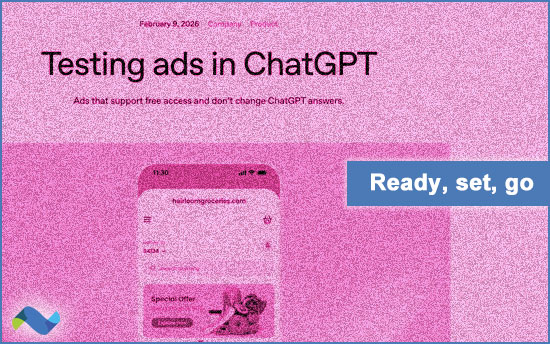
It’s been a little over three weeks since OpenAI announced its ads strategy on a Friday before a holiday weekend in the U.S.
Yesterday, a Monday, the company made clear it’s ready to start testing with ads in the U.S. for the free and “Go” versions of its AI chatbot ChatGPT.
A company blog post titled “Testing Ads in ChatGPT” began, “Today, we’re beginning to test ads in ChatGPT in the U.S. The test will be for logged-in adult users on the Free and Go subscription tiers.” The company emphasized answer independence and privacy in its delivery of test ads.
As for the type of ad targeting, OpenAI explained: “During the test, we decide which ad to show by matching ads submitted by advertisers with the topic of your conversation, your past chats, and past interactions with ads.”
Read more. (February 9)
Also, OpenAI monetization executive Asad Awan joined the OpenAI Podcast yesterday to discuss the ads test and responded to a question on what ads will look like in 10 years. Mr. Awan pivoted to what’s next: “The next version would be… can it work behind the scenes and actually aggregate the best discounts and best deals and the best version of the product?”
Listen: The Thinking Behind Ads in ChatGPT (February 9) – OpenAI Podcast
More:
- “We’ve got our first look at who is in the OpenAI ads pilot program, after ChatGPT announced the ads would start running today.” (February 9) – Ad Age reporter Garett Sloane on LinkedIn
- WPP Media and Clients Across Industries to Test Ads Experience in ChatGPT (February 9) – WPP Media
- Sonata Insights analyst Debra Aho Williamson commented about yesterday’s ads announcement on LinkedIn, “That’s looking less like social targeting and more like mining discovery and intent.”
- Advertise with ChatGPT – OpenAI
From tipsheet: There was a change in tone about ads towards the end of the post: “More broadly, we see an opportunity for advertising in ChatGPT to be uniquely valuable for people. In a conversational interface, ads can be more relevant and useful, connecting people to new products and services that fit naturally with what they’re trying to do.”
OpenAI has come a long way from its pained conversations about advertising of the recent past.
LLMs & CHATBOTS
Developments
- Funding capex: “Alphabet lines up 100-year sterling bond sale” (February 9) – Financial Times
- “I now constantly get questions about the SaaS meltdown, role of AI, system of records etc. I don’t have an answer to all these. But I do know that we saw an acceleration in our business in Q2, Q3, and now finished the year with accelerating Q4.” (February 9) – Ali Ghodsi, CEO, Databricks on LinkedIn
- Anthropic closes in on $20B round (February 9) – TechCrunch
TECH
LLM-driven AI boosts Google — Stratechery
Well-respected tech analyst Ben Thompson reviewed Google’s monster Q4 2025 results in his latest note to Stratechery subscribers. (February 9)
Thompson’s most important “two paragraphs” of last week’s earnings call were from Alphabet/Google CEO Sundar Pichai (transcript):
“First, ads quality. We’ve been deploying Gemini models to improve query understanding at a rate of almost a launch per month for the last two years. These improvements drive better query matching, ranking and quality, making Search Ads even more effective. With Gemini across our Ads quality stack, we evaluate relevance with greater accuracy than with previous generations of models. This has significantly improved our ability to systematically deliver more helpful, high-quality ads, contributing to a meaningful reduction in irrelevant ads served.
Gemini’s understanding of intent has increased our ability to deliver ads on longer, more complex searches that were previously challenging to monetize. Gemini models also have a significant impact on query understanding in non-English languages, expanding opportunities for businesses to scale globally.”
From this, Mr. Thompson noted that although the revised capital expenditure ($175-185 billion for 2026) is an enormous and eye-catching investment in “tomorrow”, it’s clear LLM-driven AI is significantly boosting Google today.
The analyst wrote:
“Specifically, LLMs (1) allow Google to understand long queries for purposes of advertising and (2) allow Google to better understand non-English language queries. The reason why these are so important is that they increase inventory — and increasing inventory is the single most powerful way to drive increased revenue for digital ads. Not only does more inventory mean more revenue opportunities, both now and in the long-term, but ad prices also become more cost competitive with competitors, increasing access and bringing more advertisers into the ecosystem. To put it another way, LLMs are increasing Google Search’s addressable market, and it’s hard to imagine anything more compelling in terms of revenue potential across all of tech.”
RETAIL MEDIA
TV ad tailwinds in the age of AI
On “Unlocking Retail Media” podcast with Kevel’s James Avery, Comcast’s Universal Ads VP of product James Borow joined for an episode titled, “Democratizing Premium TV Advertising.”
At a high level, this episode is a glass-half full look at the future of retail media and how TV will be a part of a robust online retail future.
Mr. Borow sees two “huge” tailwinds in television advertising in the age of AI (lightly edited):
[8:30]
JAMES BOROW: “One is this shift towards incrementality. A channel that you can’t click on – such as TV ads which are not clickable yet — can now actually be measured, apples-to-apples.
And then the other one is creative. Up until this whole shift with AI, creative was a huge barrier. To go and shoot a 15- or 30-second ad two years ago was incredibly daunting. But right now, you could go log in to Universal Ads, Creatify or Spaceback and you could have a TV worthy ad.”
Later, Borow and Avery opined on the future of video’s integration into AI chatbots especially as it relates to agentic commerce and advertising.
They explored what they see as Google’s Gemini’s inevitable ads integration (and YouTube integration, too):
[24:28]
JAMES BOROW: “Google, for example, they just announced personalized Gemini, where it will look at your photos and look at your email. [Eventually] it could pull out a picture of me holding out my golf bag and ask, ‘Do you like this golf bag?’
There’s no reason why this stuff won’t happen. It’s going to lead to more shopping, more commerce.
The AI platforms are incentivized to have more merchants because the ‘torso’ is so important as an advertiser. So eventually, the bigger SMB has way more opportunities to scale and be discovered than they did previously.”
JAMES AVERY: “Yes, it makes sense. It almost weakens the incumbent brands a little bit, right? Because it encourages more discovery.”
JAMES BOROW: “Yes. And back to — selfishly — TV and Universal Ads, that’s why it’s unfair that [the bigger SMB] i.e., amazing unknown brands were boxed out of this. And now, to get them here allows them to compete.
And there is a halo effect: When people see your brand on TV, there is this perception that they made it. They’re on television.
And that actually conditions people to go ahead and be more likely to transact when your ads are shown on social networks.”
Hear more on Apple Podcasts app. (February 9)
From tipsheet: There are more insights in this wide-ranging podcast — including on the future of TV advertising and where it intersects with commerce. Worth a listen.
SELL-SIDE
Reaction: The IAB’s AI bot law
Last week’s announcement of a new proposed law from advertising trade body IAB called “AI Accountability for Publishers Act” is beginning to receive feedback.
The law aims at AI bots that scrape publisher content without permission and protects “publishers from AI companies becoming unjustly enriched. Unjust enrichment is a straightforward concept: if someone receives a benefit at your expense, it would be unfair for them to keep it without paying for it,” according to a statement from IAB CEO David Cohen.
Digiday delivered a “WTF” explainer article on the new Act and reached out to IP attorney Paul Ragusa of law firm Baker Botts, who anticipated that the bill faced an uphill battle.
Mr. Ragusa said:
“The administration’s America’s AI Action Plan aims to reduce regulation and lower barriers to domestic AI innovation. They may see the Act as working against this plan by restricting access to certain training data.
The tech industry has similar concerns, particularly because the Act would override the fair use doctrine, a defense the industry has leaned on heavily in copyright infringement cases.”
Read: “WTF is the IAB’s AI Accountability for Publishers Act (and what happens next)?” (February 6) – Digiday (subscription)
On the Marketecture podcast, Ari Paparo, an experienced ad technology product executive who attended the IAB’s Annual Leadership Meeting last week, shared his ‘take’ on the IAB’s new Act after giving it a read:
“I think ‘express prior consent’ is a pretty high bar – that’s not how web scraping works. Web scraping has always been opt-out with robots.txt.
‘Express prior consent’ means the AI can’t learn anything from any website without express prior consent, which is a pretty high bar… and so that was kind of interesting for me. The other thing related to that — the IAB continues to push really hard on these publisher content marketplaces. Microsoft is live with theirs. We’ve covered that on this podcast with Matthew Scott Goldstein and a couple of other guests. So, there seems to be some optimism that that’s kind of moving forward and that there are conversations.”
Hear more on the Apple Podcasts app. (February 6)
Microsoft launched its Publisher Content Marketplace (PCM) on February 3.
Related: “IAB’s New AI Regulations (on AI disclosure) Give Advertisers A Starting Point – But Plenty Of Questions Remain” (February 9) – AdExchanger
SELL-SIDE
The IAB’s lonely protocol?
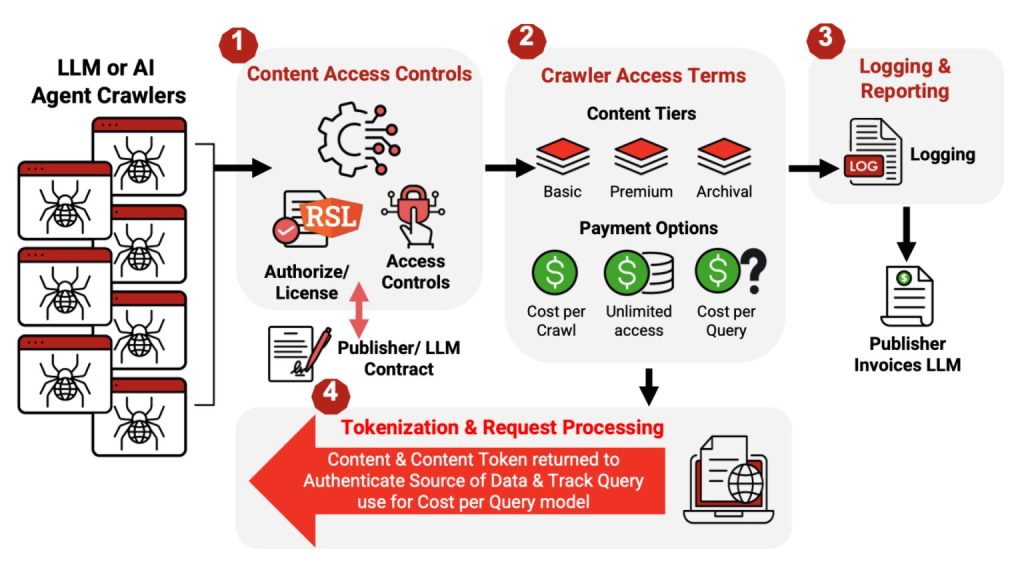
Perhaps sensing other initiatives are taking priority in the industry (such as Microsoft’s PCM and the IAB’s AI bot law), WPP Media’s Head of Investment Karthik Shankar reminded LinkedIn followers that there’s still an ongoing protocol effort by IAB in support of publishers.
He said yesterday – and included a graphic:
“IAB’s CoMP (Content Monetization Protocols) Initiative helps Publishers Monetize LLM Content. (See it) Too late or too little? – At least there is a start.”
See it on LinkedIn. (February 9)
More:
- “CoMP (Content Monetization Protocols) Initiative” – IAB Tech Lab
- IAB Tech Lab Forms AI Content Monetization Protocols (CoMP) Working Group to Set AI-Era Publisher Monetization Standards (August 12) – IAB Tech Lab
LLMs & CHATBOTS
OpenAI reaches out to ad trades
Perhaps rival Anthropic has pushed OpenAI out into the “open” on ads due to Anthropic’s pugnacious Super Bowl ads.
In a first (that I’ve seen), an OpenAI executive spoke to an advertising trade publication — Adweek’s Trishla Ostwal spoke publicly to OpenAl CMO Kate Rouch. As did Ad Age’s Garett Sloane.
Ostwal previewed the video interview on LinkedIn:
“AI had its own Super Bowl ad war. I spoke with OpenAI CMO Kate Rouch about the Codex spot, OpenAI’s ad strategy, and Anthropic’s swipe at facilitating ads within Al chatbots.
Rouch: ‘People can also use ChatGPT for free and not see ads—but have fewer queries.’”
View the 2-minute clip on LinkedIn. (February 9)
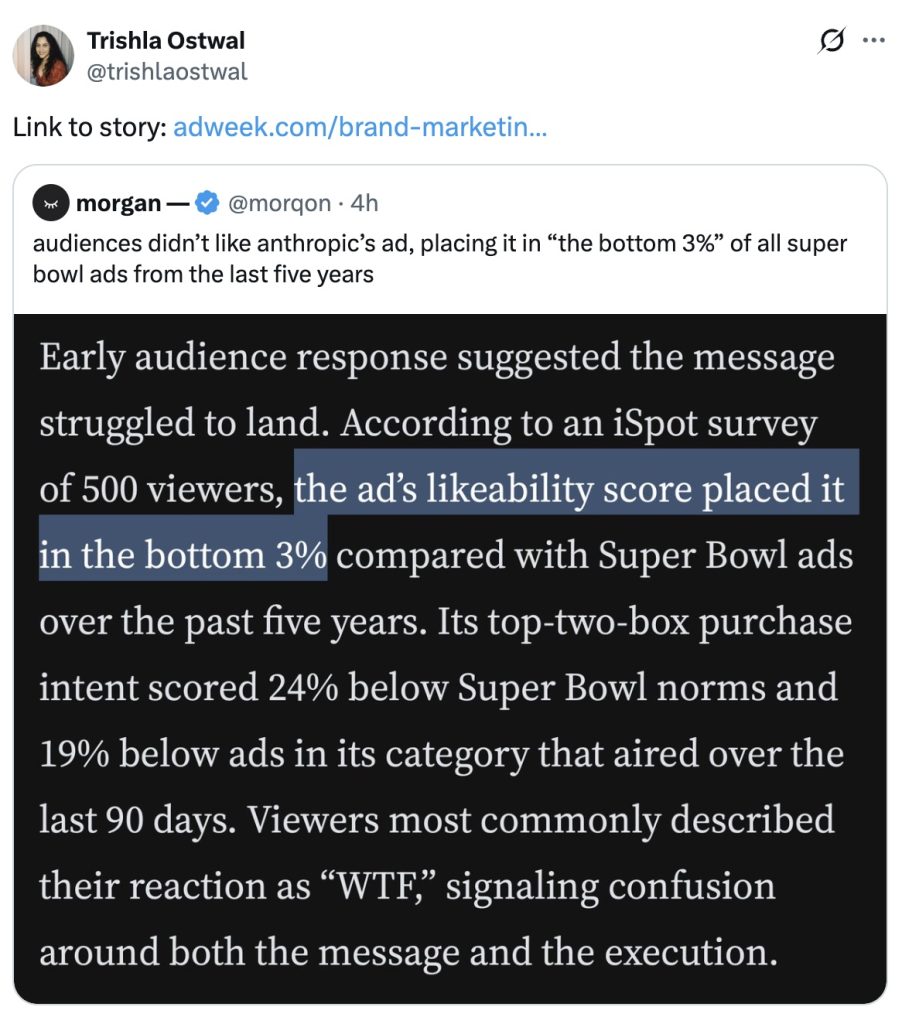
Related: Yesterday, Ostwal tweeted on X about poor reception by Super Bowl viewers to Anthropic’s ad.
From tipsheet #1: Anthropic may have done OpenAI a favor with its Super Bowl ads.
OpenAI needs to engage the advertising and marketing industry to supercharge its ads platform which, in turn, must hit the ground running when it launches. The trades are an important communication vehicle.
From tipsheet #2: Don’t poke the bear.
Not only did Anthropic’s ad not resonate with Super Bowl viewers according to Ostwal’s tweet (she said AI had a “messaging crisis” in her article), but OpenAI CEO Sam Altman said that ChatGPT had resumed 10+% month-over-month growth, according to CNBC. (February 9)
TECH
Customer Data Platform (CDP) meets AI
In a new post on his personal blog, SAP Global Marketing executive Chris O’Hara ruminated on customer data platforms in the age of AI and how it compares to what he and Salesforce SVP Martin Kihn, first wrote 5 years ago.
Messrs. O’Hara and Kihn penned “Customer Data Platforms: Use People Data to Transform the Future of Marketing Engagement” in 2020 when both were at Salesforce. See it on Amazon.
O’Hara wrote yesterday on LinkedIn:
“What held up: Our central thesis that CDPs are an evolution of CRM, not a revolution. The ‘Frankenstack’ diagnosis. The Systems of Insight vs. Systems of Engagement framework. And our privacy predictions — written before Chrome’s cookie deprecation and Apple’s ATT — read like we knew what we were talking about 🙂
What we got wrong: We assumed CDPs would be the data layer. We completely missed the rise of the modern data stack and composable CDP architecture. In 2026, the golden record lives in Databricks, Snowflake or BigQuery — the CDP activates it. We also underestimated how brutally the category would consolidate.
What nobody could have predicted: Generative AI. AI agents making campaign decisions autonomously…”
Read more on LinkedIn. (February 9)
More: “What We Got Right (and Wrong) About CDPs: A 5-Year Retrospective” (February 2026) – Chris O’Hara’s personal blog
From tipsheet: If you’re working with data in advertising (meaning “everyone”), you’ll likely learn, nod your head, etc., regarding his observations.
SELL-SIDE
AWS hints at content marketplace
“Amazon Web Services is hosting a conference for publishers in New York on Tuesday. Ahead of the conference, AWS has circulated slides that mention a content marketplace. Slides seen by The Information show AWS grouping the marketplace with its core AI tools, including Bedrock and Quick Suite, when describing products publishers can use in their businesses.” – Catherine Perloff and Erin Woo, The Information
Read: Amazon Discusses AI Content Marketplace With Publishers (February 9) – The Information (subscription)
MORE
- “Beyond the Hype: How Real Is Agentic AI In Advertising?” (February 9) – Karsten Weide, analyst on W Media Research
- Amazon enables communication between ads platform and AI agents (February 9) – Marketing Dive
- OpenAI vs. Anthropic Super Bowl ad clash signals we’ve entered AI’s trash talk era (February 9) – Fortune
- YouTube Is Trying to Solve TV’s Biggest Problem: Screentime (February 9) – Bloomberg