
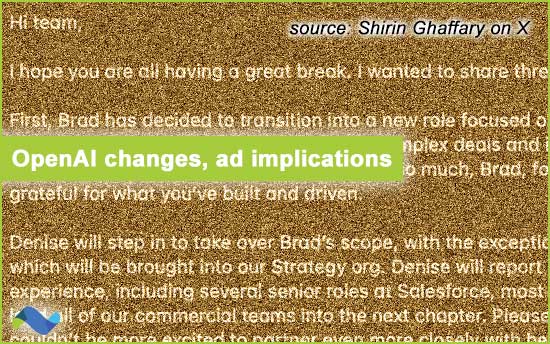
Late on Friday, OpenAI’s Fidji Simo sent out an internal memo announcing movement within the OpenAI management team.
See the memo on X via Bloomberg’s Shirin Ghaffary. (April 3)
Changes include:
- Ms. Simo, OpenAI’s CEO of AGI Development (formerly CEO of Applications), will step aside “several weeks” for health reasons.
- COO Brad Lightcap has changed to a new role in charge of “special projects” that reports into CEO Sam Altman.
- CRO Denise Dresser, who joined in December, will take over some of the duties of the COO role and report to Ms. Simo, who said, “She is the perfect person to lead all of our commercial teams into the next chapter.”
- CMO Kate Rouch is stepping aside to focus on her recovery from cancer. A search for her replacement is underway.
An OpenAI spokesperson said to Bloomberg, “We have a strong leadership team focused on our biggest priorities: advancing frontier research, growing our global user base of nearly 1 billion users, and powering enterprise use cases. We’re well-positioned to keep executing with continuity and momentum.”
Read: “OpenAI COO Shifts Out of Role, AGI CEO Taking Medical Leave” (April 3) – Bloomberg (subscription)
Related: OpenAI CEO and CFO Diverge on IPO Timing (April 5) – The Information (subscription)
From tipsheet: Ms. Simo delivered this news rather than CEO Sam Altman. Clearly she remains in her #2 role within the company — and in spite of the gravity of her health concerns.
Unofficial OpenAI ‘ad org chart’
- Ms. Simo still has advertising within her remit.
- CRO Denise Dresser, a former Salesforce executive, appears to now sit between Ms. Simo and the ad business, given the note’s reference to “lead all of our commercial teams into the next chapter.”
- Dave Dugan, who leads ad sales for OpenAI’s ChatGPT ad business, was previously reporting into Mr. Lightcap, according to The Wall Street Journal (March 23). He now appears to report into Ms. Dresser given the changes.
- Vijaye Raji, formerly of Statsig (acquired in September) and Meta, is the “CTO, Applications”, and is leading the ads push from the product side. Read tipsheet. (January 23)
- Asad Awan, another former Meta ad product executive who’s LinkedIn job title is “Monetization,” is a key team member and spokesperson for the ad product. See his ChatGPT update for March 26. He appears to be Mr. Raji’s deputy. Also see Mr. Awan as the key spokesperson for ads on the OpenAI podcast at the ad pilot’s launch. (February 9) And, he’s appearing at Profound’s GEO event, “Zero Click”, in SF this Wednesday.
- Zoheb Hajiyani, a former Instacart and Meta product executive, joined the company in February according to his LinkedIn profile. He lists his title as “Product, Monetization.” Very recently, Mr. Hajiyani has been delivering ad product updates on his LinkedIn profile. See this one supporting Mr. Awan on March 26.
- Benji Shomair, a former Meta VP, whose LinkedIn title reads “Monetization” at OpenAI. He describes his role as “Building the OAI business across Ads, Commerce, Apps, Consumer Subscriptions and beyond.” See a photo opp with Mr. Dugan in March.
- In the User Safety & Operations group, Lily Choi joined as “Monetization Safety & Operations Lead” in February. See her informative LinkedIn post last week with shoutouts to her OpenAI colleagues, Shauna O’Brien and Glen Worthington.
- Margaret-Ann Seger came over in the Statsig acquisition last year, and lists her role as “Member of Product Staff.”
- In the Finance group, Zarbux Daruwalla lists his role as “Strategic Finance” for “Product (Ads)”.
- No doubt there are many other people in this “chart.”
Last night: “If there is one good thing that can come out of having my health issues exposed to the world, it’s raising awareness for complex chronic conditions like POTS, MECFS, Long Covid or EDS.” (April 5) – OpenAI’s Fidji Simo on X
LLMs & CHATBOTS
Developments
- From Click to Command: The Shift to Agentic Payments (April 1) – Norwest Venture blog
- Hollywood Assistants Are Using AI Despite Their Better Judgment — Including in Script Development (April 3) – The Hollywood Reporter
- OpenAI co-founder Andrej Karpathy shares ‘LLM Knowledge Base’ architecture that bypasses RAG with an evolving markdown library maintained by AI (April 3) – VentureBeat
COMMERCE MEDIA
An AI-ready catalog called Eko
A Brooklyn-based company, “Eko,” is quietly, and visually, cataloguing every consumer product it can, according to a feature article in The Wall Street Journal.
Eko president Ben Kaufman explained the company’s premise in its most primitive terms, “The output of AI is only as good as the input, and there was no good input.”
The WSJ’s Sarah Nassauer continued: “The goal: to improve the accuracy of online listings for millions of products at Walmart, Best Buy and other retailers and make them easily digestible by artificial intelligence. It is a decidedly manual process. Hundreds of Eko employees work to shoot products from every angle on movie-studio-style stages, shifting lighting or buffing out fingerprints on metal surfaces as needed.”
The company was founded in 2016 and, today, Eko generates ‘tens of millions’ in revenue and has raised a $300 million investment through a Walmart joint venture.
Regarding Eko’s data, Nassauer reported:
“Eko owns all the product information it creates, then leases a product’s ‘Eko file’ to brands or retailers, giving it the freedom to make accuracy a priority.
Recently, a pillow seller complained that Eko’s images didn’t make its pillow look fluffy enough, said [eko founder Yoni Bloch]. ‘We were like, “But the pillow isn’t fluffy,”’ he said. So they didn’t change the image. Realistic images can reduce a retailer’s return rates, and if an item is what a shopper wants, it can boost sales, he said.”
Read: “One Company’s Effort to Make an AI-Ready Catalog of Everything We Buy” – The Wall Street Journal (subscription)
More: The History of Eko, and the Future of Retail” (2021) – LinkedIn
From tipsheet: No mention of an Eko ad business in the article. There’s gotta be one tied to creative or data given the company’s ability to provide unique and scaled context on consumer products. Large language models would likely enjoy access as the article intimates, too.
This is similar to YouTube providing a transcript for a video podcast which then makes the podcast and its context more accessible to AI search.
MARKETING
Travel marketing’s AI identity crisis
“With such a rapid evolution, questions swirl around what travel marketing’s future looks like: How will visibility change? How will advertising work on AI platforms? Will AI overshadow social media marketing in the age of the influencer? (…)
Travel companies are focused on boosting visibility as more consumers rely on AI, with 56% in the U.S. using AI for travel, according to Phocuswright Research. As a result, brands are working to improve generative engine optimization (GEO) and answer engine optimization (AEO)—and search engine optimization (SEO) still matters, too.”
Read: “Travel Marketing’s AI Identity Crisis” (April 2) – Phocuswright
LLMs & CHATBOTS
Q&A: Mobian CEO Jonah Goodhart on GEO product
Last week, AI-enabled ad technology firm Mobian announced a new generative engine optimization (GEO) product for brands, creating additional commercial opportunities for publishers.
Speaking to the product’s contextual capabilities, Time COO Mark Howard said on LinkedIn about his company’s latest partnership, “By cross-referencing brand ads and sentiment against AI prompts, Mobian provides the data-driven insights necessary to track and score how closely AI platforms match a brand’s true positioning.” Read more. (April 1)
More: “Time pitches GEO insights into a new brand offering” (March 31) – Digiday
Mobian CEO Jonah Goodhart answered follow-up questions from tipsheet via email including…
tipsheet: “What is Mobian seeing regarding LLM citation volatility across engines? How fine can orchestration get?”
Jonah Goodhart, CEO, Mobian: “Every engine is different, and that matters. In a recent portfolio analysis across 23 products and 5,400+ citations, OpenAI had the highest flag rate at 21%, Perplexity had the lowest at 14% but with nearly 5x the citation volume, and each engine has different source preferences and refresh cycles.”
“Another interesting finding is persistence: we’ve seen recall articles from years ago still being surfaced on neutral brand prompts, with AI engines latching onto sources and citing them long after the issue is resolved. You can’t control what any engine cites on a given query, but you can influence the source ecosystem, and that’s where publishers like Time with strong domain authority become valuable. It’s about making sure credible, on-message content exists where AI looks.”
“The takeaway is that citation behavior is highly fragmented across engines, which makes measurement and comparison critical.”
Additional questions included:
- How do you determine whether something is aligned or not?
- Is managing LLM citations a daily battle? Any best practices?
- What are the traits of a publisher for GEO? Does it need to look like Reddit?
- What unique capability is Mobian bringing?
Read Q&A: “Q&A: Mobian adds GEO product for publishers, brands” (April 5) – tipsheet
PLATFORMS
Meta’s human override for AI ad platform
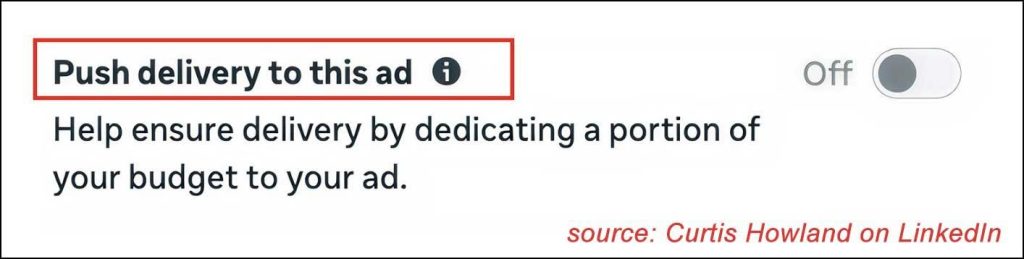
Meta is enabling marketers with the ability to funnel more budget to individual creative as the marketer receives signal outside of Meta’s AI-enabled ad ecosystem which Meta’s Advantage+ targets. The button is labeled “Push delivery to this ad.”
On LinkedIn, marketer Curtis Howland said the new feature “lets you test new ads without duplicating ad sets or resetting learning phase.”
Going deeper on the new manual override:
“So why would they give us a NEW manual ad budget feature? It’s because we have data that Meta doesn’t.
Example scenarios:
- The ad that’s getting budget is driving purchases to a product with 40% margin. You want to spend on an ad that drives to a 70% margin product. But Meta doesn’t know that.
- You want to push into a product that performs well seasonally, but Meta doesn’t know that.
- An external scenario on TikTok, Email, Retail or culture is driving heavy sales temporarily and you want to capitalize. Meta doesn’t know that.
- Meta is choosing to optimize for an ad that gets sales and keeps users on their platform longer. While another ad gets sales but is less favorable to Meta’s unit economics. Meta doesn’t like that.
- Your MTA is showing one ad with a longer conversion cycle is converting really well but Meta is losing the cookies, you want to lean into that.”
Mr. Howland concluded, “This is a positive step for Meta.”
Read more on LinkedIn. (April 5)
 Related: Meta’s “Describe Your Audience” AI Feature for Detailed Targeting (March 31) – Jon Loomer
From tipsheet: Meta CEO Mark Zuckerberg’s goal of fully automating ad creative and targeting by the end of this year will come with some asterisks.
The AI ad future will be managed by humans in all cases and to varying degrees.
BRANDS
IAB Tech Lab, AAO connect publicly
IAB Tech Lab Chairman Neal Richter, a vice president at Amazon DSP, publicly reached out to AgenticAdvertising[dot]Org leadership late last week signaling a potential thaw between the Tech Lab and AAO.
In a comment to a LinkedIn post by Scope 3 CEO Brian O’Kelley about Ad Context Protocol and supply path optimization (SPO), Richter said: “Happy to discuss ways to fix/evolve/replace ads[dot]txt Brian. It stands for Authorized Digital Sellers. A Seller is an agent in the prior sense of the word. Your ‘which’ questions are good ones, and ones that were considered. The preference was to keep it simple 10 years ago, and keep extending. I always appreciated the depth of thought on data models/schemas at AppNexus.”
Mr. O’Kelley responded: “Neal Richter would love your help!! Join the AAO slack & I’ll get you in the working group.”
See more on LinkedIn. (April 3)
From tipsheet: IAB Tech Lab has argued that any new protocol — such as AdCP — should be built upon existing standards which it currently oversees in partnership with industry. The founding consortium behind AdCP has taken a different tack and is trying to create a framework independent of Tech Lab’s oversight.
AGENCIES
Relationships and future of media buying
Last week’s acquisition of sports marketing agency 160over90 by agency holding company Publicis was a topic of conversation in the latest episode of the Marketecture podcast.
Marketecture’s Ari Paparo saw it as a strong move by Publicis into a great market — sports — and said, “I’m loving Publicis’ acquisition strategy. They’re acquiring influencer agencies, sports agencies, retail media. And in every case, it’s not really tech. It’s tech-adjacent with lots of people involved in relationships. It seems like the future of where media buying is going. And quite a smart set of acquisitions.”
Listen: “How Infillion bought Catalina and How It Fits with Catalina” (April 3) – Marketecture on Apple Podcasts app
From tipsheet: Human relationships matter even more in the age of AI.
ENGINEERING
Agentic standards undercurrents
“There’s a lot of debate about agentic standards right now. The truth is things are moving fast. This is the most interesting and exciting thing I’ve seen in our space in a few weeks and how it adapts to agentic marketing and ads use cases is where I’m spending my time.” – Former Amazon DSP product executive Brian Tomasette on LinkedIn (April 3)
Read: “Gas Town: from Clown Show to v1.0” – Former Google and Grab ads engineer Steve Yegge on his Medium blog (April 3)
MORE
- RecSys, ad ranking, and the AI advertising opportunity (April 3) – Eric Seufert, analyst on Mobile Dev Memo (subscription)
- Real-Time AI Video Is Nvidia’s New Pitch to Agencies—and It’s Turning Creatives Into Curators (April 1) – Adweek (subscription)
- Opinion: From Trend Spotters To Strategic Translators: How AI Is Reshaping The Marketing Scientist Role (April 2) – Chris Albert, SVP, Rapp on AdExchanger
- “Target has a warning if you use Google’s AI to shop” (March 30) – Business Insider (subscription)
- Introducing Helix AI: Health Intelligence that Meets You Where You Work (April 1) – DeepIntent