
PubMatic announced Decision Fabric, a new capability within AgenticOS that allows AI models to run directly within the programmatic supply path.
CEO Rajeev Goel described the vision on LinkedIn:
“Excited to launch PubMatic’s Decision Fabric, a containerization solution paired with our agentic stack. I wonder if there is a future where innovative DSPs are highly tailored AI agents leveraging our inventory scale (100K streamers/apps/sites), our containers running in our owned and operated infrastructure, our planning/buying/reporting/measurement agents, and our 300+ data partners. A brand might use dozens of agents that are specific to each campaign objective.”
Read it. (June 1)
A press release explains more about the containerization layer and the impact on the buy side:
“For DSPs in particular, Decision Fabric represents a direct entry point into AgenticOS, with the ability to run their decisioning logic inside an environment where PubMatic’s own agents are already operating and can actively call on it. If a DSP deploys an audience model via container, PubMatic’s inventory and audience agents can invoke that model directly to sharpen campaign targeting or surface higher-value deals.”
Pilot partners include Chalice AI, MiQ, inPowered AI and SWYM[dot]AI.
Read: PubMatic Launches Decision Fabric on AgenticOS (May 20)
From tipsheet: The most important shift here may not be AI agents but where intelligence runs.
Historically, optimization models operated outside the auction environment and pushed decisions into DSPs, SSPs and other execution systems. Decision Fabric moves those models closer to the transaction itself, allowing specialized AI models to operate directly within the auction environment.
The announcement also echoes themes from Index Exchange’s Index Cloud product, announced in April, which allows partner models to run closer to marketplace activity rather than through multiple intermediary layers. Notably, inPowered AI and Chalice AI are participating in both initiatives.
Overall, these developments suggest parts of the industry are beginning to build the infrastructure required for advertiser-owned audience, value, measurement and creative models to operate closer to the decision itself. The battle may ultimately be less about who owns the data and more about who owns — or becomes indispensable to — the feedback loop.
LLMs & CHATBOTS
Developments
- Anthropic confidentially submits draft S-1 to the SEC (June 1) – Anthropic
- OpenAI frontier models and Codex are now available on AWS (June 1) – OpenAI
- MiniMax M3: Frontier Coding, 1M Context, Native Multimodality — All in One Model (June 1) – Minimax
DATA
Hightouch races to replace LiveRamp
Hightouch, which positions itself as a “Composable CDP and Agentic Marketing Platform,” announced Exposure Log Matching for The Trade Desk.
A press release explained:
“The new Match Booster capability resolves The Trade Desk’s Raw Event Data Stream (REDS) logs directly to a brand’s own customer and household IDs, landing the data in the customer’s warehouse for measurement, reporting, and AI analysis.
The Trade Desk gives advertisers a detailed record of every impression, click, and conversion, along with metadata like placement, ad dimension, frequency, and more. But those events arrive behind anonymous identifiers like UID2s, mobile device IDs, and cookies. Until they resolve to consent to customer records, the data describes a campaign, not a customer journey.”
The product aligns with Hightouch’s composable CDP strategy of unifying customer profiles in the data warehouse.
Ian Maier, GM of AdTech at Hightouch, explained in the release, “Exposure Log Matching gives brands and media networks control over the bridge between ad exposure and business outcomes.”
Read: Hightouch Launches Exposure Log Matching for The Trade Desk – press release
More:
- “This New Tool Cuts Out Identity Providers By Linking Trade Desk Data With Brands’ First-Party IDs” (June 1) – Adweek (subscription)
- The Trade Desk – Hightouch Docs
LiveRamp and agentic creative
Separately, in an article in The Trade Desk’s The Current, Hightouch co-CEO Kashish Gupta is open about his company’s pursuit of LiveRamp’s business now that it has been acquired by Publicis:
“We’re very thrilled for the LiveRamp folks. I think it’s a good outcome for LiveRamp as well as for Publicis. We are now one of the best independent players in the space. And that allows a brand that does not work with Publicis to find a partner that’s quite democratic and independent, that will help them build their own identity spine.”
He also previewed his company’s agentic product strategy which extends beyond identity and data activation into creative generation:
“It is our No. 1 priority because creative is the biggest bottleneck right now in the marketer’s workflow and in the overall advertising workflow. Most brands’ personalization [efforts] are held back by the amount of content variation they have rather than by the data that they have.
The creative generation product [which would be our third product] is in the early stages. But that’s where we’re most bullish.”
Read: Why Hightouch’s top agentic priority is generative creation (June 1) – The Current
From tipsheet: Hightouch is positioning itself as a warehouse-native alternative to LiveRamp. It’s not surprising to see that Snowflake and Databricks are among its partners.
Rather than relying on an external identity layer, the company wants the advertiser’s own customer graph to become the system of record for measurement, activation and AI. As Publicis integrates LiveRamp, independent competitors are likely to emphasize neutrality, portability and customer ownership.
But Hightouch is also signaling ambitions beyond identity and activation. Gupta’s comments suggest another shift: creative, not data, may become the bottleneck. If identity, measurement and customer data become easier to operationalize, competitive advantage may shift toward generating enough content variation to act on those signals.
DATA
Google updates
- Data Manager API now supports sending events to Google Marketing Platform destinations and IP ingestion for Google Ads Customer Match (May 28) – Google Ads Developer blog
- Google Begins Limited Test Of Healthcare Ads In AI Mode (June 1) – SE Roundtable
TECH
Opinion: Agentic protocols promise transparency
Marketing consultant Sarah Caputo wrote in an op-ed on AdExchanger:
“Transparency was always the promise. Opacity was always the product.
That structure is now being dismantled by an AI-underpinned protocol stack that moves the intelligence layer into the open. It is called the Agentic Advertising and Management Protocol (AAMP).
AAMP, together with MCP underneath it and AdCP being built on top, is the first architecture in 20 years that can truly deliver on the open internet’s original promise. Not because the ambition changed. Because the plumbing finally caught up.”
Related: Opinion: “From Open Internet to Open Agent: The Architecture Buyers Were Promised Is Finally Here” (June 1) – Sarah Caputo on AdExchanger
MEASUREMENT
Amazon reduces data fees for Marketing Cloud
Amazon Ads Ad Tech Partnerships executive Eleanor Nadal-Wei announced an update on Amazon Marketing Cloud (AMC) fees yesterday:
“Starting today through December 31, 2026, Amazon 1P paid features signals are FREE to query for both audience creation and measurement/insights use cases. Just subscribe through the Paid Features page to start running measurement queries and building audiences using these signals at no additional cost. (Note: third-party paid features signals like Experian still require a subscription fee.)
If you’ve been on the fence about testing these Amazon signals — now is the time. There’s zero financial risk to experiment.”
Read more on LinkedIn. (June 1)
Potential implications
- Third-party data providers: Amazon specifically notes that third-party paid features such as Experian still require a subscription fee. Free access to Amazon-owned signals could raise the bar for paid alternatives.
- Measurement workflow: The move may encourage more audience creation and measurement activity inside Amazon Marketing Cloud rather than external environments.
- Competing data environments: By reducing the cost of using Amazon’s own signals, Amazon may make AMC more attractive relative to other data and measurement environments.
From tipsheet: Amazon is reducing friction around the measurement layer because the value isn’t the signal itself. The value is getting more advertisers operating within Amazon’s advertising feedback loop, which could ultimately strengthen Amazon DSP.
TECH
Green highlights opportunity amid reset
The Trade Desk CEO Jeff Green shared part of a recent interview with a candidate for a senior leadership role:
“I think there is so much upside and opportunity at TTD in this moment. While you’re resetting on some levels, that’s liberating. It creates a healthy exercise for the team to think about what it really values. All of this looks like opportunity to me.
There are so many businesses whose best chance of growing their brand or their business depends on TTD, OpenTTD, and the data we provide.”
Read more on LinkedIn. (June 1)
Related: The Trade Desk Announces Nate Olmstead as Chief Financial Officer (June 1) – The Trade Desk
From tipsheet: Green appears to be acknowledging reality while attempting to redefine it.
LLMs & CHATBOTS
LLMs inside recommendation systems
Mobile Dev Memo’s Eric Seufert highlighted an April Netflix TechBlog post describing how the company built an “LLM-as-a-Judge” system to evaluate show synopses.
Rather than generating consumer-facing content, the system scores synopses against four expert-defined criteria: precision, tone, factuality and clarity. Netflix found that the resulting quality scores correlated with user engagement metrics.
Read: “Evaluating Netflix Show Synopses with LLM-as-a-Judge” (April 10) – Netflix TechBlog
On Sunday, Seufert argued that the project points to a broader use case for LLMs:
“Many projects aimed at integrating LLMs into consumer-facing product features focus on generating content, which I think is mistaken. The power of LLMs for consumer-facing tasks is often better invoked through systems that rank, sort, classify, etc. at scale according to well-defined expert evals.
Most large consumer platforms don’t need more content; they need to better rank their existing content for some purpose.”
Read more on LinkedIn. (May 31)
From tipsheet: The AI conversation is often framed as LLMs versus recommendation systems. Netflix suggests another possibility: LLMs inside recommendation systems. Rather than generating content, they may increasingly help rank, classify and evaluate content at scale.
Related: “Meta already has what other chatbot operators don’t: a high-performance advertising platform. Adopting subscriptions feels like a clumsy attempt to adapt to investor expectations rather than reshape them.” (June 1) – Eric Seufert on Mobile Dev Memo (subscription)
EVENT
Webinar: ChatGPT ads and Pacvue
Pacvue is hosting a June 10 webinar on ChatGPT ads with Jocelyn Jeffries of Pacvue, Nathan Lam of OpenAI and Grace Mante of Kepler.
The session will cover how ChatGPT ads work, early learnings from live campaigns, what has surprised Pacvue and Kepler so far and how brands can join Pacvue’s OpenAI Beta Program waitlist.
Read more about the webinar from Pacvue Co-Founder and President Melissa Burdick on LinkedIn. (June 1)
TECH
Where value accrues in ad tech
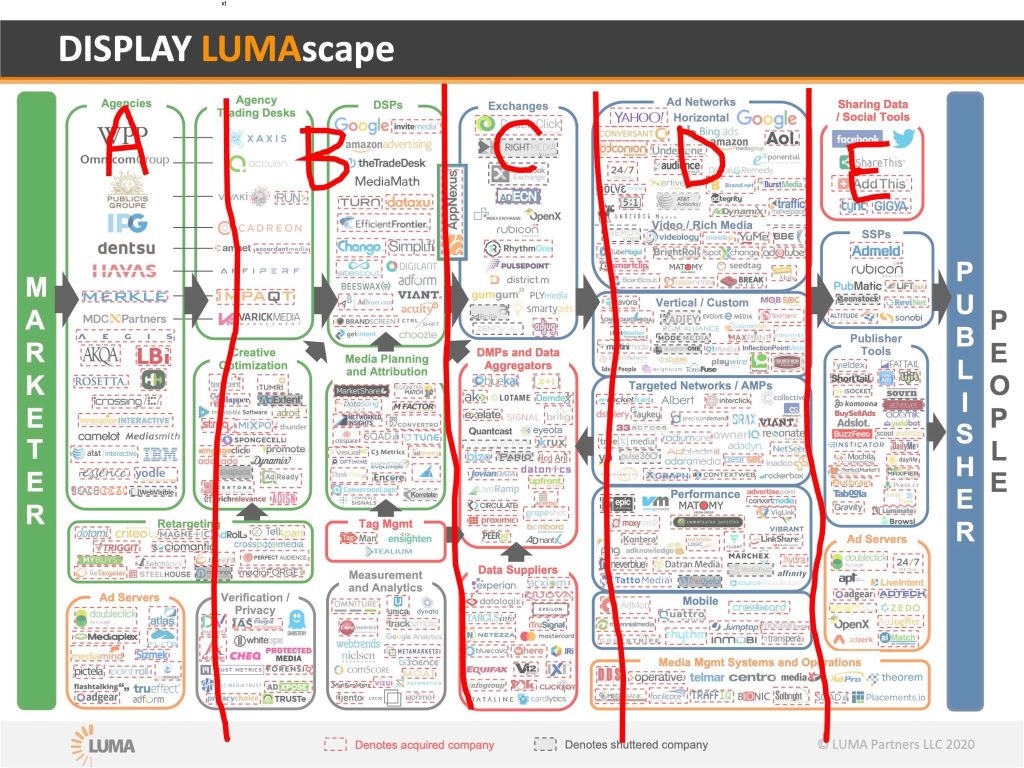
LUMA Partners CEO Terence Kawaja posed a question on LinkedIn yesterday:
“You have $10 million to invest in one of these 5 areas of Ad Tech. Which do you choose?”
The accompanying graphic divided the ad tech ecosystem into agencies, DSPs, data, exchanges and publisher tools.
See the discussion on LinkedIn. (June 1)
From tipsheet: The industry’s dividing line may no longer be DSPs versus SSPs. It may be companies that own feedback loops versus those that don’t.
TECH
Explainer: How embeddings work
Bedrock Platform engineer Damian Naglak shared a useful explanation of embedding models, which convert text into numerical representations of meaning that allow AI systems to match concepts rather than exact keywords.
He wrote:
“The turning point came when researchers showed you get better numbers by starting from a full LLM, the kind that powers chatbots, and repurposing it for that same job instead. Google’s current embedding model is built straight from Gemini, others from Qwen or Llama. Embedding models are ranked against each other on a public benchmark called MTEB, and its leaders today are almost entirely repurposed LLMs.”
Naglak argued that embeddings only work when both parties use the same model because each model creates its own “private map of meaning” in which the same text can occupy different positions.
Read more on LinkedIn. (June 1)
From tipsheet: One way to think about embeddings is as GPS coordinates for ideas. Instead of matching keywords, AI systems match meaning. Naglak’s post is another example of how frontier LLMs are evolving from standalone chatbots into core components of search, retrieval and recommendation systems.
PEOPLE MOVES
- Amy Oelkers joins The New York Times Advertising as SVP of Advertising Sales (June 1) – LinkedIn
- OpenAI Taps Salesforce Executive Brian Landsman to Lead Global Partnerships (June 1) – The Information (subscription)
- Outgoing Prebid president Mike Racic joins Knower Tech as Managing Director – Digiday (subscription)
MORE
- Opinion: “Why the Industry Needs to Stop Talking About Neutrality” (June 1) – Doug Rozen, President, Cadent on Adweek
- Reviewing McKinsey’s 10th global B2B Pulse Survey, which draws on nearly 4,000 decisionmakers, “finds that the digital capabilities B2B organizations spent a decade building are now just the price of admission.” (June 1) – The Drum
- Meta AI Gave Access to High-Profile Instagram Accounts (June 1) – 404 Media
- Why you see that ad: Inside the invisible auction called programmatic advertising (June 1) – Storyboard18