

Earlier this week, tipsheet highlighted how Shopify’s new Campaign Autopilot uses the company’s commerce data to help merchants manage marketing across channels.
In a new interview with AdExchanger, Shopify VP Samir Pradhan added more detail, saying the product is designed to allocate spend across Google Performance Max, Meta Advantage+ Shopping Campaigns, Shop Campaigns and future partners including ChatGPT.
Pradhan told AdExchanger’s James Hercher, “We find so many merchants basically telling us that they are spending on ads today and they don’t see the return. This is our attempt to basically say, ‘We can drive more out of that.’”
Shopify does not take a CPM, media or sales commission from these products, instead positioning them as merchant services designed to improve growth.
Read: Shopify Wades Deeper Into Advertising, But Not Ad Tech (June 24) – AdExchanger
From tipsheet: As tipsheet noted earlier this week, Shopify looks like more than an ecommerce platform.
Campaign Autopilot suggests Shopify intends to use its growing commerce graph not simply for measurement or targeting, but to help merchants allocate marketing spend across multiple advertising platforms.
Shopify’s key advantage is that it knows the transaction.
While Google and Meta optimize within their own black box AI advertising systems, Shopify can use merchant transaction data to optimize marketing decisions across connected channels. As advertising becomes more automated, the strategic question may no longer be who has the best inventory, but who decides where the next marketing dollar goes.
The obvious next question is whether cross-channel allocation becomes a new layer of the marketing stack. If Shopify is any indication, other commerce platforms that also know the transaction—such as Amazon and Walmart—could be well positioned to build similar capabilities.
LLMs & CHATBOTS
Developments
- OpenAI and Broadcom unveil LLM-optimized inference chip (June 24) – OpenAI
- Introducing computer use in Gemini 3.5 Flash (June 24) – Google The Keyword blog
- Meta plans to release AI-powered prediction market app, documents show (June 24) – NPR
LLMs & CHATBOTS
OpenAI highlights ad dismissals
OpenAI may be introducing a new advertising metric for conversational AI.
OpenAI CRO Denise Dresser said ad dismissals in ChatGPT have fallen 50% since the company launched advertising in February, sharing the metric at Cannes.
Search Engine Land reports:
“OpenAI says the rate at which users dismiss ads within ChatGPT has fallen by 50% since the company launched its advertising business in February. The company views ad dismissals as a proxy for relevance…”
Read: OpenAI says ChatGPT ad dismissals have dropped 50% as relevance improves (June 24) –Search Engine Land
Related: OpenAI’s Cannes pitch to CMOs and agencies: AI is now an operating model for advertising (June 23) – Best Media Info
From tipsheet: By highlighting the metric, OpenAI is signaling that success isn’t simply whether users click an ad, but whether the ad feels relevant enough to remain part of the conversation.
Side note: Advertising has traditionally interrupted content. Conversational advertising may become part of it.
RESEARCH
McKinsey: From campaigns to continuous growth
In new thought leadership, a team of McKinsey partners argues that AI is pushing marketing beyond the campaign era and toward what it calls a “continuous growth engine” built around five connected capabilities: continuous insights, scaled creativity, hyperpersonalization, agentic commerce, and always-on orchestration.
The central theme:
“The future of marketing will not be defined by how well organizations use AI tools but by how well they connect insight, creativity, personalization, agentic commerce, and execution into a single, continuously improving system. For CMOs, the task is to design that system so that the benefits of AI finally move from a promising opportunity to the bottom line.”
Read: “From campaigns to continuous growth: AI capabilities shaping marketing” (June 22) – McKinsey & Co.
From tipsheet: McKinsey is describing a marketing operating system rather than a collection of AI tools.
As AI capabilities become increasingly modular and composable, orchestration may become the most important marketing capability of all.
PLATFORMS
Microsoft Advertising’s AI economy thesis
Microsoft CEO Satya Nadella has been explicit recently about his vision for an AI economy in which value extends beyond AI model companies.
What could that mean for ads and Microsoft Advertising, specifically?
On June 14, Nadella wrote on X:
“In my view, our priority has to be building a frontier ecosystem, not just a frontier model, so value flows broadly across every company, every industry, and every country. One where every organization can own the learning loop that encodes its institutional knowledge, compounding its human and token capital.”
A June 17 Microsoft Advertising blog post by Microsoft AI CVP Rukmini Iyer provided a framing around a “new AI economy”:
“For marketers, the challenge is navigating three eras of the web simultaneously. You have to transform your business to win with LLMs and agents, while continuing to serve human customers who research and buy on your website. Every solution we’re announcing ahead of Cannes Lions helps you succeed with four key moves…”
The post brings together a series of recent initiatives, including AI Visibility in Clarity, Brand Agents, Web IQ, Universal Commerce Protocol, Merchant Center updates, MCP integrations and publisher monetization efforts.
Read: Building a new AI economy that creates value for everyone (June 17) – Microsoft Advertising blog
From tipsheet: This reads less like a product announcement and more like a strategic blueprint: Google is making Search AI-native; Meta is making advertising AI-native; and Microsoft is building infrastructure for the AI economy.
A broader theme emerging across the industry is that advertising is becoming part of the operating infrastructure of the business rather than a standalone marketing function.
BRANDS
“The Slide Getting Traction At Cannes”
According to MediaPost’s Joe Mandese, a slide presented by WARC Insight Director Aditya Kishore was making the rounds at Cannes.
Kishore said of the slide, “What it’s basically telling us is that brand is actually going to be more important in an AI era, not less.”
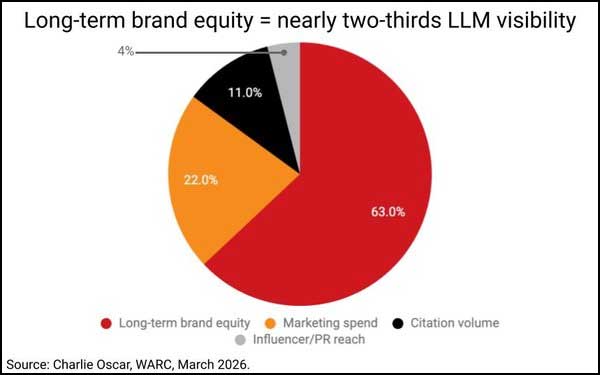
Read: “In Case You Haven’t Seen It, Here’s The Slide Getting Traction At Cannes” (June 24) – MediaPost
From tipsheet: AI systems infer reputation from the signals brands accumulate over time. A brand needs to be machine-readable.
Related: “Cannes Lions Was Melting, AI Was Everywhere, Live Streaming & Commerce Got a Word In” (June 24) – Anthony Katsur, CEO, IAB Tech Lab on LinkedIn
PLATFORMS
Meta: AI is a threshold technology
In announcing new AI creative and creator tools at Cannes alongside expanded capabilities of its Business Agent, Meta reiterated its belief that AI is a threshold technology.
With its creative/creator solution, the company emphasized “an end-to-end creative solution that makes AI-enabled ad creation accessible to every marketer, unified creator partnership tools that turn authentic content into high-performing ads, and AI-enabled experiences that connect directly with your customers.”
Underpinning — and hyperlinked from — the Meta press release was a piece titled “AI is a Threshold Technology” by Alex Schultz, Meta’s CMO and VP of Analytics, who wrote on LinkedIn last week:
“You try the products, they don’t quite meet the bar — until, suddenly, they do. When capability crosses into everyday usefulness, it feels sudden, even transformative, even though it’s been building all along.”
Read: Cannes Lions 2026: New Creative and Creator Tools for Every Marketer to Cross the AI Threshold (June 23) – Meta
More: AI is a Threshold Technology, Are You Ready to Cross It With Us? (June 17) – Alex Schultz, CMO & VP Analytics, Meta on LinkedIn
From tipsheet: Meta argues that AI has crossed the threshold from experimentation to utility across the marketing workflow—from creative generation and creator partnerships to customer conversations.
The broader idea is that thresholds are crossed when technology becomes useful enough to change how people work.
CONNECTED TV
Roku leans into performance TV
Following Fox’s agreement to acquire Roku last week, Patrick Harris, the company’s new advertising chief, says Roku has an opportunity to win advertising budgets traditionally allocated to search and social, arguing that connected TV can deliver measurable business outcomes.
Adweek’s Ryan Joe notes that Roku has shifted its strategy from encouraging marketers to buy through its own DSP, DataXu, to making its inventory broadly available through third-party demand-side platforms.
Read: “Roku’s new ad chief reveals how he’ll steal search and social budgets amid looming Fox acquisition” (June 24) – Adweek
From tipsheet: Every TV company wants brand budgets. The difference is that CTV platforms are increasingly competing for performance budgets traditionally allocated to search and social. Performance TV is becoming one of advertising’s fastest-moving strategic battlegrounds.
MORE
- Time and Axios turn AI prominence into advertising revenue (June 24) – Press Gazette
- Inside 3 app developers’ quests to transcend creative limits using AI (June 23) – Think With Google
- Consumers are sick and tired of hearing about AI all the time (June 24) – Marketing Brew
- Gap Inc. Leverages AI to Optimize Marketing and Personalization (June 22) – Women’s Wear Daily (subscription)