
With the release of SpaceX’s S-1 filing in advance of its IPO, so too are more details on its X subsidiary and its ad business. And what may be most amazing is just how much advertising is a part of the S-1 (at least 78 mentions) for a space-focused company.
On the X ads front, revenues bounced off of their 2024 lows of $1.73 billion to $1.84 billion last year. In its last full year before Elon Musk bought Twitter, the company had over $4 billion in revenue in 2021, notes The Hollywood Reporter.
Read: “Elon Musk’s Grandiose Media Ambitions Are Now a Real Threat to Some Major Players” (May 26) – The Hollywood Reporter
The S-1 explains that advertising is core to monetizing SpaceX’s AI investment, which includes large language model maker xAI and its Grok chatbot.
The S-1 also suggests Grok itself may evolve into an advertising surface:
“Advertising remains a core monetization channel for our AI segment, with revenue driven by our ability to deliver highly relevant ads. We aim to grow advertising revenue per user by strengthening performance advertising, expanding AI‑driven targeting and measurement, and introducing richer ad formats and creative tools. A central focus of ours is making ads feel like content—contextually relevant, aligned with user interests, and integrated into real‑time conversations. Grok increasingly supports this strategy by helping advertisers with campaign creation, creative optimization, and alignment with trending topics and user intent. While these factors help us drive advertising revenue, the pricing of our advertising products is also affected by other factors, including the global economy and the highly competitive nature of our industry.
We believe continued investment in AI‑powered advertising will further improve advertiser ROI while further enhancing user experience.”
Read: Space Exploration Technologies Corp (SpaceX) – Form S-1 (May 20) – SEC.gov
More: For Creators — “Interview: X Is Making a Major Creator Push, Launching Ad Product to Connect Brands and Users (Exclusive)” (May 18) – The Hollywood Reporter
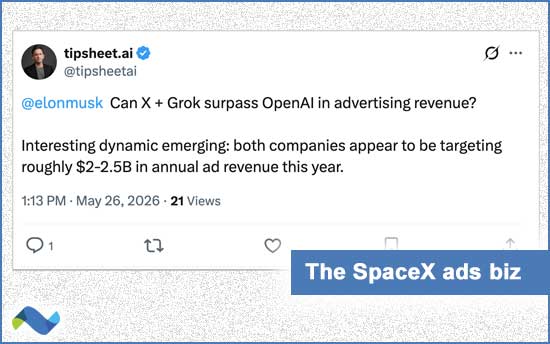
From tipsheet: X provides xAI with a live social graph — something competitor OpenAI does not have. If X continues improving its ad product, the roughly $2 billion business could grow materially from here. Recall that OpenAI’s reported ad revenue goal is $2.5 billion this year.
Do you think that Elon Musk would like to beat Sam Altman when it comes to ad revenue—let alone chatbot ad revenue? Something to watch.
One long-running outside thesis around OpenAI is that consumer AI products may ultimately require advertising-supported economics to scale profitably — regardless of management’s historical discomfort with ads. SpaceX’s S-1 suggests X, and potentially Grok itself, may be evolving toward a similar model.
LLMs & CHATBOTS
Developments
- Mistral AI Takes Aim at Legal Sector Through Expanded Harvey AI Partnership (May 26) – The Wall Street Journal
- Tech titans prepare for blockbuster IPOs in new front of AI race (May 26) – The Hill
- Big Four consulting has 2 AI nightmares. KPMG’s answer to both is the same (May 26) – Fortune
AGENCIES
‘Middlemen’: Omnicom eyes ad tech margins
Digiday’s Jessica Davies reports that Omnicom agencies are encouraging buyers to route more spend directly to publishers and away from ad tech intermediaries.
But publishers aren’t convinced there is a new windfall on the horizon. In fact, agencies may be trying to protect or expand their own margins.
Davies wrote:
“Four execs Digiday spoke to, who asked to remain anonymous to protect relationships, said that any holding group reaffirmations about investing in publisher-owned tech is more politically convenient than anything that could move the needle for publishers. ‘In all this noise about AI and supply-path clean-up, holding groups still need to be seen to back journalism and publisher initiatives,’ said one exec.“
The shift aligns with recent comments from Omnicom CEO John Wren, who said agentic media buying is fundamentally about “shortening the media supply chain” and creating more direct publisher connections. Wren argued that reducing “hops” in the supply path improves targeting fidelity and media effectiveness, particularly when combined with identity and data assets like Acxiom and Omni.
Read: “Omnicom’s ‘fewer middlemen’ push is reaching publishers – just not their P&Ls” (May 26) – Digiday
From tipsheet: Omnicom’s Wren is digging for margins. The fight with middlemen centers on who captures the economics between the advertiser and the impression: agencies, DSPs like The Trade Desk or other intermediaries. See Publicis/The Trade Desk.
Wren’s “agentic media buying” framing may partly be about margin capture dressed up as AI strategy. But the underlying premise still matters: AI systems increasingly reward whoever sits closest to decisioning, data and supply. As automated buying systems optimize in real time, improving signal fidelity, execution speed and direct access to inventory may become strategically more important than simply aggregating impressions.
Related to “middlemen” auditing: “How to audit your ad tech relationships before problems surface” – Ad Age (subscription)
LLMs & CHATBOTS
‘Middlemen’: Marketers eye ChatGPT ad partners
The self-serve advertising interface now publicly available to ChatGPT advertisers was the subject of a report from The Information yesterday.
Beyond large brands, agencies and ad tech firms, OpenAI’s self-serve push is also aimed at unlocking the enormous aggregate spending power of SMB advertisers as it scales ChatGPT ad revenue.
The Information’s Ann Gehan reported:
“OpenAI executives have told some outside ad technology firms that one priority is courting small local businesses, such as car washes or dry cleaners, a person who spoke with them said. It’s also launching features more tailored to smaller advertisers in general, an agency executive said, including ads designed to prompt consumers to take action, like making a purchase, booking an appointment or submitting a contact form.”
Later in the article, OpenAI’s pixel for conversion tracking is said to be rolling out this week, coinciding with the recent launch of a Conversion API.
And good news for agency and ad tech partners:
“Some ad-buying firms say they’re already shifting to buying ads through outside firms instead of from OpenAI directly, in part because of the added capabilities those firms can provide.
‘When you think about partners that they’ve opened up to, this could go in a lot of different ways in terms of deeper data integrations or commerce experiences or rich creative,’ said Deanna Cullen, vice president of media investment at Wpromote, which works with clients including Vuori and Aritzia.”
Read: “OpenAI Targets Smaller Advertisers With New ChatGPT Ads” (May 26) – The Information (subscription)
From tipsheet: The real segmentation may not be “small vs. large” advertisers, but advertisers seeking scalable self-serve performance versus advertisers seeking an edge.
OpenAI’s self-serve interface expands access to ChatGPT ads much the way Meta and Google historically scaled their platforms. But as measurement infrastructure matures, agencies and ad tech intermediaries are also positioning themselves as the edge for advertisers seeking to extract more performance from the system.
TECH
Podcast: Alphabet CEO Sundar Pichai on AI era
Listen: “How Sundar Pichai is rethinking Google for the AI era” (May 26) – Alphabet CEO Sundar Pichai on Decoder with Nilay Patel
SELL-SIDE
Microsoft says publishers need AI bots
Microsoft is telling publisher partners that preparing for the AI future means allowing AI systems to crawl website content.
AdExchanger’s Anthony Vargas reported that Microsoft AI VP of publisher product Nikhil Kolar distinguished between AI models using publisher content for “training” versus “grounding.”
“[Kolar] pointed to a distinction between using publisher data for ‘training’ and using it for ‘grounding’ AI models. (…) Microsoft’s focus with its publisher marketplace is on the latter, Kolar told AdExchanger.”
Microsoft opened its Publisher Content Marketplace (PCM) earlier this year.
Read: Microsoft To Publishers: Don’t Block The AI Bots (May 26) – AdExchanger
From tipsheet: The publisher debate around AI bots may be shifting from “allow versus block” toward which bots get access and for what purpose. Microsoft appears to be arguing that “grounding” AI systems with current publisher content differs economically from training foundation models on massive amounts of historical web data.
The most important person at a publisher these days may be the ad operations specialist responsible for the robots.txt file.
PLATFORMS
Meta’s Manus deal unwind
Read: China Expands Travel Curbs to Top AI Talent at Private Firms (May 26) – Bloomberg (subscription)
Related: Manus Weighs Raising $1 Billion to Unwind Meta Takeover (May 21) – Bloomberg
MEASUREMENT
Unity’s AI tech extends to Day 28
Zacks equity research analyst Vasundhara Sawalka recently reviewed the prospects for Unity on Yahoo Finance.
Among several observations, Sawalka highlighted the innovation Unity’s Vector AI engine is bringing to clients:
“Unity’s advertising technology push is increasingly centered around Vector, the company’s machine-learning platform focused on targeting, prediction and measurement improvements. Vector has supported stronger campaign optimization capabilities while helping advertisers evaluate user quality over longer periods. The transition from Day-7 to Day-28 return-on-ad-spend optimization reflects a broader industry shift toward measuring lifetime user value instead of near-term activity. Unity believes the addition of runtime behavioral signals into production systems can further stabilize growth and improve advertising consistency as adoption expands.”
Read: Unity Rides on AI Integration and Ad Tech Push: What’s Ahead? (May 25) – Yahoo Finance
From tipsheet: Moving from Day-7 to Day-28 optimization suggests greater confidence in Vector’s predictive modeling across longer attribution windows. The shift toward lifetime value (LTV) metrics instead of immediate conversion proxies reflects how AI systems are increasingly optimizing for downstream outcomes.
PEOPLE MOVES
Now hiring
- “I’m joining OpenAI as Chief Marketing Officer, Business. Hard to overstate how surreal that sentence feels. Some companies build great products. A few change what people believe is possible. OpenAI is one of those companies. What I can’t stop thinking about is how quickly ideas can now become real. A prompt becomes a prototype. A question becomes an analysis. A rough idea becomes code, research, or a new way of working.” (May 26) – Former ServiceNow CMO Colin Fleming on LinkedIn
- “Excited to share that I’ve joined Dentsu as VP, Platforms on the Amplifi team.” (May 26) – Former Daily Mail VP, Programmatic Sales, Michael Persaud on LinkedIn
MORE
- Google’s latest commerce moves deepen the battle over agentic shopping (May 25) – Digiday
- Dentsu Revises Industry Ad Revenue Projections: This Year Downward, Next Year Up (May 26) – MediaPost
- Pirated Sports Streams Are Warping TV’s Most Important Ratings (May 26) – AdExchanger
- Optimizely and Deloitte Digital collaborate to help accelerate AI-powered marketing transformation (May 26) – press release