
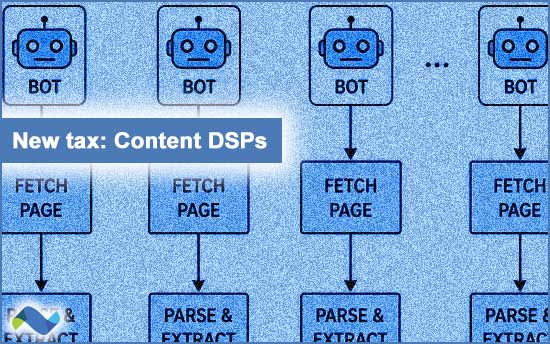
Third-party content scraping received a deeper look on Digiday as publishers worry their content is getting sucked up into a new type of AI data broker or “content DSPs” which scrape, package and resell publisher content to AI platforms.
For publishers, the outcome is a new form of “ad tech tax” — but it’s actually even worse. Publishers aren’t getting any of the revenue pie this time versus the old tax where they at least received a slice.
A publishing executive suggests that “30, 40, 50” startup content DSPs are currently taking part in the new business model, i.e. turning unauthorized access to publisher content into an AI business model.
Read: “From ad tech tax to AI data brokers: the new middlemen keep 100%, publishers say” (May 4) – Digiday
From tipsheet: The old “ad tech tax” was about losing margin from the publisher’s perspective. The new model described in Digiday is about publishers losing ownership.
If there’s a market for scraped content, there’s also a market for content that can be verified, attributed and priced.
As agents take over discovery and decisioning, and as the value shifts from raw content to trusted inputs, this creates an opening for publisher-approved, verifiable data. And not just as a moral argument, but as a performance layer.
LLMs & CHATBOTS
Developments
- Anthropic Unveils $1.5 Billion Joint Venture With Wall Street Firms (May 4) – The Wall Street Journal (subscription)
- OpenAI Finalizes $10 Billion Joint Venture With PE Firms to Deploy AI (May 4) – Bloomberg (subscription)
- “Anthropic co-founder explains why there’s a 60%+ chance of AI systems autonomously building their successors by 2029 and the consequences of automated AI R&D” (May 4) – Import AI on Substack
FINANCIALS
Earnings reported yesterday
- Markets: Reddit stock was up 15.4% in after-hours trading yesterday.
- Stat: “Revenue was $1,008 million, growing 18% year over year. On a constant currency basis, revenue would have grown 15% year over year. Global Monthly Active Users (“MAUs”) increased 11% year over year to 631 million.”
- Company: Pinterest Announces First Quarter 2026 Results (May 4) – Pinterest
- Transcript: Pinterest Q1 2026 Earnings Call Transcript – Motley Fool
- Transcript highlight: “Pinterest is pursuing integrations of TV Scientific directly into Performance+ for a unified performance solution spanning search, social, and connected TV, potentially accessing incremental advertiser budgets.”
- Read: “Pinterest forecasts upbeat quarterly revenue on resilient advertiser spending” – Reuters on Yahoo Finance
More on earnings: “Resiliency this earnings season is broader than appreciated with a median stock EPS growth rate of 16% and a beat rate of 6% (strongest in four years). Further, EPS revisions breadth has resumed its ascent with the momentum coming from Semis, Financials, Industrials and Consumer Cyclicals.” (May 4) – Mike Wilson, Chief Investment Officer, Morgan Stanley
PLATFORMS
‘Selling revenue’ and AppLovin’s Axon
AppLovin CEO Adam Foroughi joins David Senra’s podcast and recounts the story of AppLovin’s beginning and eventual growth into today’s $160 billion mobile advertising technology juggernaut.
Later in the podcast, Foroughi discusses a core premise of his company’s AI-enabled Axon platform. Every ad buyer is an ‘arbitrageur’:
David Senra: “You know if your Axon model is good or not immediately, right? Because you’re in the business of ‘selling revenue‘ is the way you put it, right? So explain when you knew it was working the way it is now, and what was happening before that?
Adam Foroughi: Where we are today is… the product has to be good enough to sell itself. Otherwise, we’re begging for business and we don’t have a good advertising solution that’s scalable.
And so what does that mean? Well, if you’re a game developer today and you plug into our platform, you’re going to spend $1,000 and you’re going to know, with certainty, you made more than $1,000 on that spend. (…) Whatever your business model allows, you’re going to be able to price into our system and generate more money from the dollar spent than what you put into the system.
Now, what’s important about that approach is that they become an arbitrageur. The only constraint on them scaling in our system is the money that they have in their bank account. Because if you tell someone, you’re certain to make more money than what you put in, you’re going to know it.”
Foroughi also points to gaming as the foundation of AppLovin’s data advantage, while highlighting expansion into e-commerce: “When you have this many people who are playing games and they’re middle-aged, the only limit is the technology for targeting and the customer on the other side. And I fundamentally believe the biggest opportunity we have as a business is help the small to medium-sized businesses.”
He also suggested the model could extend into the enterprise over time.
Listen: “Adam Foroughi, AppLovin” (May 3) – David Senra
From tipsheet: Axon’s positioning skips past the tech and goes straight to the outcome: more dollars out than in. That reframes advertising as capital allocation, or put yet another way, a compounding machine rather than a media channel.
This echoes Meta’s push toward fully automated, outcome-driven buying, which Foroughi acknowledges.
Notably absent: agencies. The model assumes self-serve, SMB-driven growth, where complexity is abstracted away and the system does the work.
It’s also notable that this is Foroughi’s second high-profile podcast appearance in two weeks (following a 20VC interview with Harry Stebbings).
That increased visibility comes alongside recent governance changes: Foroughi stepped down as Chairman but remains CEO and on the board.
Taken together, it suggests a company expanding beyond its gaming roots toward a broader set of advertisers — including e-commerce and potentially B2B — while maintaining a self-serve model that “sells itself.”
COMMERCE MEDIA
Conversational Commerce and SMS
AI chatbots are driving renewed interest among DTC marketers in conversational commerce.
On the most recent episode of the Marketing Operators podcast, Mike Manheimer, Chief Customer Officer of Postscript joins hosts and DTC marketing leaders Connor MacDonald and Cody Plofker for a discussion about Postscript’s AI product for SMS marketing and conversational commerce.
Postscript’s Mannheimer describes the product (lightly edited):
“We have a conversational AI product that’s called Shopper. It’s called Shopper because it helps people shop. Simple. And it’s powered by Brand Center, which is our policy and voice guidelines that help make sure that what we’re saying actually sounds like the brand and is aligned to everything from your offer strategy, your merchandising strategy, reading all your meta field data and Shopify. We’re learning everything we possibly can about your brand and we’re selling on your behalf using AI.
That’s been scaling for the last year or so. And at any given time on Postscript, we’re having somewhere between 750,000 to a million concurrent conversations with AI, with people who are shopping on Postscript customers’ sites.”
The consumer conversation trend:
Mannheimer: “We really believe that most consumers are being trained right now to expect [conversation] anywhere on the internet where they see a text box — that they should be able to get an instant, strong conversational answer back. ChatGPT, Claude, AI tools, Gemini are training them all over the place.
The expectations are changing on what consumers can do when they text something in, or they type something in, and they want it to be an amazing chat experience that dominates our world now.
From our point of view, conversational is going to be the core capability that people are going to judge SMS, RCS and other messaging channels like WhatsApp, etc.”
On “zero-party” data opportunity in conversations:
Mannheimer: “And so the conversation data is great because it helps people make decisions and it drives future purchases and whatnot. But the other bit is that we can mine that data to enhance your subscriber profile — your CDP, your CRM — wherever you’re housing all that subscriber data to have things that we would actually consider to be real customer data.
In the past, we always left out CRM or CDP data — none of that data would allow you to have a real relationship with anybody. It’s all like internet breadcrumbs.
What can I do with that to do an amazing wow experience from a marketing point of view? Where does that data live? — it lives in conversations. We actually have a source to be able to pull out those zero-party data attributes that are going to make a lot of sense.
(…) We think Shopper might have the most interesting stream of consumer insight data that exists in ecommerce right now.”
The “a-ha“ moment for SMS AI conversation:
Mannheimer: “Just send a normal cart abandonment message or something like that. After the link, just add a question. ‘Is there anything else I can help you with today? Do you have any questions I can answer?’ Just do that. You will get so many replies. That’s the first ‘a-ha’ moment for most people.”
Listen: E109: Rethinking SMS Marketing for Ecommerce: AI, RCS & LTV (April 28) – Marketing Operators podcast
From tipsheet: Ads can get a consumer to “I’m convinced.” But the sale is often decided in the edge cases no landing page can anticipate. That’s where conversation takes over — resolving objections in real time.
In a conversational interface, advertising doesn’t end at the click. It continues in the answer.
Also of note: RCS gets a shoutout as the rich media version (carousels) of SMS. Something to keep an eye on as conversational commerce evolves via messaging.
Related: “AI Shopping Creates an Opportunity for Retailers to Reimagine the New Storefront” – Dr. Mark Grether, VP/GM, PayPal Ads on TotalRetail
MARKETING
Opinion: Defining ‘agentic’ for marketers
“Let’s dive into what agentic advertising means in practice, where it’s already showing up in programmatic, and what marketers should focus on right now.
First—what does ‘agentic’ actually mean?
At its core, agentic AI refers to systems that can act independently to achieve defined goals within set guardrails. In advertising, that means tools that can evaluate signals, apply logic, and take action without waiting for manual input.
But here’s what matters: Agentic AI doesn’t replace the programmatic ecosystem. It expands it and creates new ways for every participant to operate with more intelligence and efficiency.”
Read: “What Agentic Advertising Means for Marketers” (May 4) – Lori Goode, CMO, Index Exchange on ‘Index Explains’ blog
From tipsheet: Index Exchange, traditionally positioned on the sell-side, is now speaking directly to marketers — not just publishers or supply partners.
That shift maps directly to its Index Cloud vision and containerization.
If the exchange becomes a computing layer — where models run, decisions get made, and outcomes are optimized — then it naturally pulls closer to the marketer’s objective, not just the publisher’s inventory.
Related: “I’m Getting Container-Pilled” (May 4) – Ari Paparo on Marketecture
LLMs & CHATBOTS
Audience data and OpenAI
OpenAI’s U.S. privacy policy received an update on April 30. Read it here.
From Adweek:
-
“The [U.S. privacy policy] updates are notable for what they make explicit: OpenAI openly acknowledges receiving data from advertisers and their partners, including information about purchases users make, to measure ad effectiveness on its platform. The AI company also renamed its vendor disclosure category to include ‘marketing partners,’ a tell that the company is formalizing relationships with outside ad tech that go beyond traditional service providers.” (May 1) – Trishla Ostwal, reporter, Adweek
Read: OpenAI is Now Sharing Its Users’ Data With Advertisers (May 1) – Adweek (subscription)
Related: OpenAI To ‘Promote’ Own Products Via Your Browser Cookies (May 1) – MediaPost
From tipsheet: Conversational ads don’t need tracking to target, but they need it to learn. OpenAI’s policy update shows the feedback loop taking shape: advertiser and purchase data flowing back into the model.
PLATFORMS
About Meta’s MCP and Marketing API
Regarding last week’s Meta news regarding new AI connectors for Meta’s Ads Manager via Model Content Protocol (MCP), CSO Olivia Kory of incrementality firm Haus saw a new day dawning:
“Last week Meta released their Ads MCP and CLI, and I sort of can’t believe this day has arrived. For Meta to ship and maintain a first-party tool on top of their own Marketing API, that API has to be stable enough to build on.
If you’ve spent any time maintaining Marketing API integrations, you know how rare that’s felt historically and how painful it can be. Breaking changes, inconsistent behavior, constant upkeep.
The FMPs (Smartly, 4C, Nanigans, Sprinklr) fought this battle for years. While Meta’s native tools have eroded parts of their value prop, a stable and reliable platform would have made their lives (and products) dramatically better.
A new era. If you are close to ads manager in any way, read up on this release.”
Read on LinkedIn. (May 4)
More: “Meta discusses new MCP functionality” (May 1) – tipsheet
From tipsheet: If the API holds steady, agents can plug into Ads Manager.
PLATFORMS
Unity launches Unity AI via MCP
Unity’s Chief AI Officer & SVP Product Technology, Felix The, announced yesterday:
-
“Today, we’re launching Unity AI in Open Beta. Built directly into the Editor, it’s the only agent that is truly engine-authoritative. It navigates your scene as a live graph and ensures every edit is compile-validated before it ever touches a project. Developers can focus on design and iteration, while agentic tools automate repetitive tasks and generate assets within either their Unity project or their preferred IDE via MCP Server.”
Read more on LinkedIn. (May 4)
More:
From tipsheet: Unity gives agents direct access to the environment. In an agentic stack, control may accrue not to the interface, but to the system where actions actually execute.
LLMs & CHATBOTS
Report: Amazon replacing search with AI
Entrepreneur Juozas Kaziukėnas observed on LinkedIn yesterday:
“Amazon is testing replacing the conventional search results with AI responses. When I searched for a CO2 monitor, it didn’t show the expected product grid – the result was an AI generated summary and a few best sellers, plus a conversation box to keep chatting. ‘Show search results’ takes me back to the default experience. (It doesn’t have any Rufus branding, but I bet that’s the same engine powering this)
This made me think of Walmart because nearly a year ago they said, “We expect that the search bar and the conventional way of searching for items will be replaced by this multimodal interface in Sparky” (Hari Vasudev, CTO of Walmart U.S.) Amazon has never discussed this but they are aggressively pushing Rufus. This limited test is doing what Walmart said Sparky might do in the future.
Bad news: it is slow.”
Read more on LinkedIn. (May 4)
MARKETING
Data is the fuel
“Sports teams are starting to use fan data in game-changing ways. They’re responding faster to feedback and tailoring marketing messages and experiences to individual fans in real time. One organization has even launched what it calls the first sports retail media network that uses fan data to place highly targeted ads on behalf of brand clients.” (May 1) – Jon Springer, reporter, Ad Age
Read: “How sports teams are using AI and fan data to rethink marketing” (May 1) – Ad Age (subscription)
MORE
- Losing Traffic To AI Search? Do More Video, Says Major League Fishing’s Jared Collett (May 4) – AdExchanger
- “Amazon, Rufus, and the agentic commerce question” (May 4) – Eric Seufert on Mobile Dev Memo (subscription)
- How Qualcomm is building an iconic consumer brand for the AI era (May 4) – Marketing Dive
- “‘Still early in our journey’: After hitting $2bn revenue, what’s next for Uber Advertising?” (May 4) – The Drum