
Earlier this month, tipsheet reported that OpenAI was building a reseller strategy after the company posted a Head of Scaled Ads Solutions role responsible for designing direct, reseller and outsourced sales channels. Now, a second role adds another piece of the puzzle.
From OpenAI Careers: “We are hiring a Global Vendor Manager to build and scale the vendor operating model that powers our Ads business globally.“
The role will “own performance, governance, forecasting, quality, capacity planning, and operational excellence across our outsourced sales ecosystem.”
From tipsheet: Together, the two roles reveal more than hiring plans. They outline OpenAI’s advertising go-to-market architecture. The first defines the sales channels. The second defines the operating model behind those channels. Together, they suggest OpenAI intends to scale advertising through a managed ecosystem of partners rather than employees alone.
PLATFORMS
Google expands PMax into local services
Google is bringing Local Services Ads into its AI-driven Performance Max platform.
From Google Ads’ help documentation:
“Over the upcoming months, existing Local Services Ads campaigns will be automatically migrated to a specialized Performance Max campaign type optimized specifically for pay-per-lead goals. While the platform you use to manage your advertising is changing, where and how your ads appear to local customers on Google Search and Google Maps remains exactly the same.”
Google says previous Local Services Ads performance reports will not carry over to Google Ads.
Read: Local Services Ads come to Google Ads via Performance Max (July 20) – Google Ads Help
Search Engine Land says the move effectively brings Local Services Ads “into Google Ads via Performance Max,” while preserving the pay-per-lead pricing model and Search and Maps inventory that advertisers use today.
Read: Local Services Ads come to Google Ads via Performance Max (July 20) – Search Engine Land
From tipsheet: Google is using Performance Max as a shared AI optimization engine instead of maintaining separate systems for specialized products. After Smart Shopping, Local Campaigns and now Local Services Ads, Performance Max is becoming Google’s common optimization layer while preserving business-specific features like pay-per-lead pricing. AI reduces product complexity by allowing one optimization system to support many business models.
MEASUREMENT
Meta’s Incremental Attribution gains ground
Independent measurement firm Haus says Meta’s Incremental Attribution (IA) is now outperforming Meta’s standard attribution settings in controlled incrementality tests, reversing findings it published a year ago.
From Haus Chief Marketing and Strategy Officer Olivia Kory on LinkedIn:
“The most useful takeaway may not be ‘IA is now better’ in absolute terms, but rather that the gap has narrowed and reversed direction over the past year. That improvement shows up across business models but is strongest for DTC-only brands, and it holds regardless of brand size.”
Read: Is Meta’s Incremental Attribution Outperforming Standard Attribution? (July 17) – Olivia Kory on LinkedIn
Kory emphasized that Haus was not comparing Meta’s own reporting. Instead, it measured business outcomes through randomized holdout tests comparing campaigns optimized for Incremental Attribution with campaigns optimized using Meta’s standard attribution.
More: “About Incremental Attribution” – Meta
From tipsheet: Better measurement creates better optimization signals. If Meta’s AI is optimizing against more causal signals than traditional attribution provides, incrementality becomes more than a reporting tool. It becomes part of the model.
Related: W3C revives browser-based attribution. “WTF: W3C’s Attribution API?” (July 20) – Digiday (subscription)
LLMs & CHATBOTS
Developments
- Who’s Afraid of Chinese Models? (July 20) – Stratechery (subscription)
- Safety and alignment in an era of long-horizon models (July 20) – OpenAI
- Alibaba Says New AI Model Is Just Second to Anthropic’s Fable 5 (July 20) – The Wall Street Journal (subscription)
RETAIL MEDIA
Trade, performance budgets begin to converge
On the Unlocking Retail Media podcast, Kevel’s James Avery interviewed Matt Vignieri, Chief Growth Officer at Skai (formerly Kenshoo), who said trade marketing and performance marketing budgets are converging as retail media matures.
Vignieri said Joint Business Plans (JBPs), which establish annual commercial commitments between brands and retailers, are becoming the baseline for commercial investment. Incremental spending is then allocated based on expected return.
He explained from the brand’s perspective: “The JBP dollars are dollars that I have to give you. I’m gonna fight as hard as I can to give you as little as possible to get my positions. The dollars I invest through a platform like Skai are the money I want to give you because it’s demonstrating performance and value and it’s meeting my KPIs.”
Listen: “How Brands Win Across 200+ Retail Media Networks with Matt Vignieri” (July 15) – Unlocking Retail Media podcast
From tipsheet: Above the JBP baseline, AI can allocate incremental investment across retailers, campaigns and channels based on expected return. Retail media may evolve beyond retailer-specific budgeting toward continuous commercial capital allocation.
Related: How 4 Retailers Are Pitching Creative Ad Formats (July 20) – Adweek (subscription)
TECH
Advertising splits into two architectures – Heimlich
Adam Heimlich, co-founder and CEO of AI advertising company Chalice, argues that the demand side of advertising is dividing into two architectures: pooled, platform-driven decisioning and advertiser-owned decisioning for the largest enterprises. He says recent deals by Walmart (Vibe) and Publicis (LiveRamp) signal the industry’s diverging paths.
In an interview with Madison & Wall, Heimlich makes his case:
“The network side of advertising is consolidating into pooled, standardized infrastructure built for the median advertiser. The largest and most sophisticated advertisers are going the other way — building decisioning they own and control, and routing around the pooled stacks entirely.
The demand side used to be one thing. Now it’s two.”
Read: “An Interview with Chalice’s Adam Heimlich…” (July 20) – Madison & Wall on Substack
In the first installment of a four-part series on his blog, Heimlich expands on his thesis that AI is splitting advertising into pooled and proprietary architectures.
Read: “The Two Architectures, Part One” (July 17) – Adam Loves Ad Tech
From tipsheet: Heimlich’s most important insight is that AI changes the economics of decisioning. As AI lowers the cost of custom decision systems, more advertisers can justify owning their own optimization while pooled AI infrastructure becomes even more valuable for everyone else. AI doesn’t eliminate the tradeoff between shared and proprietary intelligence. It shifts where that line is drawn.
MEASUREMENT
Amazon expands omnichannel measurement
Amazon Ads has introduced retailer-level reporting for Omnichannel Metrics (OCM), allowing eligible Amazon DSP advertisers to measure off-Amazon sales by individual retailer.
Kolby Capelouto, an Amazon Ads sales executive, said customers have been asking for the capability for years:
“I’ve been hearing the same ask from customers for my entire 11 years at Amazon: show me how my Amazon Ads investment moves sales in my other retail channels. Now for the first time, Hardlines and Fashion & Lifestyle brands running Amazon DSP can see exactly which retailers their campaigns are driving off-Amazon sales to via Omnichannel Metrics.
Retailer Breakouts: Walmart. Target. Home Depot. Nordstrom. Wherever your brand is sold. At the study and campaign level. This is the first always-on, cross-retailer attribution that shows where your Amazon Ads investment works across the broader retail landscape.”
Read more on LinkedIn. (July 18)
More: Measure holistic advertising impact with Omnichannel Metrics (November 2025) – Amazon Ads
Capelouto says the feature is available in the Amazon Ads console at no additional cost for eligible advertisers.
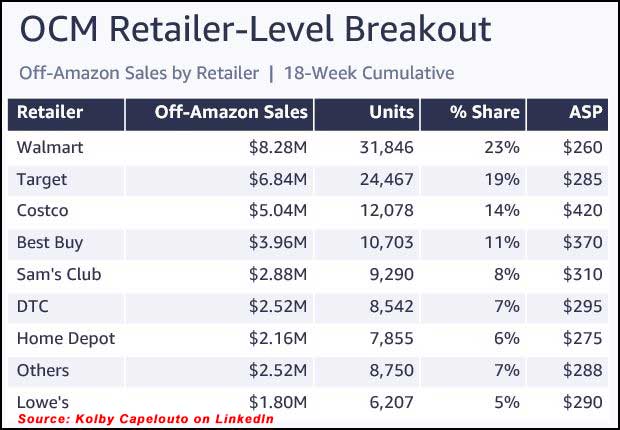
From tipsheet: By measuring sales at individual retailers, Amazon is making the case that its advertising can drive demand across a brand’s entire retail footprint, not just on Amazon. That gives Amazon evidence that its advertising creates value across a brand’s entire retail ecosystem, strengthening its position with both CFOs and retail partners.
COMMERCE MEDIA
UCP expands into food ordering
Google’s Universal Commerce Protocol (UCP) is expanding beyond retail into restaurant ordering and delivery.
The company announced a new Food Tech Council (Food TC) whose inaugural members include DoorDash, Square, Toast and Uber Eats. The group will help guide the protocol’s technical direction, roadmap and capabilities for local food ordering and delivery.
Google VP/GM Ashish Gupta wrote on LinkedIn, “UCP is expanding to the food industry… The new Food TC will drive the technical direction, roadmap, capabilities, and more specifically for local food ordering and delivery.” Read more. (July 17)
In the comments, Google VP/GM of Advertising & Commerce Vidhya Srinivasan said, “The key to making agentic commerce work for everyone is a true ecosystem approach.” She added that Google looks forward to partnering with the council on the protocol’s roadmap for local food ordering and delivery.
Read: “Announcing the new Food Tech Council members” (July 17) – UCP GitHub discussion
From tipsheet: Search monetized information. UCP could monetize transactions. If AI agents become a primary interface for buying, advertising and sponsored recommendations could become a monetization layer built on top of an open commerce protocol.
MORE
- An interview with Beehiiv CEO Tyler Denk on the company’s programmatic advertising strategy, subscriber-level targeting roadmap and publisher monetization plans (July 20) – AdExchanger
- Meta’s ads MCP server is now available for developers (July 16) – Meta
- Criteo CEO Michael Komasinski on the Future of Commerce Media (July 8) – DMEXCO Podcast
- Stagwell Launches Stagwell Curate (July 16) – Stagwell