

The Verge is reorganizing its audience development team for a future in which Google search delivers very little traffic.
According to Digiday, rather than prioritizing SEO, virality and pageviews, the Vox Media publisher is investing in specialists focused on newsletters, community engagement and audience analytics. The reported strategy doesn’t address where AI search fits.
The emphasis is on converting anonymous visitors into registered users and paying subscribers. More than half of The Verge’s subscriber acquisitions now come from readers visiting its subscription signup page directly.
Read: The Verge switches up its audience team to prepare for Google Zero (Oct. 19) – Digiday (subscription)
From tipsheet: I’m still waiting for publishers to quantify the business value of AI search beyond referral traffic. AI discovery can generate advertising impressions, subscribers and future direct visitors, some of whom may never be attributed to AI. The Verge’s strategy emphasizes reducing dependence on third-party traffic. Great if you can make it work, but why not pursue a more holistic approach to audience yield optimization that accounts for both AI discovery and direct relationships?
Answer: It’s hard. Sounds like an opportunity.
SELL-SIDE
Some publishers leave door open to AI search
Publishers are taking a more selective approach to AI crawlers than the industry’s “Google Zero” (as in no referrals from search) rhetoric might suggest.
In a LinkedIn post, Axios media correspondent Sara Fischer writes: “An exclusive Axios analysis of 102 top U.S. publisher domains found that 42% block AI training crawlers outright, compared with just 25% that block AI search crawlers.”
Another 39% have mixed rules for AI search, allowing some bots or portions of their sites to be crawled.
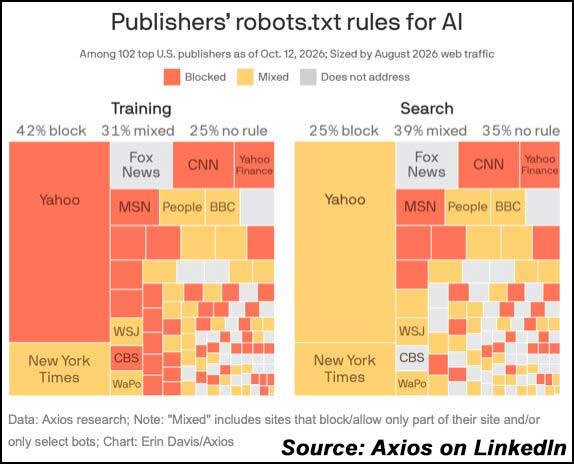
Read more. (Oct. 19)
Also: Publishers block AI training bots, but embrace search (Oct. 17) – Axios (subscription)
From tipsheet: Some publishers appear more willing to let AI companies use their content for discovery than for training. That makes commercial sense if AI search can deliver valuable audiences — whether directly or indirectly. But robots[dot]txt is a blunt instrument and communicates crawling preferences, not the terms of discovery, attribution or compensation.
DATA
Can AI agents solve CDP integration problem?
Customer data platforms (CDPs) have traditionally required considerable engineering work to connect, clean and unify customer data. Startup Minerva, which identifies itself as “AI for marketing leaders,” is betting AI agents can automate much of that work.
AdExchanger’s Allison Schiff explains:
“A brand plugs its CRM, data warehouse and other sources into Minerva, where an agent it built using OpenAI called the ‘agentic data engineer’ maps it all out. Then Minerva’s agents unify the data into a single view of each customer and supplement it with information from what [Minerva CEO Jackson Engles] refers to as its ‘B2B2C identity graph,’ which includes work email, personal email, phone number, address and online identifiers.”
Schiff notes that Minerva’s three co-founders have no marketing background. Oof.
Read: “AI Startup Minerva Built An Agentic CDP, But Don’t Call It That” (Oct. 19) – AdExchanger
More: “Minerva Launches AI Platform for Consumer Marketing with $20M from The General Partnership, 8VC, Lingotto Innovation, Topology Ventures and NBA Investments, Alongside OpenAI Collaboration” (June 9) – press release
From tipsheet: The interesting part here is the possibility that agents can do much of the integration work that has historically made CDPs expensive and complicated to implement. This could change the economics of customer data infrastructure as long as the underlying data doesn’t suck wind.
LLMs & CHATBOTS
ChatGPT ads look more like the conversation
OpenAI appears to be experimenting with a less visually distinct ad format in ChatGPT.
On LinkedIn, entrepreneur Joe Kaziukėnas reported seeing a fourth iteration of ChatGPT ads:
“The latest version doesn’t look like an ad anymore because it doesn’t have the typical border line. The only giveaway is the small ‘Ad’ icon on the right. OpenAI still only ever shows ads below the conversation, but this latest format is starting to look perfect to blend in mid-conversation.”
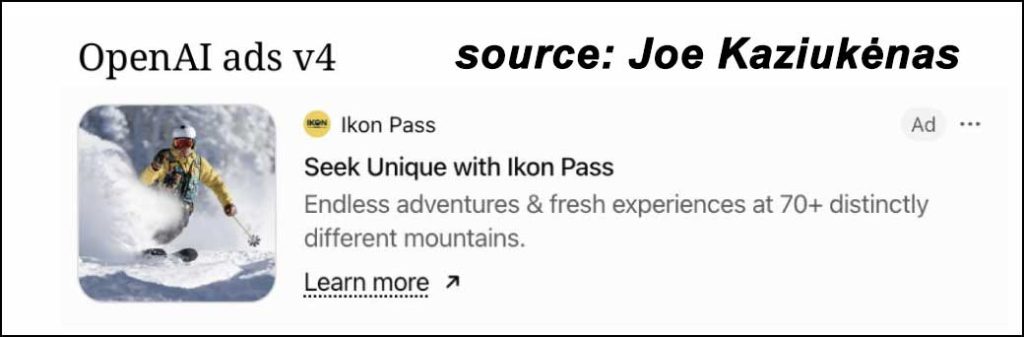
Black border added by tipsheet for clarity.
See how this compares to the previous three versions. (Oct. 19)
From tipsheet: Ads that look less and less like ads — very Google Search-like, no?
LLMs & CHATBOTS
Developments
- All your watts are belong to: “Inside Prometheus: Meta’s Journey to a Gigawatt-Scale Supercluster” (Oct. 19) – Meta
- Open-weight: “MiniMax M3.1 Flash: Redefining Agent Performance and Cost” (Oct. 19) – MiniMax
- Gemini’s Jeopardy moment: “Four Gemini 4 Argon agents beat Minecraft without any human help” (Oct. 18) – The Decoder
MORE
- AI creative feedback loop: Nativeads[dot]ai and Adverteyes combine creative generation with predictive performance scoring, feeding recommendations back into future briefs and prompts. (Oct. 19) – press release
- Blocking CTV ads: “People are using AI to make their smart TVs dumb again” (Oct. 19) – TechCrunch
- Explainer: “How Does Agentic AI Work” – Martin Kihn, SVP Strategy, Salesforce on LinkedIn
- Mutinex measuring: “How Australian Home Lender Lendi Measures The Invisible Work Of AI” (Oct. 19) – AdExchanger