
Walmart reported its Fiscal Q1 2027 earnings yesterday and although the retailer’s overall revenue and earnings expectations were impacted by higher oil prices, Walmart showed strong momentum in AI-related areas including retail media.
On Sparky
In his presentation to investors, Walmart Inc. CEO John Furner discussed the company’s AI shopping assistant Sparky, which the company positions as a key element of its agentic shopping strategy:
“We’re also becoming AI native. Using AI, we can now serve customer needs that previous technologies could not meet. From making shopping easier and more personalized, to expanding the range of shopping occasions and interactions we have with our customers and members.
And Sparky, our AI shopping agent, is making this possible. Weekly active users are up over 100% just in the last quarter, and our investments in AI have increased Sparky intelligence and response quality by 40% this year. Sparky is becoming more useful by the day. You can now use Sparky in stores and automatically reorder items you have on repeat.
Sparky even speaks Spanish these days. And as we’ve mentioned before, customers using Sparky have an average order value that’s about 35% higher than non-Sparky customers.”
Walmart US CEO David Guggina added about Sparky:
“I think it’s important to note that early in Sparky’s life, engagement was really centered more heavily on general merchandise discovery missions. But as we have expanded the capabilities around replenishment, meal planning and personalization, we’re increasingly seeing customers use Sparky for everyday essentials like food and consumables. And as a result, units purchased through Sparky have grown more than 4x since the previous quarter.”
On retail media
Furner also noted overall strength in advertising for Walmart:
“Momentum in our advertising business continued in Q1, led by strength in Walmart US, which grew 36%. This performance reflected strong engagement with marketplace sellers, who grew their advertising spend by over 50% and saw a corresponding lift in sales. We continue to enhance our toolkit for ad buyers, including AI features that help to dynamically adjust content mix to optimize campaign performance while expanding reach and services with VIZIO’s connected platform.”
CFO John Rainey pointed out Walmart’s transformation due, in part, to advertising:
“And so, when you take categories like membership categories, like advertising, those two combined comprise roughly a third of our earnings today. That’s very different from Walmart of 10 years ago.”
Walmart EVP and Chief Growth Officer, Seth Dallaire, framed Walmart’s fulfillment and delivery infrastructure as increasingly important to Marketplace advertising growth:
“The Marketplace business is exciting because we’re building on the rails of all the speed investments in terms of delivery that we’ve had over the past few quarters. (…) As assortment increases, we drive more customers and members to our business that attracts more advertisers. And we’ve seen that actually in our third-party Marketplace advertising revenues have increased 50% year-over-year. So, we’re really encouraged by that.”
Read:
From tipsheet: Walmart is optimizing the closed-loop dynamics of its commerce system. The company’s earnings show how retail media, Marketplace growth and fulfillment infrastructure are becoming economically intertwined. Faster delivery improves conversion, better conversion attracts sellers, and seller competition drives more advertising spend through Walmart Connect.
LLMs & CHATBOTS
Developments
- Anthropic’s Code with Claude showed off coding’s future—whether you like it or not (May 21) – MIT Technology Review
- Cursor Hits $3 Billion Annual Sales Rate Ahead of SpaceX Deal (May 21) – Bloomberg (subscription)
- OpenAI Generated Nearly $6 Billion in Revenue in First Quarter, Boosted by Codex – The Information (subscription)
LLMs & CHATBOTS
OpenAI hires for enterprise ads marketing push
OpenAI has added a new open role titled “Head of Ads Enterprise Marketing,” shedding more light on the company’s target markets and advertising industry ambitions as it expands its ChatGPT ads business.
From the listing on the OpenAI Careers website, responsibilities include:
- “Define industry-specific narratives and go-to-market strategies across key verticals including CPG, Retail, Automotive, Financial Services, Technology, Entertainment, Telecom, and Travel.”
- “Own OpenAI’s presence and narrative strategy at major industry events including Cannes Lions, CES, Advertising Week, Possible, and DMEXCO.”
Read: “Head of Ads Enterprise Marketing” – OpenAI Careers
From tipsheet: This role makes ChatGPT ads look less like an experimental effort and more like the construction of a full enterprise marketing organization around OpenAI’s ads business.
The event focus is especially notable. Cannes Lions, CES, Possible and DMEXCO are major advertising industry power centers where narratives are shaped. The sponsored yacht at Cannes oughta be unreal.
Combined with recent hires like former Meta executive David Dugan as Head of Global Ads Solutions and The Trade Desk’s Samantha Jacobson joining soon as VP of Partnerships, OpenAI appears to be assembling the executive bench required to compete seriously for brand and agency budgets.
Meanwhile, OpenAI reportedly has a $2.5 billion ad revenue target by year-end.
SELL-SIDE
Index: a content marketplace for agents
On the Stratechery podcast, Ben Thompson interviews Parallel Systems CEO Parag Agrawal (former CEO of Twitter) about the launch of his startup’s new Index product – essentially a search engine built for agents where content owners are compensated.
On the company website, Parallel asks users to input their website’s URL to: “See what your content is worth to AI agents.” Try it.
Valuation is based on “Shapley values,” a concept from game theory which assigns relative value according to the uniqueness of the information.
On the podcast, Agrawal discusses his admiration for Cloudflare CEO Matthew Prince’s interest in a content marketplace for AI crawlers. (Yet, after a series of blog posts last summer which included Prince defending his publishing clients and openly decrying “bots run wild” at Cannes, Cloudflare has since seemingly deprioritized its interest in building a content marketplace.)
Listen: “An Interview with Parallel Founder Parag Agarwal About Valuing Content on the Agentic Web” (May 21) – Stratechery (subscription)
FYI, Agrawal just raised another $100 million in venture funding for his startup.
More: “Ex-Twitter CEO’s AI Startup Raises Funds at $2 Billion Valuation” (April 28) – The Wall Street Journal (subscription)
From tipsheet: I get the high-level idea but, in my opinion, Agarwal struggled to articulate exactly how the market will come together. Is it too far ahead of its time such that even he doesn’t know? The hour-long podcast left me wondering whether Index itself is really “the” product — or more of a precursor to something else. It doesn’t help that the URL input on the Index home page feels more like a lead gen flow than evidence of a functioning marketplace.
Ben Thompson seemed excited, though. And that’s something.
SELL-SIDE
The Economist prepares for agents
“The Economist is testing new ways of structuring content to be read solely by agents as AI engines increasingly surface and summarize news. For now, the subscription publisher is experimenting with agent‑readable versions of content that already sits outside its paywall — chiefly marketing copy and B2B sales material — and restructuring those surfaces for AI answer engines.” – Jessica Davies, Senior Editor, Digiday
Related: “The Economist prepares for a two‑track internet: one for humans and one for AI agents” (May 18) – Digiday
LLMs & CHATBOTS
Google edges into GEO optimization
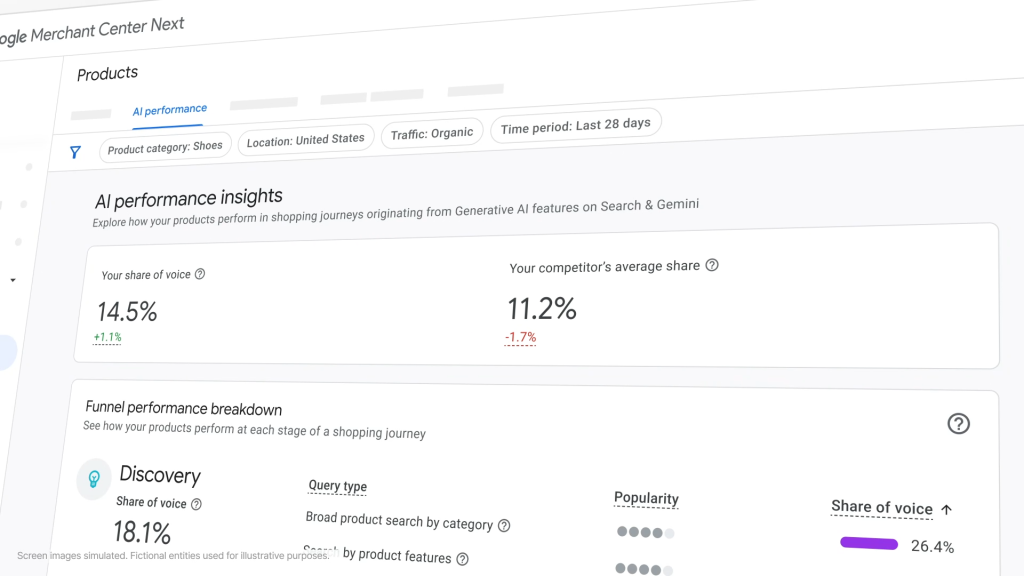
Within the flood of announcements at Google Marketing Live on Wednesday, Google announced it will provide Google Merchant Center clients with “AI Performance Insights” — a new analytics layer showing how brands and products are appearing across Google’s AI surfaces as the company edges further into the generative engine optimization (GEO) space.
A blog post explained:
“The new AI performance insights tool in Merchant Center gives you a clear view into how your brand is performing on AI surfaces by comparing your share of voice against similar brands. It’s rolling out in Australia, Canada, India, New Zealand and the U.S. in the coming months.”
Google Merchant Center VP/GM Ashish Gupta explained the analytics package is limited to Google-owned surfaces such as Search and the Google Gemini app.
Read: “How we’re helping retailers thrive with new Universal Commerce Protocol features and AI tools on Google” (May 20) – Google The Keyword blog
From tipsheet: Microsoft rolled out a similar tool for its AI surfaces (Bing and Copilot) in February. OpenAI would appear to be “next up” for providing a GEO analytics platform for its LLMs.
From here, given Anthropic’s strong stance against advertising and its argument that it violates user trust (and that the company is B2B focused) — it seems unlikely Anthropic will launch a GEO analytics product of its own.
And just like advertising, where marketers optimize across opaque black-box systems and walled gardens, managing brand visibility and discoverability across AI chatbots will remain a challenge — and an opportunity for GEO-focused software vendors, startups and agencies.
COMMERCE MEDIA
AI wants your product feed to close the loop
From Google’s Marketing Live event, the company outlined several priorities for retailers that appear increasingly applicable across AI platforms broadly — not just Google’s own ecosystem:
- “Product Feeds — boost your discoverability across Al Experiences”
- “Data Strength — maximize your data for better predictions”
- “AI Campaigns — adopt the best AI-powered solutions to drive sales”
- “Agentic Infrastructure — Future-proof your business for Agentic Experiences”
Among the bullets above, Google recommends a structured data taxonomy it calls “conversational attributes.”
Read: How to use conversational attributes – Google Merchant Center Help
From tipsheet: Retailers — or marketers — are publishers. (I mean, where do you think soap operas came from? Soap marketers.)
Product feeds are becoming an increasingly important form of machine-readable content in a world where AI systems attempt to close the loop for consumers.
AI systems need to understand both what consumers want (intent) and what retailers have (their product feeds) simultaneously.
Structuring product information within feeds — pricing, attributes, availability, specifications and merchant data — becomes important as AI agents evolve into commerce functions spanning discovery, recommendations and transactions.
FWIW: Content creators are human product feeds.
LLMs & CHATBOTS
ChatGPT referral update: More traffic
From his startup’s GEO platform data, Profound Co-Founder Josh Blyskal shared new LLM referral data:
“ChatGPT referral traffic to brand websites increased ~60% starting May 7, I pulled 8+ million referral visits across thousands of sites to figure out what’s going on:
ChatGPT has fully pivoted to hyperlinking brand homepages directly inline in its answers instead of primarily using citation chips to link. It’s the same brands being mentioned, but now every mention routes to the brand’s site.
- OpenAI referral traffic to monitored brand sites: ~1.6x overnight (and held there)
- Share of logged-out ChatGPT answers containing a clickable brand URL: ~4-5% to ~22% (~5x increase)
- Homepage share of all OpenAI referrals: 3.5% → 24.2% (~7x)
- Hitting logged-out users the hardest.
As far as I can tell, this is the largest single-day change in AI-driven brand traffic we’ve measured all year.”
Read more on LinkedIn. (May 20)
From tipsheet: The bottom line — ChatGPT’s conversational interface is becoming more clickable.
As OpenAI shifts from citation chips toward inline links, brand mentions themselves become more commercially valuable, with implications for marketers, publishers and GEO optimization strategies.
PLATFORMS
Microsoft on AI, ads and transparency
Microsoft will be providing performance marketers with more transparency in its Performance Max (PMax) AI ad platform.
Carolyn Chou, Director, Product Management, Microsoft Advertising, said in a blog post:
-
“Auction insights for PMax, coming soon, will build on existing impression share metrics by showing how your campaigns perform relative to competitors. You’ll be able to understand where you’re winning visibility, where competitors are outranking you, and how often you appear alongside them. With metrics like overlap rate and outranking share, you’ll gain a clearer picture of the competitive landscape across your account—helping you make more informed decisions and unlock greater performance from your campaigns.”
Read: Providing more transparency for your Performance Max campaigns (May 7) – Microsoft Advertising blog
Related: When discovery becomes decision: How AI Search is redefining customer intent (April 27) – Microsoft Advertising blog
From tipsheet: Competitive visibility.
As AI-driven campaign systems become increasingly automated and opaque, advertisers still want visibility into who they’re competing against — even if the underlying optimization decisions are increasingly made by machines.
On the other hand, how much transparency is too much? Do advertisers really want competitors knowing what they’re doing?
TECH
Explaining it
- “AdExplainer: The Programmatic Auction Is Changing In Real Time – Here’s How” (May 21) – AdExchanger
- “Following the Agentic Dollars – How agentic advertising demand might actually flow from buyers to publishers” (May 20) – Marketecture’s Ad Tech Explained
PEOPLE MOVES
Now hiring
“Excited to share that I am joining Bill Wise, Zvika Netter, Nick Galassi and the amazing teams at Mediaocean. The combination of global teams of industry experts, market-leading customers and partners, and massive scale of infrastructure + deep workflows + unique data makes the company a category of one in the age of AI.” (May 20) – Iván Markman, Mediaocean’s new President, Chief Operating Officer on LinkedIn
MORE
- Meta announces expansion of brand safety partnerships with DoubleVerify, IAS, Scope3, Zefr; adds Channel Factory and Protected by Mediaocean (May 18) – Meta
- On TikTok’s new travel bookings and the dedicated ‘agentic hub’ launching next month (May 21) – Marketing Dive
- Spotify adds AI-powered Q&A and briefing generation features to podcasts (May 21) – TechCrunch
- Why AI adoption may look bigger than it really is: Data (May 21) – Search Engine Land
- WPP Media Led New Business In The First Quarter (May 21) – MediaPost