

OpenAI wasn’t the only one that was disappointed with the ChatGPT checkout capability Instant Checkout. Walmart was, too, as testing revealed that buyers were forced to buy a single item at a time, according to Wired.
After OpenAI put the brakes on the Instant Checkout initiative earlier this month, the new solution for Walmart (and OpenAI) is to put Walmart’s Sparky AI chatbot inside ChatGPT with checkout capabilities.
From Wired on Wednesday:
“In the new experience, Walmart users log into Sparky the first time they encounter it in ChatGPT. Their basket from Walmart’s website or app and within ChatGPT will sync with another in the hopes of better reflecting people’s actual shopping habits. Consumers add peanut butter one day on the Walmart app, foil the next, and a birthday gift at the last second on the website before checking out. ‘When Sparky travels, it’s the Walmart store meeting you where you are, instead of a completely broken experience,’ [said Daniel Danker, who oversees design and product for Walmart].
Walmart has good reason to want to get the experience in ChatGPT correct. The chatbot is now bringing in about twice the rate of new customers as search engines, Danker says. He suspects that’s because the power users of ChatGPT are not typical Walmart customers. But the retailer’s price, selection, and broad geographic footprint mean that its products are showing up in many ChatGPT responses…”
Wired said Google’s Gemini will add a similar Sparky login for its AI chatbot in April.
Read: “Why Walmart and OpenAI Are Shaking Up Their Agentic Shopping Deal” (March 18) – Wired (subscription)
Related: “Walmart Just Patented a System That Lets Algorithms Push Prices” (March 19) – Yahoo Finance
From tipsheet: Lots of great info in the Wired article. A few thoughts:
- AI agents: Walmart wants Sparky everywhere. Perhaps this spurs Amazon to put its Rufus shopping assistant everywhere if the success Walmart is having is true. The article reaffirmed that Walmart lets AI agents surf its websites. Amazon is fighting the same urge with Perplexity currently.
- Retail media: There was no mention of the impact on Walmart’s retail media ads business by Wired or Walmart. You may recall that Walmart added “Sponsored Prompts” to Sparky late last year. Amazon has this for Rufus, too. Note: Walmart’s ads business is $6.4 billion annually, according to its last earnings report. Amazon’s is estimated to be $60-70 billion.
- “Ads” questions: Do “Sponsored Prompt” ads within a chatbot such as OpenAI’s ChatGPT potentially accelerate retail media? Checkout could becomes a mini-website for the retailer. Separately, what’s the impact on OpenAI’s future ads business? This is likely beneficial for OpenAI and its datasets due to users who are discovering and purchasing what they want within ChatGPT’s environment.
LLMs & CHATBOTS
Developments
- OpenAI Plans Launch of Desktop ‘Superapp’ to Refocus, Simplify User Experience (March 19) – The Wall Street Journal (subscription)
- Design at the speed of AI (March 19) – Google’s Stitch
- Introducing MAI-Image-2 (March 19) – Microsoft AI
PROTOCOLS
Google updating UCP protocol
“UCP can help make online shopping more intuitive and convenient, thanks to a new Cart option that will let agents save or add multiple items to a shopping cart at once from a single store — just as a shopper typically would…”
Read: “AI shopping gets simpler with Universal Commerce Protocol updates” (March 19) – Google The Keyword blog
TECH
Meta AI comes to content moderation
Yesterday, Meta announced new AI workflow automation to replace parts of its costly, large-scale content moderation operation.
From Meta’s Newsroom:
“Over the next few years, we’ll be deploying these more advanced AI systems across our apps once we’ve seen them consistently perform better than our current methods of content enforcement, transforming our approach. As we do this, we’ll reduce our reliance on third-party vendors for content enforcement and focus on strengthening our internal systems and workforce. While we’ll still have people who review content, these systems will be able to take on work that’s better-suited to technology, like repetitive reviews of graphic content or areas where adversarial actors are constantly changing their tactics, such as with illicit drugs sales or scams.”
Read: “Boosting Your Support and Safety on Meta’s Apps With AI” (March 19) – Meta
The company had already been cutting back on its moderation capabilities through its content moderation contractor Telus last year. Read more. (April 2025)
Related: “Meta changes course on Horizon Worlds VR shut-down” (March 19) – Lowpass
From tipsheet: A few thoughts:
- Margins – Another step forward for margin improvement for Meta the publicly-traded company as human workflow becomes automated.
- Manus – Is this AI agent startup Manus at work, again? In a Manus blog post on March 6, the company — which was acquired by Meta in December and quickly went to work — touted “content moderation” capabilities via AI agents. Manus appears to have a bit of autonomy within Meta, and may be the catalyst in the customer service (CS) product suite. Check out a Manus tagline: “Business AI That Works Like Your Best Employee.”
- Customer service – No doubt there will be stories ahead of content moderation missteps as AI keeps learning. But, Meta is in the CS business. The content moderation technology would seem to have connections elsewhere in Meta such as the company’s Business AI initiative (announced in October) where an AI customer service chatbot helps online retailers facilitate their business. Though all revenue roads lead back to ads today, could the company productize CS in such a way that it scales not only ads and business on Meta properties, but anywhere? Perhaps they join the race of startups and not-so-startups re-architecting call centers—voice agents (Y Combinator, a16Z), for example.
ENGINEERING
Meta’s Ranking Engineer Agent (REA)
Meta explained the technical inner workings of its ability to rank ads in a blog post on Wednesday while highlighting the work of over 30 Meta AI ad engineers.
The group unpacked what it calls “Ranking Engineer Agent (REA)” and went deep into the details:
“REA addresses three core challenges in autonomous ML experimentation:
-
- Long-Horizon, Asynchronous Workflow Autonomy: ML training jobs run for hours or days, far beyond what any session-bound assistant can manage. REA maintains persistent state and memory across multiround workflows spanning days or weeks, staying coordinated without continuous human supervision.
- High-Quality, Diverse Hypothesis Generation: Experiment quality is only as good as the hypothesis that drives it. REA synthesizes outcomes from historical experiments and frontier ML research to surface configurations unlikely to emerge from any single approach, and it improves with every iteration.
- Resilient Operation Within Real-World Constraints: Infrastructure failures, unexpected errors and compute budgets can’t halt an autonomous agent. REA adapts within predefined guardrails, keeping workflows moving without escalating routine failures to humans.”
Read: “Ranking Engineer Agent (REA): The Autonomous AI Agent Accelerating Meta’s Ads Ranking Innovation” (March 17) – Meta Engineering
Related: “Multi-Round Auctions: More from Every Impression” (March 19) – Kainar Kamalov, CloudX on the CloudX blog
LLMs & CHATBOTS
Alibaba chatbot ads may not be “viable”
Alibaba announced its fiscal Q3 2026 earnings yesterday, and revealed that its Qwen AI chatbot now reaches 300 monthly active users. The ecommerce and technology conglomerate’s CEO, Eddie Wu, talked optimistically about AI as the company’s next growth engine.
But, according to The Wall Street Journal, some analysts are questioning whether monetization for Alibaba’s chatbot is possible.
The WSJ’s Tracy Qu reported:
“Alibaba has been reorganizing its AI operations, creating a new unit to bring its various AI businesses under one umbrella overseen by [Alibaba CEO Eddie Wu]. It also recently raised prices for AI services, accelerating the U-turn taking shape in an industry previously characterized by cutthroat discounting competition.
While the key competitive factor for AI agents in China currently lies in ecosystem strength, the monetization model for consumer AI assistants globally remains unclear, Third Bridge analyst Jamie Chen said in a commentary. ‘Whether through direct subscription fees or advertising, these approaches are not currently viable in the Chinese market,’ Chen wrote.”
Read: “Alibaba Earnings Disappoint, but AI Outlook Bright” (March 19) – The Wall Street Journal (subscription)
More: “Alibaba Group has announced its financial results for the quarter ended Dec 31, 2025, highlighting strong progress in AI + Cloud, alongside accelerating consumer adoption of AI through the Qwen App.” (March 19) – Alibaba on LinkedIn
SELL-SIDE
Cloudflare crawler and publisher eyebrows
“Last week, [Cloudflare] released a crawl API (its crawl endpoint within Cloudflare’s browser rendering API) that can scrape an entire website with one request. (You give it a URL, it crawls the whole site and returns the content in HTML, Markdown, or structured JSON). The announcement raised eyebrows and left some publishers confused and unsettled by the move to provide its own version of what it has so far protected publishers from.” – Jessica Davies, Senior media editor, Digiday (March 19)
Read: “Cloudflare’s compliant crawler highlights tension – and opportunity – in the emerging AI content market” (March 19) – Digiday
More: “CDN Cloudflare has a crawler, too” (March 13) – tipsheet
AGENCIES
Publicis-Trade Desk opinions swirl
As technology and service businesses collide in the form of demand-side platform The Trade Desk falling out of favor with agency holding company Publicis (see memo), CartographAI co-founder Jay Friedman provided a solution for what he thinks is really in play.
On Adweek, Mr. Friedman wrote:
“First, brands should ask their agencies a simple question: What would you need to charge us, fully transparently and above board, to stop playing games? (…)
Second, the industry should stop supporting vendors whose primary business model is built around enabling opacity. (…)
Third, and most importantly, we should refocus the entire conversation on brand growth.”
Read: Opinion: “The Trade Desk-Publicis Fight Is Really a War Against Transparency” (March 19) – Jay Friedman on Adweek
Commenting on Friedman’s LinkedIn post about his Adweek opinion piece, investment banker Terence Kawaja of LUMA Partners commented:
“[Jay Friedman] says the quiet part out loud by pointing out the opacity of the ecosystem and regrettable practices of the agency HoldCos. Of course the blame cannot be laid at their feet alone. Their actions to pursue principal trading and undisclosed rebates are a function of the declining economics of the client business. If you ask me, procurement departments played a big role in driving those survival tactics based on their misguided obsession with cost…”
Read more on LinkedIn. (March 19)
Related: “The world of AdTech loves three-letter acronyms and incredibly complex concepts. Some use these to mask what’s really going on behind the scenes. One of the things that has surprised me most…” (March 18) – Samantha Jacobson, CSO, The Trade Desk on LinkedIn
From tipsheet: AI is helping to push the transparency “envelope” in advertising and marketing. The battle between tech and service companies for the marketer’s budget continues with profit margins at stake for everyone.
PROTOCOLS
Event: Agentic Audiences at IAB Tech Lab
Agentic audiences (fka User Context Protocol) was front-and-center at yesterday’s IAB Tech Lab event, Signal Shift.
“Sam White from LiveRamp dropping knowledge on Agentic Audiences, part of IAB Tech Lab’s Agentic Advertising Management Protocols (AAMP) initiative, with Felix Zeng from The Weather Company providing the perspective on publisher value. Nothing quite like getting into cosine similarity and Euclidean distance at Signal Shift.” – Anthony Katsur, CEO, IAB Tech Lab on LinkedIn (March 19)
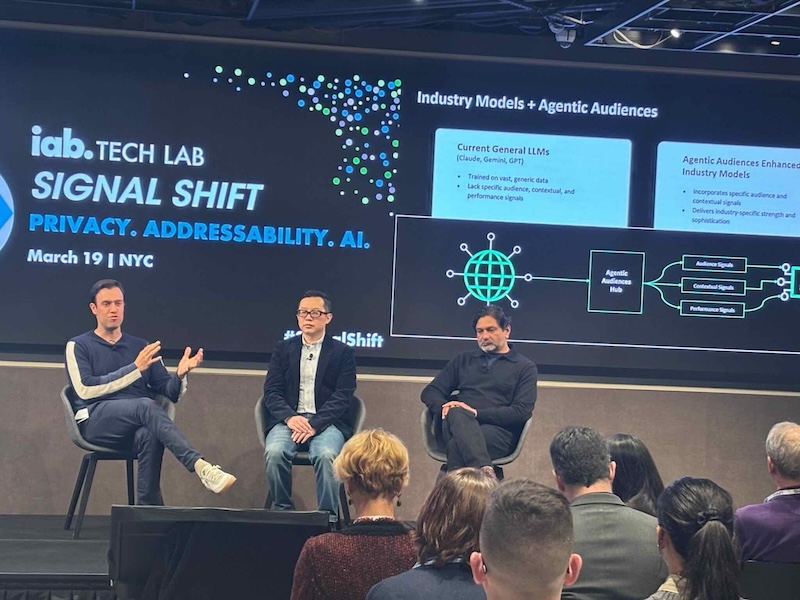 See more from IAB Tech Lab CEO Anthony Katsur on LinkedIn. (March 19)
More:
- “Agentic Audiences (formerly UCP/User Context Protocol)” – IAB Tech Lab
- AAMP (Agentic Advertising Management Protocols) (updated March 16) – IAB Tech Lab
MORE
- Podcast: “Deploying AI personalization at scale (with Christina Augustine of Bloomreach)” (March 17) – Eric Seufert, analyst on MobileDevMemo
- Future Is Training Its AI On Publisher First-Party Data (March 17) – AdExchanger
- Opinion: “AI Mode is Google’s next ads engine — and it already knows how to monetize it” (March 19) – Andrew Goodman on Search Engine Land
- Attain Reports Second Consecutive Year of Triple-Digit Enterprise Growth (March 19) – press release
- Why Pinterest is going all in on open-source AI (March 17) – Fortune