
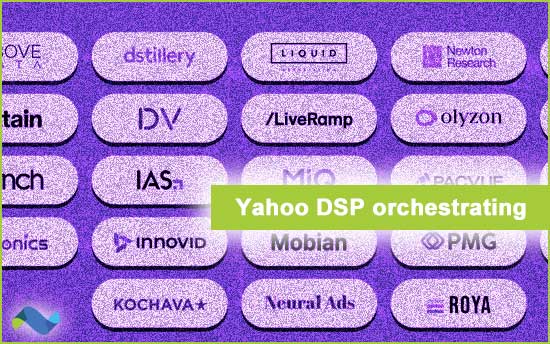
Yahoo DSP launched Agent Network, a framework that allows advertisers to connect AI agents from 23 technology partners directly into the platform. Yahoo said the network spans creative, audience, measurement and activation workflows, enabling advertisers to use both Yahoo’s native AI capabilities and third-party agents.
From the release:
“The Yahoo DSP Agent Network brings it all together, connecting advertiser demand with partner innovation at the pace the industry demands. Advertisers can activate their preferred partner AI agents across every stage of the media buying workflow for their Yahoo DSP campaigns, all with enterprise-grade governance, compliance, and authentication built in…”
Read: Yahoo DSP Launches Agent Network, Opening the AI Ecosystem for Advertisers (June 18) – Yahoo DSP
From tipsheet: The first generation of agentic advertising platforms focused on building AI assistants. Yahoo is making a different bet: the future is not one agent but many.
As AI fragments across planning, creative, measurement and activation, orchestration becomes a new control point. Yahoo is positioning its DSP as the layer that coordinates specialized agents across the advertising workflow. The strategic question shifts from who builds the best agent to who becomes the orchestration layer.
LLMs & CHATBOTS
Developments
- Self-improving Memory for Agents (June 18) – Perplexity
- The $13 Billion AI Startup Betting on Cheaper Alternatives to OpenAI, Anthropic (June 18) – The Wall Street Journal(subscription)
- New usage analytics and updated spend controls for enterprises (June 18) – OpenAI
SELL-SIDE
WBD rebuilds advertising workflows with AI
WBD (Warner Bros. Discovery) announced an agentic AI-powered advertising platform built with AWS. The company said the system uses autonomous agents across audience planning, forecasting, optimization and measurement while unifying workflows across linear, streaming and digital channels.
The press release discussed the rollout:
“In 2026, WBD began rolling out a new generation of capabilities, including agentic automation for direct response and commercial workflows, advanced audience forecasting, and enhanced measurement and attribution.
Building on this, the company will introduce unified media planning in Q3, followed by a phased rollout of composable order management, pricing, and stewardship in Q4—further advancing their end-to-end advertising transformation built with AWS.”
AWS GM for Media, Entertainment, Games & Sports, Samira Panah Bakhtiar, described the partnership: “By combining WBD’s iconic content portfolio and rich audience signals with AWS’s cloud and agentic AI capabilities, we’re enabling a new era of intelligent, automated advertising that delivers better outcomes for brands and viewers alike.”
Read:
- Warner Bros. Discovery Announces Agentic AI-Powered Advertising Technology Built with AWS (June 17) – Warner Bros. Discovery
- Warner Bros. Discovery revamps ad-tech stack around agentic AI, AWS (June 18) – Marketing Dive
Related: “WPP Enterprise Solutions and AWS Team Up on Agentic Transformation” (June 18) – Adweek (subscription)
From tipsheet: One day after Fox unveiled an end-to-end agentic advertising platform, WBD announced an agentic AI system for advertising workflows.
Fox is focused on enabling agent-to-agent advertising transactions. WBD is focused on automating the planning, forecasting, optimization and measurement workflows that support those transactions. Together, the announcements suggest media companies see opportunity in both the marketplace and workflow layers of advertising.
AGENCIES
Memories of Xaxis meet agentic video buying
WPP Media announced an Agentic Standards Initiative with Disney, Netflix, Fox, NBCUniversal, Comcast Advertising, IAB Tech Lab and Prebid[dot]org designed to establish trusted standards for AI-powered video buying.
From the release:
“As part of the initiative, we are developing a Buyer Agent for Video within WPP Open, our agentic marketing platform. The Buyer Agent will operate as part of our Agentic Activation Orchestration Layer, the infrastructure inside WPP Open that coordinates how our people, agents, data, tools, approval controls, and partner systems interact.
Our initial focus is linear TV, connected TV, and premium video — areas where high-value investment and complex transaction workflows make trust, governance, and interoperability essential. Over time, our learnings from this work will inform our approach across other channels.”
Brian Lesser, CEO, WPP Media, said on LinkedIn, “When we launched Xaxis — a decade and a half ago — we were building for a programmatic future many could see coming, but few fully appreciated or understood. Today, we’re on the cusp of the next major shift in our industry: agentic media, which will be even more impactful than programmatic…” Read more. (June 18)
Read:
- “Establishing trusted standards for agentic video buying” (June 18) – WPP Media
From tipsheet: Agentic advertising is becoming a standards problem. As buyer and seller agents begin negotiating media transactions directly, the industry must establish trusted rules for how autonomous systems interact and transact.
Unity’s Core Standards initiative announced yesterday points to the same reality: before markets can automate, participants must trust the infrastructure. The bottleneck to autonomous advertising may prove to be governance, not intelligence.
TECH
Pre-Cannes AI stack positioning
- Human-First, AI-Enabled: Snap’s Latest Ads Innovations (June 18) – Snap
- Horizon Media Launches Agentic Orchestration Layer for Real-Time Media Decisioning (June 18) – Horizon Media
- Rembrand Launches Spaceback’s Social Creative Intelligence: An AI-Native Intelligence Platform (June 18) – Rembrand
- Truthset, Magnite direct integration aims to help buyers, sellers optimize CTV campaign performance through data quality (June 18) – Truthset and Magnite
- iHeartMedia First to Bring ‘AudioGraph’ to Market, Introducing Digital Precision and Measurability to the Largest Audio Audience in America (June 18) – iHeartMedia
From tipsheet: The industry is beginning to map itself around AI layers rather than traditional ad tech categories. Some companies are building systems that help buyers and sellers transact. Others are building workflow systems that help marketers plan, optimize and measure. Still others are positioning themselves as intelligence layers that feed both.
As Cannes begins next week, AI is appearing across every layer of the advertising stack. The emerging question is not who has the latest AI, but which layer becomes the primary point of control.
TECH
Google turns GAM into a troubleshooting agent
Google launched Ask Ad Manager, a conversational interface for Google Ad Manager (GAM) that helps publishers diagnose underdelivering campaigns, analyze bidder performance, and answer operational questions about ad delivery. The tool currently recommends actions but does not make autonomous changes.
AdExchanger’s Anthony Vargas reports:
“‘Every day, someone’s troubleshooting something, or they’re asking for reports and analytics,’ [Google’s Peentoo Patel] said. The goal is to reduce hours spent ‘doing the back and forth.’
Ask Ad Manager is built on Google’s Gemini AI tech. The chatbot is grounded on the first-party data sourced from the publisher using the tool, as well as generalized benchmarking data that has long been provided by GAM, Patel said. It does not pull in data from other publishers or third-party sources.”
Read: “GAM Launches A Chatbot For Troubleshooting Ad Campaigns” (June 18) – AdExchanger
More: “Introducing Ask Ad Manager, the AI agent that will help you get more done” – Peentoo Patel, Senior Product Management Director, Google on Google Ad Manager blog
From tipsheet: The first generation of advertising agents is arriving as diagnostic systems rather than autonomous operators. Before software can execute decisions, it must first explain them. Ask Ad Manager moves publisher ad operations from reporting toward diagnosis.
DATA
Zeta brings Athena to Stagwell, agencies
Zeta Globalannounced the expansion of Athena to agencies. The company positions Athena as a “superintelligent agent” that combines consumer data, predictive models and activation capabilities to help marketers make decisions and execute campaigns.
As evidence of agency interest, Matt Adams, Global CEO of Stagwell Media Platform, said in the release, “Connecting Athena across our audience, creative, and intelligence layers, and driving intelligence directly into our stack, unlocks huge benefits for our clients.”
Also of note, Zeta said its SuperGraph identity platform continuously analyzes signals across 245 million individuals in the U.S.
Read: “Zeta Global Brings Athena by Zeta to Agencies” (June 18) – press release
From tipsheet: The most important question in agentic marketing is not whether marketers can chat with software. It’s whether the software can actually make decisions. As conversational interfaces become table stakes, differentiation shifts to the data and intelligence powering the agent.
Scale matters: With 245 million in its graph, Zeta is hinting at where it believes its moat resides. Amazon says its authenticated graph reaches 90% of U.S. households, while Walmart says it serves approximately 150 million U.S. customers each week.
LLMs & CHATBOTS
ChatGPT ad minimums disappearing
The once lofty ad spend minimum commitments that OpenAI was initially requiring from marketers during the ChatGPT ads pilot phase may be disappearing.
Adweek’s Trishla Ostwal previews Adweek article on LinkedIn:
“StackAdapt’s revenue chief Christian Gerron tells me the company has dropped its minimum spend for ChatGPT ads to zero– a reversal from its $50K ask in April, undercutting rival Criteo’s $10K threshold.
Worth noting: Nate Elliott, principal analyst at EMARKETER points out this isn’t a price war but OpenAI trying to hit $2.5B in ad revenue by opening up to anyone. ‘If OpenAI wants to get anywhere near its ad revenue goals—which is already incredibly unlikely—they need to open the platform up to as many advertisers as possible as quickly as possible,’ he said.”
Read on LinkedIn. (June 18)
More: StackAdapt Drops Minimum Spend Commitment for ChatGPT Ads (June 18) – Adweek
Related: OpenAI projects $100 billion in ad revenue by 2030 (April 9) – Axios
From tipsheet: The disappearance of spend minimums suggests ChatGPT advertising is moving from a controlled pilot to a broader distribution phase. For OpenAI and its partners, expanding advertiser participation may now be more important than restricting access. The next question isn’t who can buy chatbot ads—it’s whether chatbot ads can generate performance that earns a lasting share of media budgets.
MORE
- How USA Today Co. is trying to beat AI Overviews on World Cup news (June 18) – Digiday (subscription)
- New Features for the 500 Million Monthly Users on Threads (June 16) – Meta
- DISQO Launches the First Product to Measure the Incremental Effect of Advertising on LLMs (June 17) – press release
- Perion Launches Ask Perion, an Agentic Self-Serve Mobile App Designed to Accelerate Omnichannel Execution and Increase Efficiency (June 18) – press release