

Amazon is considering building a “World Product Graph” of information about products sold across the web, including those it doesn’t carry, Reuters reports.
The internal planning document carries an aspirational October 2027 launch date. Amazon describes it as outdated and exploratory.
The ambition is straightforward: give shoppers fewer reasons to leave Amazon to research what to buy, which could also help protect its advertising business.
The proposed graph would help shoppers understand which models are newer, which products work together and which alternatives to consider. Better information could also improve Amazon’s AI shopping assistant, Alexa for Shopping, and ultimately reduce the cost of answering questions.
Read: “Exclusive-Amazon’s plan to own the world’s product data and fight AI shopping agents” (Nov. 13) – Reuters on Yahoo Finance
More: “Meet Alexa for Shopping, your personalized, agentic AI assistant on Amazon” (May 13, updated with international availability Nov. 13) – Amazon
From tipsheet: With conversational chatbots growing as a channel for product discovery, Amazon appears willing to compete for that research while also restricting rival agents’ access to its shopping site. Examples include Perplexity (March) and Meta’s Muse (September).
Amazon is also hedging its bets. Its ChatGPT advertising partnership, announced in September, lets advertisers extend Amazon Ads campaigns into OpenAI’s chatbot—giving Amazon a role even when the conversation happens elsewhere.
Related: “Mars wants to future proof impulse buys as AI is poised to take over more grocery runs” (Nov. 11) – Digiday (subscription)
SEARCH
Some ChatGPT mentions don’t get counted
OpenAI’s ChatGPT Business Hub, launched last week, gives marketers first-party data about their presence in AI answers.
Ad Age senior editor of technology and AI Garett Sloane explained how the “mentions” metric works for online businesses on LinkedIn Friday:
“For one, not all mentions are mentions, at least by ChatGPT’s definition. A brand mention only counts when ChatGPT links to its website. If someone asks about Nike and ChatGPT recommends it without linking to its site, that doesn’t register as a mention in Business Hub.
Profound and other AEO and GEO companies quickly picked up on that distinction. It gives them a way to show they still have data ChatGPT won’t be sharing, including how competitors appear in AI answers. It was interesting to see third-party vendors come to explain why their services are still essential.”
Read more. (Nov. 13)
Read: “ChatGPT adds verified brand pages and business agents—what marketers should know about its latest tools” (Nov. 13) – Ad Age (subscription)
From tipsheet: OpenAI’s data could help check third-party estimates, if the definitions line up. But a website citation, a brand mention and a recommendation are different signals. None alone shows whether ChatGPT influenced a purchase.
MARKETING
Maybe you need a plugin, not an ad?
Alex Mashrabov, co-founder and CEO of Higgsfield AI, on LinkedIn Friday:
“Our ChatGPT plugin brought 100,000 new paid subscribers to Higgsfield in 10 weeks. That’s an average of 10,000 a week.
Users describe a video, and ChatGPT runs an agentic workflow on Higgsfield to create the finished clip, all inside the conversation.
Now people find us inside an assistant they already use, right when they need a video. It’s a new channel for us, and it gets bigger every week.”
Read more. (Nov. 13)
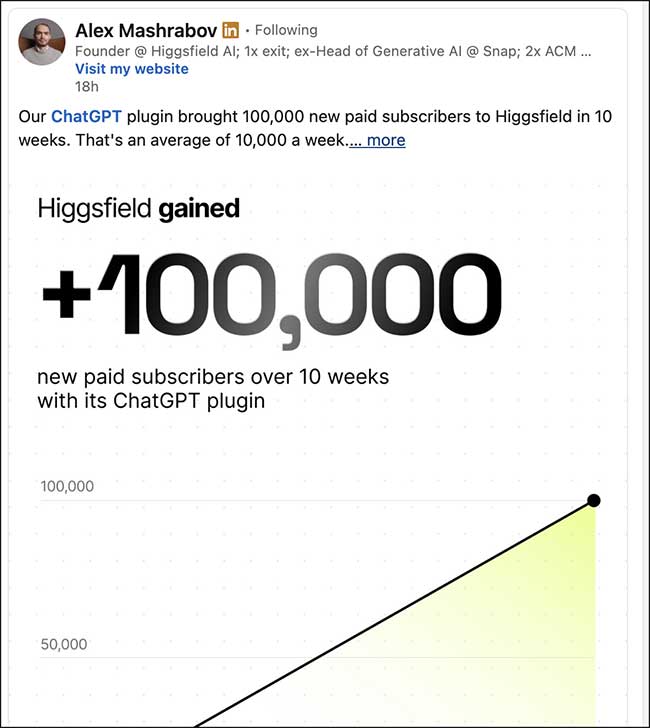
Commenting on Mashrabov’s post, OpenAI marketer Dane Vahey offered to share guidance: “We’ve walked a few customers through how to build a plugin and which types of plugins get the most engagement. happy to have my team turn that into a short video and share it here on LinkedIn if you all are interested…” Read more. (Nov. 13)
PLATFORMS
Optimizing for what?
Groupon and BODi are finding that ad algorithms don’t necessarily cooperate with a change in marketing strategy, The Wall Street Journal’s Nat Ives reports.
Groupon shifted from acquiring customers whose returns would cover acquisition costs within seven days to those expected to deliver greater value over a year. But higher marketing spending failed to produce the expected returns, contributing to an earnings miss and lower full-year guidance.
CEO Dusan Senkypl said the company was still working to get Google and Meta’s algorithms to reach its new target audience:
“We are still cracking and changing the way how we operate the campaign so that we evaluate based on 12 months and not seven days. But at the same time, we are keeping much tighter guardrails so that the marketing is under better control.”
BODi, formerly Beachbody, encountered a different problem as it sought new customers following its exit from multilevel marketing.
“‘The algorithm was putting us in a position where we were bringing back people that frankly already exist in our CRM base and can be more efficiently reached that way,’ Executive Chairman Mark Goldston said.”
BODi cut paid advertising spending while it revamps its approach.
Read: “When Ad Algorithms Don’t Play Along With Your New Marketing Strategy” (Nov. 13) – The Wall Street Journal (subscription)
From tipsheet: Are acquisition campaigns finding first-time buyers, or paying to reach people advertisers could contact more cheaply through their own channels? BODi’s experience highlights the gap between the audience an advertiser wants and the audience an algorithm delivers.
LLMs & CHATBOTS
Criteo makes the case for open models
It’s not all about frontier labs and closed models.
Arnaud Meunier, head of AI Lab at Criteo, shared how the ad tech firm is using small open-weight models for shopping recommendations.
At a recent Criteo–NVIDIA meetup in Paris, two researchers explained how they balance accuracy, latency, throughput and cost:
“Zakaria Ouzarf and Marius Alonso gave a first look at the fine-tuned LLMs we run at the Criteo AI Lab: small open-weight models, trained on our data, running on our own GPUs. Their recipe: evaluation and good training data first. Then fine-tuning and distillation. Then the serving work, from caching to quantization, to balance all four.”
Meunier’s takeaway: “For shopping, a small model can match a frontier model at a fraction of the cost.”
Read more on LinkedIn. (Nov. 13)
From tipsheet: Criteo offers a concrete example of why the open-weight model ecosystem matters to ad tech: companies can adapt models to their own data and workloads, with more control over serving costs. Former NVIDIA CEO Jensen Huang championed that approach (Oct. 21). Whether his departure changes NVIDIA’s commitment bears watching, given the economics of running recommendations at scale.
PEOPLE MOVES
Arrivals and a return
-
- HubSpot: “Notes From the HubSpot Refounding, Day 1… To start with, we’re sharpening the product vision. We are leaning strongly into a headless version of HubSpot. This means that an increasing amount of HubSpot’s capabilities will be consumable by AI agents and AI harnesses (like Claude and ChatGPT) via MCP.” (Nov. 13) – HubSpot co-founder Brian Halligan, returning as CEO, on LinkedIn
- Skai: “As I wrap my first week at Skai I can confidently say that I am 10x more excited than when I began; not that I wasn’t excited, but you never know what lies on the other side.” (Nov. 11) – Former Amazon and LiveRamp executive Avi Spivack, now EVP of Product at Skai, on LinkedIn
- OpenAI: “Very excited to share that I’ve joined OpenAI as Global Head of Scaled Ads Solutions!” (Nov. 11) – Former Spotify and Snap executive Samuel Bevan on LinkedIn
LLMs & CHATBOTS
Developments
-
- “Introducing ChatGPT Wallet” (Nov. 13) – OpenAI
- “Meta Testing New Prediction-Market App With Employees” (Nov. 13) – The Wall Street Journal (subscription)
- “Muse can now place calls to US businesses — if you pay” (Nov. 12) – TechCrunch
MORE
-
- Earnings: “Liftoff Sees Big Wins Ahead For Mobile As AI Pushes Budgets Into Apps” (Nov. 13) – AdExchanger
- Podcast: eMarketer analyst Nate Elliott speaks with Katy Friday of StackAdapt and OpenAI’s VP of Monetization Partnerships Samantha Jacobson, also a board member at The Trade Desk, on conversational AI and audience targeting (Nov. 11) – eMarketer
- AI licensing: “Yahoo becomes first licensee of ‘Spotify-like’ collective AI content licensing model” (Nov. 12) – Digiday (subscription)
- Commerce media: “Proving AI’s business value: Views from PayPal Ads SVP and GM Mark Grether” (Nov. 12) – McKinsey & Co. (email signup)
- Privacy: “Italy fines Meta $887 million over Android users’ data access” (Nov. 14) – CNBC