
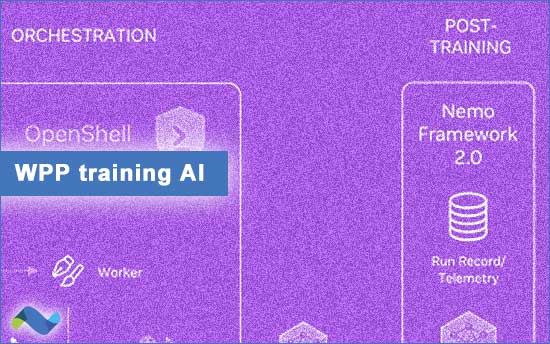
New architecture combines agent orchestration with continuous learning.
Agency holding company WPP is developing creative production infrastructure with NVIDIA and Google Cloud that could improve through experience, using feedback from actual creative decisions to train its AI agents.
WPP Chief AI Officer Daniel Hulme explains:
“Every run is recorded. When a user chooses between two generated assets, that choice becomes telemetry, and the telemetry feeds post-training through NVIDIA’s NeMo Framework. The agents improve with use, steadily optimising for the variables that matter to a client, such as latency, cost and brand fidelity.”
The architecture runs on Google Cloud’s NVIDIA-powered A5X infrastructure, connecting specialized AI agents with creative applications and digital twins in environments designed to protect client assets. WPP also reports performance benchmarks demonstrating the system’s capacity to analyze complex creative assets and support large numbers of concurrent agents.
Read more on LinkedIn. (Oct. 22)
See a quick explainer from WPP on YouTube. (Oct. 21)
Promoting the announcement, WPP CTO Stephan Pretorius said on LinkedIn:
“WPP Research is the only open source research resource for the application of AI to the marketing industry. We invest in open source research because we believe in it: it’s great for attracting talent, for differentiating our products and, most importantly, because it pushes our industry forward. The future is open!”
Related: “WPP AI chief says AI will start shopping for you, changing how brands advertise” (Oct. 20) – CNBC
From tipsheet: The potentially consequential development isn’t faster creative production. It’s the possibility of turning an agency’s accumulated creative decisions into a learning advantage. If those feedback loops demonstrably improve results over time, the agency’s value could reside increasingly in the intelligence of its production infrastructure rather than the labor required to produce individual campaigns.
COMMERCE MEDIA
Walmart opens to AI shopping agents, eyes ads
While Amazon is blocking third-party shopping agents, Walmart is building infrastructure to welcome them — on its own terms.
Walmart announced an Agent Gateway using MCP to let approved outside AI agents shop at Walmart and Sam’s Club. New Agent Profiles will let customers authorize agents, set spending limits and review purchases separately, while Walmart retains control of sensitive customer information.
Read: “Walmart Makes It Possible for Agents to Shop on Behalf of Customers, While Keeping Customers in Control” (Oct. 21) – Walmart
Walmart executives weighed in on LinkedIn:
-
- CEO John Furner: “We’re not waiting to see what shopping becomes. We’re helping shape it by building the connections and protections that will let customers shop with us through the apps and agents they choose.” Read more. (Oct. 21)
- Reposting Furner’s thoughts with his own, Walmart Connect GM Ryan Mayward added: “The opportunity is to be relevant to what a customer is trying to accomplish, not just what they’re searching for.” He sees commerce media connecting brands with new moments of product discovery. Read more.
When your CEO posts on LinkedIn, you repost. Write it down.
Related: “Walmart Connect pitches brands directly as it pushes lift studies ahead of holiday ad deals” (Oct. 22) – Digiday (subscription)
From tipsheet: Walmart is opening its commerce infrastructure to outside agents without surrendering control of transactions and customer data. Its advertising chief sees an opportunity to monetize new moments of product discovery. But who ultimately influences recommendations when independent AI agents shop on behalf of consumers: the agent, the retailer or the advertiser?
CONNECTED TV
AI awaits Comcast split
Comcast is preparing to split its content businesses from its connectivity and technology operations. But where do Universal Ads and one of the industry’s most important CTV advertising technology platforms, FreeWheel, belong? Comcast or NBCU?
Yesterday’s Comcast Q3 2026 earnings release reaffirmed the planned separation but did not specify where FreeWheel or Universal Ads will sit. Digiday reported in July that both were expected to remain with Comcast.
The central distinction is between the two businesses:
-
- Comcast (Xfinity): Connectivity, network infrastructure, wireless, enterprise services and technology-enabled customer relationships.
- NBCUniversal/Sky: Content, streaming, sports, studios, theme parks and the advertising revenue associated with those media properties.
Comcast co-CEO (it’s so big they need two) Mike Cavanagh described the objective as creating two companies with the flexibility, financial strength and leadership to grow independently.
Both FreeWheel and Universal Ads currently sit within Comcast Advertising, and Universal Ads is built on FreeWheel technology.
Read:
-
- Comcast earnings call transcript (Oct. 22) – Yahoo Finance
- Earnings coverage: “Newly Profitable Peacock Is The Feather In The Cap Of NBCU’s Planned Spinoff” (October 22) – AdExchanger
Related: “FreeWheel Launches AI Agent Infrastructure to Transform How Premium Video Advertising Is Bought and Sold, Pilots with PMG” (March 11) – FreeWheel
From tipsheet: FreeWheel’s position raises a question about the boundary between media ownership and advertising infrastructure. AI agents appear to be on the verge of assuming more responsibility for advertising transactions — starting with workflows — so does an ad tech platform serving publishers that compete with NBCUniversal belong with a media company or with a technology business?
COMMERCE MEDIA
AI doesn’t win the sale
Reporting on a new survey from agentic commerce platform Feedvisor, Modern Retail writes:
“AI recommendations are a starting point, not the final word. Shoppers still check reviews, compare prices, visit retailer and brand sites, and look at shipping and return policies, for example, before deciding.”
Read: “AI boosts discovery but reviews still seal the deal, new research shows” (Oct. 22) – Modern Retail
PLATFORMS
Meta automates ads, shifts liability to advertisers
AI brings TOS changes.
Meta is giving its AI more control over advertising creative while holding advertisers responsible for the results — even when its automated tools make changes without their knowledge.
Adweek reporter Trishla Ostwal writes:
“Starting Oct. 30, all that is legally the advertiser’s problem. Under Meta’s updated Commercial Terms, the contract that governs every business using its products, advertisers who run ads on Meta will be ‘solely responsible’ for whatever its AI features create or change, including features Meta switches on. This language sits in a new section, ‘AI Features,’ that does not exist in the current version.”
Read: “Advertisers Pull Meta Ads That Had Unwanted AI Glow-ups” (Oct. 22) – Adweek
Love that phrase “glow-ups”. You look a little under the weather. Try some AI!
More: “Meta may use sweeping new commercial TOS to avoid millions in AI licensing fees” (Oct. 16) – Ars Technica
From tipsheet: Meta’s push toward autonomous advertising is exposing a fundamental imbalance: The platform is assuming more control over creative execution while advertisers retain responsibility for the outcome.
Advertisers may be willing to surrender control in exchange for better performance. But surrendering control without surrendering liability is a different proposition.
FINANCIALS
Reaction: Meta earnings
In reaction to Meta’s impressive Q3 2026 earnings released on Wednesday, industry analysts offered their takes.
Dan Salmon, lead analyst, New Street Research:
-
- AI pays off: “The regional data makes the case best for improvements to the ad stack. US & Canada, Meta’s most mature and valuable market, was the only region to accelerate, to 33% from 31% in 2Q26, on a 23% increase in price per ad and just 8% impression growth. That’s hard to explain without better conversion performance. It also fits with the rollout of the upgraded Lattice model and the Adaptive Ranking Model (ARM), which we believe had not yet reached the #1 Retail vertical when we wrote on the topic in May.” (Oct. 21)
Karsten Weide, analyst, W Media Research:
-
- Concentration risk: “If you buy on Meta, nothing changes this week. The auction works, the AI works, the prices go up. But consider your concentration risk. Meta’s business rests on users trusting it with their data, and courts keep finding that trust was misplaced. One of these days a ruling may touch ad targeting itself, and then it’ll do more than just move the stock. Until then, Meta will keep doing what it does: paying for both its future and its past at the same time.” Read more on LinkedIn. (Oct. 22)
LLMs & CHATBOTS
Developments
-
- Agents: Anthropic previews AI agent Claude Duet (October 22) – Anthropic
- Agents: “Using thousands of AI agents to uncover new leads in biological data” (Oct. 21) – OpenAI
- Former OpenAI, Meta, Twitter exec: Warp Sciences, founded by former OpenAI CPO Kevin Weil to speed up drug development using AI, emerges from stealth with $215M at an $865M post-money valuation (Oct. 22) – Kevin Weil on LinkedIn
MORE
-
- Amazon’s ad biz may constrain agentic commerce: “Podcast: Amazon and Agentic Commerce” (with Gigi CEO Adam Epstein) (Oct. 21) – Analyst Eric Seufert’s Mobile Dev Memo podcast
- Controls for an AI world: “Retailers: You’re no longer limited to flat-rate bidding adjustments for customer acquisition & retention.” (Oct. 22) – Ginny Marvin, Ads Product Liaison, Google on LinkedIn
- Connecting payments to customer IDs: “TransUnion Unveils Transaction Matching to Help Merchants Recognize More Customers” (Oct. 21) – TransUnion
- Basis lays off 10% of staff: “In my 30-plus years in this industry, no technology has reshaped things as fast as AI is now.” – Shawn Riegsecker, CEO, Basis Technologies on LinkedIn