
Zeta Global announced AthenaOS at its Zeta Live event last week, describing it as an enterprise intelligence operating system and an expansion “beyond marketing” of the company’s AI infrastructure, according to CEO David Steinberg.
Its new AthenaOS aims to combine enterprise knowledge with Zeta’s customer intelligence, then assemble the applications and actions needed to pursue a business objective and learn from the results.
Meanwhile, Athena MCP would bring that intelligence into companies’ own agents and workflows, including ChatGPT, Claude and Gemini. Zeta also announced specialized models developed with Fireworks using NVIDIA Nemotron, and early work on a specialized chip with partners.
It was only a year ago that the company first announced Athena as a conversational agent that “transforms questions into actionable answers.”
On the availability of AthenaOS and progress on the chip, the company said in a press release:
“AthenaOS is currently in limited internal beta, and expected to enter public beta later this year, with general availability planned for the first quarter of 2027. Additional capabilities will roll out over time.
The development of the chip is in the early stages, and the architecture and development paths are still taking shape. Zeta will share additional details as it progresses.”
Read:
-
- Zeta Introduces AthenaOS, the Enterprise Intelligence Operating System that Turns Intelligence into Growth (Oct. 8) – Zeta Global
- Zeta Global Teams Up with Fireworks to Unveil New Specialized Athena Inference Model Using NVIDIA Nemotron (Oct. 8) – Zeta Global
More: Zeta now has an $8.3 billion market cap — roughly 50% larger than The Trade Desk’s.
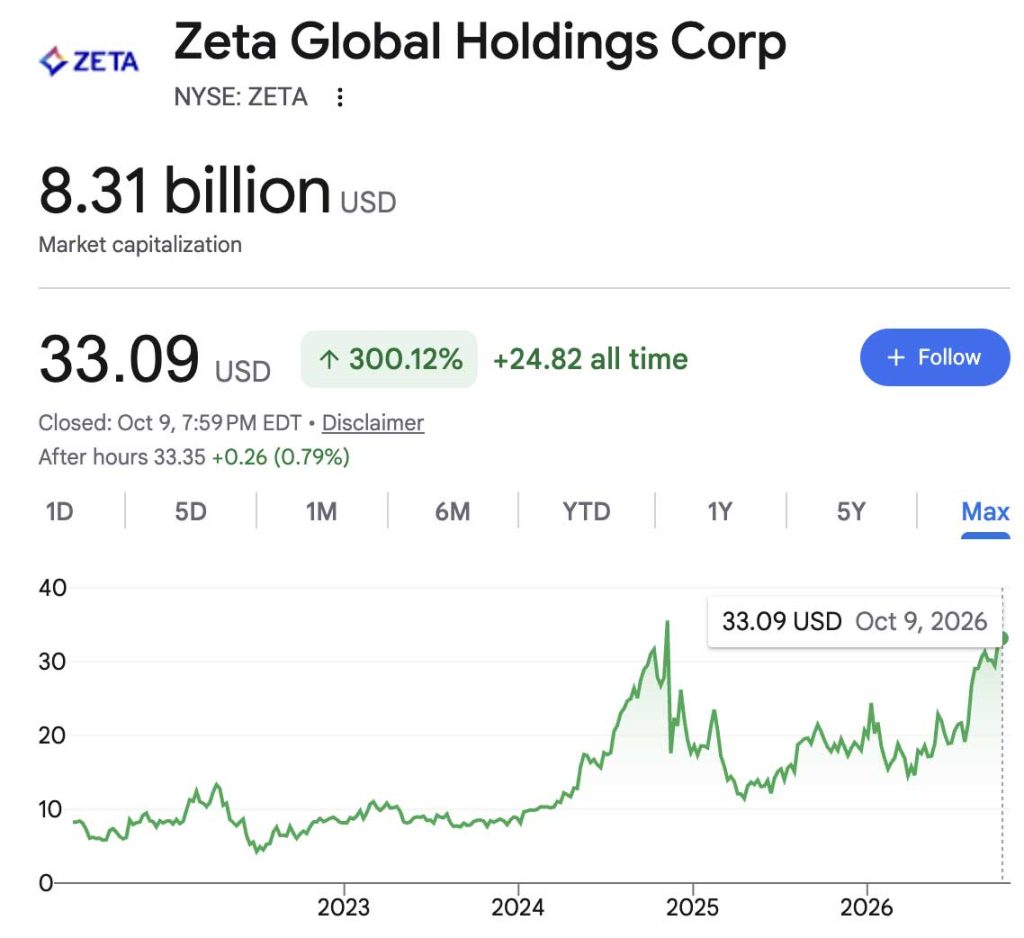
From tipsheet: Marketing is becoming an entry point for broader business AI: marketing platforms already have customer data, tools to act on it and results to learn from. Agents could extend those capabilities into sales, service and other operations. Zeta’s move beyond marketing echoes Meta’s Business AI which launched last year.
MEDIA
Is ad tech next for Skydance?
With Paramount Skydance’s acquisition of Warner Bros. Discovery closing last week and the combined company taking the Skydance name, ad industry participants are wondering about its next moves in advertising technology.
On the Marketecture podcast, Ari Paparo and Aperiam Ventures’ Eric Franchi brainstorm on Skydance’s future. Paparo noted the company’s lack of owned ad tech assets and that WBD was FreeWheel’s second-largest customer. Ad tech company FreeWheel is owned by Comcast.
Franchi, a former colleague of Skydance ad sales chief Jay Askinasi at Undertone, suggested that ad tech M&A may make sense for the media giant.
Franchi speculated on possible targets (lightly edited):
[28:45]
“So I don’t want to talk our book but we are invested in a couple of companies that I think are interesting. We are invested in an AI-first CTV ad server because we think that there’s opportunity there. And then I hear that Integral Ad Science is trying to figure out Publica — so maybe something like that? I don’t know, but there are talent acquisitions that could really get to work on this thing…”
Listen: “Episode 194: Hooray for Advertising Week. Ari and Eric Talk About Everything That Happened” (Oct. 9) – Marketecture Podcast
More: “Skydance Names Jay Askinasi Head of Ad Sales, Taps David Decker to Lead Content Sales and Ray Hopkins as Distribution Chief” (Oct. 8) – Variety
Skydance’s agentic future?
Also, in an email Q&A with tipsheet back in June, Dr. Nage Sethu, SVP of Technology at WBD, described his company’s new agentic platform partnership with Amazon Web Services (AWS).
Sethu said at the time:
“We partnered with AWS to create an agentic platform that unifies planning, activation, optimization, and measurement, making it easier for advertisers to access the full value of WBD’s inventory through a single intelligent workflow.”
Read tipsheet. (June 21)
Now that Skydance has taken over, what’s next with AWS and agents?
In June, WBD said it had begun rolling out direct-response and commercial workflows, audience forecasting, and measurement and attribution. It planned to introduce unified planning in Q3, followed by phased rollouts of order management, pricing and stewardship in Q4. What has gone live, and whether Skydance will keep that roadmap, remain open questions.
Could the platform eventually coordinate buying across the combined Paramount and WBD inventory?
AWS and FreeWheel could conceivably play different roles for Skydance.
Related: “Warner Bros. Discovery reinvents linear television advertising with AWS” (Dec. 2025) – AWS blog
DATA
From CDP to AEP: data platforms add agents
Marketing platforms are adopting agent language in their product names. Hightouch or Bluefish, for example, both call themselves agentic marketing platforms.
AdExchanger’s Joanna Gerber reports on another adopter:
“Three years ago, Nestlé México opted to partner with Treasure AI. The customer data platform recently rebranded itself as an “agentic experience platform,” which basically means AI agents are embedded into every step of its data analysis and campaign planning.
Now, Nestlé Mexico connects its data repository – which contains information like customers’ names and email addresses, along with demographic info – to Treasure AI.”
Read: “Nestlé Mexico Had More Scale Than It Knew What To Do With – Until It Unified Its Data” (Oct. 9) – AdExchanger
From tipsheet: The strategic change is sharing customer insight across brands. Treasure AI’s ‘agentic experience platform’ (AEP) aims to help Nestlé put the scale it already had to work for company brands with less data of their own.
COMMERCE MEDIA
AI commerce + advertising tips
Agentic commerce continues to attract the interest of the advertising community. Ad Age’s chief technology reporter Garett Sloane gathered up tips related to agentic commerce at last week’s Advertising Week in New York.
He shared on LinkedIn:
“Agentic commerce, UCP and AI were hot subjects at Advertising Week New York. Brands are thinking about this, but not many are acting on it yet. In fact, InMobi’s Abhay Singhal tells Ad Age that only 36% of digital merchants are prepared to sell to AI agents.
Meanwhile, TikTok launched a shopping assistant, joining Meta as a social media platform with a new commerce buddy. TikTok’s Neha Singla talked all about how AI absorbs and reflects context in commerce settings…
In ad tech, which is deeply entwined with commerce, Yahoo DSP’s Joshua John said candidly that most agencies, holdcos and brands talk a good agentic game, but adoption of key tools like MCP is low.”
Read more. (Oct. 9)
Read: “Coca-Cola says context will define agentic shopping—and more tips for AI commerce” (Oct. 9) – Ad Age (subscription)
Still more: “What Advertising Week 2026 revealed about AI, creators and media buying” (Oct. 9) – Ad Age (subscription)
LLMs & CHATBOTS
Agencies and ChatGPT Ads plans
Job listings for ChatGPT Ads roles are once again revealing OpenAI strategy for growing its ads business.
Previewing her latest article, Adweek’s Trishla Ostwal says on LinkedIn (Oct. 9):
“Scooplet: Joint business plans are coming to ChatGPT ads. OpenAI is hiring an agency partner to negotiate them with the holding companies, the same playbook Meta and Google used to turn agency spend into committed annual budgets.”
Read: OpenAI Wants ChatGPT Ads to Become a Permanent Line Item in Agency Media Plans (Oct. 10) – Adweek (subscription)
PLATFORMS
Hot takes on the Amazon DSP
In response to Apostra CEO Brian O’Kelley saying “Amazon isn’t a DSP anymore”:
-
- “Hot takes on LinkedIn are often not factual.” (Oct. 9) – Neal Richter, VP, Advertising Science/Engineering, Amazon DSP on LinkedIn
MEASUREMENT
Meta’s Incremental Attribution may be better
Tyler Horner, an insights executive at incrementality measurement firm Haus, says that according to company data, Meta’s Incremental Attribution (IA) setting drove more incremental return than standard attribution. Horner said on LinkedIn Friday, “IA tracked measured lift more closely than Meta’s standard windows. The edge over 7-day click is modest, but real for most brands.”
For advertisers who use platform-reported conversions to guide budget shifts between experiments, IA may be a better baseline. Haus says brands using pre-March data to calculate their incrementality factor should recheck it.
Read more. (Oct. 9)
From tipsheet: The AI connection is the feedback loop: optimizing toward IA asks Meta’s system to find conversions more likely caused by its ads. That can shape who sees ads and where the campaign spends.
PLATFORMS
Google’s machine-readable march
Google is making more buying controls machine-readable, perhaps laying groundwork for campaign automation.
Search Engine Land’s Anu Adegbola reports:
“For agencies and advertisers managing large DV360 accounts, the update makes it easier to apply audience and location targeting consistently across campaigns. However, teams using automated SDF workflows will need to review their templates and scripts to accommodate the new column formats.”
Read: Google launches Display & Video 360 Structured Data Files v11 with expanded targeting (Oct. 9) – Search Engine Land
More: “Structured Data Files – Version 11” (Oct. 9) – Google Display & Video 360 Help
Related: “Google Ads Tests Using Google AI For Goals & Assets” (Oct. 12) – Search Engine Roundtable
PEOPLE MOVES
Now hiring
Smartly names new CTO: “What drew me to Smartly is the opportunity to build intelligent systems that continuously learn – where every signal across creative and media helps make the next decision better. In other words, a chance to push the bounds of what AI can do in the real world, combined with incrementality at scale.” (Oct. 8) – Former Tala and Netflix technology executive Kelly Uphoff on LinkedIn
LLMs & CHATBOTS
Developments
-
- TypeSafe AI, the startup behind Jev, raises “Series AI” (Oct. 9) – TypeSafe AI
- Models as Insider Risks in the Super Intelligence Era (Oct. 10) – Satya Nadella, CEO, Microsoft on X
- Introducing Muse Wonder and Muse Wonder Full: Frontier Models for Agents (Oct. 12) – Meta
MORE
-
- Let’s get physical: “AI Is Pushing Advertising Back Into the Physical World” (Oct. 7) – Adweek
- Kantar and MSFT: “Building an agentic system and a learning loop around customer IP” (Oct. 5) – Microsoft Command Line
- Pay-with-data wall: “As AI search shifts referrals, publishers revisit registration walls “ (Oct. 8) – Digiday
- Data strategy: “Staying Focused on Identity” (Sept. 30) – ID5
- Pharma ads: Google Opens AI Mode to Prescription Drug Ads (Oct. 12) – Adweek (subscription)