
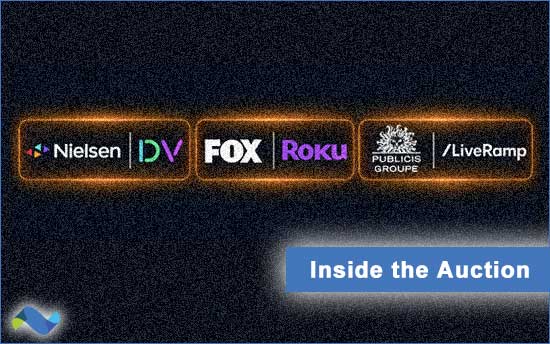
The AI opportunity in advertising and marketing is often described through the tools that generate creative, plan campaigns or operate agents. Three recent acquisition auctions show another part of that opportunity: the assets companies need to give AI systems better inputs and places to act.
- Nielsen wins DoubleVerify’s verification signals: verification and performance signals that can make measurement more actionable.
- Fox wins Roku’s distribution: connected TV distribution and an advertising execution surface.
- Publicis wins LiveRamp’s data infrastructure: identity and data-collaboration capabilities.
Together, the auctions point to the same strategic question: as AI takes on more planning, buying, measurement and optimization work, who controls the inputs, execution environment and feedback loops that give those systems an advantage?
AI raises the value of the inputs to decisioning
Advertising is a feedback loop:
- Plan: Decide whom to reach, where and with what message.
- Activate: Buy and deliver the media.
- Measure: Evaluate audience delivery, media quality and performance.
- Learn: Identify what worked, for whom and under which conditions.
- Adjust: Feed those insights into the next decision.
Mapped to that loop, the three transactions occupy different positions:
- Roku gives Fox a place to activate: inventory access, consumer distribution and an advertising execution environment.
- LiveRamp gives Publicis a way to connect the loop: identity and data collaboration across brands, publishers and platforms.
- DoubleVerify gives Nielsen more of the measurement and learning layer: verification, media quality and performance signals that can inform the next decision.
No one deal controls the full loop. Together, they show which parts of it companies believe are strategic enough to own.
These deals reflect established market forces: streaming TV’s growth, identity fragmentation, cross-platform measurement, verification demand and consolidation.
AI makes the inputs more strategic
That is why the strategic asset in advertising is often not the AI system alone. Models can be licensed and capabilities can be shared. Differentiated signals, direct inventory relationships, cross-company data permissions and control of the feedback loop are harder to recreate.
AI can compress the time between each step: evaluating more options, acting more often and learning from results faster. That speed can improve efficiency on its own.
A durable advantage emerges when the system also has distinctive inputs and permission to act on them.
Ownership is one answer. Access is another.
The transactions raise a harder question than whether these assets are strategically important: when should a company own one — and when is a partnership enough?
The answer differs in each case. Fox is buying a consumer distribution and execution environment. Publicis is buying infrastructure whose value depends on remaining useful outside its owner’s walls. Nielsen is buying signals intended to make measurement and optimization more actionable.
The comparison is between the control ownership can provide and the openness a partnership can preserve.
- Ownership can tighten integration, speed decisions and give a company greater control over the signals and feedback loop.
- Partnership can preserve neutrality, broaden market access and avoid the cost and disruption of integrating an acquisition.
AI does not dictate whether ownership or partnership wins. It makes the choice more consequential by increasing the value of faster decisions, differentiated signals and trusted execution.
AI is the accelerant.
Read: “Inside the Auction” series
- Part 1: Nielsen wins DoubleVerify’s verification signals
- Part 2: Fox wins Roku’s distribution
- Part 3: Publicis wins LiveRamp’s data infrastructure
- Part 4: AI is the accelerant