What can Meta’s advertising system do today that it couldn’t a year ago?
Meta is making the case that its AI investments are improving its advertising business.
Across a series of engineering posts this month, the company has described systems that understand products more deeply, share learning across advertising objectives and evaluate more ads without proportionally increasing computing costs.
For advertisers, the promise is better customer matching and more conversions. For investors, the economic argument is that Meta can turn greater model intelligence and infrastructure efficiency into a more valuable advertising platform. The performance results help support that case; sustaining those gains as investment grows remains the test.
The latest updates, published yesterday, cover three connected systems:
-
- Andromeda selects ads for ranking. Meta’s new engineering post (Oct. 28) explains how work with NVIDIA allows its retrieval system to evaluate a larger pool of ads with more sophisticated models. Meta says it increased Andromeda’s model complexity tenfold in Q3 without increasing computing costs or hardware needs, lifting Facebook conversions 1.37%.
- GEM teaches ranking models to predict ad performance. Meta’s central advertising foundation model learns across surfaces and objectives, then transfers that knowledge to models serving ads in real time. Its October 13 engineering post describes how richer click data can help improve predictions for less frequent conversion events.
- GenRecs uses product and ad details to match ads to people. Its October 19 post explains how a shared vocabulary of product and ad characteristics lets new items benefit from learning about related ones. A new running shoe can inherit useful knowledge from last season’s version, even when its product ID changes.
Meta’s accompanying business blog post (Oct. 28) brings the three together, explaining what the changes mean for advertisers. The improvements reach their accounts automatically, the company says.
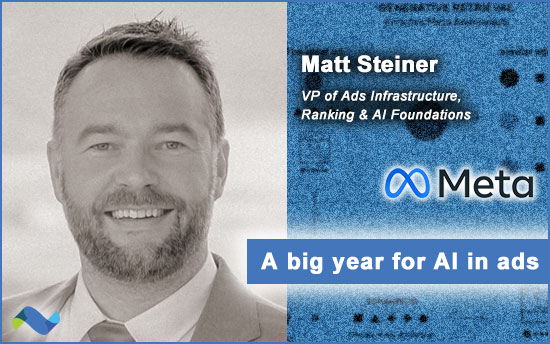
In a conversation with tipsheet on Tuesday, Matt Steiner, Meta’s VP of Ads Infrastructure, Ranking & AI Foundations, explained how the systems work together, what they change for new campaigns and where marketers still need to make the decisions.
Topics covered include:
-
- Learning about products beyond their IDs
- Reducing the cold-start problem for new ads
- Making more use of existing GPU capacity
- How GEM teaches models serving ads in real time
- Muse’s role in content understanding
- What marketers should automate and what they should decide
- Why detailed product and purchase data matter
Scroll down for the interview, which has been edited for length and clarity.
Learning beyond the product ID
tipsheet: What can Meta’s advertising system do today that it fundamentally couldn’t do even a year ago?
Matt Steiner: In the old recommender system paradigm, we would calculate probability based on the unique identifiers corresponding to everything in the system: a business, an ad campaign, a creative ID, a product ID. What’s the probability this particular creative is going to resonate with this person?
We have moved to a world where we have borrowed the concept of semantic tokenization from large language models. It represents a concept as a token. Sometimes those are very human-understandable concepts; sometimes they’re less human-understandable.
Now we can accrete learnings and probabilities to those conceptual tokens instead of IDs, which change fairly frequently.
If you update your product from year one to year two, maybe you change the color a little bit or make the padding a little softer. To you, it’s a different product. But somebody who buys the same pair of sneakers every year because they’re their favorite sneakers isn’t less likely to buy the updated version because the product ID has changed.
A lot of the things they appreciated about the prior shoe generation — the toe-box width, the padding, the slope of the foot in the shoe, the color palette — carry over to the current generation, even if it’s a different product ID.
Using semantic understanding, you can learn a person’s affinity for wide toe-box shoes or running shoes that slope in a particular way. Maybe it’s New Balance shoes. Maybe they love their running shoes to be red.
You can learn what a person actually likes about the shoe across a bunch of different purchases, rather than just learning about that abstract product ID, which is effectively ephemeral and is going to go away at some point.
We have started to use large language models to build a semantic token vocabulary for advertising in the same way we use that vocabulary for understanding content.
This video is about kids going to a park and sliding down a slide. This video is about how to build your greenhouse more efficiently. You learn those concepts through large language model content understanding.
You can apply that same understanding to products, creatives, campaigns and businesses themselves. Then you can have the learnings from the performance data accrete to those concepts rather than the specific IDs.
The way you take advantage of that semantic tokenization is to build a large language model that starts to retrieve ads based on a semantic understanding of the ads, not just a prior performance history.
Prior performance history still matters. It’s still very useful. But we can augment that with an actual semantic understanding of the product, creative, campaign and advertiser, as well as the things a person is interacting with on the organic or paid engagement side.
That generative recommender [GenRecs] model can generate ad IDs that would be relevant to you even if you’ve never interacted with this product or business before, because we’ve learned what you like better on a semantic concept level.
Reducing the cold start
Matt Steiner: The advantage to an advertiser is that this is going to reduce the cold-start problem advertisers experience.
It’s not going to eliminate it. It’s not gone. But your ad will start performing sooner.
That will also reduce the learning phase an ad goes through after it’s created. It’s not going to eliminate the learning phase. We still have to learn about this particular creative and who the message resonates with. But it will reduce the amount of time spent learning because of that better initial targeting.
We have our large language model semantic retriever and our traditional recommender system retriever, and those both feed ad candidates into our retrieval system.
We have a new generative recommender addressing some of the pain points advertisers feel, particularly starting up new campaigns and driving performance. That led to a 2% conversion lift in the target segments where the generative retriever was launched.
Getting more from the GPU
Matt Steiner: The layer above that is the entirety of the retrieval system. You’re taking the traditional recommender system retriever and the generative retriever, mixing the outputs together and scoring them to find the ads most relevant for this particular person at this time.
When we first talked (2024) about Andromeda, we talked about a 10,000-fold improvement in the amount of compute available during retrieval. We could do true personalization on retrieval for the first time.
But there are a lot of ads and those ads carry a lot of data about their interaction history. If you try to pull them all into the GPU at the same time, you tend to saturate the memory bandwidth. There was a bunch of stranded compute on the GPU.
One of the things we’ve done in the 2026 version of Andromeda is move more of that compute from outside the GPU to inside the GPU.
We’re pulling less data across the memory bandwidth layer and doing more compute on the GPU directly. That allows us to utilize the compute available to the GPU, scoring every ad with a lot more compute than we were able to before.
That’s a co-design of the system with Meta Ads and NVIDIA to produce next-generation Andromeda with better performance. It leads to expert heads in the machine learning model being able to specifically evaluate each ad through that mixture of experts.
GEM teaches the models making live predictions
Matt Steiner: The output of Andromeda is that shortened list of a few thousand ads that we’re going to apply very heavyweight ranking to. We have a very large machine learning model, an adaptive ranking model, specifically evaluating those.
The foundation model that powers those adaptive ranking models is called GEM. We’ve made some very meaningful performance improvements to its architecture.
We’ve improved the model architecture to be twice as efficient, which allows us to apply twice as much compute to every ad or consider twice as many ads. You can imagine the optimum is somewhere in between.
We’re considering a longer history of user interaction data, twice as long as before, so you get more examples of what’s relevant and interesting to a person.
Because of the efficiency improvements, that didn’t require twice as much compute. We’re using a model that is two and a half times larger than the prior generation of GEM, which was already an LLM-scale model, and considering longer user interaction sequences.
Since 2025, we’re talking about a 19% lift in conversions and a 12% ad click-through rate improvement coming from improvements to the foundational GEM ranking model. GEM then distills that learning into the adaptive ranking models sitting in production, making live predictions.
The best part is that it just works. There are no levers or buttons advertisers have to flip. The performance just goes up.
An accelerating improvement curve
tipsheet: Is it safe to say there’s been a decent change in one year?
Matt Steiner: One of our observations about the AI industry is that the performance of machine learning models is on a really steep incline.
When you have more compute available, you can train larger models on longer sets of data and that improves performance. It’s true for almost every type of machine learning model and very true in the recommender systems ads world.
It’s not like we are at the end of the improvement curve. In fact, it’s accelerating. These machine learning models are getting better faster than ever before.
The rate of change is only accelerating. It’s wild. It’s crazy. It’s hard to keep up with. It’s the best time to work in tech ever.
I think advertisers are seeing the fastest rate of performance improvements, maybe in the history of the ad space.
Where Muse fits
tipsheet: Does Muse plug in anywhere here? I’m talking about the LLM.
Matt Steiner: We are utilizing the Muse models for content understanding.
This is that key portion of understanding what organic engagements or paid engagements are about and what the products themselves are about. We are using Muse to generate that semantic token vocabulary shared across these properties.
There are a lot of machine learning models and it takes a lot of time to get them all up to speed with the latest techniques, including semantic tokenization. It’s going to take a while for all these techniques to propagate through the entire machine learning model fleet.
A common language of semantic tokenization that we can use across Meta’s properties — whether people are engaging on Facebook, Instagram or even the Muse chatbot — is going to benefit every product in Meta’s portfolio: more relevant content on the organic side, more relevant ads on the ad side and more relevant answers on the AI bot side.
What marketers should automate — and decide
tipsheet: As this technology continues to improve, what is the essential input the marketer needs to get better at?
Matt Steiner: I have two suggestions.
The first is that when we look at the ads workflow our customers go through, a lot of them are still using manual configuration settings across their campaigns.
The data says machine learning models are going to be able to pull mechanical levers based on performance data faster, more reliably and with fewer errors than humans.
That’s been the direction of the space for a few years, but it’s accelerating. The more mechanical levers you can defer to the machine to flip and pull, the better performance I think you’ll see.
You’ll see a faster response to shutting down campaigns that aren’t performing and ramping up campaign spend and conversions that are performing. Machines are really good at looking at the data and making a data-driven decision faster than a human.
The first suggestion is to use as much automation as possible in setting up your advertising campaigns. You’ll benefit from improvements to the machine learning models driving that lever pulling across our surfaces through Advantage+ shopping and so on.
The second observation is that a lot of marketing is really business-specific decisions about how you want to grow your brand portfolio, what margins you want to maintain and how you want to maintain brand identity.
The machine learning models have no idea about that. They can’t make your business-specific decisions.
How much do you want to invest across your brands and across stages of the funnel? What margins do you want to maintain?
What creative development do you want to defer to automation, maybe for a low-margin, high-volume portion of your business, versus high-touch premium brands where humans are driving all the creative content?
Being able to differentiate that for your specific brand, or for the advertisers your agency supports, involves human-driven decisions that machine learning models aren’t going to make because they don’t have your specific business context, objectives and plans for pursuing them.
That’s where humans can add a ton of value, whether it’s within the business, at an agency or some combination of the two.
Why detailed product data matter
tipsheet: Where does structured data fit in and how should marketers think about providing it to your systems?
Matt Steiner: The more fine-grained, high-resolution data you can provide about the products you’re selling and their pricing, the better ability the machine learning model has to predict what works for your business and what doesn’t.
Structured data is particularly valuable there.
Rather than just saying someone purchased a basket of goods, you can provide the basket, a link to the product page for each item and the price paid for each item.
That helps the model learn: These are the prices people are willing to pay when they buy from your store. These are the most popular products coming through online purchases.
Better-resolution, fine-grained, structured data are really helpful to the machine learning model in improving its future predictions for your business.
Less-structured, less-fine-grained data — “a $23 purchase was made” — are not nearly as helpful.