
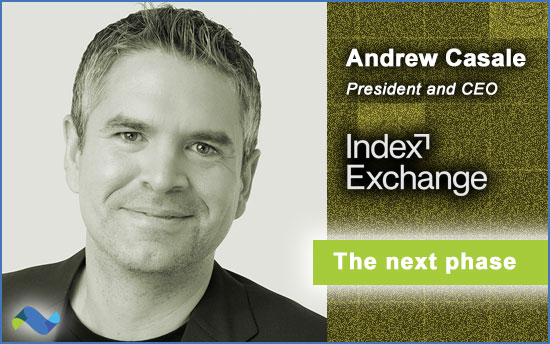
Index Exchange President and CEO Andrew Casale thinks programmatic advertising is entering another architectural shift.
At the center is Index Cloud, which allows DSPs, algorithms and other applications to run closer to where impressions originate rather than operating remotely through conventional cloud infrastructure.
Index began developing the approach with ad tech startup Chalice, bringing custom bidding models closer to the transaction through containerization. Their work was an early precursor to IAB Tech Lab’s Agentic Real-Time Framework (ARTF), which standardizes containerized interoperability across programmatic advertising.
In a conversation with tipsheet yesterday, Casale explained how Index got here and where he thinks it goes next.
Topics covered include:
- Index Exchange’s evolution from SSP to neutral exchange
- Orchestration and the “dumb pipe”
- Containerization and the cost of compute
- Prediction: Every DSP will eventually containerize
- The performance advantage of seeing more supply
- Sell-side decisioning means choice
- Marketer-owned models as a new competitive advantage
- Publisher economics and closing the buy-side information gap
- Index Cloud’s path to becoming a larger business than media
- A future with more specialized and vertical DSPs
- The open internet’s path toward “walled garden” performance
Scroll down for the interview, which has been edited for length and clarity.
From SSP to neutral exchange
tipsheet: Give us the very brief history of Index Exchange. How did you get here, and what is Index today?
Andrew Casale: We are one of the longest-standing companies in ad tech now. We’re over 20 years old.
We’re an independent company, always focused on the sell side. Our customers are media owners. The company started in the early days of ad tech when we were all trying to figure out what to do on the web. As the world became more addressable, data-driven and automated, we evolved the company into the exchange we are today.
We’ve been a strong advocate for getting as much of a marketer’s media spend over to working media as possible. The company is obsessed with scale and efficiency, creating a stronger foundation for the economics of media.
We’ve been part of a lot of industry firsts, from the early days of RTB and header bidding to streaming and, more recently, sell-side decisioning and powering applications on top of our platform through containerization.
We’re very technically focused. Half the company’s headcount is in engineering and product roles.
tipsheet: Do you distinguish between calling Index an exchange and an SSP?
Andrew Casale: We sit in the sell-side or supply-side platform category, so we’re labeled an SSP. But we invoke the exchange narrative because we believe that at full maturity there will be a neutral exchange layer known for scale and efficiency that processes the vast majority of transactions. That’s the company we want to be: not biased, not a black box, super transparent.
In more recent times, what an SSP is has become gray and watered down:
- There are SSPs that have DSPs.
- There are SSPs that are in performance and have black boxes.
I think the category has lost its meaning to a certain degree.
We sit in it, but we’re focused on being a neutral exchange at massive scale: transparent and efficient.
Orchestration and the ‘dumb pipe’
tipsheet: Do you think of what Index does as orchestration?
Andrew Casale: Orchestration to a large extent happens above Index. There’s an attempted rebranding in the AI era of the intelligent platform or the SSP being known for intelligence, not a dumb pipe. We don’t subscribe to that.
We’re a platform that companies and partners build on top of. Increasingly, they do so to gain access to signal and scale at global internet size. They’re doing the incredibly smart work.
Our partners use their own orchestration infrastructure to push and pull signals, instructions and data in and out of Index. We’re not doing that directly; we’re enabling our partners to do it.
Containerization and the cost of compute
tipsheet: Why is containerization important?
Andrew Casale: It’s a funny one because I got that question on stage at ATS two weeks ago, and I said, “It’s really not.” It’s geeky and it has its audience. At a higher level, where this all goes is more performance and less cost. That’s really all they need to worry about.
The internet never stopped growing. We’ve gained new channels and devices, and programmatic has grown with them. We’re now well over 800 billion requests a day across Index, on our way to a trillion. A year ago it was maybe 600 billion; a year before that, maybe 500 billion.
The scalability of ad tech started to break down as compute costs rose, particularly in the last few years as AI and pressures on electricity surged the cost of compute. A lot of ad tech pushes requests out and then ingests responses back in, largely through public clouds like AWS or GCP.
Applications in public clouds pay to move those requests and responses, as well as for the compute to process them.
Containerization asks: Why push all these requests across the internet and incur those costs when we can localize applications?
We process all these impressions on Index. We can run the application right there, and that alone is removing about 80% of the cost of compute. If a request is processed locally, it’s also so fast that every CPU core can do more work.
We built ad tech at great distance and great cost, and that exacted a toll on working media for the media owner and on marketer performance.
The irony is we’re trying to beat the walled gardens, yet they are hyper-efficient closed systems. This gets us to a place where we can remain open while operating in a way that almost mimics a closed system.
‘Every DSP’ will containerize
tipsheet: What happens if the major DSPs adopt containerization?
Andrew Casale: I think it’s inevitable that they will. I can say this on good authority because some very exciting multi-stage integrations and architectural sessions are well underway.
You’re not really trading anything as a DSP by embracing containerization because, to the exchange, the transaction works essentially the same.
Today, if we’re processing an impression on Paramount, we might send a bid request to a DSP’s bidder in AWS. The DSP looks at the request and maybe sends a bid back.
In the containerized flow, we send the request to the container and it sends a bid back, yes or no, to the exchange.
The container has full autonomy and control. It’s encrypted and secure, so we don’t know what’s inside it, but it can handle way more scale.
For more mature DSPs, this is a potential rearchitecture that will take time, but the benefit is significant: the cost of computing the growing internet drops dramatically. You can see more of it, gain more signal and make smarter decisions.
I hope to be able to announce early next year some fairly large DSPs who’ve embraced containerization.
tipsheet: Where does this ultimately go?
Andrew Casale: I think every DSP in five years will containerize. You trade off nothing because you still have your secret sauce and IP. You gain full internet scale at a fraction of the cost and massively cut down your cloud bill.
For a lot of ad tech companies, that bill rivals employees as the top opex cost. There are no prizes for saying, “We just spent $100 million on the public cloud.” Why spend that money when you can turn it into $100 million more in working media?
Marketers own the model
tipsheet: Is there also a data-sovereignty argument here for advertisers?
Andrew Casale: If a DSP chooses to containerize, I don’t think that has anything to do with data sovereignty. That’s a structural change in where they host their company.
On the other side, a marketer working with a vendor like Chalice or building its own models is a very exciting trend that I look at as the advent of a modern competitive advantage.
Most marketers have been using their DSPs or Google’s Performance Max or Facebook’s Advantage+. They give their data to these algorithms, which can drive great performance — but they’re also training them.
There’s a growing fear that if an algorithm does an amazing job for you, it might also drive amazing performance for your competitor because you gave it all your data.
Custom bidding algorithms ahead of a DSP can allow a marketer to own that IP and train it with its own data. I think that is very powerful.
I separate that from DSP containerization. They’re not the same trend; they simply can both be hosted in a container.
Bedrock and the performance case
tipsheet: You mentioned at the most recent ATS London event that early A/B tests using Bedrock’s containerized DSP technology showed “pretty stark” performance differences. What is driving the difference?
Andrew Casale: I think a lot of the market has trivialized scale as an advantage. We’ve normalized the idea that the internet’s too big — that 800 billion number is too big — and has to be made smaller because it costs DSPs money to process it.
Every SSP implements QPS (queries per second) caps. We take that big number and shrink it down. A DSP might say, “I know you burst at 20 million requests a second, but you can only send us 100,000.”
We look at the big internet and what’s relevant to the DSP’s advertisers and campaigns, and we funnel it down so that we’re just sending them the portion of the internet that we think is a good fit for those campaigns.
The challenge is the DSP still has to pace and fulfill those campaigns. If it’s too picky, it won’t fulfill the budget. So after we’ve made something big relatively small, it has to buy from what it’s given.
With Bedrock containerized, we can send it the vast majority of the internet. Its A/B tests are showing an advantage the market has been foregoing.
Given the bigger universe, the bidder can be more selective. It can wait for more deals, find better prices and ultimately find better performance.
People have been assuming the internet’s smaller than it is. The internet also performs a lot better if we allow these mechanics to actually get solved. There are good deals and good performance on the internet. But if you don’t actually look at the whole thing, you’re potentially foregoing the best-performing pockets.
We’re excited about the early results, and they’re compelling established DSPs to take a hard look at containerization.
Cutting public cloud operating expenses is interesting to the CFO, but if campaigns also perform better, that’s almost more important.
Sell-side decisioning means choice
tipsheet: When you say sell-side decisioning, what exactly is moving to the sell side?
Andrew Casale: I would change the word “moving” to “choice.”
Up until now, the sell side hasn’t been tasked to do much in a programmatic transaction beyond run the auction, send the bid request, wait for the bid and pick the winner.
The DSP has done everything: data, identity graphs, performance, creative, attribution, measurement and frequency.
Sell-side decisioning says: What a DSP can do, you now have the choice of also doing on the sell side. It’s not about moving every use case; it’s about gaining optionality.
If a DSP has a narrow QPS aperture and is looking for a niche audience, it might not find much if data is applied after the bid request. Apply it before the bid request on the sell side and you can use the whole universe to find those audiences, then send them to the DSP.
Sell-side decisioning is the idea that use cases historically associated with the DSP are now possible on the sell side, giving the market a choice about which use cases belong where. You can pre-decision on the sell side, too.
Bringing compute back to the edge
tipsheet: Is there a new hardware strategy emerging in advertising around infrastructure and colocation?
Andrew Casale: About a decade ago, it was normal for tech companies to stand up data centers and be close to both the software and hardware. AWS and GCP normalized the idea that you didn’t need hardware or data centers — just run applications in the public cloud. It was convenient and cheap.
Today, particularly for companies running internet-scale applications, the public cloud has never been more expensive.
So why is Index Cloud efficient? In computing, distance is a cost.
Sending requests out and responses back is the 80% of public-cloud cost that’s now gone when an application runs on Index because we don’t have to send anything anywhere. It’s not that our chips are cheaper than AWS’s. Everything is localized, so it’s fast, uses fewer CPUs for the same activity and eliminates the network cost.
This isn’t unique to ad tech. Applications in other industries that historically ran at great distance are also being re-homed locally into what’s called “worker clouds.” We’re bringing that trend to ad tech.
Closing the publisher information gap
tipsheet: How should publishers think about the revenue opportunity from sell-side decisioning and containerization?
Andrew Casale: Ad tech has become more and more of a black box to the publisher, and I think we’re starting to shine more light on what’s really going on.
Our obsession with efficiency also means translating more of a marketer’s ad spend into working media, which ultimately funds people producing great content.
But the former is important. The sell side in its prior role would run all these auctions at great scale, send these bid requests into the ether and hope and pray for a bid back. When we got a bid back, we’d be really happy and excited. When we didn’t get a bid, we wouldn’t know why.
As we start to implement more and more decisioning on the sell side, we’re starting to illuminate what buyers are looking for, and we’re learning a lot. We’re collectively raising the sell side’s awareness of what really matters to the end client, what really was going on that led to the bid or the lack thereof.
We’re starting to solve an information-asymmetry problem that’s existed since the beginning: the knowledge has been on the buy side, while the sell side has largely been kept in the dark unless it gets a bid.
We’re balancing that. I don’t think it’s ever going to go into the inverted balance where now the sell side has the asymmetry advantage. I think we’re really just going to this equilibrium where hopefully over time we know just about as much as the buy side, and so the media owners do too.
That’s one of the biggest advantages for a publisher, along with greater efficiency and more ad spend reaching working media.
Index Cloud could surpass transaction revenue
tipsheet: What’s the revenue opportunity for Index if this architecture takes hold?
Andrew Casale: My hope is — I’ve always been obsessed with getting the company to a business model that looks a lot more like Visa than Uber. It’s a phrase I’ve used a lot over the years, which basically means massive scale, many billions of dollars in media spend, a relatively nominal take.
I think what’s exciting to me is I do believe we are the most efficient company in ad tech by far. If we were a public company today with public financials, I think we would spook the Street at just how much ad spend we pay out to publishers and how little we keep as revenue. And I think that’s healthy.
What will help us get even healthier is allowing us to accelerate that flywheel by growing Index revenue from a cost that’s already sunk.
Hundreds of millions of dollars today go into public cloud compute costs, which over time I see moving into the Index Cloud. We’re not going to take nearly as much of that revenue because it’s not going to require as much cost to be able to compute by gaining the advantage of light speed, but that will allow us to continue to grow Index’s revenue while also continuing to reduce our cost to transact.
My hope long term is that our cloud revenue exceeds the revenue that we get from media transactions as we continue to scale Index and get us to a place where we’re a single-digit nominal fee for the transactions that we process.
More DSPs, not fewer
tipsheet: If this technology takes hold, what becomes of the DSP?
Andrew Casale: I think the DSP gains an equal advantage. So many DSPs struggle with the scale of the internet and the cost of processing it, and I know this definitively because I know the QPS we send them.
Outside a small few with massive books of business, many DSPs struggle with QPS because of the cost of computing it in the public cloud.
As soon as that goes away, I think you’ll see DSPs become massively unshackled, scale faster and innovate in ways they historically couldn’t because unless you hit massive scale, you’ve always struggled with the size of the internet.
My hope is that we see more DSPs, which are more differentiated and verticalized — one of the original promises of RTB and programmatic that structural dynamics held back.
There’s already a renaissance. We’re seeing strong growth in healthcare with DSPs like DeepIntent and PulsePoint, and in the mid-independent-agency market with StackAdapt and Yahoo. In performance TV, platforms like MNTN, Madhive and Tatari are growing, and in app-to-CTV we’re seeing platforms like Moloco and Smadex.
I see that as the direction for the next decade. The last decade consolidated around a small number of horizontal platforms that had enough scale to afford processing the internet. I think that’s changing for the better, which is exciting.
Taking on the walled gardens
tipsheet: Given this transformation around containerization and sell-side decisioning, are these the seeds of the open internet potentially matching the advertising performance of the walled gardens?
Andrew Casale: I think it’s the pre-seeds.
If we stay on this trajectory for the next two to three years, yes. We’re gaining a new environment for innovation.
By localizing applications close to the impression in a secure way, we’re also creating an opportunity for more cooperation. The media owner, the marketer and algorithm companies each know a piece of the formula for exceptional performance, but none necessarily knows everything.
Because we’ve operated at such great distance, everyone’s shared only its little secret piece of the formula, and that’s been a disservice to performance. In an environment where everyone can compute locally, where everything is secure and encrypted, there’s much less downside to cooperating more.
I think collectively we all know more than the walled gardens do. Are we there today? No. But if we stay on this road, I think the open internet is going to rise.
What Meta can do with a phone is unbelievable. The performance is fantastic. But it’s a little device.
We have the biggest screen of all with sight, sound and motion. We have the TV.
As we up our collective game, we have a real opportunity to drive comparable performance at population scale and wrestle some of that power back, along with what we can do on the web, apps and other channels.