Mediaocean has spent decades operating largely behind the scenes of advertising, providing the planning, buying, billing and financial infrastructure used by agencies.
After expanding beyond its Prisma roots through acquisitions including 4C, Flashtalking and Innovid, the company is building NIVO AI, an agentic platform designed to orchestrate its own software alongside agents, data and systems from agencies, marketers and other advertising companies.
As agents increasingly replace traditional software interfaces, CEO Bill Wise believes the systems of record, sources of truth and connections underneath them will become more important.
In a conversation with tipsheet yesterday, Wise explains why Mediaocean now sees itself as “infratech.”
Topics covered include:
- Mediaocean’s long-term strategy
- From processing to influencing spend
- 4C, Flashtalking and Innovid
- AI, client data and billing intelligence
- NIVO and agentic orchestration
- AI-powered decisioning
- Independent ad infrastructure
- Mediaocean’s four moats
- Neutrality and interoperability
- From ad tech to “infratech”
- The future of advertising workflows
Scroll down for the interview, which has been lightly edited for clarity.
Building the MEDIAOCEANscape
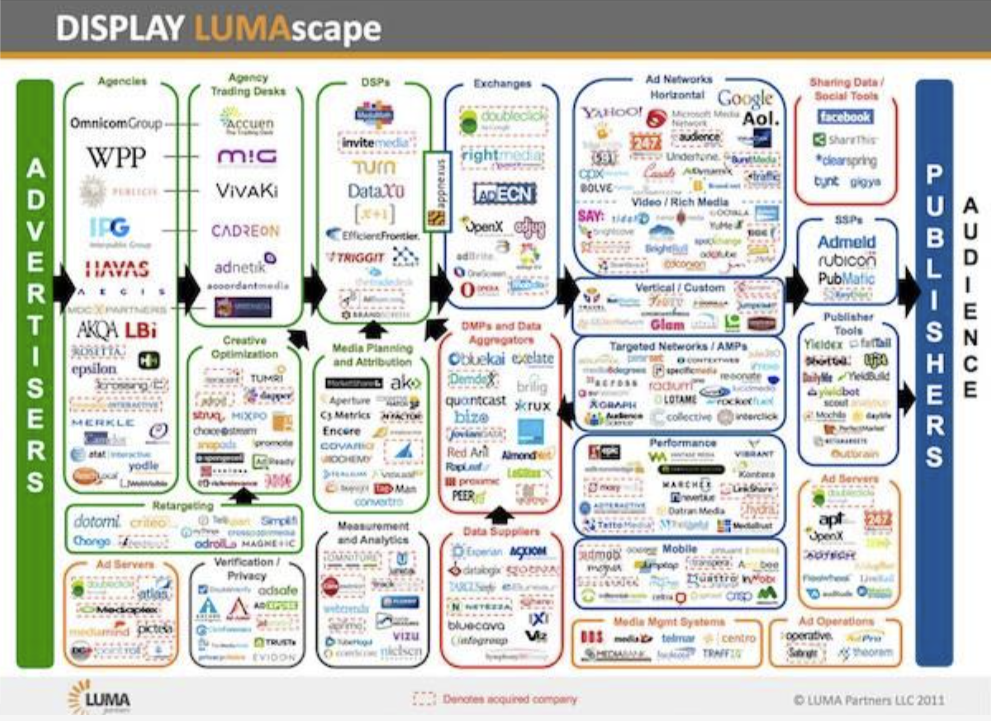
tipsheet: You begin your January MEDIAOCEANscape post with the original LUMAscape, which was a visualization of the ad tech landscape at the time created by LUMA Partners’ Terence Kawaja. When everyone else saw fragmentation in ad tech back then, what did you see that they didn’t?
Bill Wise: First, the heart of Mediaocean — the legacy of Mediaocean — is that we’re more like a vertical ERP for ad agencies.
We have some media-buying workflow, but the core moat is that we provide media finance. I always call it the plumbing and electricity of the industry. Nobody cares about plumbing and electricity until it breaks.
Luckily for the industry, that side of the business doesn’t break. There’s stability. It provides infrastructure that’s highly necessary. It creates some standards.
Because we had $100 billion, then $120 billion, $150 billion, now $200 billion of spend going through these pipes, we saw just how complex, costly and fragmented the ad tech supply chain is.
The core thesis was: What if we start building, partnering and acquiring our way to create a more efficient supply chain? Then maybe we have a shot at competing with the walled gardens, which do all of this themselves.
We began that six years ago. We started acquiring quote-unquote ad tech companies.
Then it got to the point where people didn’t truly understand the breadth and depth of our solutions. I would speak to someone at an agency that uses Prisma and an independent ad server and they’d say, “I didn’t know you did social buying across all the walled gardens. I didn’t know you did dynamic creative personalization. I didn’t know you had a brand-safety solution.”
Because the industry accepted the LUMAscape as the standard way to define the fragmentation and potential consolidation of the industry, we called Terry and said, “Can we steal your LUMAscape and do a MEDIAOCEANscape?”
Part of it was explaining not only the acquisitions Mediaocean did, but the acquisitions that the companies we acquired did. Add it all up and we have our own little LUMAscape.
It fostered conversations we maybe weren’t having in the market in a very easy-to-understand way.
To the financial and strategic community, there’s always talk of consolidation, and you’re always looking for the platform by which to consolidate and make things more efficient. Don’t look any further. Mediaocean is it.
We also embrace our independence and neutrality. Partners are another key component. We’re not going to do everything ourselves.
In addition to the MEDIAOCEANscape, there’s a partner-scape with another 200 logos of companies we’ve integrated with.
In essence, what you get is an independent, neutral operating system at scale.
From processing ad spend to influencing it
tipsheet: You wrote that 4C Insights moved Mediaocean from “processing ad spend to actually influencing it.” Why was that shift so important?
Bill Wise: 4C was the first ad tech acquisition we did (2020).
Very simply, Prisma did not have workflow into buying the social networks and walled gardens. That’s exactly what 4C did.
They had new workflow and a new way to think about buying audiences regardless of the walled garden, including having an audience layer on top of all the walled gardens.
It got us into the ad tech business, which frankly is very different from Mediaocean’s core Prisma business, being that vertical ERP or system of record.
The pace of innovation in ad tech is so fast that if you don’t keep up, you will lose market share. I include the walled gardens themselves in that. Look at the pace at which Meta, Google, TikTok and Amazon are building out their ad tech solutions. If you don’t keep up, you become extinct very quickly.
It required a different level of management DNA. That’s where Mediaocean needed to start shifting the DNA. Processing billions of dollars versus influencing billions of dollars is a different business model. So we shifted into the ad tech mindset, but again with an eye on independence and neutrality.
Building an independent ad-serving alternative
tipsheet: Before Innovid, what couldn’t Mediaocean do that you believed it ultimately needed to do?
Bill Wise: The second large ad tech acquisition we did was Flashtalking (2021). That gave us capabilities in primary ad serving as well as DCO and personalization, in addition to some other measurement capabilities.
I always say you never want to be the third horse in a two-horse race. The ad tech market seems to organize itself into duopolies.
When it comes to ad serving, if Prisma is the system of record, ad serving is the source of truth.
The largest ad server in the market is owned by the largest seller of media, Google.
We acquired Flashtalking, which was the number three ad server. There was a number two ad server called Innovid (2025).
Flashtalking and Innovid had complementary ad-serving footprints, with Innovid stronger in video and CTV. Combining number two and number three into an open, independent, neutral platform to compete with Google being number one, owned by the world’s largest seller of media, was a huge unlock.
We make all of the data through the ad server transparent to the buy side, whereas our largest competitor does not.
Every buy-side company has some sell-side capabilities and every sell-side company has buy-side capabilities, but you have to pick a primary side.
We are on the buy side. We represent agencies and their clients, the marketers.
We believe there’s no reason third-party ad serving for the open web, mobile, video and CTV should be owned by the world’s largest seller of media.
We believe that needs to be an independent company at scale.
AI, client data and billing intelligence
tipsheet: Mediaocean has enormous amounts of advertising spend flowing through Prisma. Obviously there are important client-data and privacy guardrails around that. Does AI create an opportunity to unlock new intelligence from that data?
Bill Wise: With AI, data ownership rights, who has access to data and how you can use that data are things you have to be very careful about, and we are very careful.
I always characterize it this way: The spend data going through Mediaocean isn’t our data. It’s our clients’ data, which are the agencies, and the agencies sometimes say, “It’s not our data. It’s our client’s data,” meaning the end advertiser.
I think what AI unlocks is the opportunity to set guardrails and say, in a world of AI, access to differentiated data can differentiate us against our competitors.
There will be no commingling of this data. But a client may say, “I want to use some of this data to unlock an AI strategy or an agent-buying strategy where cost data that nobody else can access plays a key role.”
We’re having those conversations with our clients and our clients’ clients, and we will proceed privacy-first. But yes, I think there is a big unlock there.
tipsheet: Is there a broader distinction emerging between pooled infrastructure and proprietary intelligence in AI?
Bill Wise: I think in a world of AI, unique proprietary data matters most. Some of that data is connectivity, audience and interoperability.
In a world of agentic and AI, the winners are the people with the most connectivity, with the infrastructure to enable more connectivity and access to unique proprietary data that matters.
The NIVO vision
tipsheet: Last November, Innovid introduced Orchestrator as an AI orchestration superagent. In January, you published the MEDIAOCEANscape. Then in June, NIVO launched. Help me connect those moments. What’s the larger vision you’re building toward?
Bill Wise: NIVO is the larger vision. The way to think about agentic and software in general is like building a house. You spend a lot of time with architects and builders to build a foundation.
You don’t necessarily see the foundation, but the house can’t get built on a weak foundation.
All of the solutions we have in the MEDIAOCEANscape become the foundation for what becomes NIVO.
What you’re going to see going forward is an agentic platform that’s independent and neutral. It will orchestrate not only our own software solutions, but also have an orchestration layer for everyone else’s.
Publicis has agreed to acquire LiveRamp. They’re going to want to include Epsilon and LiveRamp. Omnicom has Omni. Other agencies have principal-buying businesses. WPP has Open.
Everyone will have their own secret sauce, their own agentic strategy. But you need someone to orchestrate it all. In essence, that’s what NIVO is.
It could be your surface. It could be our surface. All the agencies will have a surface. Marketers may have their own surface. Everyone will have agents as well.
The first step is building these infrastructure agents. We launched a trafficking agent, an ad ops agent, a QA agent and a taxonomy agent. As those agents mature, we’ve seen cases where agents reduce the time required for trafficking and ad operations by 90%.
But that’s step one.
Step two is agents talking to other agents. That’s the orchestration layer.
We’ll have our agents. Agencies will have agents. Data companies will have agents. Marketers will have their own agents. We don’t necessarily care who owns the surface. We want to be the infrastructure that enables the agentic surface.
We’ll provide our own, but to move the industry forward, you have to enable people to differentiate. We think independence and neutrality matter in that world.
From ad tech to “infratech”
tipsheet: Every software company is adding AI. What makes Mediaocean’s ambition different? What has to happen before Mediaocean becomes infrastructure that AI depends on?
Bill Wise: That’s exactly where we’re going.
Today people log into Prisma. They log into Innovid. They log into Protected. They log into our DCO personalization and ad-serving products.
With our agents and orchestration layer, those will become the foundation that you don’t see in the house.
They’re critical components, but in the future you won’t log into them. You’ll log into NIVO, or you’ll log into a surface that NIVO is orchestrating and powering. It goes from being a co-pilot to being the pilot.
That’s where the world is moving.
For us, the workflow is those surfaces. Prisma is the media-finance system of record. Innovid ad serving is the source of truth and does the actual ad serving.
The surface will become an agentic platform owned by many different companies that needs to access that infrastructure agentically. We believe software companies with moats that can evolve into an agentic world actually become stronger and more necessary.
That’s where Mediaocean becomes more of an infratech business versus an ad tech or ERP business.
Integrating the stack
tipsheet: Do Prisma, Innovid, Protected and NIVO actually work together today, or is that still the destination?
Bill Wise: NIVO is early days.
We’re applying a lot of focus. With agentic, things move 10 times faster, 100 times faster.
We think this is an enormous opportunity for companies that are sprinting, have moats, see where the puck is going and apply the necessary focus and resources.
I’ll use a crazy example.
We built Prisma on the standard ad-serving platform 20 years ago, DoubleClick, now Campaign Manager 360 owned by Google.
When we acquired Flashtalking, we owned Flashtalking for two years before the Prisma integration with Flashtalking, which we owned, was at parity with the Google integration.
That tells you how difficult and deep these integrations are. We have scars, tears and pain in our joints from tying these things together. Did we get to a point where it was very obvious to a customer? Not necessarily.
If they’re still using Google and they’re still using DoubleVerify and they’re still using Smartly, it didn’t matter that we put it together so cleanly.
But with agentic, that’s all below the surface.
You’re just going to say, “I need to launch this creative on this day with these partners. Let me know what else you need.” The ad ops agent does its work. The QA agent does its work. Software is not visible to the end user anymore.
Whoever has assembled the most infratech and software solutions, together with an agent layer, an orchestration layer and a surface, is going to enable the ecosystem.
AI decisioning
tipsheet: NIVO introduces a Decisioning Agent. Where does decisioning stop today? Do you ultimately see it extending into planning, buying and budget allocation?
Bill Wise: The short answer is yes, it will.
But being an independent, neutral provider for the ecosystem, every client and agency will be able to configure the agentic NIVO platform how they want to, understanding that they’ve built their own agents and their own agentic platforms.
It will be available to customers of our existing software solutions, and they get to configure it how they want.
In the case of ad agencies, they have their own planning systems. We don’t have incredible planning systems, so they’ll own that.
In terms of optimization, they will own that. What data they want to bring in on behalf of what clients, they will own that.
We’ll help.
We’ll create the orchestration layer and connection points into our software solutions and into other solutions.
We can enable it all, but the client will decide what they want to configure and how they want to configure it.
Infrastructure over destination
tipsheet: People say they’re using different platforms and agencies today. When does Mediaocean enter that mix? Does Mediaocean eventually become a destination, or is the goal to remain invisible infrastructure?
Bill Wise: I started this interview saying historically we’ve been the plumbing and electricity for the ecosystem. We’re perfectly content being the pipes.
Increasingly, those pipes are more critical in an agentic world.
A lot of people talk about this ad tech company and this agency and this data provider or identity solution. I think everyone knows Mediaocean, but we may not come up in conversation like those other companies do. We’re fine with that.
The reason we’ve been around for five decades and we’re going to be around for the next five decades is that the ecosystem needs an independent solution at scale for the advertising industry, and someone who knows their place and is content in the infrastructure, or infratech, part of the market.
People appreciate that.
Other than me doing a couple of Wise Words on LinkedIn and us getting up on stage every once in a while, we’re okay playing that role for the industry.
Mediaocean’s four moats
tipsheet: Is Mediaocean’s long-term AI advantage scale, or the context of planning, buying, measurement, verification and billing?
Bill Wise: Our differentiation is absolutely in media finance and having that billing infrastructure.
It’s absolutely in having a core independent ad server and tying those two together: system of record and source of truth.
And we have connections into the ecosystem. We have 300 partners we’ve integrated with, on top of 5,000 publishers, TV broadcasters and others on the supply side. I think it’s our connections, our media finance and bill pay, our ad server as the source of truth and, finally, trust.
I keep saying that the AI protocols don’t solve for trust. You want to work with a trusted partner. Those are our four moats that are going to move us forward in an agent world.
Some of the other things we do, other companies also do. We’re open enough to say you can interoperate with our solution or another solution. But those are the four moats.
The future of advertising workflow
tipsheet: What part of today’s advertising workflow disappears because of AI?
Bill Wise: I think most existing workflow disappears because of AI.