
AI advertising platform Smartly built its business helping marketers create, manage and optimize social advertising. With yesterday’s launch of Intelligence Pro, it’s putting more emphasis on the intelligence behind campaign decisions and its ability to act on them.
The offering brings incrementality measurement together with planning, forecasting and benchmarking tools. The aim is a tighter feedback loop between understanding what advertising contributes and deciding where to invest next.
Because, you know, outcomes.
Read: “Smartly Launches Intelligence Pro to Connect Campaign Planning, Performance and Incrementality” (Nov. 2) – Smartly
For Smartly, which now has roughly 1,000 employees and ambitions spanning social, connected TV and commerce, the launch is part of a broader effort to bring creative, media and measurement into the same platform.
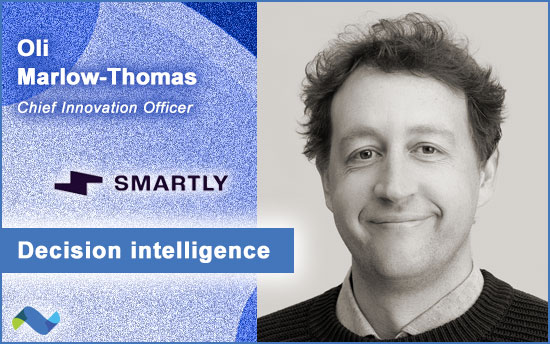
To discuss the launch and the AI opportunity behind that strategy, tipsheet spoke on Friday with Smartly’s chief innovation officer, Oli Marlow-Thomas.
Marlow-Thomas joined Smartly in 2022 through its acquisition of Ad-Lib, the creative tech company he founded after leaving Google. The deal strengthened Smartly’s creative capabilities and brought it deeper into Google’s ad ecosystem, complementing its established relationship with Meta.
More recently, he has been closely involved in the acquisition and integration of INCRMNTAL, the incrementality measurement company Smartly acquired in May. Bringing those capabilities into Intelligence Pro connects measurement directly to the creative and media decisions made within Smartly.
“We need as a company to pivot to decision intelligence,” Marlow-Thomas said.
Topics covered with Marlow-Thomas include:
-
- From measurement to decisions and Intelligence Pro
- Building the feedback loop
- What AI does today
- Earning confidence in AI decisions
- Keeping intelligence inside Smartly
- Choosing where to compete
- The next few years
- Social teams taking on CTV
- Intelligence for agentic campaigns
The interview below has been edited for length and clarity.
From measurement to decisions
tipsheet: What problem is Smartly trying to solve with Intelligence Pro?
Oli Marlow-Thomas: It starts with discussions with our client advisory board last year, which led to the acquisition of INCRMNTAL. In September 2025, we sat down and said, “What are the big problems you guys are facing?” Incrementality came up time and time again.
Marketers have more data and faster execution, but still need confidence to know where to invest, how performance compares and where growth may be possible for their brand.
There’s been a ton of focus on incrementality from a measurement perspective, but not from an activation perspective. We became extremely interested in the idea of a real-time incremental optimization signal.
There are lots of companies out there that report on incrementality, but how powerful would it be if you could optimize toward incrementality?
Clients’ CFOs were coming to them every week and saying, “How do we know this marketing spend is incremental? How do we know those Meta conversions weren’t just going to happen anyway? How do we know adding a new channel is actually going to drive more sales?”
We needed to find tools that solve for that problem, as well as making that a real-time signal.
The market is responding very well to it, but it’s to be seen whether they really feel confident optimizing toward an incremental signal. That’s going to be quite a mindset shift from a post-view, last-touch moment to a true incremental signal opportunity for optimization.
tipsheet: So this is the next step in the evolution of the strategy that began with the INCRMNTAL acquisition?
Oli Marlow-Thomas: We’ve been building intelligent decisioning capabilities for some time. That started with Smartly’s predictive budget allocation tools.
That product was extremely well adopted. We started to realize: If we’re moving budget between the different channels, how long is it until customers say, “How are you really making that decision? We need more intelligence around those decisions.” That’s when we started to look at INCRMNTAL.
We needed a company that was real time, small and nimble enough to work within our infrastructure and had very powerful models.
Headroom Analysis allows you to assess where additional investment may have room to drive growth and where returns may start to diminish. This has been a very powerful tool to connect into INCRMNTAL because you can start to see how the flywheel could work.
If you can understand what an incremental conversion is, how many more incremental conversions could you get on Meta if you invested this much additional investment, or Google if you invested that much?
The capabilities are very much joined at the hip.
Building the feedback loop
tipsheet: The walled gardens benefit from learning through a feedback loop. It sounds like you’re building a more robust feedback loop.
Oli Marlow-Thomas: That’s exactly right. If you think of Intelligence Pro as the overarching branding, within Intelligence Pro there’s Headroom, INCRMNTAL, Benchmarks and Reach Planner.
All of those capabilities are connected, and all of them basically rely on a simulation, a prediction and an outcome. Those things are all connected to inform the best possible outcome for the customer.
We need to get to outcomes as an industry. That’s a big focus for us. If we don’t get to an outcome, we can’t be held accountable, and we can’t hold ourselves to account.
What AI does today
tipsheet: Where do AI and automation fit into this product?
Oli Marlow-Thomas: We made sure customers could use integrations they already have with Smartly. INCRMNTAL Connect, which is the launched product as part of Intelligence Pro, is only available for social channels because we already have all that data. Most of our customers are connected to multiple channels.
Because we’re all connected, we don’t need to do any work. We can just turn on the incremental signal and optimize toward it.
As we expand the capabilities, I would expect customers to ask: Can you pull in search? Can you pull in OpenAI? We want to understand how incremental those platforms are. Automation is taking care of a lot of the setup of those processes.
AI is the underlying infrastructure of both Headroom Analysis and INCRMNTAL Connect. They’re both built on AI models and engines to drive both the decisioning and the recommendation.
Both of those tools are only possible because of a powerful simulation engine. We simulate, forecast and predict what we think is going to happen, and it’s those simulations that allow us to give the recommendation to the customer.
We’re not saying we won’t get to the stage where the tool is making a lot of those decisions in real time. But at the moment, from what we’ve seen from our customers, most of them want a recommendation of what to do versus the business taking action for them in real time.
Earning confidence in AI decisions
tipsheet: What’s the missing piece in getting to those outcomes today?
Oli Marlow-Thomas: There’s still a missing human piece. As we started to research this, what we realized is we could do a lot of these capabilities without informing the end customer.
We could make a lot of these decisions, reallocate budget in real time, trigger specific creative variations based on what’s worked against various audiences, identify the reach of a specific channel and move the spend to drive incremental reach.
But as we talk to more customers, they still want to be able to control a lot of those decisions. Although AI and autonomous decisioning are available now in our industry, I still see the big customers wanting control and guardrails around some of those risks.
We’re looking at whether Smartly can deploy engineering teams into our customers to help them get more comfortable with some of this decisioning.
As a technology company, we need to be on the front foot, providing additional resources to help customers get confident with this decisioning engine.
We need as a company to pivot to decision intelligence. Workflow is an important part of it, but workflow becomes most powerful when the decisions are made on behalf of the workflow. We can’t do that without the buy-in and confidence of the brands.
Customers are sitting there thinking, “How do I justify my Smartly spend? What is it they really give me when I get down to it?” The answer is this decision intelligence.
Keeping intelligence inside Smartly
tipsheet: Can a client use Intelligence Pro with another platform instead of Smartly?
Oli Marlow-Thomas: Currently, no. We do still have the INCRMNTAL acquisition that we completed, so we have the capability to use that separate platform when a customer wants to partner to understand incremental decisioning. We will keep that platform available for customers for the foreseeable future.
We also have customers who are currently just on INCRMNTAL. They came as part of the acquisition.
We think it’s super important to get away from how the industry has been operating for the last 10 years—media, creative and measurement—and pull those things back together.
If we started to offer our intelligent decisioning layer separately, it wouldn’t make sense because we need to be able to pull on the creatives that are working for that audience, for specific targeting strategies, maybe even the bid deployed on the particular media platform.
It helps us pull all of these capabilities together. I’m open to it, and if there’s a use case, we’ll always have the discussion. But at the moment, we’re packaging this into one solution.
Choosing where to compete
tipsheet: Should marketers think of Smartly as potentially the overarching buying platform for all their advertising?
Oli Marlow-Thomas: I think yes. What we’re not doing is search and programmatic. The most important thing a company can do is identify what they’re not doing. These are two areas we’re not investing in.
We do want customers to think of us as a place to buy social, CTV and e-commerce, maybe with Amazon. But we don’t want them to think of us as their primary demand-side platform or their primary search partner. We think those sit somewhere quite differently and generally in different teams.
Our opportunity is connecting brand and performance, and creative and media. Those are the two things we really want to do on the social and CTV side.
tipsheet: Why aren’t programmatic and search part of the platform, at least currently?
Oli Marlow-Thomas: At the heart of what Smartly believes is creative: assets, visuals, images. We think that is the lever that drives performance, and a lot of the intelligence capabilities we’ve built use creative signals.
With search, there are limited things you can do there. That’s changing in the OpenAI environment, when they’re coming to us and saying, “Can you think a little bit about how creative would sit better in these environments?” We’re trying to get on the front foot and be creative with our approach inside the chatbots and the LLMs.
On the programmatic side, there’s a feeling that space has been fairly well mopped up by a lot of different partners. I think programmatic and time on the open web is decreasing, not increasing.
People are finding the answers they used to find in websites now via the OpenAI and Claude systems. The advertising opportunity may be very different on those open ecosystem websites in the future.
I’m not saying never. I’m saying there are other places the consumer is spending their time right now. We always try to anchor what we do in a consumer narrative, and where consumers are spending their time is slightly different from where it was two years ago.
The next few years
tipsheet: Given the pace of change brought on by AI, what change do you see coming for Smartly over the next few years?
Oli Marlow-Thomas: The next step for AI in marketing is not doing more faster. It’s giving teams better information at the moment they need to decide. I think we’ll see much more data driving those decisions.
At the moment, we’re still very focused on informing and educating. In the next couple of years, we’ll see more action being taken and the expectation of action. That’s why Smartly has been so focused on this decision intelligence.
If we can actually be the thing that decides and then takes action, it puts us in a very powerful position moving forward.
We’ve just added Amazon. We’ve added Google. We’ve got an amazing insight into where the consumer is spending their time and the decision intelligence that can power the advertising around that.
Social teams taking on CTV
Oli Marlow-Thomas: The second big trend, and I think this is probably sooner, is we see a real piece of connectivity between social and CTV.
CTV is currently sitting over with the programmatic players, but what we’re hearing more and more is, “We want our social teams to run CTV. It’s best-in-class creative. It seems to act more like social. It’s a real-time environment.”
We’re thinking about how we start to offer what Smartly has—in a lot of instances, gold-standard social creative, personalized to many different audiences—and pull that into a CTV environment.
We started that partnership with Prime, and we’ve also launched with Roku. We’re going to do more of that over the next couple of years. I’m very confident that will be something that drives our business and a real change over the next few years.
The main problems still exist on CTV: It’s fragmented. It’s shit creative. By the way, that’s exactly where Smartly started with social. It’s fragmented. The creative is not consistent. It’s many of the same problems.
Intelligence for agentic campaigns
Oli Marlow-Thomas: The third one is agentic campaign orchestration.
Separate from decisioning, optimization and outcomes, the workflow side of Smartly has been something customers have found very valuable. But we need to do a better job of migrating that workflow into full agentic capabilities.
Later next year (2027), we’re going to release an AI orchestration that’ll start to make a lot of decisions on your behalf, generate campaigns cross-channel, et cetera. It’s informed by all the decision intelligence work.
It’s been a sequential approach. We’re launching decision intelligence, which is made up of Intelligence Pro as the brand, and then that is going to power a lot of the AI orchestration.