
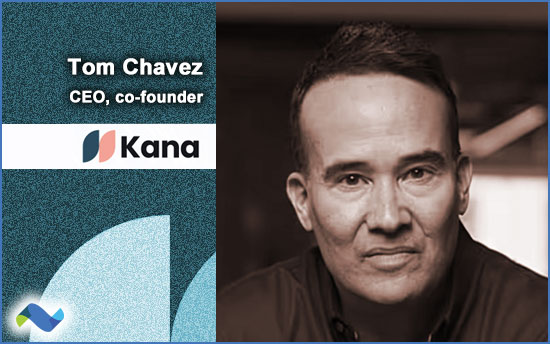
Tom Chavez has spent more than 25 years building software around a problem marketers have never fully solved: turning fragmented data into coordinated decisions.
The companies have changed, from Rapt (acquired by Microsoft in 2008) to Krux (Salesforce, 2016) to Habu (LiveRamp, 2024) and now Kana, but Chavez has had a front-row seat for several generations of technology and the promises that came with them.
Launched earlier this year, Kana is his latest bet, an agentic marketing platform built around the idea that AI can turn much of the existing marketing technology stack into capabilities orchestrated by agents.
Tipsheet spoke with Chavez yesterday about Kana and the larger transition underway in marketing and enterprise software.
Topics covered include:
- The AI bubble and what comes after
- AI’s “bread and water” opportunity
- Unified intelligence
- Agents and enterprise adoption
- Getting started with agentic marketing
- Nielsen-DoubleVerify and Publicis-LiveRamp
- GEO, AEO and AI visibility
- The agentic marketing operating layer
- The 2028 inflection point
- Proprietary data in the AI era
- Marketers owning infrastructure — including hardware
Scroll down for the interview, which has been lightly edited for clarity.
The AI bubble
tipsheet: You wrote on your Substack a few days ago, “We’re in a bubble, and bubbles always pop.” What makes you confident we’re in an AI bubble, and what survives when it pops?
Tom Chavez: I think there can be no question that we’re investing on the supply side to feed a demand side that has yet to emerge. I can say that with some confidence because — as an enterprise software person — I’m in the business of meeting business users where they lie and helping them solve “bread and water,” pedestrian, everyday problems.
What I see is this incredible disparity between the hopes and dreams of CEOs and boards, who are demanding that their companies get on Claude or OpenAI or whatever, and the willingness and ability of employees to actually do that. We have to talk about the psychology of the business worker. It’s not just poor people in districts where data centers are being built, with jobs promised that aren’t actually being created. It’s also white-collar workers who are not comfortable with the idea of all their work being replaced by AI.
They’re pushing back quietly. There’s a silent kind of revolt among enterprise workers. If that’s the demand side and I compare it with the supply side, Houston, we’ve got a problem. It perfectly echoes the fiber buildout that we saw in the late 1990s and early 2000s.
It’s not all doom and gloom, by the way. My point is that there is always a gift. What remains after the fiber bubble? All of this excess fiber. I remember a moment when we said, “Oh my God, there’s no way we’re going to light all of that up.” And we sure did.
Similarly, you can look at this and say, “Wow, we’ve got all of this absurd artificial intelligence firepower in these models, neoclouds and hyperscalers. There’s no way we’re ever going to consume all of that.” That’s the gift. The bet is that we will consume it.
It just doesn’t happen at the pace and on the schedule expected by the investors pumping trillions of dollars into the infrastructure. That timing disparity creates the heartbreak. That’s what leads to the bubble popping. But wait for it. Good things unfold if you give it a little more time.
tipsheet: Is that how you think about Kana? Is it a company for a future solution, or is it solving problems today?
Tom Chavez: In the near term, enterprise workers have “bread and water” problems. You’ve been in this space for a long time, as I have. We have these basic problems involving data synthesis, campaign orchestration and personalization.
In 1999, people were already talking about one-to-one marketing and personalization. We’ve kind of achieved it, but not really. The “bread and water” opportunity for AI and Kana is to meet marketers where they lie and solve those problems once and for all, with a velocity, precision and customization we couldn’t have achieved in olden times.
I’ve been building software for a long time. We live in wondrous times. The things we can do now are not 10 times cooler, better and stronger than what we did before. Try 50, approaching 100. The claim on the table is: Hey, marketers, let’s not get fancy.
What we shouldn’t do today is deploy a swarm of agents that follows the consumer around, anticipates his needs, gives him everything he wants and negotiates with merchants and commerce providers on his behalf. Those dazzling AI futures are coming. They’ll probably come sooner than we anticipate. But here on Earth right now, the job for marketers is to grow revenue and pay off all these commitments and claims around personalization. They need to harness the data they’ve ritualistically gathered and stored in silos for the last two decades.
Now we can actually unlock that data and pull it together into a system of intelligence, using AI to help marketers answer questions and drive results they couldn’t before. That’s what I have in mind. The opportunity for Kana is that we get to use all of this infrastructure.
It reminds me of Krux. We were able to latch onto the cloud disruption and it sure benefited us. The services Amazon was creating were well in excess of what the market could metabolize at the time, but we were innovative and we got to it fast. I see the same trend unfolding here.
We’re latching onto it. We’re using these models to do things at a speed and precision we don’t think others are achieving. If we get that right, we think there’s a big prize and a lot of value for marketers in the short term.
Putting a tent over the circus
tipsheet: The promise of martech platforms has been to create a holistic dashboard, if not an orchestration system, across paid, owned and earned media. Does the introduction of AI mean we are finally there?
Tom Chavez: The short answer is yes. Paid, owned and earned, and don’t forget email and other channels as well. We’ve been talking for a long time about putting a tent over the circus. The truth is that, despite all the hopes, dreams and false promises of the martech SaaS providers that came before, it really hasn’t happened.
Some CMOs will step onto a stage and say shiny things, claiming they nailed it. Everything we see tells us no, it hasn’t happened. But to your question, absolutely yes. We’re doing it now. It’s not a state of mind. It’s not a hope or a dream. Exactly as you describe it: paid, owned, earned, email and all of the data that has been stuck in these little stovepipes can finally flow into a single system of intelligence using AI. That allows a brand like Heineken to see and understand user behavior at a very granular level across all of those touch points.
That’s exciting. It’s also what I call “bread and water.” It’s exciting and a little boring, but that’s where we live right now. If we can claim those wins, they are immediately consequential for every modern marketer we know.
What an agent is
tipsheet: Kana describes itself as an agentic marketing platform. Where do agents fit, and how do you define an agent?
Tom Chavez: There are different types of agents and not all of them are created equal. You’re probably using OpenAI or Claude. That is a one-shot, vending-machine kind of interaction with an agent. It’s a base case.
As you climb that continuum, you move into a more continuous, autonomous and proactive set of actions that agents take to fulfill your objectives. The entire Kana suite is conceived and built as a set of highly aligned, loosely coupled agents that take action, reason on their own and deploy different tools to solve problems and achieve objectives specified by a human master.
That’s our conception of agents. It sounds super cool. It’s also not something we could have achieved five years ago. We’re using multiple models to power those agents. Once you unpack what’s going on, there are lots of tasks. The job is to deploy the right model for the right task at the right time and at the right cost-performance level.
Claude was down for another four hours yesterday. These platforms go dark. If you’re an enterprise software AI user, you need reliability. You need the agentic equivalent of what used to be dial tone. Our job is to weave in those different models. If one goes down, we cascade and fall back to another model in real time that can achieve the task and objective specified at a higher level of abstraction.
I do want to make a dreary little point here.
Software engineers have been talking about things like componentization for decades. Think of agents as the cooler, crack-cocaine version of that. Agents are well-defined, well-circumscribed chunks of software that are much smarter than the software we could build before. But the same design principle still holds. These need to become more our problems than our users’ problems.
The economic buyers and investors need to see a commitment to AI. Their CEOs are demanding fast movement toward that objective. But when it comes to enterprise workers, I don’t think we have to bludgeon them upside the head with lots of agentic AI blobbity-blob. We need to help them do their jobs faster, better and with greater efficiency and precision than they did before.
One of the things we’re doing is gently insinuating some of the agentic bits into the workflow. A lot of enterprise workers, when they see a chat interface for an agentic marketing solution from Kana or anybody else, freeze up. “You mean I can ask any question? I can do anything?” That’s terrifying and weird for people who have spent years clicking through dashboards. We look at that as an opportunity to bring them along and offer ready-made prompts and sample questions to get them started.
There is a different rhythm and flow to the software now. You have to put the cookies on the low shelf and understand what people are trying to achieve. We could just say, “Type anything you want into the chat interface and it’ll happen. It’s a magic genie in a bottle.” Most enterprise workers are not ready to metabolize all that wondrousness. We have to meet them where they lie, strip it down, stop bludgeoning them with AI-speak and give them the answers and outcomes they care about.
Where marketers should begin
tipsheet: What would you recommend to marketers? Where should they begin with the vision you’re building?
Tom Chavez: Our job is to have informed opinions about the greatest value they can achieve by stepping into this opportunity, but without being too ham-handed about it. The shortest answer is to give them the aerial intelligence we discussed earlier, that wraparound intelligence that finally solves the thing they’ve been promised for decades.
Some people feel like they already have something that’s good enough. Then, as always happens in technology markets, you have natural-born innovators who just love cool shit and want to be the first to use synthetic data, which is another element of Kana’s offering.
I’m just saying that most of the marketers we see are not ready for those more sophisticated use cases.
- The first place to start is unified intelligence.
- The second is campaign orchestration and campaign optimization. That’s another “bread and water” problem. There are still too many marketers and media operators sitting in front of a bizarre array of seven spreadsheets, hunting and pecking, taking information out of different systems and trying to flow it into a single spreadsheet so they can optimize the next moves and reallocations they want to make across campaigns. That’s crazy.
- The third is what we used to call journey orchestration, but which I would now describe as next-best-action. I have consumers and I’m hitting them with different messages across different channels. There are unknown users on the open web and named users for whom I have email addresses. How do I orchestrate and optimize that journey from unknown to known, to purchase and then to retention? How do I do that end to end?
Those are the three pillars of the temple. Those are the three we see most marketers latching onto today.
Two deals and the problem with attribution
tipsheet: We’ve recently seen two major deals across advertising data and measurement: Nielsen buying DoubleVerify and Publicis buying LiveRamp. What do those deals tell you about where the industry is going?
Tom Chavez: Nielsen buying DoubleVerify is predictable and a little uninspiring. Honestly, it’s solving yesterday’s problem using old techniques, without what I discern to be a clear or compelling strategy.
I put LiveRamp in a different box. They have a lot to prove, but the premise of taking LiveRamp’s data and using it to energize an agentic transformation at Publicis is on the come. I’ve talked to LiveRamp CEO Scott Howe about this. The premise glistens. If they can achieve 20% of that dream by leveraging LiveRamp’s data to energize the agentic transformation of an old-line agency like Publicis, I would be curious and open-minded if I were one of their shareholders.
But I’d also say, “We’re from Missouri, the Show Me State. Now you have to go do it.”
To be clear, LiveRamp isn’t an attribution play, as best I can tell. But the Nielsen-DoubleVerify discussion leads to my problem with most old-school approaches to attribution. By the time you give me the results that tell me whether I hit the side of the barn or not, the market has moved 25 times.
But all of us who have been in the boiler room know there’s wrong and then there’s this kind of wrong. It’s so inaccurate and so out of sync with the velocity of the market. Look at the speed at which consumers are moving across channels and the rate at which you need to readjust how you allocate your dollars.
A slow-moving attribution or media mix model that gives you an answer nine months after the fact might satisfy curiosity, but it isn’t going to improve any decisions.
It’s a ritualistic thing marketers have had to do because there has been nothing else. I’m not telling you Kana is going to attack those problems today. Over time, I expect we will. But what I see in the market right now is a lot of exhaustion and skepticism among marketers. They won’t say it on panels, but the real attitude is: “Yeah, I have to do this attribution thing. I don’t really believe it, but it’s something I have to do.”
I don’t see attacking that as the highest and best use of our efforts right now.
The AEO market has collapsed
tipsheet: There has been a lot of investment by venture capitalists and marketers in generative engine optimization, answer engine optimization and AI visibility. Where does that fit within the agentic marketing platform strategy you’re developing?
Tom Chavez: I’m going to say something that may surprise you. We had GEO, AEO or AI visibility as a first-class element in Kana’s offering. We put it on the shelf because that market has collapsed.
There is no AEO market.
The companies out there peddling AEO as their reason for being, or as the entirety of their solution, are dead men walking if that’s all they do. There’s no there there. Markets are efficient and a flood of players rushed in to do it. From an implementation perspective, it was the easiest and coolest opportunity. We had dollar signs in our eyes as well.
It was a really easy way to give immediate value to marketers because you weren’t integrating or ingesting any of their internal data. All the data you needed was external data that you could scrape and ingest from the open internet. It was also very difficult to differentiate because everybody had their own suite of metrics.
We believed ours was a better mousetrap because we were doing what we called response orchestration. We would generate content that marketers could place in third-party locations to boost an AI engine’s awareness of their brand, offering or product.
But that was a thin sliver around a tiny margin. At the end of the day, we decided to save our calories and efforts for opportunities on higher ground.
The operating layer
tipsheet: Your fellow Kana co-founder and CTO Vivek Vaidya recently described agentic marketing not as another point solution, but as an operating layer. What exactly is that operating layer?
Tom Chavez: Let me fix ideas with an example.
We’re really proud of what we built at Krux. In the context of Kana, the entirety of Krux is one or possibly two adorable little agents, and we rebuilt it cooler, better and stronger. A “CDP,” meaning the ability to discern, curate, segment and activate audiences across any source or channel, is what those agents do.
The point is that a CDP is not a company in the context of 2026. The same applies to GEO. That’s a feature masquerading as a product masquerading as a company.
The “operating layer” idea takes seriously the fact that marketers are exhausted with all the onesies and twosies. Those solutions don’t fix their problem. They don’t solve the whole problem. You have to conceive of this as a broad, spanning layer that attacks all of those problems in an organized and orchestrated way. It goes back to the idea of a suite of agents that are loosely coupled, highly aligned and working in synchrony with one another to solve the whole problem.
We’re living in a place now where there’s almost no partial credit given. GEO companies are finding that out the hard way. If you’re a legacy CDP company, you’re not going to survive, in my view. That’s the opportunity for Kana. When I talk about “dirt to dinner,” I mean that we have wallowed in this boiler room for a lot of years. We understand the space.
We have a better architecture for solving all the pieces together. We’re also patient. Customers will latch onto a particular piece of the puzzle today, but our job is to usher them along the entire journey.
I mentioned attribution. We’re not doing that today. We’ll get there later. At the end of the day, we’re going to be able to solve all of these problems through this unified operating-layer approach.
The 2028 inflection point
tipsheet: What does the inflection point look like? What will tell us that the market has reached it?
Tom Chavez: If I knew the answer to that, I’d be going short and long on public stocks. I’d close the software company and start a hedge fund. I humbly recognize that I don’t know. But I always have a theory of the case.
The telltale signal will be marketers crossing the barrier to believability and realizing, “I’m actually not being sold false hopes and dreams. This unified intelligence really works.” Their confidence and comfort that it actually works will compound. That’s when we go exponential. If I’m taking a swing at it, I think we’re looking at one to two years. It’s not happening in 2027.
We’re going to go through at least a couple of years of putting kindling around the fire. Every company I’ve been part of has had early pioneers who become lighthouse examples of what success looks like.
Marketers are very social. They’re always watching and listening to what other marketers are doing. I think 2028 is when things get really sporty and interesting. The existence proofs will be there. Marketers will have the confidence that they aren’t being sold snake oil. Then everybody rushes in.
The gospel of proprietary data
tipsheet: You’ve preached the importance of proprietary data for years. At the same time, pooled infrastructure can make sense for areas such as security. How do you think about the pooled-versus-proprietary balance as AI opens new opportunities for decisioning?
Tom Chavez: I’ve preached the gospel of proprietary data for decades. Capture it and generate it by whatever means possible. If you’re sitting on proprietary data, or you have the opportunity through the natural gears of your business to create it, it is always a no-regrets winner.
I can’t help but flash back to Rapt. I was bopping around Manhattan, imploring digital media publishers to stop giving their ad inventory to Google for pennies on the dollar. Claim the value. Invest a little. Don’t sell it for nickels. Sell it for dollars. Nobody listened, and we know how that went. I see the same thing unfolding with data now.
What scares me is companies giving up their data to the frontier models under the cover of, “Let’s have an AI initiative and help you get the results you’re after.” I don’t see companies rushing into that right now. Everybody has their antenna up. They’re going very slowly with Anthropic and OpenAI.
But once you put your data into their machine, you can never selectively lobotomize an LLM. It sees what it sees. It never forgets what it sees.
Machine unlearning is one of the pioneering problems in machine learning today. Nobody has solved it and it doesn’t seem solvable at all. Please, please, please don’t do what the digital media publishers did 20 years ago. That is your proprietary data.
If you can pool it or find other ways to get to higher ground relative to the onslaught of LLMs whose machines are hungry for data, you have to get there by whatever means possible. If there’s just one company called Anthropic in the United States, say goodbye to free and fair markets. The societal implications are terrible.
Proprietary data, defending it, nurturing it and capturing it, is the path to viability and independence.
Will marketers own the infrastructure?
tipsheet: Does that mean marketers should expect to own some infrastructure in the future that they haven’t owned before, potentially including hardware?
Tom Chavez: That’s a really intriguing question. Possibly yes.
What would underpin that movement is severe distrust of the hyperscalers. Marketers would have to reach a point where they say, “I don’t trust Google. I don’t trust Amazon. I don’t trust Microsoft.”
It would be a perilous moment if marketers said, “You know what? You’re all thieves and scoundrels. I don’t trust you anymore. Whatever assurances you make and whatever you put in the contract, I have to invest in my own infrastructure.”
That is not beyond the pale. It’s a really compelling scenario.
Disclosure: John Ebbert is a limited partner in super{set}, which Tom Chavez co-founded. super{set} co-founded and invested in Kana.