
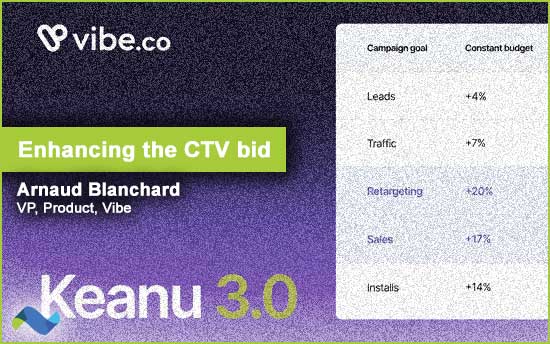
In late April, self-serve Connected TV and streaming platform Vibe announced the launch of its new AI optimization model Keanu 3.0, which it describes as a “unified multi-head prediction model for CTV performance bidding.”
Vibe CEO Arthur Querou said of Keanu, “Rebuilt from the ground up. Already driving +12.4% ROI than its previous version. Not only is it a huge leap, it’s also a foundation that will enable us to move faster and deliver stronger optimizations in the future.” Read LinkedIn,
Read: “Introducing Keanu 3.0” (April 7) – Vibe
Vibe VP of Product Arnaud Blanchard answered a selection of follow-up questions from tipsheet via email.
tipsheet: Arthur Querou described it as “rebuilt from the ground up.” What actually changed in Keanu 3.0?
Arnaud Blanchard: The specific change was architectural. Previous versions of Vibe’s bidding stack ran separate prediction models for each campaign objective. Sales had its own model. Leads had its own. Retargeting had its own. Each trained in isolation on its own slice of data. What a Sales model learned about a user never reached Retargeting. What Traffic learned never reached Leads.
Keanu replaces all of that with one model. Multiple output heads, one per campaign goal, but a single shared backbone trained simultaneously across all objectives. The signal a Sales campaign generates about auction context and user behavior is now visible to the Leads predictor. Retargeting state feeds into Traffic bidding.
The model also trains on a broader signal set than any prior version: auction context, advertiser context, retargeting state, user history, and campaign goal, all in one network.
The gains were broad precisely because the change was architectural. You don’t get +20% across every objective from a tuning change. You get it from replacing the system.
What makes Keanu an AI system rather than a traditional optimization engine?
Traditional ad optimization is a rate card with math on top. Take a target CPA, estimate a conversion rate, submit a bid. The “intelligence” is the pacing logic keeping you on budget.
Keanu is a calibrated probabilistic prediction system. For every ad opportunity, the model outputs a predicted action-through rate (pATR): the actual probability that this specific impression will generate the advertiser’s target outcome, given this auction, this publisher, this user state, this ad pod. The bid is a direct function of that probability.
What is the model optimizing for exactly?
It’s goal-specific. The five objectives are Leads, Traffic, Retargeting, Sales, and Installs. Each gets its own prediction head trained on that outcome.
What data feeds the feedback loop?
Several layers. At bid time: publisher, app, content genre, device, geo, daypart, ad pod position, and whatever pod metadata the publisher sends. User state: whether this user has previously visited the advertiser’s site (retargeting state), behavioral history where available, and user-level embeddings the model builds over time. Advertiser state: campaign goal, pacing, and historical performance rates for that specific advertiser.
Where does human control end and the model take over?
Advertisers control the setup layer: objective, budget, audience, creative, pacing preference. Define those and you’re done. From the first bid request, the model operates.
At every auction, Keanu calculates a predicted probability for that specific impression, normalizes it against the campaign’s historical average, applies a pacing factor to keep spend on track, and submits a bid. Millions of these decisions happen daily with no human involvement.
The pacing factor deserves mention because it reveals something about how the system is architected. An unstable pacing factor is mathematically equivalent to degrading the prediction model, because both enter the bid formula multiplicatively. Budget delivery and prediction quality are the same problem. Stabilizing one improves the other.
Human control re-enters at the campaign level: reviewing performance, adjusting budgets, changing creative. Between those touchpoints, everything is the model.
How should we think about Keanu in an agentic context?
Right now, Keanu is an automated decision system operating within a fixed decision space. It decides what to bid, at what price, on which impression. This limits the need for an operator—human or agentic—to manage a complex set of controls and allows them to focus on what is essential: setting goals, choosing budgets, and adjusting based on performance. By automating these tactical bidding choices, Keanu streamlines the execution layer while humans or higher-level agents maintain strategic oversight.
Does this make CTV a prediction problem, and where does Keanu live?
Yes. The framework reduces the entire bidding system to one question: how accurately can you estimate P(Outcome | Impression, features)? Everything else, the budget math, margin structure, auction mechanics, is scaffolding around that prediction. The internal auction design is intentional: it creates a truthful system where a better prediction directly translates to more value, with no incentive for the model to game its own outputs.
Where Keanu lives: at the bid decisioning layer, in the roughly 100ms window between receiving a bid request from the exchange and submitting a price. Downstream of targeting, upstream of reporting.