
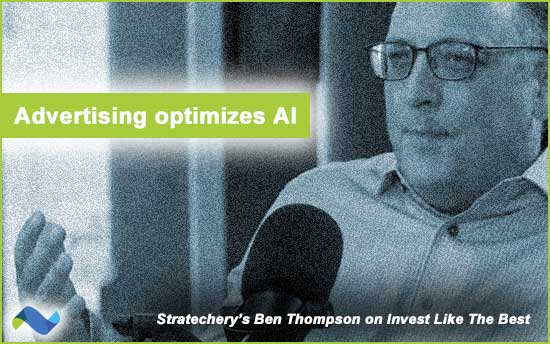
AI → advertising → billions of human decisions → verification → better AI
On the Invest Like The Best podcast, Stratechery analyst Ben Thompson argues Meta and Google have a structural AI advantage hiding inside their advertising businesses: a global system for testing AI-generated outputs against actual human behavior.
Thompson explained (lightly edited):
“Running a gazillion AB tests on all these different things — seeing what works, seeing what doesn’t… Most ads are a throwaway. It’s fine. It’s fine the vast majority of ads don’t convert. They have this massive advantage, this huge liquid market that is a verification machine where the verifiers are humans deciding whether they click on that ad and make a purchase or not, but they’re doing it at global scale. That can actually have a feedback loop to make their products better.”
Listen: What Happens When the AI Boom Runs Out of Money – Stratechery’s Ben Thompson on Invest Like The Best on YouTube
From tipsheet: Seen this way, advertising isn’t just a way for OpenAI to monetize ChatGPT. It’s potentially part of the learning loop. The wider that OpenAI can extend its advertising footprint through partners and resellers, the more real-world signals it can collect about which creative, recommendations and ad matches actually produce outcomes and use those signals to improve its advertising systems.
Thought bubble: Does this make independent ad tech with proprietary outcome data and optimization loops more strategically valuable to AI companies — including as acquisition targets?
LLMs & CHATBOTS
Enterprises want control of the agent layer
Yesterday on X:
- “I’m thinking about banning Claude Code at Shopify until they change their mind and read AGENTS[dot]md and .agents/skills etc. Insisting on only reading CLAUDE[dot]md sometimes leads to split brain problems when different team members use different tools. Just unnecessary.” – Tobi Lutke, CEO, Shopify on X
A bit later:
- “Hi Tobi, thanks for the feedback! We are working on making Claude Code more hackable, which will include being able to easily use Agents[dot]MD or make other system prompt modifications. I’ll share more here when it’s ready to roll out.” – Thariq Shihipar, Member of Technical Staff, Anthropic on X
From tipsheet: Companies want one portable instruction layer that they control, rather than rebuilding company context and rules around each model provider.
There’s an advertising analogue: one portable data layer that advertisers control rather than intelligence pooled inside someone else’s platform.
PEOPLE MOVES
Ad tech’s quiet truth
Former Googler Jitendra Kumar on why he joined agentic marketing platform Hightouch as Head of Commercial, Advertising:
“After 20 years at Google managing a $15B national portfolio, everyone asked me: Why leave now? It started two months ago in Cannes during a late-night (early morning?) conversation with Tejas Manohar. We talked about a quiet truth in adtech: campaign execution has become commoditized, yet the largest ad platforms, agencies, and brands remain trapped in signal loss, fragmented tools, and massive data waste… An AI agent disconnected from your data warehouse is mostly just an expensive engine for automated waste…”
Read more on LinkedIn. (August 25)
From tipsheet: If execution is commoditized as Kumar says, value moves upstream: to the proprietary signals and intelligence that tell the agent what to do.
SELL-SIDE
Bring your own intelligence to the auction
Magnite is making the case for moving advertisers’ proprietary AI and decisioning closer to the supply.
In a LinkedIn post on Monday, the sell-side platform highlighted work with Chalice AI, SWYM[dot]ai, Omnicom Media and inPowered AI that embeds partners’ intelligence directly into Magnite’s execution infrastructure.
Chalice CEO Adam Heimlich describes the model as bringing “a brand’s proprietary intelligence and decisioning models into the auction while relying on Magnite’s infrastructure.”
SWYM[dot]ai co-founder and CEO Ravi Patel makes the sell-side decisioning argument: rather than simply passing impressions into the market, “supply should be optimized before the auction begins.”
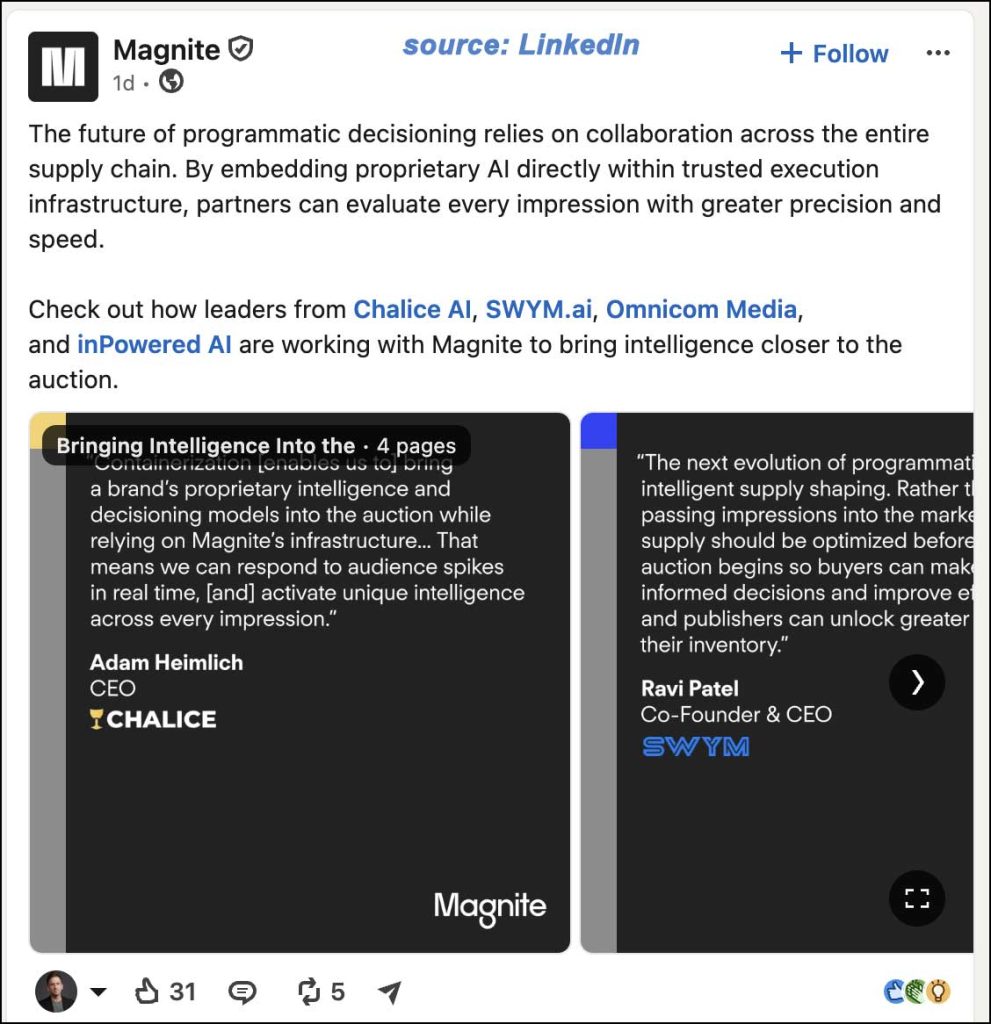
From tipsheet: Bring your own data, models and decisioning. Let the infrastructure execute them closer to the auction.
Related: The Evolution of Data Collaboration: Why Neutral Infrastructure Matters in a Signal-Driven Market (August 25) – Magnite blog
SELL-SIDE
Tracking the sell-side evolution
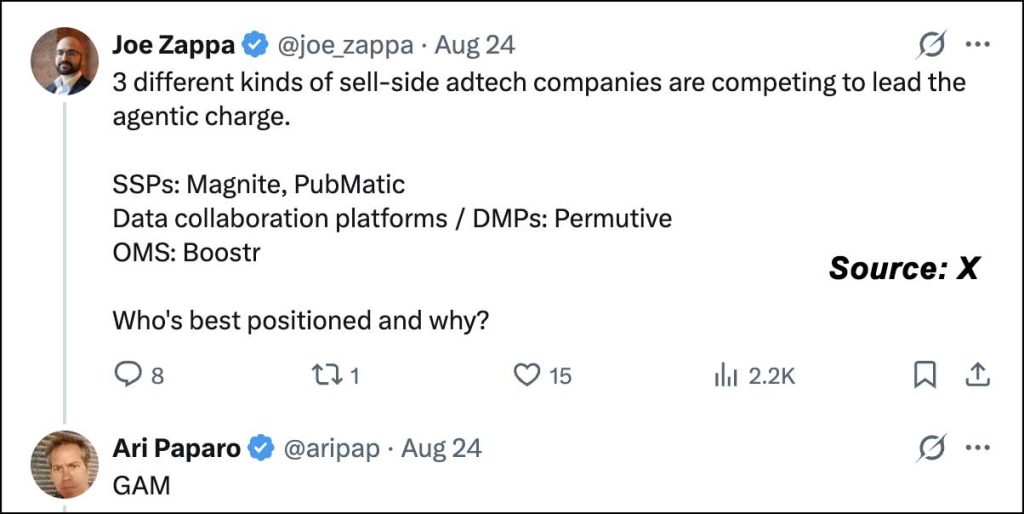
GAM = Google Ad Manager
SEARCH
New dataset, same story: AI and search
Marketing agency Brainlabs analyzed Google Analytics data from 54 advertisers across 19 sectors over 14 months. Digiday reports the results provide “a broad view of a finding businesses have reported anecdotally for the last year.”
After Google AI Overviews became widespread in Search, organic sessions across the advertisers fell 10.5%, while referrals from AI platforms increased 163%, according to Brainlabs. More importantly, traffic from ChatGPT, Copilot, Gemini and Perplexity generated key events (like making a purchase or signing up for a newsletter) at 1.5 times the rate of organic search traffic.
Brainlabs’ Sam Paez says AI Overviews are still “overwhelmingly” triggered by educational and informational discovery queries, although they are beginning to reach commercial searches.
Read: “In Graphic Detail: How AI search has impacted the web traffic of over 50 advertisers” (August 25) – Digiday (subscription)
From tipsheet: The story isn’t new and the evidence is getting harder to dismiss. The next question is how the economics compare: monetizing discovery the old way through traditional Search vs. the new way through AI.
LLMs & CHATBOTS
Developments
- Jalapeño’s first results show industry-leading speed and efficiency in AI inference (August 25) – OpenAI
- Introducing Portable Computer for local-first AI (August 25) – Perplexity
- Accel-backed Keenable is indexing the web for AI agents (August 25) – TechCrunch
CONNECTED TV
The feedback loop forming in CTV
From Jason Fairchild, CEO of Pinterest-owned CTV platform tvScientific, yesterday:
- “Our AI’s goal is to get better at moving consumers through the funnel and driving the outcomes advertisers care about. That means feeding audience signals, media delivery data, creative performance, incrementality, and halo effects back into optimization systems.”
Read: “From inspiration to purchase: how performance TV advances Pinterest’s monetization strategy” (August 25) – Jason Fairchild on tvScientific’s blog
From tipsheet: Another feedback loop. Pinterest is turning its advantage in knowing what consumers are considering into an advantage in learning what actually makes them buy. tvScientific closes more of that loop.
MORE
- X Launches Advertiser MCP, Enables Third-Party AI (August 24) – MediaPost
- Jon Whitticom, Netflix’s VP of Product for Advertising, is exiting the company. Previously, he was FreeWheel’s Chief Product Officer (August 25) – Business Insider (subscription)
- “Programmatic Gets An Agentic Brain” with Butler/Till CSO Scott Ensign (August 25) – AdExchanger Talks podcast
- New Meta AI Features for Small Businesses (August 19) – Meta
- “One of the web’s most-cited domains in AI answers (Reddit) almost fell off ChatGPT in four days – and nobody at OpenAI will say why. Is this the start of big tech’s new marketing merry-go-round?” (August 15) – The Drum (subscription)