
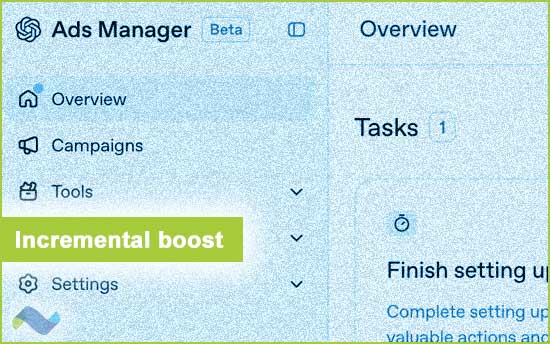
Yesterday, Criteo CEO Michael Komasinski shared early performance data from the company’s ChatGPT Ads integration:
“We’re now expanding our integration with ChatGPT Ads through Criteo across 31 European markets. More than 2,000 brands are already advertising on ChatGPT through our platform, reflecting strong momentum.
Early results show that conversion rates are already outperforming other referral channels, click-through rates are 2-3x higher than comparable formats in other environments, and more than 80% of ad-driven traffic comes from customers who are new to a brand.”
Read more on LinkedIn. (August 24)
The European expansion echoes what OpenAI announced last week for ChatGPT Ads. Read OpenAI VP of Monetization Benji Shomair on LinkedIn. (August 21)
More:
- Criteo Accelerates ChatGPT Ads Integration with Europe Expansion (August 24) – Criteo
- An Update on Criteo’s Integration with OpenAI (June 2026) – Criteo
Context: A rumored private equity acquisition of Criteo surfaced in early July and remains unresolved after an earnings miss in Q2.
From tipsheet: ChatGPT’s pitch to advertisers is starting to come into focus:
- Reach consumers while they’re deciding what to buy, not after they’ve already decided.
- Reach incremental customers rather than simply harvesting existing demand.
Now we’ll see whether that advantage survives scale.
TECH
Meta’s AI infrastructure gets a second business
In his latest research for investors, New Street analyst Dan Salmon reviews the potential returns from Meta’s enormous investment in AI infrastructure.
He sees two increasingly distinct ways Meta can monetize that spending:
- Improve the core business: Recommendation systems increase engagement and ad performance. Salmon now attributes more of Meta’s recent ad growth to these “under the hood” improvements.
- Monetize the infrastructure itself: Rent some of Meta’s AI compute externally, effectively creating a new cloud business.
“We think there will be revenue this year and it will be a catalyst for shares,” Salmon writes.
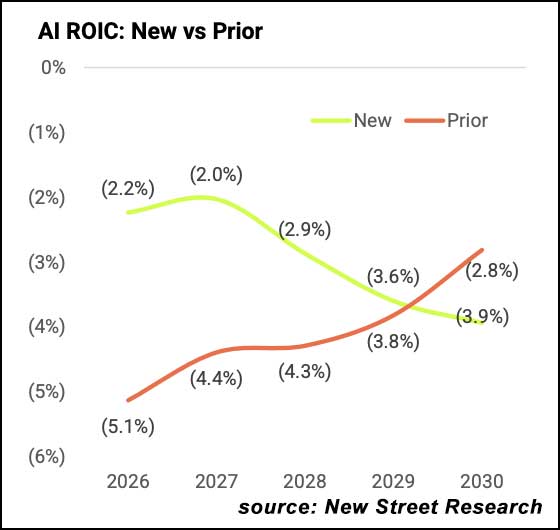
See image: New Street has substantially raised its estimates for Meta’s AI return on invested capital through 2029, but still expects those returns to remain negative. By 2030, its new estimate is actually worse than before as higher capex and depreciation catch up.
Related: Platforms Petition Court To Block Recommendation Restrictions (August 24) – MediaPost
TECH
Sell-side decisioning gains momentum
The DSP had the audience. The sell side found more of it.
Healthcare marketing platform Wrango and OpenX say supply-side targeting helped pharma advertisers reach more healthcare providers on the same budget.
The companies compared multiple specialty pharma campaigns targeting the same deterministic physician audiences through two paths: uploading the audience directly to a DSP and targeting through OpenXSelect, which applies multiple identity signals at the point of the bid request. Creative, budget, flight dates and bid strategy were held constant.
OpenXSelect delivered 32% greater physician reach and a 22% lower cost per unique HCP. Notably, 100% of impressions delivered through the DSP-direct path ran on publishers also accessible through the OpenX Deal ID.
OpenX EVP Tyler Romasco said on LinkedIn (August 20): “Both approaches accessed the same publisher inventory, so the difference wasn’t supply. It was identity resolution on the supply side.”
Read: “Wrango Finds 32% more HCPs with Supply-Side Targeting via OpenXSelect” (August 19) – press release
From tipsheet: The larger implication is that some decisions may be better made on the sell side. Identity resolution now has a performance case for moving upstream, adding to the broader shift of intelligence away from a DSP-only model.
Related: New Chairman Joel Meyer (CTO of OpenX) Dishes On Prebid’s Reset For The Agentic Ad Tech Era (August 24) – AdExchanger
PLATFORMS
Google gives PMax better local signals
The targeting input is getting more precise just as Google shifts more control of execution to its AI-powered ad system Performance Max.
Search Engine Land reports that Google expanded the businesses eligible for Local Services Ads, adding more specific categories across restaurants, automotive and beauty ahead of the product’s migration into Google Ads.
Restaurants, for example, can now identify themselves as sushi, Italian or vegan restaurants, while automotive businesses can select specialties such as transmission, brake or oil change services.
The expansion comes as Google begins moving Local Services Ads into Performance Max campaigns with pay-per-lead goals. The transition starts with select U.S. advertisers this month and continues through 2027.
Read:
- Local Services Ads transition to Performance Max campaigns with pay-per-lead goals – Google Ads Help
- Google expands Local Services Ads categories ahead of migration (August 24) – Search Engine Land
From tipsheet: AI loves structured data. As Google’s AI gets better signals about what an advertiser does, it can take on more of the work of matching that business with the right customer.
TECH
The ad tech squeeze
What would actually drive ad tech consolidation?
Marketecture’s Ari Paparo argues that it’s not the crowded LUMAscape:
“What drives actual consolidation is economics, when customers or resources get squeezed such that survival and growth requires more scale. If there’s no economic crunch, then there’s no consolidation.”
Paparo sees that squeeze coming from declining open-web traffic, agency holding companies investing in their own technology, rising infrastructure and AI costs, and tighter capital. He points to Taboola’s exclusive NBCUniversal deal as one example and argues that agency tech ambitions may even be contributing to The Trade Desk’s challenges.
So where should you look for the next wave?
Read: What Does Ad Tech Consolidation Look Like? (August 24) – Marketecture
LLMs & CHATBOTS
OpenAI builds ads reseller program
Last month, tipsheet reported that OpenAI was building a reseller strategy after a job posting for “Head of Scaled Ads Solutions,” which has since been removed, revealed plans for direct, reseller and outsourced sales channels.
Now OpenAI is putting more infrastructure behind that strategy with a new “GTM Strategy & Operations Lead, Reseller & Ecosystem Programs (APAC)” role in Singapore.
Role highlights include:
- “Design and build the ChatGPT Ads reseller program, including partner segmentation, eligibility criteria, commercial model, operating model, onboarding, governance, and performance management.”
- “Define the role of resellers and ecosystem partners across customer acquisition, activation, spend growth, market expansion, support, and scaled coverage.”
- “Develop partner coverage and engagement models across advertisers, agencies, resellers, outsourced sellers, and other ecosystem participants.”
From tipsheet: The reseller strategy is moving from concept to operating model. OpenAI is defining who qualifies, how partners participate and how their performance is measured. Starting with a dedicated APAC role also suggests resellers could help OpenAI expand advertiser coverage without building a direct sales organization in every market.
B2B Marketer? OpenAI is still looking for a “Head of Ads Enterprise Marketing”.
- May 22: “OpenAI hires for enterprise ads marketing push” – tipsheet
- August 24: “OpenAI is sharpening its focus on enterprise advertisers with enterprise marketing role” – Digiday (subscription)
LLMs & CHATBOTS
Developments
- SpaceXAI Adopts NVIDIA Vera CPU to Accelerate Agentic AI at Massive Scale (August 24) – Nvidia
- Nvidia Discusses Perplexity Investment at $30 Billion-Plus Valuation (August 23) – The Information (subscription)
- Autonomy and Innovation (August 24) – Analyst Ben Thompson on Stratechery (subscription)
MORE
- NYT: Netflix considers opening its app to rival streaming services, taking a page from Amazon and YouTube (August 24) – The New York Times (subscription)
- After Years Of Fighting LGE, Alphonso Is Headed For An IPO (August 24) – AdExchanger
- How YouTube monetization is changing for the platform’s smaller creators (August 24) – Ad Age (subscription)
- Agentic commerce is a mirage — part 3 (August 24) – Analyst Eric Seufert on Mobile Dev Memo (subscription)
- Tracing MFA to the Source: How Amazon Ads and HUMAN Are Protecting the Open Internet (August 20) – Human