
The agenda for Amazon Ads’ unBoxed event later this month in San Francisco offers a clear picture of where its advertising architecture is headed: advertisers set the objective, budget and constraints while agents handle planning, creative, execution, optimization and measurement.
Amazon Ads is building around Ads Agent, MCP connectivity (see open beta from Feb), real-time signals and multi-agent coordination, including systems in which specialized agents can discover, communicate and work with one another.
The model extends beyond Amazon Ads.
Warner Bros. Discovery is already building its agentic advertising platform with Amazon Web Services (AWS) and Amazon Bedrock AgentCore: advertisers define outcomes and audiences while agents help forecast, allocate and optimize WBD inventory.
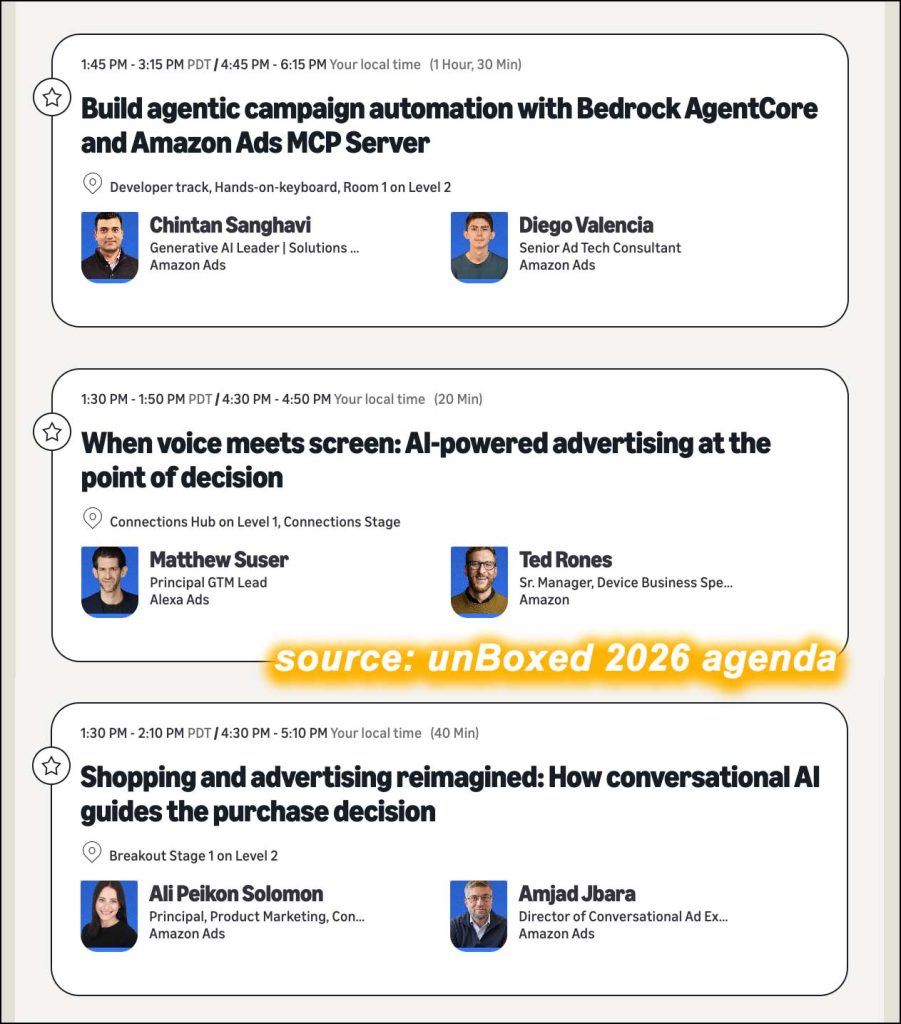
At unBoxed, developers will build multi-agent campaign loops using Bedrock AgentCore and the Amazon Ads MCP Server. The pieces point toward a larger possibility: Amazon providing the infrastructure for an agentic advertising ecosystem that extends beyond Amazon Ads.
See: unBoxed 2026, San Francisco, September 28-30 – Amazon Ads
From tipsheet: The intriguing endpoint is buyer agents communicating with seller agents. Amazon hasn’t said its buying agents will communicate directly with WBD’s selling agents, but the connective infrastructure is taking shape. If buyers express objectives and constraints while seller agents determine how inventory can satisfy them, advertising starts moving from humans operating platforms toward machines negotiating how those objectives get executed.
Related: Q&A: WBD building ‘agentic platform that unifies’ (June 21) – tipsheet
COMMERCE MEDIA
Walmart’s Sparky AI assistant making moves
Azoma GTM and sales leader Christian Rich, whose company helps brands optimize their products for recommendations by AI shopping agents, noticed Walmart’s AI assistant taking a bigger role in product discovery in-app.
On LinkedIn yesterday, Rich wrote: “Walmart Sparky is leaning into intercepting page 1 search results with category questions and personalization triggers. If ChatGPT and Gemini are the Pacific Ocean for product discovery, Walmart and Amazon are building a backyard pond with your favorite fish.”
He adds: “Owning category prompts means you’re in the mix for everything related to them going forward, and you might box a few competitors out entirely.”
Read more. (Sept. 9)
And see below:

From tipsheet: Search advertising was about winning placement against a query. Agentic commerce introduces another layer: winning the reasoning that determines which products make the shortlist in the first place. Then comes the obvious monetization question: What happens when retailers start selling placement inside the recommendation itself? The optimization target shifts from keywords people search toward questions agents answer.
PLATFORMS
A ‘walled garden’ begins to grow?
OpenAI has stopped accepting ChatGPT ads for image- and audio-generation products that compete with its own AI capabilities, The Information reports.
Read: OpenAI Cuts Off Adobe, Others From Advertising Some Competing AI Products in ChatGPT (Sept. 9) – The Information (subscription)
The unpublished restriction surprised advertisers including Adobe, an early participant in the ChatGPT Ads pilot that had advertised Acrobat Studio and AI image generator Firefly. Video generation products remain eligible.
Adobe senior director of Americas Media Doug Wyatt noticed something potentially significant on the organic side as well: ChatGPT no longer appears to return citations or outside links for some action-oriented image queries, including “photo editor,” “image generator” and “how do I edit a photo.”
Wyatt writes on LinkedIn:
“Adobe was an early adopter of OpenAI’s ad platform, one of a small pool of beta testers. So imagine our surprise when they quietly updated their ads policy to exclude ads promoting competing image-generation and voice/audio-generation products. Video-generation ads, notably, remain permitted.
Read together: ChatGPT is narrowing both the paid and organic discovery pathways for tools in categories it now competes in directly. Image and voice/audio are closed off. Video’s still open…for now.
Platforms curating their own inventory isn’t new. But this is a real shift if you’re running GEO or paid media anywhere ChatGPT is expanding into. Worth watching closely.”
Read more. (Sept. 9)
From tipsheet: The paid restriction is clear, but the organic question may be more consequential. When ChatGPT can perform the task itself, sending a user to another image or audio tool competes with its own product. If those outside tools also can’t buy their way onto the surface, OpenAI controls both the recommendation layer and access to the advertising inventory around it.
MEASUREMENT
CAPI is the price of performance
Mobile Dev Memo’s Eric Seufert argues that conversion APIs (CAPIs), which send advertiser conversion data directly to platforms’ servers, have become central ad tech infrastructure. They let platforms build behavioral advertising systems beyond the browser and operating system, but create a new divide: advertisers will only prioritize so many integrations, favoring the largest platforms with proven performance and authenticated consumer relationships.
He writes:
“I regard CAPI as a revolutionary development in the landscape of the digital economy. CAPI makes the capacity to secure and use direct conversion connections a central component, possibly the most consequential component, of advertising competition.”
Read: The CAPI revolution (Sept. 9) – Eric Seufert on Mobile Dev Memo (subscription)
More: Your CAPI Cheat Sheet: Understanding Conversion APIs (June 2025) – AdExchanger
TECH
Debates
- Publisher monetization “snake oil”: Freestar founder David Freedman says publishers are being promised eye-popping revenue lifts by an unnamed competitor. “Publishers deserve to know what assumptions are behind a revenue projection. What the baseline is. What inventory is being compared. What changed.” (Sept. 9) – David Freedman, founder, Freestar on LinkedIn
- Agentic reckoning: PubX founder and CEO Andrew Mole “said the agents could connect buyers and publishers without sending every transaction through the conventional collection of platforms. ‘If we remove the need for those tools because an agent can run a campaign speaking to an agent, it doesn’t need to use a DSP or an SSP,’ Mole claimed.” (Sept. 10) – Mi3 (Australia)
CONNECTED TV
DOJ takes a deeper look at Fox-Roku
As tipsheet reported Tuesday, the initial U.S. antitrust waiting period for Fox’s proposed $22 billion acquisition of Roku was set to expire on Tuesday night unless the Department of Justice took further action.
It did.
According to Roku’s filing on Tuesday:
“On September 8, 2026, as expected, each of Roku and FOX received a request for additional information and documentary material (the “Second Request”) from the DOJ in connection with the DOJ’s review of the Mergers. (…) Roku and FOX will continue to work cooperatively with the DOJ in its review of the Mergers.”
Roku and Fox still expect the merger to be consummated by the first half of calendar year 2027.
Semafor reported that rivals fear Fox could favor its own content after taking control of Roku’s CTV operating system. The transaction would also bring together Fox-owned Tubi and The Roku Channel, two competing free ad-supported streaming services. Fox CEO Lachlan Murdoch has said he expects to run the two services separately while selling advertising across them.
Read: Justice Department to take a closer look at Fox’s $22 billion Roku deal (Sept. 8) – Semafor
From tipsheet: Tuesday’s deadline has become a deeper regulatory test of the deal’s central proposition: control of the interface where viewers discover content and not just ownership of the content itself. As recommendation systems become more AI-driven, the question extends to who controls the logic that decides what viewers see and where advertisers can reach them.
DATA
Actionable turns CX into decisioning signal
Causal AI startup Actionable has raised $10 million to expand a platform designed to help brands understand why customers behave the way they do, predict what an individual customer will do next and try to change the outcome.
Paris-based Actionable pulls customer data from systems including CRMs and CDPs into an industry-specific “Common Model,” then identifies the drivers behind outcomes such as churn and repurchase.
AdExchanger spoke with co-founder and co-CEO Nicolas Rieul:
“LLMs ‘just don’t understand’ raw data without an additional semantic layer and industry-specific context, like why, exactly, customers are churning, said Rieul. And without that context, the models can hallucinate.”
The system can then turn those predictions into audiences for activation.
Read: Actionable Raises $10 Million To Build A Better Understanding Of Cause And Effect In Customer Service (Sept. 9) – AdExchanger
From tipsheet: First-party data becomes more valuable when AI can understand what it is. Actionable is turning customer experience (CX) into a decisioning signal: identify the cause of a customer’s likely behavior, build an audience around it and use advertising or CRM to try to change the outcome. That could help marketers drive incremental behavior rather than simply harvest demand from customers already likely to convert.
BRANDS
What is AI transformation, really?
PepsiCo is on an “AI transformation” journey, according to Ad Age senior editor of technology and AI Garett Sloane.
He tries to give the popular phrase some meaning in a LinkedIn post previewing his latest Ad Age article with Brian Bonilla: “One, it’s more than just giving a brand infinite ‘versioning’ of ads through generative AI. And it’s more than just slapping an agentic interface on a portal.” Read more. (Sept. 9)
Read: How to compete for AI transformation work—and what PepsiCo’s search reveals about the stakes (Sept. 9) – Ad Age
From tipsheet: AI transformation is about redesigning the workflow around what humans do, what agents automate and how existing systems work together. That gives agencies a much bigger opportunity by competing for a role in determining how marketing gets done. (See WPP’s expansion of WPP Enterprise.)
LLMs & CHATBOTS
Developments
- The greatest AI opportunity is in trusted information (Sept. 9) – Deloitte
- AI opportunity robust in footwear recycling (Sept. 8) – Resource Recycling
- What will our economic future look like? (Sept. 9) – Anthropic
PEOPLE MOVES
Now hiring
- “After 8 years at LiveRamp developing measurement capabilities, I’m excited to share that I’ve joined Newton Research as Chief Customer Officer.” (Sept. 9) – Christine Grammier on LinkedIn
- “I’ve joined Verve as Vice President of Business Operations, where I’ll help shape and execute the business’s strategic priorities, accelerate growth, and strengthen alignment across the group.” (Sept. 9) – Former LiveRamp executive Keaton Pieper on LinkedIn
- “I’m excited to share that I’ve joined Precise[dot]ai as Chief Revenue Officer.” (Sept. 8) – Former DISH media executive Dave Antonelli on LinkedIn
MORE
- Ads for agents: “Some companies are using ads to influence AI agents” (Sept. 8) – Marketing Brew
- RMNs: “How 11 retail media networks are trying to differentiate themselves to advertisers” (Sept. 8) – Modern Retail
- Sell-side: “AI’s promise does not justify using any means to build it” (Sept. 9) – Jason Kint, CEO, Digital Content Next on DCN’s blog
- Product data becomes ad evidence: “AI Shopping Ads Don’t Reward Bids. They Reward Proof.” (Sept. 9) – Intero Digital’s Jessie Morris on Design Rush
- The AI operating layer: “Everyone In Ad Tech Will Soon Have An AI Operational Layer. Are You Building Yours Or Renting Someone Else’s?” (Sept. 9) – Anastasia-Nikita Bansal, CEO, TeqBlaze on AdExchanger (sponsored content)