
OpenAI puts an agent at both ends of the ad interaction.
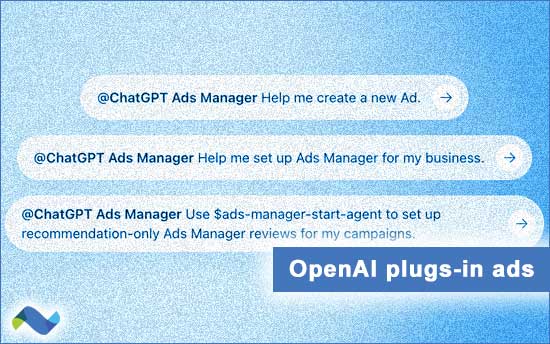
Last Thursday, OpenAI shared its latest product updates in an email blast to ChatGPT Ads users. At the top of the list was a ChatGPT Ads Manager plugin that lets advertisers create, manage and analyze campaigns from ChatGPT or Codex.
“Create, manage, and analyze campaigns from ChatGPT or Codex. Use plain language to turn a website or brief into ready-to-launch ads, create variants, update campaigns, troubleshoot delivery, review performance, and get prioritized recommendations. The plugin previews recommended changes and asks for confirmation before applying them.”
That is a meaningful design choice. The ad platform is not simply automating campaign work in the background: it is moving the interface for that work into an agent, while preserving a human approval step for execution.
OpenAI also previewed a future conversion-optimization campaign type:
“We will be introducing a new conversion optimization model that optimizes through the inclusion of view-through conversions. This model allows for optimization based on conversions from both ad clicks and ad views. With this campaign type, billing is impression-based while delivery optimizes toward your selected conversion goal. More details will be shared as this campaign type rolls out more broadly.”
OpenAI’s current conversion-optimization model bills by the click and optimizes using click-through conversions. Its public documentation says view-through conversions remain a separate reporting metric, suggesting the email previews a materially different model that has not yet rolled out broadly.
It follows a reported July test of ads that direct users to a Business Agent rather than a website.
From tipsheet: Control moves from operating the platform to setting constraints and approving the agent’s proposed actions. The landing page, meanwhile, becomes a conversation managed by another agent.
CONNECTED TV
Fox-Roku: Today’s antitrust deadline
The U.S. antitrust review of Fox’s acquisition of Roku is reaching an important deadline.
Fox and Roku initially filed their Hart-Scott-Rodino notifications on July 6. Fox subsequently withdrew its filing on August 5 and refiled on August 7, a move the companies said was intended to give the Department of Justice additional time to review the transaction.
That restarted the HSR waiting period. According to Roku’s merger filing, it is scheduled to expire at 11:59 p.m. ET today, unless the DOJ takes further action.
If the waiting period expires without a Second Request, Fox and Roku will have cleared a significant U.S. regulatory hurdle. The transaction still requires other approvals, including regulatory clearance in the UK and Germany and shareholder votes.
From tipsheet: Today won’t determine when Fox gets Roku. It could tell us whether U.S. antitrust review is likely to be the thing that slows it down.
CONNECTED TV
Fox-Roku: Roku moves further into the TV
Roku launched its first OLED televisions last week, moving its Roku-made TV line further upmarket. The company began selling its own branded TVs in 2023 after years of licensing Roku OS to television manufacturers.
The new Pro Series OLED starts at $999, while a higher-end LX model arrives in October starting at $1,299. Both are being sold exclusively through Amazon.
The move is notable as Fox prepares to acquire Roku. Walmart’s $2.3 billion acquisition of Vizio gave the retailer a Connected TV hardware and operating-system layer alongside its advertising business. Fox is assembling its own version of that loop with Roku: content, TV hardware and operating system, viewer relationships and advertising.
Read: Roku Launches All-New Pro Series OLED and Pro Series LX OLED TVs (Sept. 1) – Roku
From tipsheet: Walmart bought Vizio. Amazon built Fire TV. Fox is buying Roku. Owning the operating layer connects distribution, audience data and advertising on the same device. AI makes that feedback loop move faster and more valuable.
COMMERCE MEDIA
Last week’s retail media upfront
The Wall Street Journal covered last week’s first-ever retail media upfront organized by Ascendant Network:
“Despite robust attendance at the Showcase, retail media’s biggest names—Amazon and Walmart—were nowhere to be found.
‘It’s well documented that retail media spend is artificially consolidated with a handful of players far beyond their commensurate share of sales,’ Brian Monahan, senior vice president of Albertsons Media Collective, told the audience in a not-so-subtle reference to those category leaders.”
Read: Retail Media Rivals Host an Upfront-Style Event to Court Ad Buyers (Sept. 3) – The Wall Street Journal (subscription)
From tipsheet: If the event attracts brand budgets, Amazon, Walmart and the other walled gardens will eventually want in, even if the event’s agenda was designed partly to challenge them.
For now, it is an attempt to present fragmented retail media as both a scaled alternative to dominant platforms and a destination for TV upfront budgets, though neither a shared stage nor AI can create shared measurement without consistent data.
PLATFORMS
Trade Desk: Layoffs and a push for speed
The Trade Desk CEO Jeff Green on LinkedIn Friday: “I believe more than ever that our team is the best assembled in ad tech today.”
The Trade Desk reduced its global employee count by about 15% on Friday. In an email to employees, Green said the company is reorganizing into “smaller pods and smaller scrums” with greater focus. He said the layoffs are not expected to become routine at TTD, despite being “a common practice in big tech.”
Notably, he did not attribute the cuts to AI as some tech companies have in the past.
Read: Important TTD team and business focus updates (Sept. 4) – The Current, owned by The Trade Desk
Green framed the move as an operating change, not a response to financial distress. The company has about $1.5 billion in cash, no debt and generated more than $2.9 billion in revenue last year.
From tipsheet: The Trade Desk’s operating model argument appears to be:
- Smaller teams
- Greater ownership and speed
- Faster client outcomes
The biggest risk: clients experience the change as less support. AI would appear to be a key lever in making the model work.
FINANCIALS
Trade Desk: Dropped from S&P 500
- The Trade Desk will be removed from the S&P 500 and added to the S&P SmallCap 600 effective September 21 (Sept. 4) – S&P Global
TECH
Debates: Logs
- DSP transparency: “Syndicating your programmatic media log files shouldn’t be this difficult” (Sept. 2) – Sarah Caputo, consultant, Fraction Method on LinkedIn
- Who owns Google’s logs: [20:18] “… LiveRamp has proved you could do ID-based work privately by encoding and transcoding. That’s something I told DOJ: Google shouldn’t be able to keep the advertiser-side GAM logs. They belong to the advertiser. The advertiser should be able to get them out — the transcoded IDs — and then be able to model conversions.” (Sept. 4) – Adam Heimlich, CEO, Chalice on the AdTech AdTalk podcast
Related: “This New Tool Cuts Out Identity Providers By Linking Trade Desk Data With Brands’ First-Party IDs” (June 1) – Adweek (subscription)
MEASUREMENT
Google news: GeoX goes GA
Google VP, Global Ads Dan Taylor on LinkedIn Friday:
- “Really excited to see Meridian’s GeoX move to general availability worldwide for anyone to run controlled Incrementality experiments across any platforms and calibrate their MMMs with causal ground truth!”
Overview: “Swipe through to see how Meridian GeoX anchors your measurement” (Sept. 4) – Google Ads on LinkedIn
From tipsheet: The deeper play is Google shaping how marketers measure media even when it doesn’t own the channels being measured. Meridian and the open-source Universal Commerce Protocol reflect the same strategy: build infrastructure that works across platforms while keeping Google close to how the market operates.
More Google:
- Ad tech trial: The Verdict Is In! Now What? (Sept. 4) – Ari Paparo on Marketecture
- Workflow: “AI-powered conversational assistant… has now rolled out to 100% of English Help Center traffic in Beta.” (Sept. 3) – AdSense Help Center
- Raiding YouTube: “Netflix’s YouTube opportunity, part 3” (Sept. 4) – Eric Seufert, analyst, on Mobile Dev Memo (subscription)
LLMs & CHATBOTS
Paparo: Chatbot ads may include the conversion
Discussing the momentum behind ChatGPT Ads, Marketecture’s Ari Paparo pointed to an emerging opportunity for ad tech inside conversational interfaces:
[44:20]
“One analogy that people don’t know so much about is that in Japan back in the 2000s, when mobile ads started working, a lot of the vendors that developed were both advertising and conversion landing-page providers because marketers didn’t know what to do with a click-out.
The standard model was: You did everything for the advertiser. You did conversions, optimized conversions and measured conversions. This strikes me as similar, in that maybe the vendor places an ad and then you execute the conversion in the chatbot through a syndicated chat conversation. That would be something I would look for because that’s a value-add that won’t be eliminated by the platform.”
Listen: “Episode 189: Jeremy Hobson is Bringing Live Radio to the Digital Era, Plus Google’s Big Win in Court” (Sept. 4) – Marketecture Podcast
LLMs & CHATBOTS
Developments
- “An Alien Mind” by OpenAI Chief Scientist, Jakub Pachocki (Sept. 6) – OpenAI
- Kai-Fu Lee: China Will Win the AI Race for Reach (Sept. 4) – Bloomberg
- Anthropic pushes back IPO as investors await one of AI’s biggest public-market tests (Sept. 5) – Calcalist
MORE
- Zeta Global: Inside Zeta’s Transformation From Hopeful Do-Over To Surging AI Marketing Stock (Sept. 4) – Investors’ Business Daily
- Amazon and FTC: “The FTC’s Amazon Lawsuit Is Ad Tech’s History Of Opacity Repeating Itself” (Sept. 4) – AdExchanger
- Case study: “How Halo Collar Uses Data And Incrementality To Raise Both Awareness And Sales” (Sept. 4) – AdExchanger
- Crawler lawsuit: Seattle Times sues Microsoft and OpenAI, alleging they trained their AI on its journalism (Sept. 4) – GeekWire
- A GEO firm’s August: “August was another huge month for product. Here are a few of the many features that the team shipped in the last 30 days” (Sept. 4) – James Cadwallader, CEO, Profound on LinkedIn