

Mobile ad tech firm AppLovin quietly launched a new invite-only social app called Gist, quickly becoming a topic of conversation across the mobile advertising industry.
See the app on the Apple App Store.
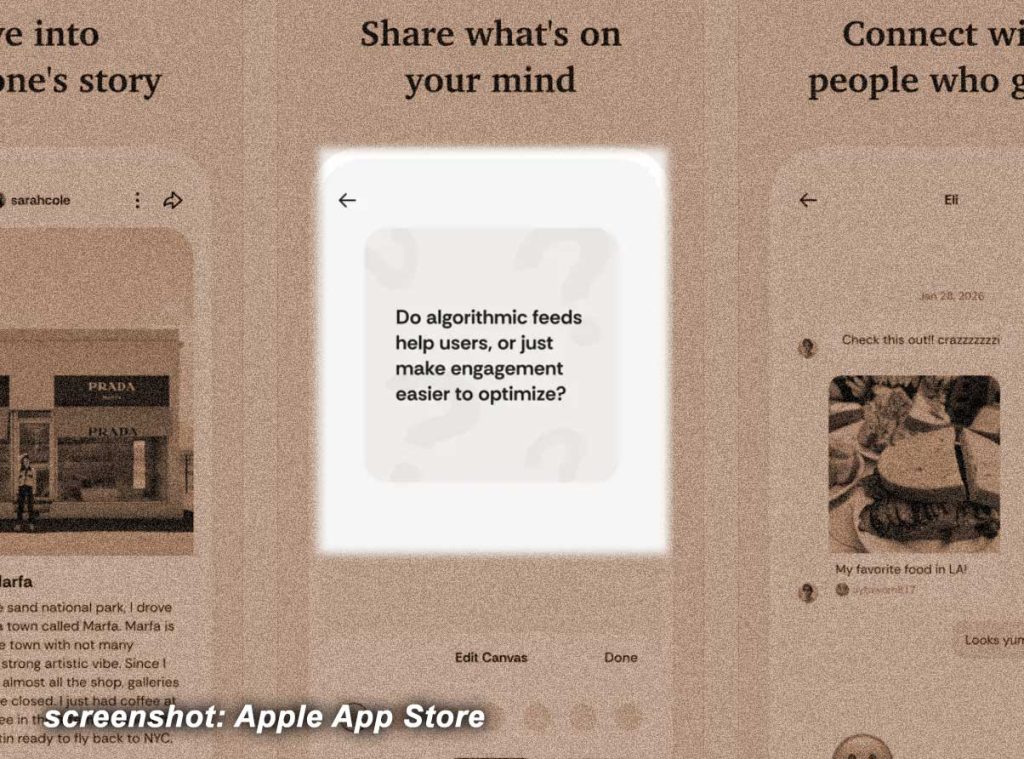
One App Store screenshot appears to tweak algorithmic social feeds — and companies like Meta — asking: “Do algorithmic feeds help users, or just make engagement easier to optimize?” (More in the Meta “Forums” blurb which is next.)
Business Insider framed the launch in the context of AppLovin’s failed bid for TikTok in the U.S. Read it. (May 22)
The app’s App Store landing page reads, “Gist is a social media platform for curious individuals who want real substance on their feed — practical, thoughtful content on the things that shape real life. No noise.”
Industry reaction
Zynga marketer Nebojsa Radovic said on X:
“I wanted to close the loop on today’s discussion around AppLovin’s new social app, Gist, and the question of whether AppLovin can scale it to 10M+ users. (…) This is what they are best at, and if/when Gist is ready for prime time, I would expect them to scale it aggressively.
It is also worth noting that this would not be their first time scaling first-party consumer apps. Back when AppLovin was publishing mobile games, titles like Matchington Mansion, Wordscapes, and Project Makeover all became massive businesses, reaching well over $100M+ ARR. They scaled them quickly and efficiently, thanks to their own first-party ad network.
So I don’t think the main question is whether AppLovin can drive tens of millions of installs for Gist. The real question is whether they can build a product sticky enough for people to use every day.”
Read more on X. (May 22)
Referring to earnings call comments from AppLovin CEO Adam Foroughi earlier this month, analyst Eric Seufert observed about the rationale for the new app on Mobile Dev Memo:
“Mobile gaming is scalable but tends to see fairly low margins after accounting for user acquisition costs; social media platforms, while also requiring user acquisition investment (see again the case of TikTok), tend to be stickier, in success, from an engagement standpoint, and they also benefit from virality and network effects.
And the upside is undeniable: rather than merely facilitating ad sales and taking some percentage of their value, AppLovin would be able to capture all of it. Owning a scaled social media platform would not only give AppLovin access to more supply but also better economics on that supply.”
Read: “AppLovin publishes Gist, a social media app” (May 22) – Eric Seufert on Mobile Dev Memo (subscription)
From tipsheet: A successful Gist would give AppLovin something rare in modern ad tech: owned consumer engagement feeding a closed-loop optimization system more commonly associated with the “walled gardens.”
PLATFORMS
Launch: Meta’s new “Forum” app
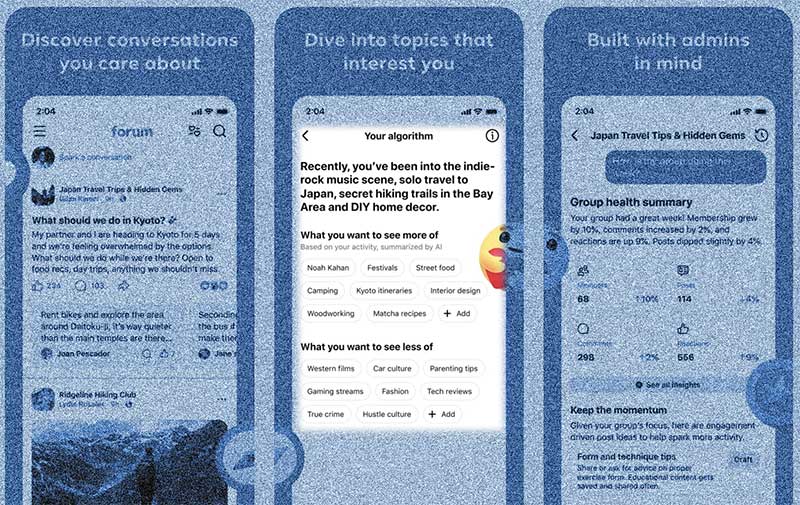
Meta released a new standalone app built on Facebook Groups called “Forum” (see it) for iOS on Friday. Reddit stock fell 6% Friday as some investors weighed the competitive implications of the launch.
CNBC reported on a Wall Street analyst’s view: “Analysts at Truist wrote in a note on Friday that it’s ‘an attempt by the company to compete against Reddit as an online forum for public discourse’ and ‘represents a new threat…’”
Nevertheless, Truist analysts were bullish on Reddit’s stock. Read more on CNBC.
Engadget dug deeper on the app and reported:
“Users will need to have a Facebook account to be able to use Forum, and their profile and activity will carry over after they log in with their credentials. So it’s not really a website for anonymous conversations like Reddit, but users will be able to use anonymized usernames like they already can on the main Facebook app. It’s just that administrators will be able to see their real identities.
Unlike the Facebook feed that shows a collection of posts from a user’s friends, the groups they’re in, the Pages they follow and random posts Facebook’s algorithm thinks they might be interested in, Forum’s feed will feature conversations from their various Groups.”
Note: Forum’s “algorithm” slide closely echoes the AppLovin Gist “algorithm” slide — or vice versa.
Read: “Meta quietly released a new Reddit-like app called Forum” (May 22) – Engadget
From tipsheet: Meta seems to be asking a simple question: What if Reddit-style conversations could be rebuilt on top of Facebook’s logged-in identity graph?
That makes Forum less a Reddit clone than a test of whether Meta can turn Groups into more addressable, AI-searchable community inventory.
The AppLovin/Gist comparison is revealing, too. Both screenshots lean into “your algorithm,” but from opposite directions: Meta is extending its identity-and-groups machine; AppLovin may be positioning Gist as the anti-Meta version of algorithmic social.
LLMs & CHATBOTS
Developments
- Project Glasswing: An initial update (May 22) – Anthropic
- Magnifica Humanitas: On Safeguarding the Human Person in the Time of Artificial Intelligence. (May 25) – Pope Leo XIV
- Meet Mark Zuckerberg’s Right-Hand Man (Andrew Bosworth) Who’s Unleashing AI at Meta (May 24) – The Wall Street Journal (subscription)
TECH
LiveRamp founder on Publicis-LiveRamp
In a fascinating discussion on the implications of Publicis’ planned $2.2 billion acquisition of data collaboration platform LiveRamp, former LiveRamp co-founder and former CEO Auren Hoffman joins Ari Paparo and Aperiam’s Eric Franchi on the Marketecture podcast.
Hoffman sold the company to Acxiom for more than $300 million in 2014. Acxiom later spun it back out as a standalone public company in 2018.
One highlight among many:
- Hoffman, an ad tech product expert now working in venture capital, believes there’s still much more value inside LiveRamp.
- Paparo, also an ad tech product expert, jokingly suggested Hoffman may want to buy the company back.
- Hoffman denied interest.
Listen: “Episode 174: Auren Hoffman Wants to Make LiveRamp Great Again” (May 22) – Marketecture Podcast
COMMERCE MEDIA
The ‘evolving’ definition of agentic commerce
- “AI won’t kill retail media, but it won’t spare it either” (May 20) – IAB VP of AI & Marketing Innovation Caroline Giegerich on The Drum
LLMs & CHATBOTS
Are you in the “token path”?
On the Invest Like the Best podcast, investor Gavin Baker discussed the growing importance of being “in the token path” — the infrastructure layers through which AI inference, orchestration and application activity flow.
Baker said: “If you’re a software company or an AI company of any kind, you have to be in the token path.”
He pointed to companies like Databricks as examples of businesses positioned directly inside AI compute and data workflows.
Baker also warned that companies outside the token path may face mounting pressure as frontier AI models commoditize broader application functionality: “If you’re not in the token path and you’re not in some really niche thing, life may be hard.”
Listen: “Gavin Baker, Watts and Wafers” (May 20) – Invest Like The Best on Apple Podcasts
“Token path” origin: “Clouded Judgement 3.6.26 – Get in the Token Path” (March 6) – Jamin Ball on his “Clouded Judgement” Substack
From tipsheet: The phrase “token path” reframes where AI value may ultimately accrue. The biggest winners may not simply be consumer applications, but the infrastructure layers every AI-related request and agent action must pass through.
That idea maps onto advertising.
In an agentic advertising world, the equivalent of the “token path” may become the infrastructure controlling identity, signals, inventory access, optimization and execution.
The strategic question increasingly becomes: who sits in the path of the decision?
That does not necessarily mean only infrastructure owners win. But it does suggest the systems closest to the flow of data, inference and execution may accumulate disproportionate leverage over time — a dynamic that historically favored walled gardens.
COMMERCE MEDIA
AI and the retail media network
Austin Leonard, VP and GM of Dollar General’s DG Media Network, speaks with Kevel CEO James Avery on the latest episode of the “Unleashing Retail Media” podcast.
Leonard says today’s AI involvement in his business has been going for a while now thanks to machine learning: “We see AI as a huge enabler. Clearly when you have a dataset across as many stores as we have (21,000 stores), some of the core things that are happening behind the scenes are just the ability to crunch that data faster. The ability to connect those dots so that you can more accurately build a profile of our shopper base and be able to do things like measurement, that’s all stuff that has been powered by machine learning — and technically would be AI.”
Leonard added that AI is also streamlining audience model development and reporting.
Listen: “Building From the Inside Out: Scaling a Retail Media Powerhouse with Austin Leonard” (May 20) – Unlocking Retail Media podcast
From tipsheet: AI compresses the human workflow behind retail media, allowing networks to scale advertiser demand without scaling operational complexity at the same rate.
SELL-SIDE
Use case: Ad operations
Former Mediavine product lead Jordan Cauley, now a sell-side consultant, took attendees of AdExchanger’s Programmatic AI event last week through a list of real-world, AI use cases for ad operations.
AdExchanger’s Andrew Byrd reported:
“One of AI’s core ad ops use cases, Cauley said, is understanding a sudden revenue dip with no clear explanation. In a traditional workflow, a weird trend sends teams into a cycle of pulling niche reports, filing engineering tickets and waiting hours for someone to confirm when a change shipped, he said. That kind of investigation used to take ad ops teams two weeks to complete for a major issue.
Once Cauley wired Claude and ChatGPT directly into Google Ad Manager (GAM) and his clients’ ad stacks, the same kind of issue took about three hours to narrow down, he said. Instead of building one GAM report at a time, the model runs multiple queries in parallel across different slices of inventory or formats, then synthesizes the results into a single narrative.”
Read more. (May 24)
Related: AI Needs Humans In The Lead, Not Just In The Loop, Says JPMorgan Chase Programmatic Lead (May 22) – AdExchanger
From tipsheet: Ad ops may be one of AI’s clearest early workflow winners on either the sell- or buy-side.
MEASUREMENT
Research: Quality becomes a buying signal
Was brand safety, now media quality.
Announcing his participation in a new Coalition for Innovative Media Measurement (CIMM) study, TVision CEO and Co-founder Yan Liu said on LinkedIn (May 21):
-
“The ad market has a multi-billion dollar pricing problem: We still buy and sell impressions like they’re all equal. CIMM’s new paper, ‘Quality Matters,’ argues that Media Quality must become core market infrastructure—not just a post-campaign filter. Erez Levin, Gabriel Dorosz did an amazing job!”
From the CIMM paper:
-
“The study argues that Media Quality (MQ) must evolve from a secondary optimization variable into a form of market infrastructure: a set of measurable, transactable signals that enable the market to distinguish, value, and price differences in advertising opportunity.”
Read: “Quality Matters: Navigating Quality in Media Buying and Measurement” (May 21) – CIMM
From tipsheet: The industry spent years treating impressions as mostly interchangeable commodities. But AI-driven optimization systems increasingly require richer signals to distinguish differences in attention and outcome quality. This is infrastructure for automated decisioning.
Increasingly, the old “brand safety” conversation is being absorbed into a broader “media quality” discussion.
Related: “New for WPP colleagues: ‘AI Vault on Teams’ — My working library of prompts, agents, skills and ready to use HTMLs, built from real commercial, ops and WPP wide work.” (May 24) – David Argenti, WPP Open X Global Commercial Operations Lead, WPP on LinkedIn
LLMs & CHATBOTS
OpenAI heads to Cannes next month
In another strong signal of OpenAI’s growing push into the advertising industry, Criteo CEO Michael Komasinski said Friday that he will join OpenAI’s Head of Global Ads Solutions David Dugan at next month’s Cannes Lions International Festival of Creativity to discuss AI, commerce and advertising.
On LinkedIn, Komasinski wrote: “As discovery becomes more conversational and intent-driven, high-quality commerce intelligence will become increasingly important.”
The session will focus on “trusted, useful advertising experiences in emerging AI-driven environments” and early learnings from the partnership between Criteo and OpenAI.
Read:
Related: “Cool job alert – We’re almost 3 months in to ChatGPT ads solutions and the pace of growth and feature expansion continues at a rapid clip. We’re nearing our pilot launch in the UK very shortly, and my team and I will be in South Korea and Japan this week as we ready for our launches there in June…” (May 24) – David Dugan, OpenAI on LinkedIn
From tipsheet: As tipsheet noted Friday, OpenAI’s Cannes presence alongside a commerce media and ad tech company like Criteo — combined with signals such as last week’s job listing for a Head of Ads Enterprise Marketing — suggests the company is beginning to position ChatGPT as a serious advertising and commerce surface.
MORE
- What Google’s new AI Mode ad formats mean for brands and their trust in automation (May 22) – Ad Age (subscription)
- Meta Defeats Location Privacy Suit (May 22) – MediaPost
- How to Staff the 10x Media Manager (May 20) – Adam Epstein, CEO, Gigi on his Substack
- Why WPP’s AI boss believes agents are still in the ‘teenage sex’ stage of development (May 22) – Digiday
- Agentic Commerce Reality Check(mate) (May 22) – Analyst Andrew Lipsman on his “Media, Ads + Commerce” Substack