
On Saturday, The Information’s Catherine Perloff summarized everything she has recently learned about progress with ChatGPT’s ads pilot.
Learning #1: The pilot ends when a wider rollout begins next month — which may include a self-serve ad manager currently being tested.
Perloff reported:
“As OpenAI prepares to open up ad sales to more marketers next month, it is trying to address what some advertisers say was lacking in the initial ad sales offering. Among other things, the ChatGPT creator is planning to streamline the process of ad buying, either in partnerships with ad tech firms or with its own ad management system.
So far, advertisers that bought the first ad campaigns on ChatGPT have said that the process was low tech and that they haven’t received much data showing if their ads worked. Two executives at agencies working with early ChatGPT advertisers said they haven’t yet been able to prove the ads have driven any measurable business outcomes for their clients.”
More highlights from the Information, and commentary by tipsheet, on the ChatGPT ads pilot include:
-
Budgets for the pilot are small and spent slowly. Only 15-20% of current commitments have been delivered. Obviously, this is still very much a test phase.
-
OpenAI ad reporting remains very limited. But, OpenAI claimed week-over-week results are improving.
-
Ad tech companies acting as ChatGPT ad resellers remain part of OpenAI’s strategy. Criteo is confirmed and The Trade Desk is still rumored at this stage, according to The Information. No doubt any firm that can bring scaled demand is of interest to OpenAI as ChatGPT ads enters a wider rollout.
-
Criteo will only be able to use a “limited” amount of data from OpenAI to facilitate targeting. What’s not clear is what the data is and what data Criteo will be allowed to bring to the targeting “table”.
-
OpenAI said there were no plans for programmatic auctions currently. That would be a significant shift if OpenAI went “full” programmatic in ChatGPT. It would upend OpenAI’s previous positioning (revealed in January and February) which aligned user trust and advertising with the use of context rather than audience data (i.e. cookies, retargeting, etc).
Read: OpenAI’s First Advertisers Can’t Prove ChatGPT Ads Work (March 21) – The Information
Reaction: Mobile Dev Memo analyst Eric Seufert noted about The Information’s article on Saturday: “Measuring and credibly asserting performance is precisely what ad agencies are paid to do. If an ad agency says it can’t provide performance data because the channel doesn’t provide it, it is merely a media buying intermediary.” Read more on LinkedIn. (March 21)
From tipsheet: It’s still early for ChatGPT ads. OpenAI is figuring things out in an extremely dynamic environment.
The only regret OpenAI may have at this stage is that they didn’t start their ad strategy sooner such that this essential testing phase was already behind them.
LLMs & CHATBOTS
Developments
- OpenAI to double workforce (from 4,500 to 8,000 by end of 2026) as business push intensifies (March 21) – Financial Times (subscription)
- Anthropic just shipped an OpenClaw killer called Claude Code Channels, letting you message it over Telegram and Disco (March 20) – VentureBeat
- Channels reference (March 22) – Claude Code Docs
TECH
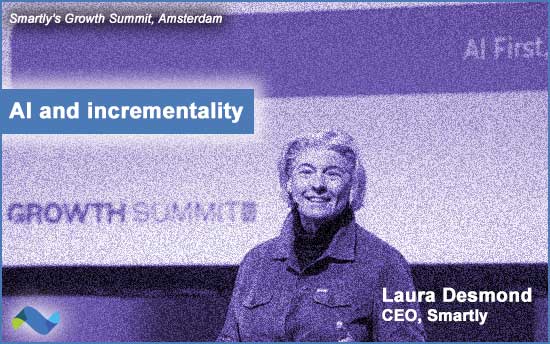
Smartly on incrementality, AI orchestration
At its 2-day Growth Summit last week in Amsterdam, Smartly, an AI-enabled creative and media automation platform, announced its intent to acquire incrementality measurement firm INCRMNTAL.
Even though the acquisition is still at the “letter of intent” stage, AdExchanger reported that all of INCRMNTAL’s 25 employees are expected to join Smartly including co-founders CEO Maor Sadra and CTO Moti Tal.
Read: Smartly Signs Letter of Intent to Acquire INCRMNTAL (March 17) – Smartly
AdExchanger’s Allison Schiff also reported:
“INCRMNTAL’s pitch has always been ‘always-on’ incrementality. Instead of forcing marketers to carve out control groups, halt campaigns or set up elaborate tests and formal experiments, [Smartly CEO Laura Desmond] said, its models analyze the natural fluctuations in campaign activity and infer the incremental impact of those changes in near real time.
Still, Desmond positioned incrementality as a complement to existing marketing mix modeling (MMM) and multi-touch attribution (MTA) tools, not a replacement. ‘This isn’t an incrementality versus MMM or MTA story,’ she said. ‘But marketers do need real-time incremental information in order to make the shifts that are needed to stay relevant.’”
Read: “Smartly Is Planning To Acquire INCRMNTAL Within The Next Few Weeks” (March 17) – AdExchanger
On the Marketecture podcast, Ari Paparo observed about the acquisition, “I think the only thing to [add] here is INCRMNTAL is very much an in-app install kind of play. So that kind of gives you a sense of it.”
Hear more on Apple Podcasts app. (March 20)
Related: “Incrementality study on Meta’s AI ad system” (July 2025) – tipsheet
AI Orchestration
From the Smartly Growth Summit in Amsterdam last week, the company reiterated its overall positioning regarding “AI orchestration” on Instagram: “After diving into our product roadmap and vision the previous day, Day 2 was all about how we are bringing AI-powered solutions to life for our customers. We took a deep dive into the world of AI Orchestration and explored exactly what’s possible when cutting-edge technology meets creative strategy.” Visit Smartly on Instagram. (March 20)
Read: “How AI Media Orchestration Helps Global Brands Scale Smarter: Inside Spotify’s Strategy” (November 2025) – Smartly
AGENCIESE
Differentiating The Marketing OS
Digiday’s Sam Bradley looked across a range of “hot” agency topics including the intersection of AI and marketing operating systems. He wondered if there’s enough differentiation.
Bradley began his argument:
“WPP developed WPP Open and Omnicom launched Omni, while indies like Max Connect built tools like Kudos. (Other examples include Stagwell’s The Machine, Havas Converged, PMG’s Alli, Horizon’s Blu, and Meet The People’s MTP Intelligence). In most cases, these tools centralize data capabilities, enterprise software access and proprietary AI media planning and creative tools – providing operational glue between formerly disparate agency portfolios.”
Read: “Agency operating systems face a differentiation problem” (March 20) – Digiday (subscription)
BRANDS
Pouring content on the GEO strategy
Intuit CMO Euan Campbell told Adweek that the financial firm initially fell behind a smaller firm in its execution of generative engine optimization (GEO) strategy by thinking its current search engine optimization (SEO) strategy would fill the GEO gap.
Unfortunately, analytics was failing Intuit, too, as Adweek’s Lauren Johnson reported: “…analytics tools falsely showed that AI was driving less than 1% of traffic to Quicken’s website.”
The response: a robust content marketing strategy which included the use of a more senior content marketing staff.
Read: “Quicken Is Producing 100 Pieces of Content Every Few Weeks Using AI” (March 20) – Adweek (subscription)
CONNECTED TV
Trade Desk gets LinkedIn identity
On Friday, W Media Research analyst Karsten Weide observed some under-the-radar news last week.
He wrote on LinkedIn:
“Here is a news item from [Friday] with big implications that got mostly ignored: Microsoft/LinkedIn just plugged its professional identity graph into The Trade Desk’s CTV pipes.
In plain English, advertisers can now target actual business decision-makers – CMOs, CIOs, procurement heads – on the biggest screen in the house, using LinkedIn data inside a programmatic TV buy.
First, for advertisers, this is the long-awaited fusion of brand and precision.(…)
Second, competitively, this is a shot across the bow of the walled gardens. (…)
Third, it shores up The Trade Desk’s core business: CTV. (…)
Read more from analyst Karsten Weide on LinkedIn. (March 20)
From LinkedIn last Wednesday:
-
“New Flexible CTV Buying with The Trade Desk. As B2B buyers move between LinkedIn and premium streaming, advertisers need tools that move with them. For the first time, marketers can choose how they purchase their LinkedIn CTV Ads – either directly through Campaign Manager or programmatically through The Trade Desk, powered exclusively by Microsoft Monetize.”
Read: How LinkedIn is helping B2B marketers reach audiences at scale with creators and video (March 18) – LinkedIn
More: Microsoft Monetize (ex-Xandr SSP) – Microsoft Advertising
From tipsheet: The Trade Desk’s AI-enabled Kokai platform adds more B2B targeting for ABM on TV. Considering the value of B2B data, the CPMs are likely impressive.
EVENTS
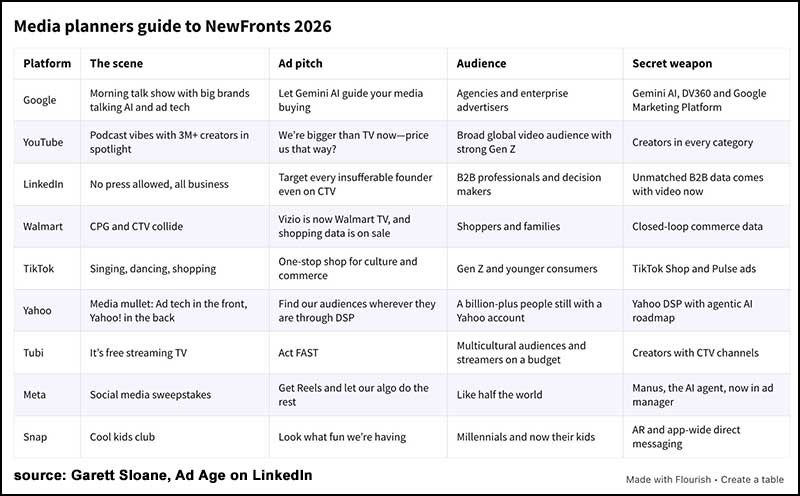
AI & The NewFronts this week
The annual “NewFronts” presentations rollout this week in New York City as media operators showcase their digital offerings in the year ahead to media buyers.
“AI” is a featured component of this year’s NewFronts, according to Ad Age’s Garett Sloane.
He previewed some several NewFronts on LinkedIn:
“AI is going to help with live sports and creators too. These are both sprawling fractured marketplaces that intelligence can help sift.
And from the big tech players—will Meta mention Manus publicly? How is Google putting Gemini into its marketing stack? How is TikTok commerce shaping up, and its new ownership?”
Read more on LinkedIn. (March 20)
Read: “Where to focus at NewFronts—AI, data, commerce and CTV device plays beyond Google and Meta” (March 20) – Ad Age (subscription)
See agenda: IAB NewFronts, March 23-26 – IAB
SELL-SIDE
AI rewrites publishers’ search headlines
Search results in Google Search are showing new news headlines rewritten by Google’s AI, according to The Verge.
The Verge’s Sean Hollister reported about his own publication’s experience:
“Google is beginning to replace news headlines in its search results with ones that are AI-generated. After doing something similar in its Google Discover news feed, it’s starting to mess with headlines in the traditional ‘10 blue links,’ too. We’ve found multiple examples where Google replaced headlines we wrote with ones we did not, sometimes changing their meaning in the process.”
Google spokespeople responded that the AI rewrites were only a limited test: “What we are seeing is a ‘small’ and ‘narrow’ experiment, one that’s not yet approved for a fuller launch.”
According to The Verge, Google said it’s not a change that is limited to news headlines but is also happening with “how other websites show up in search.”
Read: “Google Search is now using AI to replace headlines” (March 20) – The Verge (subscription)
More: “Google confirms AI headline rewrites test in Search results” (March 20) – Search Engine Land
From tipsheet: Editorial voice meets AI.
TECH
Opinion: The end of ads, open agentic commerce
In a blog post published on venture firm Andreesen-Horowitz’s a16z crypto blog, Samuel Ragsdale, argues that open agentic commerce is going to make advertising obsolete – keyword “open.”
Though he’s talking his own book, his argument is worth a look:
“Checkout in ChatGPT is the AOL of agentic commerce. It’s a curated catalog, a walled garden with better UX. To sell through it, merchants need months of BD, stringent legal docs, concrete 5-year plans, revenue, a strong user-base, and a story that will make shareholders happy when it appears on the front page of the NYT.
Open Agentic Commerce is the HTTP of today. A simple set of protocols that let agents pay for anything they need. Data, cloud hosting, communication, and plenty of things we haven’t dreamed up yet.”
Read: “’Open Agentic Commerce’ and the end of ads” (March 21) – a16z crypto
Mr. Ragsdale is a former employee at a16z and current CEO of Merit Systems, an open agentic commerce firm which has developed AgentCash.
PEOPLE MOVES
Now hiring
-
“I’m excited to share that I’m joining The Trade Desk as GM of Product.” (March 19) – Henry Stigler on LinkedIn
- Mark Zuckerberg Is Building an AI Agent to Help Him Be CEO (March 22) – The Wall Street Journal (subscription)
MORE
- Explainer: “What Does A Beta Test Of A Sell-Side Agent Look Like?” (March 20) – AdExchanger
- Make Pinterest Performance+ campaigns your new default (March 19) – Pinterest
- We Have Learned Nothing (March) – Jerry Neumann on Colossus
- OpenAI’s first crack at online shopping stumbled. It’s preparing for the next wave (March 21) – CNBC
- How AI and automation are reshaping digital marketing for law firms – The State