
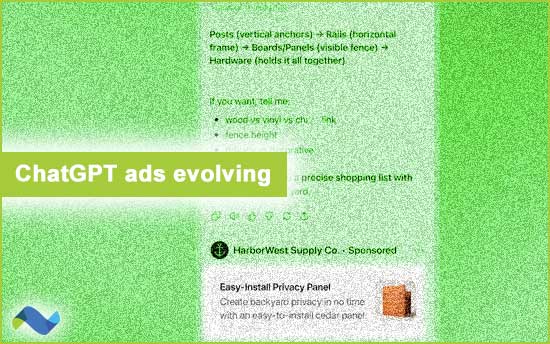
Confirming several weeks worth of independently reported news, OpenAI confirmed in a blog post that it had rolled out a self-serve ad platform, CPC bidding, a pixel and Conversion API (CAPI) yesterday.
Minimum spend commitments are going away, according to AdExchanger, which reported from a press briefing hosted by OpenAI monetization executives Asad Awan and Benji Shomair.
The company said in the post, “These updates make it easier for more businesses to participate and lay the groundwork for a broader ads platform built around how people use ChatGPT.”
OpenAI stressed the importance of closing the loop with the pixel and CAPI:
-
“One of the most requested capabilities during the ads pilot has been more robust measurement to help advertisers understand performance and what drives results. We recently launched Conversions API and pixel-based measurement so advertisers can better understand what happens after someone engages with an ad, such as a purchase, lead, sign-up, or other meaningful action.”
Also of note was OpenAI’s first public acknowledgement of specific ad tech and agency partners:
-
“We have been collaborating with leading agency partners including Dentsu, Omnicom, Publicis, and WPP to support businesses purchasing ChatGPT ads. We’ve also added technology partners such as Adobe, Criteo, Kargo, Pacvue, and StackAdapt, and will continue to invest in and expand our partner ecosystem.”
Read:
- New ways to buy ChatGPT ads (May 5) – OpenAI
- Will OpenAI’s New Measurement Tools And Ads Manager Prove Its Worth As An Ad Channel? (May 5) – AdExchanger
- ChatGPT launches a CAPI, a pixel, and self-serve (May 5) – Eric Seufert on Mobile Dev Memo
- “We’re hiring across ads and monetization.” (May 5) – Vijaye Raji, CTO of Applications, OpenAI on LinkedIn
From tipsheet: The OpenAI machine grows more powerful as the loop closes for both advertisers and consumers: ads generate outcomes, outcomes generate data, and the system learns from both.
Where’s AppLovin? I’m still waiting for the performance-focused, in-app mobile ad tech company to appear among OpenAI partners. Perhaps it’s waiting for the product and performance economics to mature before committing meaningful resources.
LLMs & CHATBOTS
Ad tech partners: Criteo on ChatGPT ads
Back in early March, Criteo announced its participation in the ChatGPT ads pilot, but at the time, OpenAI said nothing publicly about Criteo or any of its ad partners, for that matter.
Yesterday, after OpenAI confirmed Criteo and other ad tech partners in a blog post, Criteo went into detail about what it has seen thus far:
“More than one thousand brands are now live with campaigns powered by our API integration, spanning both existing Criteo clients and new brands to our platform.
As ChatGPT Ads expands to multiple markets including Australia, Canada, and New Zealand, Criteo users are also able to activate ChatGPT Ads across international markets.
For small and mid-sized businesses, we’re expanding access through Criteo GO, integrating ChatGPT as part of our self-service, cross-channel performance platform.
Budgets are incremental, with marketers leaning into ChatGPT as an additive discovery channel rather than simply reallocating from existing channels.
We’re seeing strong agency traction, as both holding companies and independents look for a seamless way to test conversational AI within familiar media planning and activation workflows.”
Read: An Update on Criteo’s Integration with OpenAI (May 5) – Criteo
From tipsheet: Criteo reports earnings later today. It may be too early for ChatGPT revenue benefits to show up given Criteo’s March (late Q1) start with ChatGPT ads.
According to Axios, OpenAI thinks $2.5 billion of ad revenue is coming to its platform in 2026. How much of that can come through companies like Criteo?
For a sense of scale, in fiscal 2025, annual spend through Criteo’s platform reached $4.3 billion on annual revenue of $1.9 billion.
Read Criteo’s Q4 and annual results published in February.
More ChatGPT ad partners:
- StackAdapt Announces AI-Powered Marketing Capabilities Through Ads in ChatGPT Pilot (May 5) – StackAdapt
- Pacvue Becomes a Technology Partner for the Ads in ChatGPT Pilot (May 5) – Pacvue
- Kargo Announces Integration with ChatGPT (May 5) – Kargo
- Performance marketing enters the conversational era with ChatGPT integration (May 5) – Adobe
LLMs & CHATBOTS
Developments
- GPT‑5.5 Instant: smarter, clearer, and more personalized (May 5) – OpenAI
- Agents for financial services (May 5) – Anthropic
- CAISI Signs Agreements Regarding Frontier AI National Security Testing With Google DeepMind, Microsoft and xAI (May 5) – NIST
FINANCIALS
Earnings reported yesterday
MNTN
- Markets: MNTN stock was down 7.7% in after-hours trading yesterday.
- Stat: “First quarter revenue grew 25% year-over-year to $73.7 million, adjusting for the divestiture of Maximum Effort.”
- Company: MNTN Reports Record First Quarter 2026 Results (May 5) – MNTN
- AI update: “QuickFrame AI 3.0 has been released out of beta and continues to advance capabilities. It now unifies ideation, storyboarding, editing, and iteration into a single workflow, while expanding support across leading generative AI models, including Seedance 2.0.”
SEARCH
Report: Amazon’s AI Overviews for search
Amazon is cautiously confirming that AI-generated search results may be coming to its shopping platform.
You may recall yesterday when an eagle-eyed LinkedIn user spotted AI search results emanating from the search bar on Amazon.
Yesterday, The Information’s Catherine Perloff compared Amazon’s potential update to Google Search’s AI Overviews and previewed her article on LinkedIn:
“Something akin to AI Overviews could be coming to Amazon. I caught up with Amanda Doerr, Amazon’s VP of core shopping who said Amazon is considering showing a conversational blurb above more traditional search results. Previously, Amazon confined the chat experience to its Rufus chat window.
Still, Amazon doesn’t imagine its site becoming all chatbot, as for some searches, product listings make more sense.
‘If you’re searching for milk, you want to see the milk you usually buy, how much it is today, and add it to your cart—not a paragraph about the pros and cons of 2% versus whole,’ Doerr said.
Read on LinkedIn. (May 5)
More: Amazon Weighs ‘Hybrid Mode’ AI Searches on Retail Site – The Information (subscription)
From tipsheet: How Amazon search will interact with the AI search that Amazon’s Rufus enables will be something to watch.
MEASUREMENT
Google adding measurement, visualization
In the lead-up to the Google Marketing Live and Google I/O events in two weeks, the company is preparing new updates aimed at helping marketers better understand, validate and optimize spend across media channels.
Gaurav Bhaya, Google’s VP & GM Buying, Analytics and Measurement, previewed three updates on the company’s Ads & Commerce blog:
-
Map View for richer data visualization and better observability: “In the coming months, we’ll roll out an intuitive new summary of your data with a map view in Data Manager, to help you understand how your data flows from different platforms, including BigQuery, Google Drive, HubSpot and Shopify. This will give you a snapshot of what powers your campaigns across Google Ads, Google Analytics, and Google Marketing Platform, helping you diagnose connection paths and improve your configuration. (…) We’re also upgrading the Google tag with a new visual setup flow.”
-
GeoX moves further into causal measurement by tracking geographic incrementality: “GeoX is built on an open-source codebase and its signals flow seamlessly into our Marketing Mix Model, Meridian. Meridian GeoX (more here) gives you a defensible, ground-truth understanding of media channel performance that you can confidently take to your CFO. Meridian GeoX will begin testing later this year.”
-
More tools for Google’s open-source MMM framework Meridian: “We’ve heard your feedback that Marketing Mix Models (MMMs) can be complex to run. To keep simplifying this process, we’re launching Meridian Studio, our new Google Cloud-powered enterprise platform that provides sophisticated teams with options to easily customize and manage high-volume models with your richest signal base.”
Read: “Turn your data into decisions: 3 things your business needs for growth in the AI era” (May 5) – Google Ads & Commerce blog
From tipsheet: AI ad systems need feedback loops to improve, but marketers still need evidence those systems are driving incremental outcomes (and so does the rest of the C-suite). Google is building both: the optimization engine and the measurement layer used to validate it.
COMMERCE MEDIA
Shopify restructuring data for AI agents
Ecommerce platform giant Shopify announced impressive Q1 2026 financial results that beat Wall Street expectations. But, disappointing projections (growth in the high 20s rather than mid-30s like Q1) resulted in the company’s stock plummeting 13%.
Nevertheless, the conference call with analysts revealed that Shopify’s “AI agent” proof-of-concept is getting into place.
Shopify President Harley Finkelstein said:
“To date, we’ve structured more than 1 billion products with clean attributes, real-time pricing and accurate inventory. So AI agents can surface the most relevant products in seconds, and the results speak for themselves. Traffic from catalog-powered AI searches convert 2x more than traffic from general AI searches where the agent is working from scraped or often outdated information from across the web. That is the value Shopify brings.”
More:
- Company: Shopify Delivers Again as Merchants Clear $100 Billion in Q1 GMV (May 4) – Shopify
- Transcript: Shopify Q1 2026 Earnings Transcript – Motley Fool
- Read: “Shopify Q1 2026 earnings beat overshadowed by slow growth outlook” – Quartz on Yahoo Finance
From tipsheet: The restructuring of commerce data for AI agents is just getting started. If large ecommerce marketers haven’t restructured their data, they will.
Shopify, with its ongoing, strategic integration of OpenAI’s ChatGPT (see 2024, September 2025, others) has been a first-mover.
CONNECTED TV
Survey: ‘Agentic AI’ use growing in video
IAB in partnership with Advertiser Perceptions and Guideline surveyed video ad media buyers and provided a pulse on the video ad spend market yesterday.
Agentic AI is growing in digital video, according to the findings:
-
“Agentic AI for digital video is quickly moving from experimental to operational – Two-in-three buyers are live (21%), testing (20%), or planning
to use (25%) agentic AI for digital video campaigns in 2026. With another 28% actively investigating it, nearly all digital video buyers are in market or on a near-term activation path.” -
“Small-to-mid-size spenders diverge from large spenders in using agents for digital video – Smaller spenders lean heavily into uses like creative testing, pre-planning, and performance analysis—replicating infrastructure
they lack. Large spenders prioritize inventory discovery and evaluation to navigate fragmentation across many deal types and partners.”
Read:
- 2026 Digital Video Ad Spend & Strategy Report – IAB (PDF)
- Press release: 2026 Digital Video Ad Spend & Strategy Report: Part One (May 5) – IAB (signup required)
- Agentic AI moves from concept to operating layer (May 5) – Martech
LLMs & CHATBOTS
Bluefish optimizing accuracy, brand governance
Bluefish, which positions itself as an agentic marketing platform (AMP), launched what it’s calling an “AI accuracy tool,” creating a structured layer for sending a brand’s information to AI channels such as Gemini, ChatGPT and Claude.
A press release explained:
“The Bluefish Agentic Marketing Suite already enables marketers to track and influence AI performance across a number of dimensions:
AI Visibility, which measures whether a brand appears in AI responses;
AI Favorability, which tracks whether the AI sentiment in the response is positive; and AI Safety, which flags content that is harmful or off-brand.
Each of these metrics are critical KPIs to track, but the new AI Accuracy insights enable brands to understand what matters most – if the response is factually accurate.
Based on brand-verified information, this new Bluefish Accuracy technology continuously monitors AI responses across every major channel, extracting and verifying every factual claim made about the brand. Every mismatch is traced to the exact channel and response it came from, scored by severity, and filterable by product line, topic, and audience profile across millions of AI responses evaluated daily, enabling brands to quickly diagnose and take action.”
As for momentum for the company’s platform, Bluefish says it already works with “more than 10% of the Fortune 500 to help ensure brands are represented accurately amid the growing challenge of AI misinformation.”
Read: Bluefish Launches AI Accuracy, Bringing Brand Verification to AI Channels for the First Time (May 5) – press release
From tipsheet: Fascinating to see the generative engine optimization (GEO) space evolve. Can it prove itself more differentiated than traditional SEO platforms? This feels like a potential moment of differentiation.
Parsing the trends here:
- “Accuracy” = distance between the LLM’s output and the brand-approved narrative.
- GEO firms are repositioning into platforms… specifically agentic marketing platforms that aim to monitor and influence AI outputs.
- Accuracy is beginning to collide with brand governance… a domain historically owned by providers like Integral Ad Science, DoubleVerify as well as the walled gardens’ approach to adjacency. But the layer is different: brand safety governed adjacency; accuracy governs the answer itself.
- The question shifts from “where did my ad run?” to “what did the model say?” — and who controls the system (the AMP) that corrects it when it doesn’t.
PROTOCOLS
AppLovin testing MCP server
“We’re looking for early access testers for the Axon by AppLovin MCP, a tool that lets you create campaigns, upload creatives, and adjust budgets from inside Claude, ChatGPT, Cursor, or any other MCP-compatible AI tool.Instead of clicking through the Axon dashboard, you’ll be able to say things like ‘upload these 40 creatives and launch a $5K/day prospecting campaign’ and the agent does it. Spots are limited and we’re approving on a rolling basis…” (May 1) – Rafael Vivas, Growth Marketing, AppLovin on LinkedIn
BRANDS
Meta’s AI opportunity: Improving decisions
Yesterday, The Wall Street Journal reported, “Meta executives believe their AI-infused ad strategy gives them plenty of runway to grow revenue further. Without better user growth, though, it is only a matter of time before Meta reaches a natural limit to what AI can do for the ad business it relies on.”
Read: “Meta’s Cheap Stock Is an Investor Trap” (May 5) – The Wall Street Journal (subscription)
From tipsheet: Gotta disagree with the WSJ. User growth is not what’s most important. It’s better decisioning.
The first leg of decisioning is prediction, so ranking (what you see), matching (which ad you get), timing (when you see it) and creative (what message converts). This leads to better CTR, conversion rates and higher ROI for advertisers. This is where the revenue really grows.
There’s a lot of talk about “ad load” on Wall Street regarding the number of ads that can be shown to users. Again, that’s not the concern for AI (at least in this example) and the bet that Meta is making.
- Pre-AI: User growth used to cap ad revenue.
- AI: The constraint shifts from audience size to prediction quality and conversion feedback.
And that’s where Lattice, GEM, Andromeda and Sequence Learning come in. (More here from Meta.)
Reach is nice, but decisioning is what brings the yield in an AI world.
Related: Meta plans advanced ‘agentic’ AI assistant for consumers (May 5) – Financial Times (subscription)
MORE
- From Devices to Daily Life: Samsung’s AI Living Push (May 5) – Adweek
- Yahoo pairs with Kochava to pitch ‘agentic’ DSP workflows (May 5) – Digiday (subscription)
- Web Bot Auth, Google’s new experimental method to validate authentic bots (May 5) – Search Engine Land
- Opinion: “Mark Ritson: Marketers can no longer afford to laugh at Reddit” (May 5) – The Drum
- FTC to ban data broker Kochava from selling Americans’ location data (May 5) – Bleeping Computer