
After postponing its $700 million initial public offering (IPO) in February, Liftoff Mobile was back with a new SEC filing on Friday as it seeks to go public again.
Research firm Renaissance Capital provided background Friday:
“Liftoff Mobile, formed in 2021 through the merger of Liftoff and Vungle, provides an AI-powered platform that supports user acquisition and ad monetization for mobile app advertisers and publishers across various verticals like social media, finance, entertainment, and gaming. As of September 30, 2025, its software development kit is integrated into over 140,000 apps, connecting to approximately 1.4 billion daily active users worldwide, while serving over 1,000 marketers globally.
The Redwood City, CA-based company was founded in 2011 and booked $686 million in revenue for the 12 months ended December 31, 2025.”
Liftoff describes the pillars of its tech in the registration statement, starting with AI:
- “Cortex, our advanced neural network-powered prediction engine, is the core AI technology that powers our entire business and provides the backbone for our innovative solutions and continuous improvement.”
- “Our leading DSP facilitates profitable user acquisition for advertisers through advanced algorithms that deliver precise targeting, underwriting, and conversion, which collectively drive user acquisition results across the app economy.“
- “Our widely-adopted SSP provides direct access to in-app users in the over 160,000 apps we are integrated in as of December 31, 2025.“
- “Our operating model extends the capabilities of our core technology platform through configurable, scalable, and reusable modules called Adapters.”
Read: Form S-1 – Registration Statement for Liftoff Mobile (April 17) – SEC
More: Blackstone-backed Liftoff moves closer to public markets with US IPO filing (April 17) – Reuters
From tipsheet: A successful IPO would be a positive signal for smaller ad tech players under pressure as larger AI-driven platforms like AppLovin and walled gardens continue to consolidate power.
LLMs & CHATBOTS
Developments
- Building the agentic future: A spotlight on Google Cloud’s media & entertainment partner ecosystem (April 16) – Google Cloud blog
- Mistral, which once aimed for top open models, now wants to be alternative to Chinese and US labs, claims $80M monthly revenue by Dec. (April 16) – Forbes
- The App Store is booming again, and AI may be why (April 18) – TechCrunch
LLMs & CHATBOTS
Anthropic sends marketers Claude Design
In announcing its new “Claude Design” product on Friday, Anthropic made its first outreach to the advertising and marketing community since its Super Bowl ad in February.
The company described Claude Design’s many use cases in a blog post:
- “Realistic prototypes: Designers can turn static mockups into easily shareable interactive prototypes to gather feedback and user-test, without code review or PRs.“
- “Product wireframes and mockups: Product Managers can sketch out feature flows and hand them off to Claude Code for implementation, or share them with designers to refine further.“
- “Design explorations: Designers can quickly create a wide range of directions to explore.“
- “Pitch decks and presentations: Founders and Account Executives can go from a rough outline to a complete, on-brand deck in minutes, and then export as a PPTX or send to Canva.“
- “Marketing collateral: Marketers can create landing pages, social media assets, and campaign visuals, then loop in designers to polish.“
- “Frontier design: Anyone can build code-powered prototypes with voice, video, shaders, 3D and built-in AI.“
Adweek’s Kendra Barnett, who said she received a press release from Anthropic (signal!), described a B2B use case likely to resonate with marketers:
“At Datadog, Claude Design has already proved capable of shortening iteration periods and ‘enabling live design during conversations,’ according to product manager Aneesh Kethini. ‘We’ve gone from a rough idea to a working prototype before anyone leaves the room, and the output stays true to our brand and design guidelines. What used to take a week of back-and-forth between briefs, mockups, and review rounds now happens in a single conversation.’”
Claude Design is “available in research preview” through Anthropic’s paid subscription plans, according to the company.
Read:
- Anthropic Debuts Claude Design for Building Marketing Assets, Decks, and UIs (April 17) – Adweek
- Introducing Claude Design by Anthropic Labs (April 17) – Anthropic
- Visit Claude Design – claude[dot]ai/design (subscription)
From tipsheet: Marketers, their teams and their agencies are potential clients for Anthropic’s Claude Design.
Also of note: creative platform Canva is mentioned as an Anthropic partner. For companies in the creative competitive set — such as Canva, Adobe and Figma — an Anthropic partnership may be the best way for “traditional” creative platforms to understand their AI future.
Enterprise applications from AI companies like Anthropic are beginning to scale rapidly.
SOCIAL MEDIA
Meta ingesting more visual data for AI
Last Thursday, Meta expanded its ability to create actionable data from consumers’ visual assets — i.e., photos and videos.
From a Facebook blog post: “Starting today, people in the EU and UK can opt in to a new Facebook feature that surfaces photos and videos and suggests fun edits and collages, making it easier to share your favorite moments.”
The feature was rolled out to users in the US and Canada in October.
Read: “Now Rolling Out: Facebook’s Opt‑In Camera Roll Suggestions in the EU and UK” (April 16) – Meta
From tipsheet: This feature is creating “transcripts for images.” The text of the transcript enables the AI engine which, in turn, can help content creation and boost engagement. That has clear implications for advertising.
Meta is already doing this for advertisers with its AI ad creative capabilities in Advantage+, for example.
The challenge would appear to be with the consumer who might be reluctant to let Meta see what’s on their camera roll.
Related: “AI-Generated Video Ads Are Getting Personal. Are Consumers Buying It?” (March) – MIT Initiative on the Digital Economy
SELL-SIDE
Chatbot ad network race: Taboola
Taboola CEO Adam Singolda discussed his chatbot ad network product, Deeper Dive, with Press & Gazette last week.
Effectively, Taboola has created a conversational chatbot with ad placements. With diminishing search referral traffic reducing publisher advertising revenues, the sell-side appears highly receptive.
Press & Gazette’s Charlotte Tobitt reported:
“The format begins with a short chatbot-style answer before more context is provided via links to relevant further coverage on the publisher’s website or wider network. Publishers can also choose whether to plug in a third-party feed, such as police press releases, to add further relevant information. There is a text box at the end to ask a follow-up question if needed.
Reach (via sites like the Daily Star) and The Independent are among the dozens of publishers who have tried out Deeper Dive since its launch in September. Huffpost UK (run under licence by The Independent) is the newest launch, announced this week.”
Taboola says it has expanded its AI search engine beyond just the English language to French, German, Hebrew, Japanese, Korean, and Spanish.
Read: “AI answer engine drives more effective advertising at Reach and Independent” (April 16) – Press & Gazette
From tipsheet: Proof is in the pudding regarding the chatbot ad network revenue potential. Taboola reports its Q1 financial results on May 7.
Taboola wants to expand as broadly as possible before Amazon — or startups like Koah or Dappier — make their pitch to publishers.
Could Google or OpenAI take the chatbot ad network ‘plunge’ in an effort to grow ad revenues but, more importantly, enrich its large language models (LLMs)?
SELL-SIDE
Adobe: AI-driven traffic accelerates in Q1
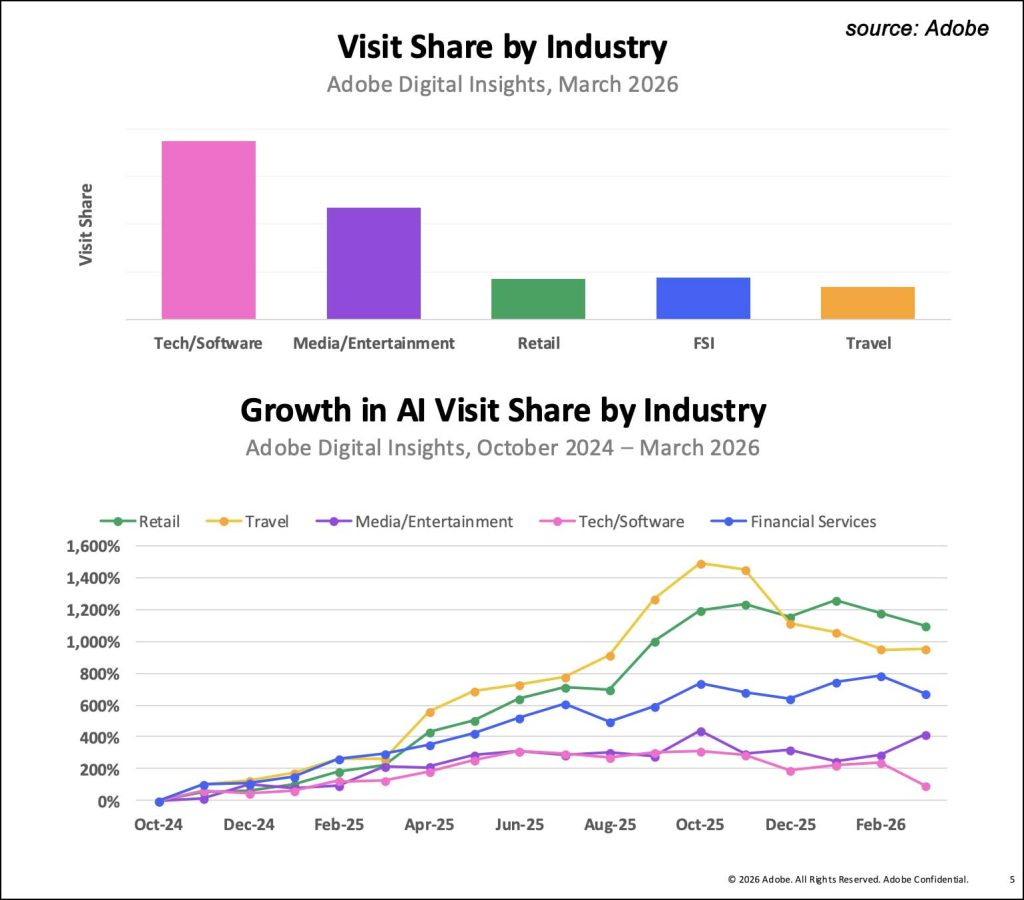
“Every industry saw an AI traffic boost during the first quarter of 2026:
- Retail: +393% YoY
- Travel: +233% YoY
- Financial Services: +158% YoY
- Media/Entertainment: +84% YoY
- Tech/Software: +63% YoY
In the March 2026 Adobe Consumer Survey, 54% of consumers say they are
turning to AI more, with 58% having used AI in the past week.”
Download: Quarterly AI Traffic Report (April 2026) – Adobe (PDF)
DATA
Podcast: Trade Desk needs proprietary data
In reviewing Viant’s acquisition of TVision Insights last week, Marketecture Podcast’s Ari Paparo and Aperiam’s Eric Franchi saw the purchase as another move by an ad tech player to differentiate itself with proprietary data — in this case, TVision’s unique panel data.
For Mr. Paparo, The Trade Desk is a demand-side platform (DSP) player that should be active with M&A around proprietary data assets, but isn’t currently.
He commented on The Trade Desk’s strategy (lightly edited):
“They’re investing in data hygiene, not in data uniqueness.
They’re trying to say, ‘We have the best pipes for data,’ more or less.
…like identity with identity aligns and prioritizing different data, and then Sincera with the cleanest contextual signals or ad quality signals…
But none of that’s unique. None of that is non-reproducible by other DSPs. And it appears that acquiring unique data — ex-Walmart and retail media — is its only play.
They’re just totally missing the boat here.”
CPCs for ChatGPT ads
Separately, the former Google executive Paparo delivered sharp commentary on news (The Information, April 15) regarding OpenAI’s potential move to cost-per-click (CPC) pricing for ChatGPT ads saying:
“It would be shocking if they weren’t rolling out CPC pricing because a lot of the intent is very search-like and click-like.
The trick with CPC that Google learned early on is that you have to have a quality score because the most clicks is not the most conversions. So it would be interesting to see how they’re going to be dealing with that.”
Listen: Joe Ligé on Culture and How It Works In Advertising (April 18) – Marketecture podcast
From tipsheet: In the age of AI, what can a platform bring that is unique? Data.
LLMs & CHATBOTS
Management shuffle at OpenAI
The management shuffle continues at OpenAI as two notable executives announced their departures.
- Kevin Weil, a former Twitter ad product leader, said: “Today is my last day at OpenAI, as OpenAI for Science is being decentralized into other research teams. It’s been a mind-expanding two years, from Chief Product Officer to joining the research team and starting OpenAI for Science.” See LinkedIn. (April 17)
- Srinivas Narayanan, CTO of B2B Applications, quoted from an edited note to his team: “Hi Team, I have decided to leave OpenAI. The last three years have been an incredible journey that felt more like ten. Leading the B2B engineering team has been an enormous privilege. With the recent/upcoming product launches, this felt like the right time to step back. I will also fondly remember my prior role leading the Applied Engineering team, from when it was ~40 people on a single floor in the 575 office, when I first started.” See LinkedIn. (April 17)
More: “Kevin Weil and (former Sora leader) Bill Peebles exit OpenAI as company continues to shed ‘side quests’” (April 17) – TechCrunch
This follows the re-organization announced on April 3 when Fidji Simo, CEO of AGI, took a leave of absence for health reasons.
From tipsheet: Optimizing for the future? There appears to be a plan in motion at OpenAI which likely includes imminent ‘big’ hires.
LLMs & CHATBOTS
Perplexity favors subscriptions, not ads
In a Benzinga article published on Saturday, Perplexity’s Chief Communications Officer Jesse Dwyer told the financial news site via email that “the monetization debate has been framed in overly restrictive terms” when it comes to ads and consumer-facing AI chatbots.
Benzinga’s Surbhi Jain reported:
“‘Analysts view the monetization question too narrowly,’ [Dwyer] said, pushing back on the idea that ads are the inevitable endgame.
Instead of maximizing queries or ad impressions, Perplexity is targeting a different user entirely.
‘Perplexity calls that “curiosity,” and we serve those people… whose decisions are GDP-altering or history-making.’ These aren’t casual searchers—they’re high-intent users who demand accuracy over convenience. And crucially, they may be willing to pay for it.
‘It seems reasonable to assume we should have no problem making money with those people as our most passionate users,’ he added.”
Read more from Benzinga on Yahoo. (April 18)
From tipsheet: Perplexity continues to enjoy being the foil in the ads-in-a-chatbot media discussion.
What’s more important to Perplexity from both a consumer and enterprise perspective may be its “Personal Computer” product which is an AI agent that runs locally and was released for Mac this past week.
“Running locally” may appeal to the interests of Apple. Maintaining Apple’s positioning around protecting consumer privacy in the age of AI while integrating locally-driven (not the cloud) AI chatbot functionality would be the goal. A more powerful Siri? Perplexity hopes so — the company was encouraging Apple to acquire it last year.
Perplexity CEO Aravind Srinivas said on X last Monday:
“Perplexity started as a small business tool for ourselves. We had 4 people and no revenue with AI at our fingertips.
The pivot to Computer is actually a full circle. Founders are using it to grow companies that matter to the economy and their communities.
It’s rewarding to see it now powering small businesses and startups in big ways.
Perplexity is still a startup. We just 5X’ed revenue from $100M to $500M with only 34% growth in team size. 2x revenue growth in 2026 with same small team. And we’re just warming up.”
LinkedIn estimates “200-500” employees today.
More: “Perplexity monthly revenue jumps 50% in pivot from search to AI agents” (April 7) – Financial Times (subscription)
AGENCIES
AI Search talent wars
In a sign that AI may be inspiring a new wave of hiring, search engine optimization (SEO) talent is in-demand for agencies seeking to meet clients’ interest in AI search optimization (AEO or GEO).
“Digiday identified eight agencies, including both indie and holding company shops, currently advertising for director, assistant director or manager-level organic search positions,” according to Digiday’s Sam Bradley.
Wpromote’s Megan Shriver told Bradley, “This (AI search) is the biggest thing that’s happened to SEO, ever.”
Read: Agencies compete for SEO talent as client demand for zero-click expertise surges (April 16) – Digiday (subscription)
From tipsheet: This is a bullish sign for agencies where human experts for SEO experts are needed. How this translates longer term with GEO platforms which seek to automate optimization will be something to watch.
Given the dynamic nature of probabilistic LLMs, human oversight would appear to have runway.
MORE
- Why your AI assistant is suddenly selling to you (April 19) – The Economist (subscription)
- AI companies lean into advertising as infrastructure costs rise (April 18) – Axios
- ‘Everything is coming down’: ChatGPT ads are getting cheaper (April 17) – Digiday (subscription)
- Three Reasons AI Is Now More Reliable Than Ever (April 18) – The Wall Street Journal (subscription)
- NAB Show is this week in Las Vegas – NAB