
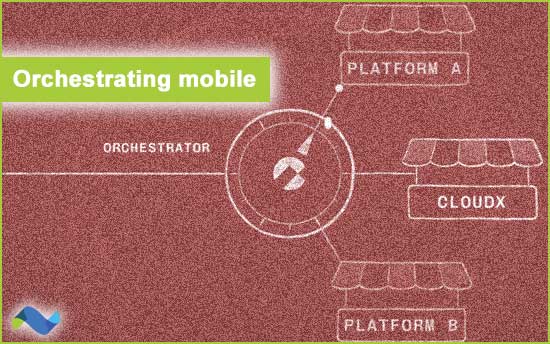
Co-founders Jim Payne and Dan Sack of mobile SSP CloudX announced the beta of Orchestrator, a tool for publishers running CloudX alongside another mediation platform.
Why? Different mediation platforms may perform better for certain types of demand or offer demand unavailable elsewhere. Publishers may want to combine platforms to access the strongest demand from each. Orchestrator lets them test different setups by ad unit and change them in the dashboard, without building and maintaining their own routing logic or shipping an app update.
Read: “Introducing CloudX Orchestrator” (Oct. 14) – CloudX
The beta is live on Android, including Unity builds, with AppLovin MAX (which the co-founders originally helped create in 2018) as the first supported mediation platform.
Orchestrator also gives buyers more visibility into how these auctions work. CloudX says bid requests will indicate whether its auction is final or another mediation platform could still win. CloudX bidders will also receive loss notifications that reflect the final outcome.
From tipsheet: AI is shifting attention from what individual systems can do to how they work together: which platform gets called, when and under whose rules. CloudX aims to bring that orchestration question to mobile monetization, giving publishers control over how mediation platforms compete for each ad unit and a way to measure the results.
SELL-SIDE
Prebid opens door to agentic ad servers
At Prebid Summit in New York on Tuesday, AdExchanger’s Anthony Vargas reported that the keeper of the open-source header bidding flame, Prebid, is advancing a proposal to let ad servers bid into Prebid, reversing today’s auction flow.
That architecture could help pave the way for “agentic-first ad servers,” said Eugene Dorfman of Postindustria, a co-author of the proposal. Those systems could eventually use auction data to automate decisions about how publishers sell their inventory.
The proposal is designed to help implement the court-ordered requirements for Google to integrate with Prebid in its ad tech case.
Read: Prebid’s Proposed Auction Overhaul Would Do What The Court Wouldn’t: Separate AdX From GAM (Oct. 14) – AdExchanger
From tipsheet: The AI implication is prospective: this architecture could give publisher-side agents more direct access to bid data and greater control over auction decisions. Whether that opportunity materializes depends on adoption of the proposal and Google participating through Prebid Server.
CONNECTED TV
Magnite, LG bring agents to the home screen
Magnite and LG Ad Solutions are making LG smart TV home screen inventory available via agentic media buying. The focus here is automating the buying workflow.
According to a press release, agency H/L is the first buyer to activate the inventory through Magnite’s agentic buying capabilities. The campaign uses a single path from media planning to execution, which the companies say eliminates manual steps typically required to launch a campaign. LG Ad Solutions is also expanding its use of Magnite’s direct-to-buyer platform, ClearLine.
Jeremy Cobb, VP at H/L, said in the release: “As the first agency to activate home screen agentic ads through Magnite and LG Ad Solutions, we can move faster, reduce technical friction and create real audience connections on the largest screen in the home. Our clients get direct access to premium home screen inventory through the same stack as everything else we manage. It’s simpler, faster and built for performance.”
Read: “LG Ad Solutions and Magnite Expand Partnership to Advance Agentic Buying on the Home Screen” (Oct. 14) – Magnite
From tipsheet: Workflow automation is a prominent agentic use case today. Reducing manual steps could save time and lower costs. Whether that translates into better campaign results at scale remains to be seen.
Meanwhile, negotiated pricing or placement terms between agents still appears to be in the future.
It’s still early.
LLMs & CHATBOTS
ChatGPT Ads busy Down Under
“OpenAI’s latest ChatGPT Ads updates: give advertisers more ways to understand performance through the measurement partners they already use…” (Oct. 13) – Andy Sinn, GTM ANZ, OpenAI on LinkedIn
Related: “To Sell ChatGPT to Businesses, OpenAI Is Going Back to Field Marketing” (Oct. 13) – Adweek
LLMs & CHATBOTS
Chatbot files for bankruptcy
Character Technologies, the company behind Character[dot]AI, filed for Chapter 11 after legal liabilities and the high cost of developing its AI entertainment platform strained its finances. CharacterAI remains online while the company pursues a court-supervised sale. Disney is the initial bidder, offering $20 million for a non-exclusive, perpetual license to certain intellectual property.
Read: “Disney Offers $20M For CharacterAI Assets As Startup Files For Chapter 11 Bankruptcy Protection” (Oct. 13) – Deadline
CharacterAI had also built an ad business around its audience, offering formats including banners, interstitials, rewarded ads and app-open placements. Liftoff said in an undated post that it had become one of CharacterAI’s top three ad partners by revenue within four weeks of launch.
Read: “Character.AI optimizes ad monetization across 1+ hour of daily user engagement with Liftoff Monetize” – Liftoff
Responding to the news on X (Oct. 14), Aperiam Ventures’ Eric Franchi said, “Last I looked (granted it’s been a while and stuff moves so fast nowadays) CharacterAI was the top inventory source for a bunch of AI chat monetization startups. Not sure if that is still the case. But this [bankruptcy] filing is worth watching. If it ends up in Disney’s hands it could be a good thing for ads in chat.”
More: “Character.AI owes Google and Big Law firms nearly $7M, court filings show” (Oct. 13) – Business Insider
PLATFORMS
Google adds controls amidst AI automation
Google is adding controls that give marketers more say over their AI-driven campaigns.
Director of Product Management for Google Ads, Tal Akabas, announced in a blog post:
“Building on updates like Smart Bidding Exploration and campaign total budgets, which put more control into the hands of advertisers, we’re introducing new optional controls in Google Ads: channel prioritization and budget allocation.
As these controls roll out globally across Search, Shopping, Performance Max, and Demand Gen, marketers will have even greater flexibility deciding where their budgets flow across Google inventory and partner networks, like Search partners and the Google Display Network.”
Read: Guide your campaign spending with new priority and allocation features (Oct. 14) – Google blog
Google says the controls begin rolling out October 15 and the current “Display Expansion” setup for Search campaigns will migrate to the new system in February 2027.
Read: About channel prioritization and budget allocation – Google Ads Help
More: “Today, we are rolling out a pair of new campaign controls: channel prioritization and budget allocation.” (Oct. 14) – Ginny Marvin, Google Ads Product Liaison on LinkedIn
From tipsheet: Google is letting advertisers prioritize channels and, where supported, set spending limits for lower-priority channels. Those limits apply on a best-effort basis, so spending can exceed them. The change reflects a recurring tension in AI-driven advertising: marketers want automation to find performance, but also want to set boundaries around where their money goes.
B2B MARKETING
Stagwell lands ServiceNow for AI marketing
Agency holding company Stagwell and ServiceNow have signed a three-year strategic partnership focused on using AI to build, activate and measure marketing campaigns.
There are two components of the deal:
“1. Unifying Operations: Stagwell will offer ServiceNow enterprise-wide access to The Machine, Stagwell’s AI-powered operating system, which unifies people, tools and data into one seamless experience, sparking creativity, eliminating silos and streamlining workflows. (…) The two companies will collaborate on joint go-to-market initiatives that pair Stagwell’s AI and marketing capabilities with ServiceNow’s enterprise reach.”
“2. Forward Deployed Creatives: Stagwell and ServiceNow will pioneer a new model of co-innovation, pairing Forward Deployed Creatives and Forward Deployed Engineers to embed directly into each other’s organizations. Together, these teams will unite creative ambition with technical execution to rapidly imagine, build, and deploy new solutions that turn bold ideas into real outcomes.”
Separately, COMvergence estimates ServiceNow’s media spend at $120 million, according to Adweek. The announcement does not say how much of that spend, if any, is included in the agency assignment.
Stagwell CEO Mark Penn called it the holding company’s largest multi-agency deal.
ServiceNow CMO Simon Mouyal said of the partnership in the release, “We share the same vision for an agentic marketing platform that delivers outcomes, drives more personalized experiences, and ultimately more growth.”
ServiceNow AI Platform is the company’s cloud-based, enterprise workflow platform which was rebranded in May 2025 for the AI age.
Read: “Stagwell Closes the AI-Marketing Execution Gap with ServiceNow” (Oct. 14) – press release
From tipsheet: Stagwell brings its AI-enabled marketing OS to help ServiceNow take its enterprise AI platform to market.
LLMs & CHATBOTS
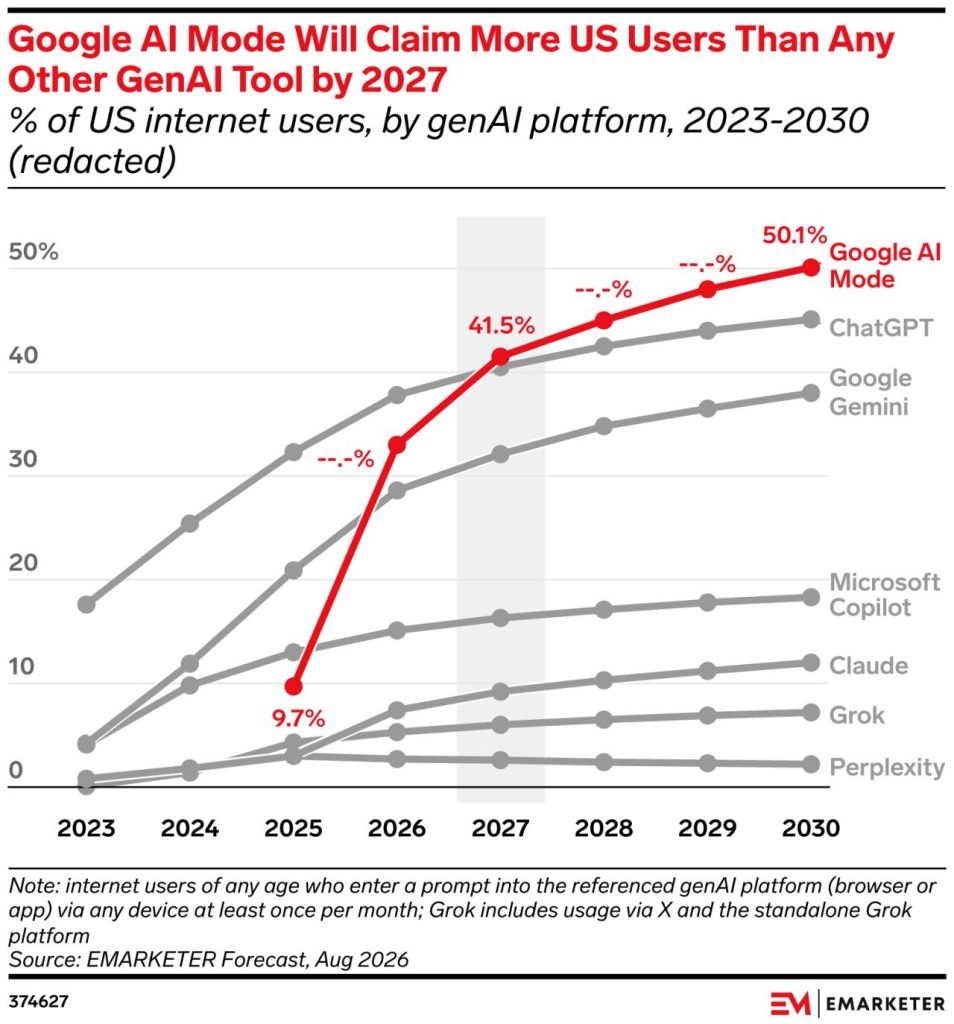
eMarketer: Google AI Mode wins
eMarketer AI in marketing analyst Nate Elliott argues that AI search’s winner may not be a standalone tool. Users may want different experiences depending on whether they’re “exploring, verifying, navigating, or acting.” The platform that lets them move between traditional and AI results could have the edge: “Google Search plus AI Mode.”
An August eMarketer forecast, shared by Elliott on LinkedIn, projects AI Mode reaching 50.1% of US internet users by 2030, ahead of ChatGPT.
Read more. (Oct. 14)
From tipsheet: Google’s advantage may be its ability to bring AI into an existing search habit. Gemini models power AI Mode and AI Overviews, while the Gemini app offers a separate destination. The forecast puts AI Mode ahead of ChatGPT, but ChatGPT’s projected second-place position still gives it a substantial audience. And don’t count out Meta, even if Meta’s AI search product and the Meta AI app aren’t included in this forecast.
LLMs & CHATBOTS
Developments
-
- The AI opportunity for Europe (Oct. 13) – European Central Bank
- Centene CEO sees health care’s biggest AI opportunity beyond automation (Oct. 13) – Fortune
- Scimplify raises $25M to challenge China’s grip on critical materials with AI (Oct. 14) – TechCrunch
MORE
-
- Ad wars: “Meta and TikTok mutually block each other’s ads” (Oct. 13) – Analyst Eric Seufert on Mobile Dev Memo (subscription)
- CMOs: “Ikea’s CMO sees LLMs as the newest place a brand has to hold its line” (Oct. 14) – Digiday (subscription)
- Retail media risk: “After spending the past few weeks experimenting with Meta’s new AI agent, Muse, I’m starting to see how profoundly agentic AI could change consumer behavior. And I think retail media in particular has a lot to worry about.” (Oct. 13) – Trey Titone, VP of Product, NBCUniversal on LinkedIn
- Amazon DSP musings: “ChatGPT Ads in the Amazon DSP Is Bigger Than an Ads Deal” (Oct. 14) – Adam Epstein, CEO, Gigi on Gigi blog
- YouTube and incrementality: “Do YouTube Ads Still Perform?” (Oct. 14) – Haus blog