
Pause ads for chatbots?
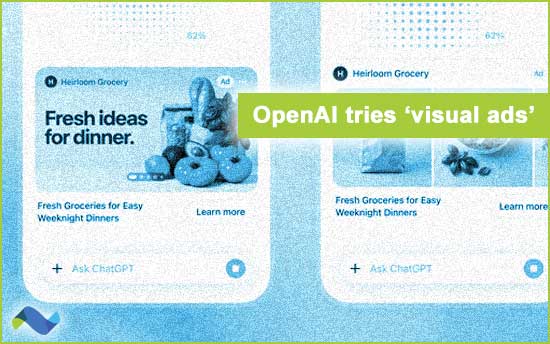
OpenAI will begin testing a “visual” ad format in ChatGPT in the U.S. later this month. The move comes alongside new measurement and brand-suitability efforts announced yesterday:
- Visual ads: Ads will appear during image generation, showing products or services in use or offering inspiration (in effect, while the user waits for an image to generate). OpenAI says they’ll be labeled and kept separate from the image ChatGPT creates and won’t influence ChatGPT’s answers.
- More measurement connections: OpenAI is adding integrations with Hightouch and Tealium for sending conversion data, alongside the previously announced LiveRamp integration. It also named a wider group of attribution partners, including AppsFlyer, AppLovin’s Adjust, Triple Whale and Rockerbox.
- Incrementality and brand measurement: OpenAI is exploring geo-based experiments with Haus, Measured and WorkMagic. Its Ads blog also names early brand-measurement tests with Kantar and Cint.
- Brand suitability: Qualifying advertisers can use “Negative Phrases” to set narrower placement restrictions. OpenAI is also piloting evaluations with DoubleVerify and IAS, which would assess its safeguards in a controlled environment without accessing private conversations.
OpenAI CTO of Applications Vijaye Raji promoted the new features on LinkedIn and said yesterday, “1.2 billion people use ChatGPT every week. Ads help us make AI accessible to more people and give businesses new ways to reach customers.” Read more. (Oct. 5)
The “1.2 billion people” weekly number was first disclosed at OpenAI’s DevDay last week. Back in March, the company claimed “more than 900 million users.” Vroom.
Two posts to read:
- “Building advertising for the way people use AI” (Oct. 5) – OpenAI
- “More ways to measure ChatGPT Ads” (Oct. 5) – OpenAI Ads blog
OpenAI monetization executive Asad Awan previewed the visual ads idea last week on Eric Seufert’s Mobile Dev Memo podcast: while ChatGPT creates an image, it shows a relevant product ad as a possible next step for the user.
From tipsheet: OpenAI wasn’t calling the new visual ads Pause Ads (made famous in CTV), but if you’re waiting for ChatGPT to finish its business, why not show an ad? Perhaps the nomenclature evolves the new “visual ads” to “generation ads” or similar.
It’s another example of inference cost monetization: using ad revenue to help cover the cost of responding to user prompts.
LLMs & CHATBOTS
OpenAI staffs up to scale ads
OpenAI continues to fill out the organization around ChatGPT Ads, with its latest hiring pointing toward a global system for acquiring and servicing advertisers — and managing the vendors and partners helping it scale. So:
- Vendor: “Do this work for us.”
- Partner: “Let’s work together to grow or enable the business.”
Among the newest openings are a North America Vendor Lead, Ads in San Francisco and APAC Vendor Leads based in Singapore and Sydney. They join an existing EMEA vendor role and are charged with building OpenAI’s outsourced sales model — including deciding which advertiser segments and sales motions should be handled by outside vendors rather than OpenAI employees.
OpenAI has also added a Customer Success Manager, Ads Solutions in Los Angeles to onboard advertisers, improve campaign performance and grow their spending.
The hires add another layer to an SMB advertising organization already recruiting for multiple roles.
See: “Ads” Careers – OpenAI
From tipsheet: OpenAI is building multiple paths to achieve scale: self-serve acquisition, direct sales, agencies and technology partners, outsourced sales and customer success — while constructing the underlying Ads Manager and Ads Integrity infrastructure to support them.
PLATFORMS
TikTok using AI across ad stack
Alongside making its 400,000-app network, TikTok Ad Network (TTAN — was Pangle), available for U.S. targeting yesterday, the social giant released a bevy of AI-related tools and updates relevant to ad lovers including:
- Shopping Assistant: A conversational shopping agent that remembers shoppers’ needs and answers questions about products, shipping, sizing and availability.
- Agentic Leads: A new AI agent that captures, qualifies and helps convert prospects through TikTok DMs or lead forms on advertisers’ websites.
- TikTok for Business MCP: The connector for building and running ad workflows with outside AI tools is now available through Claude, Kimi, Manus, Perplexity, Replit, Snowflake, Tencent WorkBuddy and listed in the IAB Tech Lab Agent Registry. TikTok says the number of advertisers using its MCP for campaign activation and management has grown more than 200% since its launch in May.
- Smart+ Search Ads: Smart+ automation now supports TikTok search campaigns, including keyword and creative selection, bidding and budget management.
- Smart+ Creative Selection: A new approval workflow brings together advertisers’ assets, Symphony AI-generated creative (launched in June) and creator content. It recommends creative groups for a campaign, while advertisers decide what goes live.
- GMV Max: TikTok is expanding its automated TikTok Shop campaign tool. It creates campaigns and shifts spend toward better-performing content, while accounting for costs such as affiliate commissions, coupons and referral fees when optimizing return.
Read:
- “TikTok Unveils AI-Powered Updates for Advertisers: Driving Discovery, Action, and Measurable Business Outcomes” (Oct. 5) – TikTok
- “Now available for U.S. targeting: TikTok Ad Network” (Oct. 5) – TikTok
- “From Discovery to Decision: How Agentic Solutions Guide Intent and Drive Action” (Oct. 5) – TikTok
Related: “TikTok’s ad network bet: More reach, more budget” (Oct. 5) – Digiday (subscription)
From tipsheet: TikTok is using AI to connect more of the advertising journey, from helping people discover and evaluate products to qualifying leads and automating campaign decisions. The larger bet is that TikTok can make discovery, conversion and ad optimization work as one system — and one feedback loop.
SELL-SIDE
Google’s ad tech remedies reach the fine print
The DOJ, 17 states and Google filed a proposed final judgment Friday spelling out how Judge Leonie Brinkema’s September 2 remedies ruling would be implemented. The court released her full opinion on September 16.
The proposals would require Google to connect AdX and DFP with Prebid, connect AdX to rival publisher ad servers and share more auction data with publishers. They would also require Google to offer DFP and AdX separately, so publishers could use one without the other. Google would keep both products.
Among the proposals’ top disagreements:
- How much latitude Google Ads (formerly AdWords) gets to favor AdX. The plaintiffs would allow AdX preference only when an advertiser explicitly asks for it, with supporting, verifiable evidence. Google’s version allows preference based on a broader set of claimed performance benefits, such as better information, lower latency or fraud protection.
- How much auction data Google must share. The plaintiffs would allow AdX preference only when an advertiser explicitly asks for it, and would require the preference to be supported and verifiable. Google’s version includes an ROI exception: Ads could favor AdX to improve advertiser returns, citing benefits such as better information, lower latency or fraud protection.
- How fast—and how broadly—the changes must happen. For some integrations, the plaintiffs propose six months while Google proposes 12. For one equal-information requirement, they differ between 12 and 18 months. Google also proposes up to 24 months for implementation outside the U.S.; the plaintiffs omit that provision.
Judge Brinkema must resolve the remaining disputes before the final judgment takes effect.
Marketecture’s Ari Paparo, who has covered the trial in depth, flagged on X a separate economic question: take rate. The proposals would generally bar compensation for preferential routing, but set no take-rate cap and do not expressly address bundling fees across Google Ads and AdX. Paparo argues those gaps could preserve an advantage for Google.
Read: United States v. Google LLC, Document 1861 (Oct. 2) – Court Listener
From tipsheet: The AI stakes of the remedies are about which signals and routes AI-powered buyers can use. Google’s proposed ROI exception could preserve an advantage for its integrated buying-and-exchange stack; the plaintiffs want advertiser direction and verifiable proof before Ads can favor AdX.
PLATFORMS
Apple reverses course
“Breaking News: TTD bidder gets off the naughty list and ad serving will be restored. Apple shipped an update to reinstate ad serving on adsrvr[dot]org. The TTD UID2 domain remains blocked.” (Oct. 5) – Consultant Scott Messer on LinkedIn
From Webkit (Oct. 5):

LLMs & CHATBOTS
Developments
- Our approach to EU text provenance rules (Oct. 5) – OpenAI
- Anthropic Subscriptions Offer 5x+ More Value Than OpenAI (Oct. 5) – SemiAnalysis
- North 2: Enterprise AI without compromises (Oct. 5) – Cohere
MORE
- Acquisition: Zeta Global to acquire GEO firm Senso (Oct.5) – press release
- Intellectual Property: “Why AI-powered IP enforcement is becoming a creator marketing problem” (Oct. 5) – Ad Age (subscription)
- Scaling local: Google Ads AI Campaign Localization Tool (Beta) (Oct. 5) – Search Engine Roundtable
- Creative: Instagram adds AI songs to DMs (Oct. 4) – Social Media Today
- SMBs: “How 3 small business owners are — and aren’t — using AI to nail their marketing campaigns” (Oct. 5) – Business Insider (subscription)