
The Information reported yesterday that the early days of ChatGPT ads are seeing CPMs slip from $60 to $15 and the company is considering selling on a cost-per-click (CPC) and cost-per-action (CPA) basis.
The Information’s Ann Gehan reported:
“Marketers have said it’s difficult to tell if (March 21) ChatGPT’s early ads are working and likely need stronger tracking and measurement tools from OpenAI before they’ll move beyond small, experimental ad spending. Offering pricing on a per-click basis would let advertisers pay when users engage with an ad, while conversion-oriented ad campaigns could let them optimize spending toward actions like purchases.”
Read: “OpenAI Plans New Pricing for ChatGPT Ads, Explores Other Upgrades” (April 15) – The Information (subscription)
From tipsheet: A few thoughts…
- CPM, CPC, CPA – it’s all the same math in the end.
- If there’s anything notable here, it’s OpenAI embracing CPA and, perhaps, the outcomes-focused results marketers are increasingly asking for.
- Early days, still. OpenAI likely wishes it had started sooner but there’s nothing they can do now but accelerate ad product development.
- There’s also a disconnect around measurement in these ChatGPT ad stories. “Leaks” seem to suggest OpenAI needs to provide better measurement tools. Buyers will likely want a pixel and a Conversion API (CAPI), but the buyer should be able to figure out whether the ads work to a certain degree without OpenAI’s involvement.
LLMs & CHATBOTS
Developments
- Gemini 3.1 Flash TTS: the next generation of expressive AI speech (April 15) – Google The Keyword blog
- ChatGPT for Excel (April 15) – OpenAI
- Nvidia CEO Jensen Huang on TPU competition, why we should sell chips to China, & Nvidia’s supply chain moat (April 15) – Dwarkesh Podcast
TECH
‘Smart’ programmatic traffic framework
Amazon Web Services announced it is donating its “Dynamic Traffic Engine” (DTE) to IAB Tech Lab yesterday. A press release described DTE as “a new framework designed to help demand-side platforms communicate bidding priorities to supply-side platforms more efficiently and transparently.”
AdExchanger’s Joanna Gerber reported:
“The DTE is made up of three components: the cloud infrastructure, the evaluator library and a filtering solution.
The cloud effectively functions as a “rules engine” on the buy side, [IAB Tech Lab CEO Anthony Katsur] said. It defines inventory that the SSP should include or exclude to attract bids. Buyers store traffic rules in the cloud, where they can specify certain ad formats to prioritize, like banner size or ad position, or something as particular as CTV from a specific region.”
The IAB Tech Lab said that DTE will join the standards org’s initiative known as the Agentic Advertising Management Protocols (AAMP), “specifically using the Agentic Real-Time Framework (ARTF) to update DTE components agentically in real time. The goal is to ensure a standardized, extensible model that supports a wide range of use cases as the industry moves toward more agentic, interoperable bidstream optimizations.”
Katsur said on LinkedIn, “We’re grateful at the IAB Tech Lab that they chose to donate this to the industry. Special thanks to Pieter de Zwart and Neal Richter for ushering in the era of ‘Smart’ programmatic traffic through their donation of the Dynamic Traffic Engine (DTE) specification…” Read more. (April 15)
Read:
- IAB Tech Lab Announces Dynamic Traffic Engine Donation from Amazon Ads to Improve Bidstream Efficiency” (April 15) – IAB Tech Lab
- Amazon Ads Hands The IAB Tech Lab A Tool That Promises To Waste Fewer Bid Requests (April 15) – AdExchanger
- amzn/DynamicTrafficEngine – GitHub
From tipsheet: The filtering capabilities of DTE speak to better and more efficient use of data in the advertising ecosystem. Better workflow – an agentic theme.
PLATFORMS
Podcast: Conversation is changing Google ads
In the latest episode of Mobile Dev Memo podcast, analyst Eric Seufert is joined by Dan Taylor, VP, Global Ads at Google, for a comprehensive overview of where AI is intersecting with Google ad products.
Everything from open-source marketing mix model (MMM) framework Meridian and Google’s early automation efforts (Universal App Campaigns) to Universal Commerce Protocol (UCP) and the new Direct Offers product are covered.
There’s also an important discussion of how and why the search advertising opportunity is opening up for Google. In a nutshell, the AI-enabled conversational format of the chatbot is creating not only more context — it’s creating a better match between the user and the advertiser’s offer. (See SimilarWeb’s findings about “ad timing” late last month.)
Taylor said—lightly edited:
“With AI Overviews (…) that’s an extension of more or less traditional search. So — it’s a representation of the traditional search result that has more information. And that’s an expansionary opportunity.
And we’re finding new opportunities to monetize there, both by understanding the longer queries better, and also the context of the page, which we talked about.
In AI mode, we’re finding opportunities to monetize in those longer, more conversational back and forth.
So we’re trying to find the right user experience and the right ad formats to introduce there. I’m mainly talking about (…) within a single conversation, but you could see how that might be something you would introduce over time. So one of the things that consumers expect from their AI-powered experiences is context.
They want to make sure that they understand experiences over time.”
Listen:
- Google navigates the AI advertising era (with Dan Taylor) (April 14) – Mobile Dev Memo on Apple Podcasts app
- Podcast: Google navigates the AI advertising era (with Dan Taylor) (April 14) – Mobile Dev Memo
More: Google VP Dan Taylor on AI and 25 Years of Google Ads (October 2025) – tipsheet
From tipsheet: Mr. Taylor talked about how AI-enabled search is allowing marketers to think about moving up the funnel due to conversations of “brand discovery.”
Ongoing measurement — such as incrementality measurement – by marketers is going to prove this one way or another.
MEASUREMENT
Meta makes Pixel and CAPI simpler
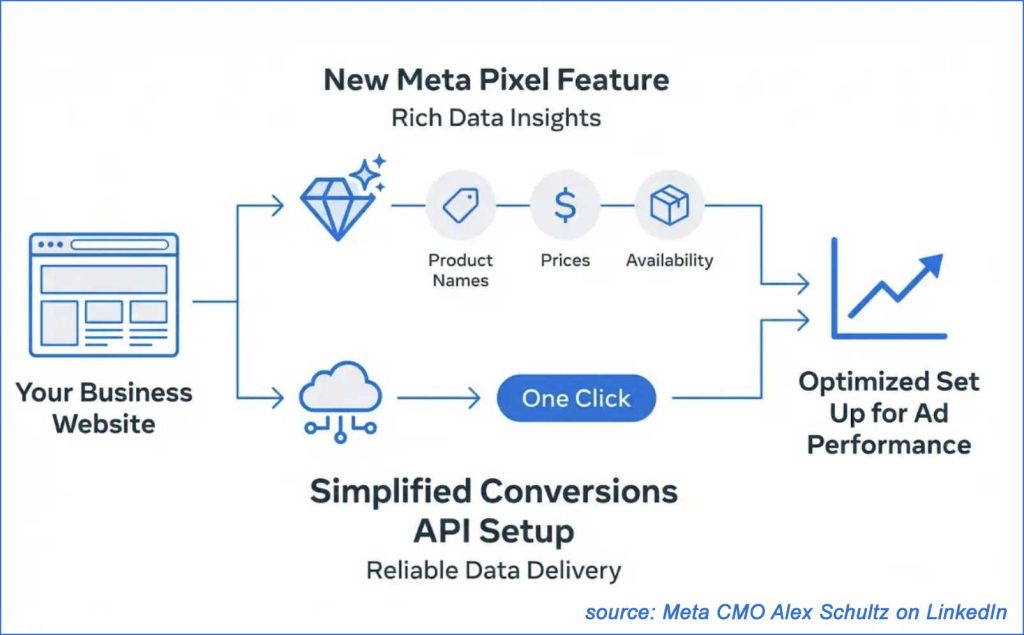
Meta announced updates to its Meta Pixel and Conversions API ( CAPI) aimed at making set-up easier for small business which may lack the expertise of larger enterprise marketing organizations.
The ultimate goal is driving “strong ad performance,” according to Meta.
Simon Whitcombe, VP in Meta’s Global Business Group explained in a post on LinkedIn:
“We’re rolling out a new Pixel feature that uses AI to automatically identify product details — like names, prices, and categories — that advertisers would otherwise need to manually code into their Pixel setup.
We know the future of marketing is increasingly agentic — AI systems that don’t just recommend optimizations, but execute them in real time. Those AI systems are only as good as the data behind them.
If your product data is incomplete or inconsistently structured, even the most sophisticated AI can’t do its best work for your business.
That’s why our new Pixel feature is such an unlock. It uses AI to automatically recognize product details on your website — names, prices, categories, availability — and structure them for optimization. No engineering team required. No added cost.”
Read more details from Mr. Whitcombe on LinkedIn. (April 15)
Also, according to Meta, Conversion API setup is now “a one-click option that requires no technical expertise, no costs, no ongoing maintenance, and will allow businesses to get set up in minutes.”
Read:
- “Removing Technical Barriers to Help Businesses of All Sizes Get More From Their Ads” (April 15) – Meta Business
- “Setting up the Meta Pixel and Conversions API are foundational steps that can help drive better ad performance…” (April 15) – Alex Schultz, CMO, Meta on LinkedIn
From tipsheet: Meta wants to be able to offer its AI-enabled marketing “machine” to anybody who has a product idea.
TECH
Viant acquires TVision for attention
“DSP wars update! There’s a new leader with exclusive data.
We just acquired TVision. While the industry has debated impressions and self-reported attribution, we went out and bought the truth.
Today, Viant officially takes the lead with marketers by delivering what the market has never had — real, independent truth in TV advertising.
Advertisers finally get a unified, buy-side view of their entire TV investment. No more relying on Amazon or Google telling you they drove every d*mn sale…” – Tim Vanderhook, CEO, Viant (April 15)
Read more from Viant CEO Tim Vanderhook on LinkedIn. (April 15)
More: “Viant Announces Agreement to Acquire TVision Strengthening Its AI-Powered Programmatic Platform” (April 15) – Viant
-
“Viant will purchase TVision for a total consideration of $40.0 million, subject to customary adjustments and hold-backs. The consideration consists of $22.5 million in cash and $17.5 million of shares of Viant’s Class A common stock.”
Also, visit TVision Insights’ website.
TECH
Earnings dates
Quarterly earnings season is upon us. It’s another opportunity to see the financial data behind today’s latest advertising products.
A selection of upcoming reports for public companies:
- Omnicom – Tuesday, April 28
- WPP – Tuesday, April 28
- Meta – Wednesday, April 29
- Microsoft – Wednesday, April 29
- Alphabet/Google – Wednesday, April 29
- Apple – Thursday, April 30
- Amazon – Thursday, April 30 (estimate)
- Reddit – Thursday, April 30
- Criteo – Friday, May 1 (estimate)
- Pinterest – Monday, May 4 (estimate)
- MNTN – Tuesday, May 5
- Viant – Tuesday, May 5 (estimate)
- AppLovin – Wednesday, May 6
- Snap – Wednesday, May 6
- Taboola – Wednesday, May 6 (estimate)
- Magnite – Wednesday, May 6
- DoubleVerify – Wednesday, May 6
- Unity – Thursday, May 7
- The Trade Desk – Thursday, May 7
- S4 Capital – Thursday, May 7
- PubMatic – Thursday, May 7 (estimate)
- Perion – Wednesday, May 20 (estimate)
- LiveRamp – Thursday, May 21 (estimate)
EVENTS
Agentic Engine Optimization – the new AEO
That’s not a typo.
Google Cloud engineer Addy Osmani is giving tips on how to best make content agent-friendly on a publisher’s website. He’s calling it agentic engine optimization. (AEO)
Search Engine Land’s Danny Goodwin reported on the reasons, “AI agents collapse multi-step browsing into a single request. They don’t scroll, click, or engage with UI — they extract what they need instantly. That makes most traditional engagement metrics irrelevant.” And that’s why a publisher needs to optimize for agents.
Osmani believes that token count is now an important optimization metric.
Goodwin parsed Osmani’s strategy:
“Osmani recommended restructuring content for how agents read:
- Put answers early (ideally within the first ~500 tokens).
- Keep pages compact and focused.
- Avoid long preambles and buried insights. (Agents have ‘limited patience’ for this, he noted.)”
Read: Agentic engine optimization: Google AI director outlines new content playbook (April 15) – Search Engine Land
More: “Agentic Engine Optimization (AEO)” (April 11) – Addy Osmani’s blog
PEOPLE MOVES
Now hiring
- Former AdapTV CEO Toby Gabriner joins Help Scout as CEO (April 15) – LinkedIn
- Former AdTheorent marketer Calynn Krieger joins Infillion as EVP of Marketing – LinkedIn
MORE
- “The Behaviors that Degrade the Ad Supported Open Internet” (April 15) – Gary Guarnaccia, Bayer on LinkedIn
- “Agentic Workflows Break User Trust Before Most Teams Know Why” (April 14) – Ryan Gauss, PubMatic on LinkedIn
- “AI Max for Search is moving out of beta, and we’re officially announcing the timeline for Dynamic Search Ads (DSA) to transition to AI Max.” (April 15) – Google Ads Product Liaison Ginny Marvin on LinkedIn
- AdCP goes international: “3 weeks ago Anne Coghlan and I agreed on the next location for the AgenticAdvertising[dot]org meetup. Amsterdam. Monday afternoon and Tuesday morning it was that day, already.” (April 15) – Lars Postmus, Owner, Draft Digital on LinkedIn
- Sports Publisher On3 Tries AI Recommendations To Keep Engagement In Its Home Court (April 13) – AdExchanger