
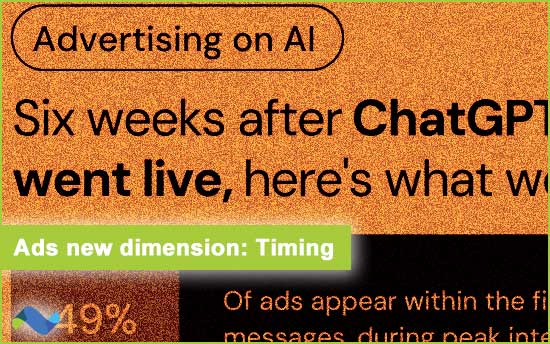
New data from Similarweb offers an early look at how OpenAI’s ChatGPT ads are actually behaving in the wild.
Details remain limited, but a few clear patterns are emerging:
- Ramping: ChatGPT ads remain scarce (<0.1% of US prompts) but are increasing week-over-week
- Targeting: Context-driven, not keyword-driven — aligning ads to the flow of conversation rather than static queries.
- Timing: “Timing is unlike any other channel – Nearly half of all ads appear early in the conversation, when intent is freshest. But here’s what’s different: nearly a third show up after turn 10, deep into the same conversation, with the user still exploring, comparing, and deciding. On search, you get one click and the user is gone. In ChatGPT, an ad can appear at the exact moment the user is closest to a decision, 15 messages in, after weighing options out loud. No other ad channel has that kind of access to real-time intent…”
Read more on LinkedIn. (March 31)
Reaction
Sonata Insights analyst Debra Aho Williamson observed: “The fact that ads are appearing deep into the conversation indicates OpenAI is closely watching the back and forth of prompts and responses to test the optimal time to show an ad. Sometimes people come into ChatGPT knowing exactly what they want, and an immediate ad makes sense. Other times people need to research and learn, and then become more receptive to an ad.” Read LinkedIn. (March 31)
From tipsheet: If search monetizes queries, ChatGPT monetizes conversations.
The ad opportunity isn’t just what the user asks… it’s when they’re ready.
- ChatGPT develops intent within the conversation.
- Waits until signals are strong.
- Then inserts an ad at the moment of maximum receptivity.
This isn’t search. It’s sequencing.
Welcome to the conversational funnel.
LLMs & CHATBOTS
Developments
- “We closed our latest funding round with $122 billion in committed capital at a post money valuation of $852 billion” (March 31) – OpenAI
- Alibaba’s New Multimodal AI Model is Not Open-Source (March 31) – The Information (subscription)
- Introducing Our First AI Glasses Built For Prescriptions (March 31) – Meta
ENGINEERING
Meta talks RecSys and LLM-scale
Another detailed blog post from Meta’s AI engineers explored Meta innovation yesterday — this time regarding the company’s “adaptive ranking model” which helps deliver the right ad at the right time for Meta’s Advantage+ platform.
The team began:
“Meta continues to lead the industry in utilizing groundbreaking AI Recommendation Systems (RecSys) to deliver better experiences for people, and better results for advertisers. To reach the next frontier of performance, we are scaling Meta’s Ads Recommender runtime models to LLM-scale & complexity to further a deeper understanding of people’s interests and intent…”
Read: Meta Adaptive Ranking Model: Bending the Inference Scaling Curve to Serve LLM-Scale Models for Ads (March 31) – Meta
Previously: “Ranking Engineer Agent (REA): The Autonomous AI Agent Accelerating Meta’s Ads Ranking Innovation (March 17) – Meta
From tipsheet: Meta’s discussion of RecSys and the core of its recommendation model recalls analyst Eric Seufert and Criteo CEO Michael Komasinski’s conversation about RecSys on the Mobile Dev Memo podcast last month.
Komasinski unpacked Criteo’s RecSys model at the time: “LLMs by definition are semantic models and they’re great at language, but RecSys models need to be built on data loops and reward algorithms at high volume and scale. We very much believe in that, and the Criteo backbone is built on a RecSys platform. This service is a way to give a front end to the RecSys platform in a way that can be tested in a partner environment and allows us to prove out the efficacy of that data set.”
PLATFORMS
Yahoo DSP aims at AI updates, performance
A recent LinkedIn job post from Yahoo DSP (see “Head of Growth Accounts”) suggests new autonomous AI features are on the way for the demand-side platform and its high-powered identity graph transition.
Adweek’s Kendra Barnett got the scoop and saw a strategy shift to performance.
She reported:
“Yahoo is building out a range of new AI-powered tools within its demand-side platform, or DSP, for mid-market, performance-focused advertisers. These include automated options for activating and managing media designed to make the DSP more accessible and easy to use for all kinds of advertisers.
The development signals an expansion beyond Yahoo DSP’s core business, which has historically serviced enterprise advertisers facilitating ad buys for brands like Kroger, Arby’s, and Planet Fitness.”
Read more in Adweek. (March 31)
A source told Barnett that the new features will land “later this year.” What the features are exactly are unknown.
From tipsheet: There are several, intertwined themes here which AI is enabling:
-
Going from brand awareness to performance.
-
Addressing the full funnel of the consumer journey.
-
The new full-service has self-service, too, and makes the human more efficient.
-
With fewer inputs, and better performance, self-service options open to the SMB marketers’ smaller teams while aggregating SMB budgets at scale.
Swirling around these themes is ever-present measurement. CAPI is one part of the equation.
Related: Yahoo DSP Launches Conversion API to Enhance Campaign Measurement and Optimization (April 2025) – Yahoo
PLATFORMS
Kargo adds agent orchestration to platform
Ad tech company Kargo announced the closed beta of its emerging agentic solution called “Project Kera” as the company refines its positioning at the intersection of creative and curated supply.
Kargo described its workflow automation — with an emphasis on intelligence — in a release: “AI agents orchestrate planning, creative development, audience and contextual intelligence, activation and in-flight optimization. The platform is powered by Kargo’s Creative Science, which applies predictive scoring and performance insights trained on years of campaign data to improve creative quality and outcomes before and during a campaign.”
Hershey, travel media network Navigator, and an integration with Horizon Media’s HorizonOS ecosystem are among the early testers, according to the company.
Read: “Kargo Launches Closed Beta of Project KERA, an Agentic Media Buying Platform Built for Creative Performance” (March 31) – press release
Kargo CEO Harry Kargman answered a selection of follow-up questions from tipsheet via email including:
tipsheet: You’re positioning Project Kera as an agentic media buying platform. Where does it sit relative to DSPs like The Trade Desk’s Kokai or Amazon Ads’ Ads Agent? Are you replacing the DSP, or orchestrating across them?
Harry Kargman, CEO, Kargo: We’re not trying to be another DSP. Programmatic in general will be disrupted.
Kera is built from the ground up to orchestrate the best way to drive results using a combination of creative, targeting, supply and audiences in a single system across both biddable and non-biddable inventory. Think of a team being able to buy a combination of Instagram ads, CTV pause ads, 15-second spots using Tiktok assets, campaigns targeted by Amazon data via the Amazon DSP which is inside of Kera, and digital out-of-home spots organized by the outcomes the brand is looking for. You can plug in existing audiences and measurement tools. Over time, it’s a simpler, more complete way to buy media without stitching together disparate tools across all channels with little transparency across the entire picture. We believe that AI makes this possible and we are looking to be that single holistic platform.
Additional questions include:
-
When you say AI agents handle planning through optimization, what decisions are actually being made autonomously today? And where are humans still in the loop?
-
Kera is built around ‘Creative Science.’ Does that mean creative, not bidding, becomes the primary lever of performance in your system?
-
Your predictive scoring is trained on historical campaign data… what proprietary signals does Kargo have that a DSP or retail media network doesn’t?
-
If this model works, what does media buying look like in two to three years… are planners still building plans, or just approving what agents generate?
Read Q&A: “Kargo adding agentic orchestration” (March 31) – tipsheet
LLMs & CHATBOTS
Screenshot: Walmart’s ChatGPT ad
Caroline Giegerich, IAB’s VP of AI & Marketing Innovation, saw an ad in ChatGPT for Walmart’s loyalty app, “Fetch,” during a search for water bottles recently.
She shared the screenshot with tipsheet and remarked: “My first native GPT ad in the wild which looks and feels like a search ad. I am hoping that the ad format itself will evolve to be more innovative than this, given the fact that these platforms operate interactive chatbots. I believe the measurement will surely come over time.”
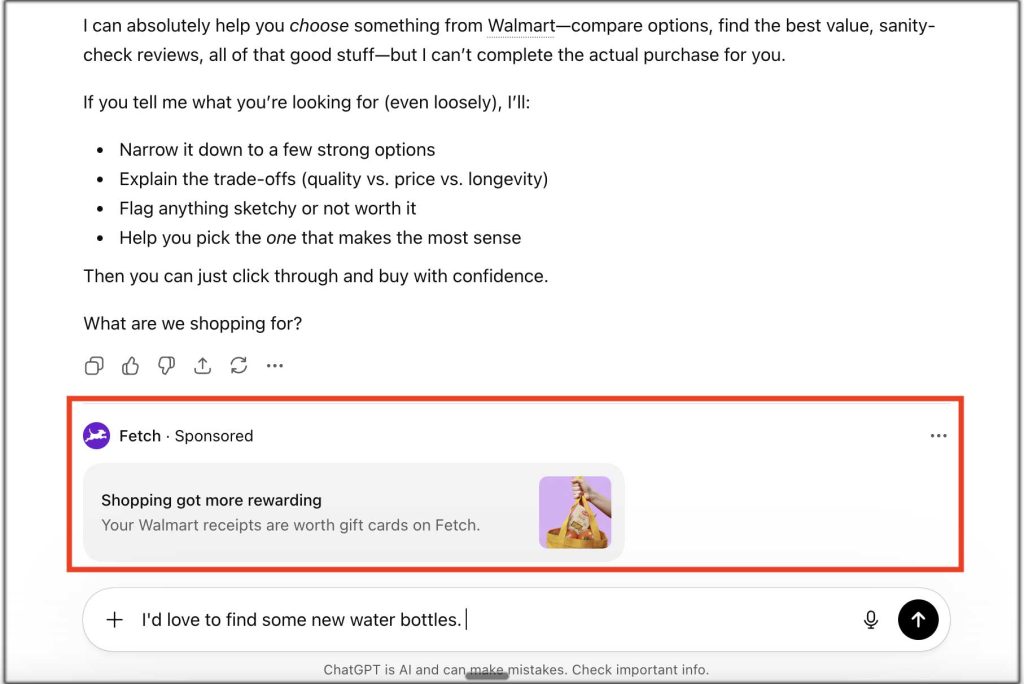
From tipsheet: Ms. Giegerich’s research reveals ChatGPT’s response: “… but I can’t complete the purchase for you.”
Ouch. Is that what OpenAI wants to tell a user looking to buy something?
How about this ChatGPT response instead, Nick Turley: “If you want to buy something, I’ll point you in the right direction.”
OpenAI mothballed “Instant Checkout” last month and it may be ‘showing’ (for now).
COMMERCE MEDIA
Criteo’s adds self-serve, Google exec
AI ad technology company Criteo announced the formal US/UK self-serve launch of its Criteo GO platform — described as a “new offering [enabling] cross-channel, full-funnel performance campaigns in as few as five clicks.”
Back in 2024, Criteo first introduced GO as “GO Campaigns” and was intended as “a simplified and performance-focused campaign creation flow for Commerce Growth users.” The company rolled it out broadly in mid-2025, and now has expanded access to SMBs as of yesterday.
General availability of the latest version of GO aspires to enter the competitive set of self-service platform behemoths such as AppLovin’s Axon, Google’s Performance Max and Meta’s Advantage+.
Criteo says the platform aims to reach SMBs including “commerce brands” with display, video, native, and social ad supply as part of GO’s campaign environment in addition to AI-enabled creative ad tools.
Read: “Criteo Expands GO with Full Self-Service Access to Its AI-Powered Performance Platform” (March 31) – press release
Onboarding agent
Criteo CEO Michael Komasinski explained on LinkedIn that GO’s “Onboarding Agent” will be a key factor in the success of the platform by predicting outcomes and automating campaign optimization. Early results show 20% ROAS, he said.
Speaking to the public markets on behalf of his publicly-traded company, Mr. Komasinski added, “As we broaden access to our platform, we’re also expanding our addressable market, unlocking a multi-year growth opportunity for Criteo.”
Read more on LinkedIn. (March 31)
New hire
In parallel with the GO launch, the company announced the notable arrival of Google’s former Head of Shopping Courtney MacConnell in a sales leadership capacity. She’ll work alongside Criteo product leader Christopher Towl who has been appointed VP of GO Product.
Towl has been instrumental in GO’s development. Read his LinkedIn post parsing GO ad channels and formats from November.
Yesterday on LinkedIn, Ms. MacConnell said:
“Excited to officially share that I’ve joined Criteo as Vice President of Commercialization for GO.
At Google, I helped scale Performance Max and saw firsthand how AI can transform the way marketers plan, activate, and optimize campaigns, while making those capabilities simpler and more accessible. That’s what drew me to Criteo…”
Read more. (March 31)
Related: Criteo and Google Announce Onsite Retail Media Integration In Google Search Ads 360 (September 2025) – Criteo
SELL-SIDE
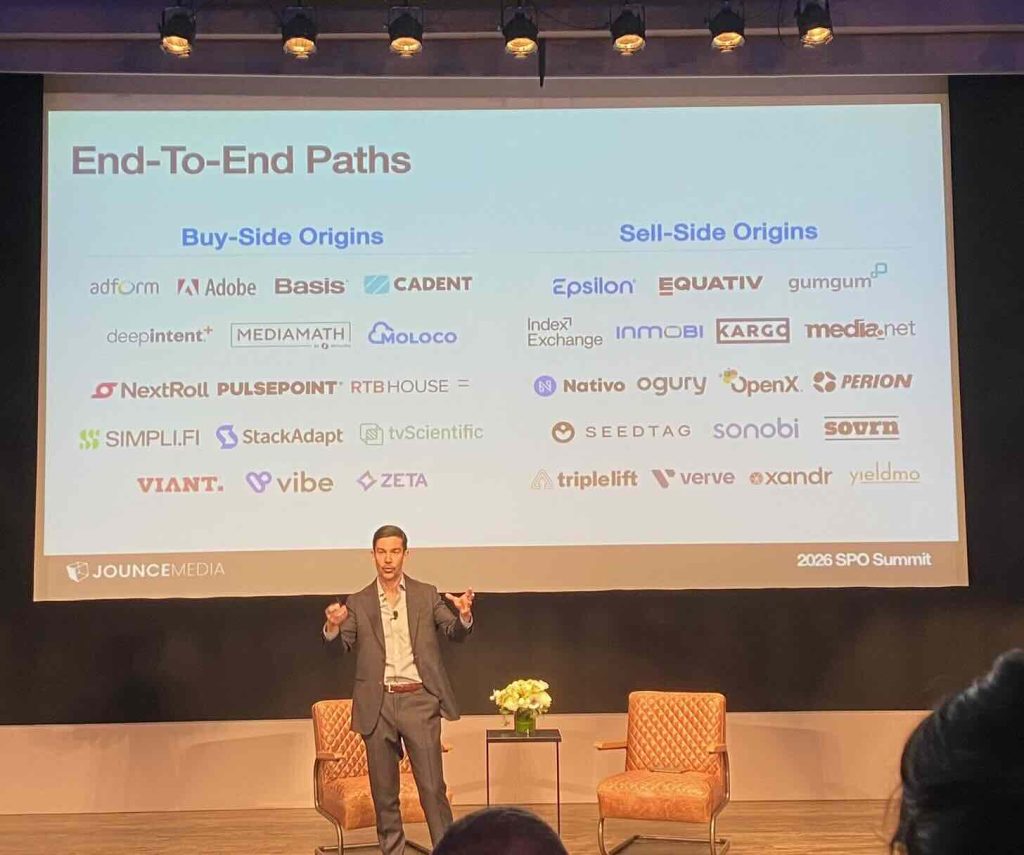
Hot topics from Jounce SPO Summit
After Chris Kane’s kickoff at the Jounce SPO Summit in New York City, Mediavine CEO Eric Hochberger reported a few takeaways:
“The premium web is facing real headwinds and they’re not cyclical.
We’re seeing structural shifts:
– The open web is consolidating
– Buying behavior is moving toward a default ‘off’ mentality
– Traffic is declining overall — but concentrating among a smaller set of scaled, trusted publishers
– And demand itself is concentrating — with a handful of platforms controlling a large share of spend, even on the open webThat last point really stood out.”
Read more on LinkedIn. (March 31)
SELL-SIDE
APIs connecting Disney and Mediaocean
Yesterday, Disney ad product director Alexandra Smith announced that her media company had partnered with Mediaocean’s Prisma platform (was Donovan/MediaBank).
Ms. Smith wrote:
“Disney is the first media company to integrate with Mediaocean’s newly launched Prisma Direct, using the same API technology that powers our self-service campaign management platform, Disney Campaign Manager.
Direct buying has been stuck in manual workflows for too long: spreadsheets, rekeyed orders, offline trafficking, disjointed reconciliation. Prisma Direct automates that end-to-end for premium video and CTV, connecting ordering, trafficking, billing, and analytics in one place.
Lower costs for buyers. Less leakage for publishers. Faster activation at scale…”
Read LinkedIn. (March 31)
Elsewhere on LinkedIn, Mediaocean pointed to the “premium TV” component in announcing the deal: “With Disney Advertising the first media company integration, this is a big step toward modernizing how premium TV is bought and sold by making activation even easier for advertisers at scale.”
Prisma Direct is scheduled for launch in Q3.
Read: “Mediaocean Launches Prisma Direct with Disney as First Media Company Integration” (March 31) – Mediaocean
From tipsheet: Mediaocean’s Prisma is the original agent. It’s all about enhancing the creaky world of billing workflow in advertising, particularly for large agencies.
VOICES
Opinion
- “The Prosperous Society, Part 2: The Human Nexus of Commerce” (March 31) – Eric Seufert, analyst on Mobile Dev Memo (subscription)
- “The new performance mandate: transparency, trust, and experience” (March 31) – Jason Fairchild, CEO of Pinterest’s tvScientific, on Beehiiv
- “The Agentic Gap: Why Brand Marketers Aren’t Listening” (March 31) – Ali Manning, Chalice AI on The Current
MORE
- The Trade Desk shakes up Identity Alliance payouts, with a new focus on incrementality (March 31) – Digiday (subscription)
- “PubMatic and Amnet Group just launched the first agentic advertising campaign in France, powered by the Claude LLM.” (March 31) – PubMatic on LinkedIn
- The Trade Desk Rivals Swoop In on the Heels of Publicis, Omnicom Auditing Drama (March 31) – Adweek
- Winning in the Digital Auction Economy (March 23) – Transparent Partners
- The AI Employment Forecast For Marketers (March 31) – Henry Innis, co-founder, Mutinex on his Substack blog