

Google’s latest results sharpen the question: Can AI drive more Search activity without weakening monetization?
Read: “Alphabet earnings miss reflects first real sign that AI is taking a bite out of search” (Oct. 29) – CNBC
Alphabet reported Q3 results on Wednesday as Search revenue grew 12% to $63.4 billion, down from 17% growth in Q2, even as Google said year-over-year Search query growth reached its highest rate in five years.
On the earnings call, Google Chief Business Officer Philipp Schindler said AI Mode’s growing query volume weighed on Search because Google was seeing lower monetization there. The company also cited foreign exchange and other factors in the slower growth.
Alphabet shares fell about 11% on Thursday, briefly cutting the company’s market value by more than $500 billion, to around $3.4 trillion. The drop followed misses on earnings and revenue, as well as concerns about rising AI costs and cash burn.
More reactions
In a note to investors, New Street Research lead analyst Dan Salmon wrote:
“We have been getting more questions about the impact of OpenAI/ChatGPT’s ad ramp (…). And while we don’t think it’s material to Google yet, OpenAI Ads drumbeat of milestones and country additions will continue. We expect this to drive more questions about when Google will introduce advertising to the Gemini app – despite tonight’s news on AI Mode’s global ad rollout — which is now over 1B users, just behind ChatGPT, which continues to see weekly users grow despite the introduction of ads.”
Eric Seufert of Mobile Dev Memo calls AI Mode’s lower monetization a “penalty” on Search growth. He argues that it may be a temporary cost of shifting users into a new format while Google learns how to monetize it. Meta’s Reels initially monetized below Feed and Stories. By Q3 2023, Meta said Reels had become net neutral to overall ad revenue. That didn’t mean its monetization rate had caught up with Feed and Stories; it meant Reels was no longer a net drag on the company’s ad revenue.
Read: “Alphabet Q3 2026 earnings: AI Mode’s monetization penalty” – Mobile Dev Memo (subscription)
Google expands AI Mode ads
On earnings day, Google also announced that it is expanding ads in AI Mode to additional international markets and introducing ads on follow-up questions in the U.S. Read more. (Oct. 28)
More on Google’s agentic shopping ad pitch: “Google has a plan to keep ads alive even when AI agents do the shopping” (Oct. 29) – Business Insider
And finally: During Q3, Google Network revenue rose 1.4% year over year to $7.5 billion, its first year-over-year increase since Q2 2022. tipsheet asked on X: Is Buyer Direct starting to contribute? The quarter’s results don’t establish what drove the increase.
SEARCH
AI traffic projected to rise and rise
A new study was published by Adobe on the holiday AI opportunity for retailers. Growth is only going one direction for AI search:
“In September 2026, AI traffic to U.S. retail sites (measured by users clicking on a link) grew 71% year-over-year (YoY). Adobe expects continued growth through the holiday shopping season, with AI traffic projected to rise 159% YoY on Thanksgiving, 95% YoY on Black Friday, and 88% YoY on Cyber Monday.”
Read: “AI traffic now generates 83% higher revenue per visit for U.S. retailers heading into the holiday shopping season.” (Oct. 29) – Adobe
From tipsheet: AI could bring retailers more shoppers who already know what they want this Black Friday and Cyber Monday. The kicker may be what else they add to the cart.
COMMERCE MEDIA
‘Shop smarter with ChatGPT’
In an email sent to consumers by the “ChatGPT Team” yesterday, OpenAI touted the use of its AI chatbot for shopping, saying, “ChatGPT helps you browse, compare, and refine options – all in one place – so you can find the right product faster.”
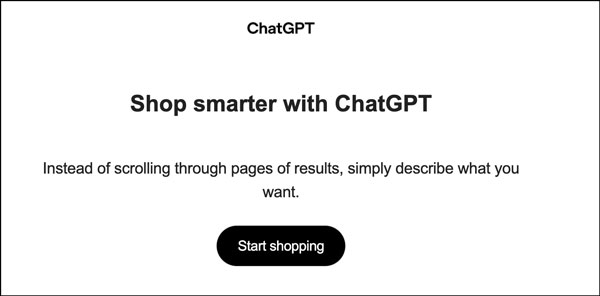
It’s a long way from its since-scaled-back checkout strategy. In March, The Information explained that OpenAI had scaled back shopping plans within ChatGPT where the company hoped to take a share of sales.
The email’s pitch centers on product discovery and comparison.
From tipsheet: More and better measurement tools could help OpenAI show retailers how ChatGPT drives sales and strengthen its case for their advertising budgets.
Related: Agentic commerce intelligence — “NIQ and Google Partner to Advance Agentic Commerce” (Oct. 29) – NielsenIQ
FINANCIALS
Earnings reports
Companies at the intersection of AI, advertising and marketing are reporting their latest quarterly results, including:
Amazon
-
- Markets: Amazon stock was down 4.7% in after-hours trading yesterday.
- Stat: Advertising revenue reached $19.64 billion, up 11% reported or 12% excluding currency, versus 26% growth excluding currency in Q2. Amazon attributes the slowdown primarily to Prime Day moving into Q2, plus other timing factors. It expects high-teens ad growth in Q4.
- Results: Amazon[dot]com Announces Third Quarter Results (Oct. 29) – Amazon
- Read: Amazon misses on earnings and holds capex steady, adding to AI spending jitters (Oct. 29) – CNBC
-
- Markets: Reddit stock was down 15% in after-hours trading yesterday.
- Stat: Advertising revenue rose 54% to $847 million, versus 12% growth in daily active uniques to 130.3 million.
- Results: Reddit Reports Third Quarter 2026 Results (Oct. 29) – press release
- Read: Reddit shares sink on weak sales guidance and plans login requirement test as Google search traffic shrinks (Oct. 29) – CNBC
- Related: “Reddit moves to logged-in experience as AI eats search” (Oct. 29) – Axios
AGENTS
The move toward headless DSPs
Is orchestration leading to a transformation of the demand-side platform model and the arrival of the headless DSP — where buyers could use Claude or ChatGPT instead of logging into a DSP’s UI?
On the latest episode of the Unharnessed podcast, hosts Jonathan Moffie of Magnite and Joseph Hirsch of Swivel unpack CTV ad platform Olyzon with the startup’s co-founder and CEO Jules Minvielle.
Minvielle sees DSPs opening their APIs so agents can work through them without relying on the usual user interface. He says he wouldn’t be surprised if Netflix offered buyers direct inventory access through MCP and sees “clearly a move towards more headless DSPs,” pointing to Yahoo DSP as an early mover.
Agents’ near-term role may be to make buying through the existing programmatic stack more efficient. He says: “Clearly, for now, I think the best way to leverage agents is to go through the stack that is already there and where the volume is. The volume is still programmatic. And in TV, it’s still direct IO.”
On agentic protocols, Minvielle adds, “AdCP is an interesting project. We are happy to contribute. But to be honest, it’s not scaling yet. And most of the inventory is both programatically or direct, not through AdCP. And I don’t think it will happen overnight.”
Listen: “Will AI Agents Revolutionize DSPs or Just the Clicking? | Olyzon Founder Jules Minvielle” (Oct. 29) – Unharnessed Podcast on Apple Podcasts
From tipsheet: Agents may change the buying interface before they replace the buying stack.
CONNECTED TV
CTV’s missing content signals
How much do advertisers know about the streaming programming they’re buying?
In a new report, AppLovin-owned CTV ad platform Wurl found that 89% of the CTV ad requests it analyzed lacked a usable program name, while 45% lacked a channel name. The company also identified more than 3,600 different genre labels during two hours of prime-time ad requests.
The AI connection: Wurl says its scene-level targeting system uses an LLM to evaluate dialogue, sounds and imagery, assigning signals for emotion, genre and brand safety. Its Content Intelligence Platform, launched in September, connects contextual signals from Wurl and partners to streaming inventory before bid requests reach buying platforms.
As the report puts it: “the challenge isn’t simply creating better content intelligence – it’s connecting it.”
Read: “The CTV Trends Report: Addressing the Content Signal Gap” (Oct. 28) – Wurl
From tipsheet: Wurl’s findings point to a practical constraint on AI’s advertising opportunity: understanding a scene creates value only if that understanding can inform where an ad runs. Wurl’s role operating FAST channels could give it an advantage in making that connection.
For publishers, richer signals offer a way to distinguish valuable moments within their programming. For buyers, the test is whether that additional context improves campaign results.
Related: “CTV advertising has a genre-label problem” (Oct. 28) – Digiday (subscription)
LLMs & CHATBOTS
Microsoft ties agent revenue to usage
Microsoft is extending Copilot’s per-seat model with usage-based charges. “As agents take on higher-value work, consumption opens up business funded demand with spending tied directly to the value these agents deliver,” CEO Satya Nadella said on the company’s fiscal Q1 2027 earnings call.
Microsoft said the number of Copilot customers actively consuming credits grew more than 75% quarter over quarter.
Read: Microsoft Q1 2027 Earnings Call Transcript (Oct. 28) – Motley Fool
More: Earnings Release FY27 Q1 (Oct. 28) – Microsoft
LLMs & CHATBOTS
Developments
MORE
-
- $17 billion: “DoorDash to Acquire Instacart to Help Local Stores Win” (Oct. 29) – DoorDash
- AI creative versioning: “How to use AI to create multiple versions of an ad the right way” (Oct. 28) – Ad Age (subscription)
- More app inventory: “Meta launches two new AI apps, including one aimed at kids” (Oct. 28) – Social Media Today
- You’re hired: “ShopMy Taps Ex-Trade Desk Vet Jed Dederick as CRO to Scale Creator Commerce” (Oct. 28) – Adweek (subscription)