
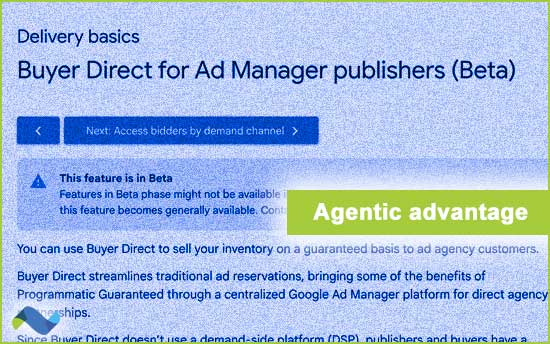
In an opinion piece for AdExchanger, Gamera co-founder and CEO Gareth Glaser makes the case that Google’s Buyer Direct could give the company a significant advantage over emerging agentic media buying platforms.
(Glaser first raised Buyer Direct on the Adtech Adtalk podcast we covered earlier this month. Buyer Direct was originally announced by Google last November.)
Rather than relying on AI agents to stitch together fragmented publisher inventory and negotiations across multiple systems, Glaser contends Google can embed those capabilities directly into Google Ad Manager (GAM), where much of the publisher ecosystem already operates. He suggests Buyer Direct could become Google’s “plan B” if antitrust remedies weaken or separate AdX, allowing Google Ad Manager itself to become the source of liquidity.
Read: Google’s Buyer Direct Could Beat Agentic Ad Tech At Its Own Game (July 27) – AdExchanger
Glaser’s analysis depends on Google retaining control of Google Ad Manager. In LinkedIn comments (July 27), privacy attorney Alan Chapell noted that the DOJ has also proposed divesting DFP/Google Ad Manager, suggesting Buyer Direct’s future could depend as much on the court’s remedies as on Google’s product roadmap.
Related: In a Q&A with tipsheet earlier this month, Google said agencies should think of Buyer Direct as “an enabler for… agentic planning and media buying needs” and that it plans to integrate agentic capabilities into the product over time. Google also confirmed Buyer Direct has expanded to open beta for all publishers and agencies.
From tipsheet: Glaser argues Google’s infrastructure advantage could prove more durable than standalone agentic buying tools. Google’s comments to tipsheet are consistent with that thesis: rather than positioning Buyer Direct as simply a more efficient transaction workflow, Google describes Buyer Direct as a future platform for agentic planning and media buying built inside Ad Manager.
MEASUREMENT
Nielsen makes its intelligence AI-readable
TV measurement firm Nielsen announced Ad Intel AI, describing it as the company’s “first in a new generation of AI products built to turn data into action.” Put another way, Nielsen is moving from reporting to recommendations, transforming its Ad Intel platform into an AI-powered decision engine.
The company says Ad Intel AI uses generative AI to let marketers query competitive spending, creative strategies and market trends conversationally across Nielsen’s global advertising database. It also supports Model Context Protocol (MCP), allowing customers’ own AI agents to access Ad Intel directly.
Nielsen adds that its advantage isn’t the underlying language model but the proprietary data behind it. The company describes its dataset:
“Nielsen’s vast data sets include viewing behavior, identity data, and Gracenote content metadata. This data exists at a massive scale and through Nielsen, it is cleaned, structured and tagged specifically for media context, which is the most critical ingredient for effective Gen AI models.”
Read: “Nielsen Launches Ad Intel AI: the Only Product of its Kind that Transforms Fragmented Ad Data into Actionable Intelligence” (July 27) – press release
From tipsheet: Nielsen is following a broader enterprise AI pattern: proprietary datasets are becoming AI infrastructure. By supporting MCP, Ad Intel evolves from a destination for human users into a source of intelligence that AI agents can incorporate into automated workflows.
SEARCH
Green: AI puts search budgets in play
In a sponsored post on Business Insider, The Trade Desk CEO Jeff Green adds to the growing discussion around Google Search’s AI Mode and AI Overviews.
He says Google’s shift toward AI-generated answers could do more than disrupt publisher traffic — it could reshape the economics of digital advertising: “While Google spent the last few years building a fence, the rest of the industry spent that time building doors.”
According to Green, as Google replaces links with AI-generated responses, advertisers have already begun moving toward premium channels outside Google’s control, including connected TV, streaming audio and retail media. His conclusion: the hundreds of billions of dollars historically tied to search advertising are increasingly “up for grabs.”
Read: Google’s AI search revamp impacts the open internet ecosystem (July 24) – Business Insider
From tipsheet: Green isn’t just saying Google’s AI search threatens publishers. He suggests AI could weaken Google’s grip on search advertising itself, putting one of the largest pools of performance advertising spend up for grabs.
AGENTS
Fairchild: Agentic pressure on DSPs
Jason Fairchild, CEO of Pinterest-owned tvScientific, argues that agentic advertising could reshape programmatic buying by making ad tech fees far more transparent and, in some cases, reducing the need for a traditional DSP.
In a LinkedIn post, Fairchild describes seeing a demo of an AI agent connected to an LLM. A prompt began: “‘Please list all fees for the (XYZ) media buy, with specific % for each fee.’ And within a second or so, the entire fee structure for the buy was in front of me. Media cost, SSP take rate and data fees, IAS fees, DSP fees with all attendant add ons. Real line item transparency.”
Fairchild suggests that in some workflows, AI agents buying directly through an SSP could reduce total take rates from roughly 40% to 15%, although he notes he has not independently verified that claim.
Read more on LinkedIn. (July 27)
From tipsheet: Fairchild’s vision also points to a more composable ad tech stack. Instead of convincing advertisers to work inside its platform, a focused company like tvScientific could compete by becoming the best CTV execution engine for AI agents to call. Competitive advantage could shift toward the companies that expose the richest machine-readable infrastructure.
LLMs & CHATBOTS
Developments
- Industry Leaders Unite in Open Secure AI Alliance for AI Safety and Security (July 27) – NVIDIA
- Introducing MAI-Cyber-1-Flash inside MDASH (July 27) – Microsoft AI
- Releasing the model weights and technical report of Kimi K3. (July 27) – Kimi on X
LLMs & CHATBOTS
AI visibility misconceptions
Digiday’s Kimeko McCoy reported yesterday:
-
“Brands are worried about how they show up in LLMs as calls for AIO strategies reach a fever pitch. There’s urgency to this topic: an estimated 30% of shoppers are using AI for product research, according to a recent Brainlabs report. A year ago, that figure was just 12%. With any new popular methodology comes a slew of misconceptions.”
Read: “Mythbusters: AI visibility’s biggest misconceptions” (July 27) – Digiday (subscription)
From tipsheet: The AI visibility space is wide open. There is no established playbook.
TECH
FreeWheel’s home is still TBD
In the aftermath of last week’s Comcast earnings report (the first since the company announced plans to divide its cable and entertainment empire), LightShed Partners analyst Rich Greenfield argues the company’s ad tech assets are in play:
-
“…the real story is what Comcast keeps refusing to say: where do FreeWheel and Universal Ads go after the split? These are the infrastructure backbone of NBCUniversal’s entire advertising business, linear, streaming, and their bet to compete with Meta and YouTube for DTC ad dollars. There’s only one right answer. Comcast’s silence is getting louder. Where do you think FreeWheel and Universal Ads end up?”
Read it on LinkedIn. (July 23)
From tipsheet: Comcast’s eventual decision will determine whether FreeWheel remains part of an end-to-end advertising platform or becomes infrastructure serving a much broader ecosystem.
Related: The Biggest Screen Meets the Smallest Budgets (July 24) – The Current
MEDIA
YouTube strengthens subscriptions with NBCU
Neal Mohan, CEO at Google’s YouTube, announced yesterday on LinkedIn:
“Today, we’re announcing that starting in early 2027, YouTube Premium subscribers in the U.S. will get Peacock Premium included with their membership.
We’re excited to expand our partnership with NBCUniversal, bringing new benefits to YouTube Premium members and extending our multi-year distribution agreement for YouTube TV. Together, we’re giving viewers more…”
Read more. (July 27)
From tipsheet: The announcement strengthens Google’s position as a subscription aggregator while deepening ties with NBCUniversal ahead of Comcast’s split.
FINANCIALS
Earnings calendar this week
- Omnicom – Today
- Meta – Tomorrow
- Microsoft – Tomorrow
- Apple – Thursday
- Amazon – Thursday
- Reddit – Thursday
From tipsheet: Google’s increase in capital expenditures rattled investors last week, despite robust quarterly earnings. Will this week’s earnings show that the rest of big tech is making the same AI infrastructure bet?
MORE
- Q2 2026 Market Report (July 28) – LUMA Partners
- CMO Survival Guide: How CMOs should navigate AI opportunities and risks (July 27) – Ad Age (subscription)
- “Proud to share that Axel Springer became the first publisher to adopt AWS RTB Fabric in their self-hosted Prebid Server” (July 27) – AWS executive Stephanie Layser on LinkedIn
- Why PubMatic Ditched Its Prebid Web Wrapper, But Never Its SDK (July 27) – AdExchanger
- AI Fraud The Ad Industry Has Yet To Discover (July 27) – MediaPost